Skip to Content Facebook Feature Image

The only Chinese found on foreign banknotes had a great story behind

The only Chinese found on foreign banknotes had a great story behind

The only Chinese found on foreign banknotes had a great story behind

2017-12-22 12:55 Last Updated At:16:32

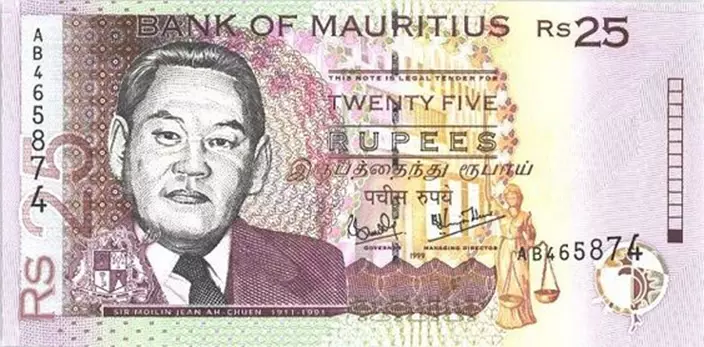
Normally, celebrities and presidents are printed on banknotes. But how can a Chinese man be printed on Mauritius's banknotes?

Examples are Queen Elizabeth II on British currency and Japanese bacteriologist Hideyo Noguchi on 1000 yen notes. But one exception is Moilin Jean Ah-Chuen, a Chinese Hakka, who appears on the 25 rupee-banknote in Mauritius.

More Images
Photo via Internet

Photo via Internet
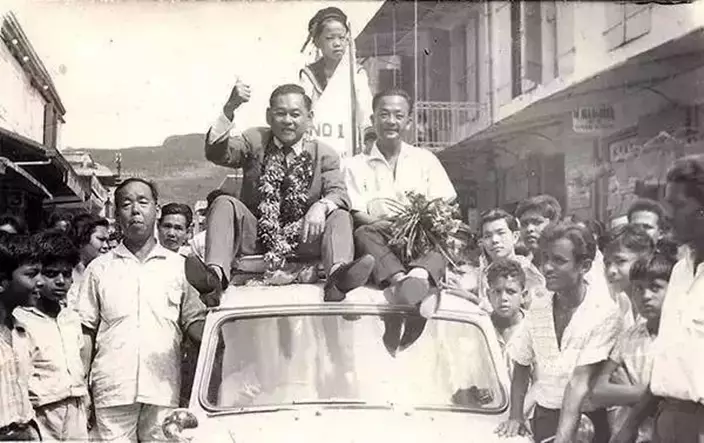
Photo via Internet

Photo via Internet

Photo via ABC Group
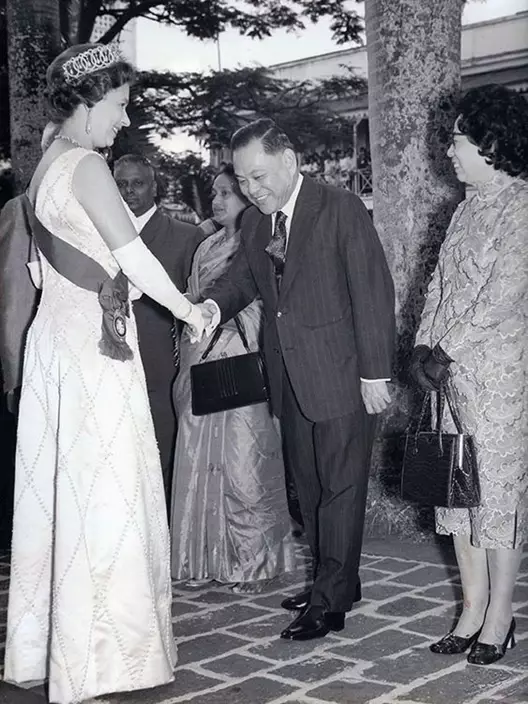
Photo via ABC Group

Photo via ABC Group

Photo via ABC Group

Photo via Internet

Photo via Internet

Many people believe that it is the richest country in Africa. Indeed, it used to be a British colony. In the late 19th century during the Qing dynasty, many Chinese went abroad in search of a better livelihood. One of those was Moilin Jean Ah-Chuen’s dad, identified as Jean Wei Xun from Guangdong. He went to Mauritius and opened a grocery store.

Photo via Internet

Photo via Internet

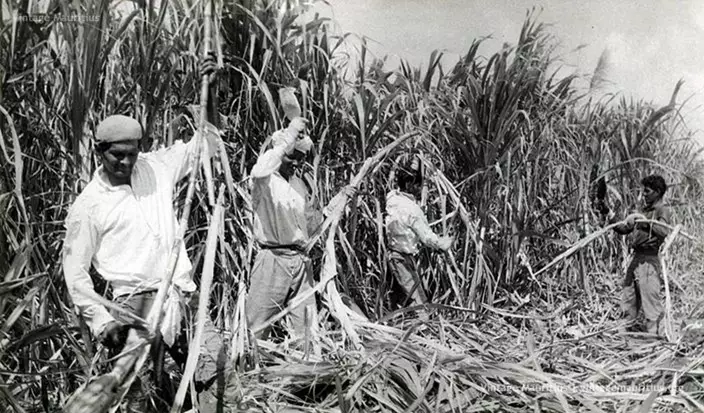
At that time Mauritius was famous for production of sugar cane. Most locals were underprivileged farmers. Only Jean Wei Xun came up with the “put-it-on-account” concept. Based on trust, his business grew rapidly.

Photo via ABC Group

Photo via ABC Group

As his son Moilin Jean Ah-Chuen took over, the grocery store opened in 1931 continued to grow, and became a major retail chain in the country.

During the second World War, Mauritius suffered from a desperate shortage of commodities. As a retail magnate, Jean assisted the government in distributing goods while importing foreign goods to help solve the crisis.

During the war, he called for donations from Overseas Chinese to support China which was under attack. He also established a homeland security team.

After WWII, he became the first Chinese councilor in the country, and in late 60s, he headed the Ministry of Finance as the country declared independence from Britain. Mauritius is a member of the Commonwealth, and Jean received a knighthood from Queen Elizabeth in 1972.

Photo via ABC Group

Photo via ABC Group

During the 1970s recession, the country’s economy plummeted by at least 40 percent, particularly in the sugar cane industry. Jean then approached Hong Kong businessmen to invest in Mauritius, especially in the textile industry and chemical industry.

In the 1980s, he twice went back to China for investments. He passed away in 1991.

In 1998, Mauritius decided to use his portrait on its 25 rupee-banknote. He is the only foreigner to be featured on banknotes anywhere in the world. In 2011, on the centenary of his birthday, the country launched a commemorative stamp collection in his honor. Until now, keeping one minister position for Chinese becomes the country’s usual practice.

Established in 1931, Jean’s ABC Group remains a leading business conglomerate in Mauritius. It is one of the top 100 enterprises in the Indian Ocean.


BUKAVU, Congo (AP) — In the city of Bukavu in eastern Congo, Alain Mukumiro argues in a small wooden hut with a shopkeeper who refuses to take his money.

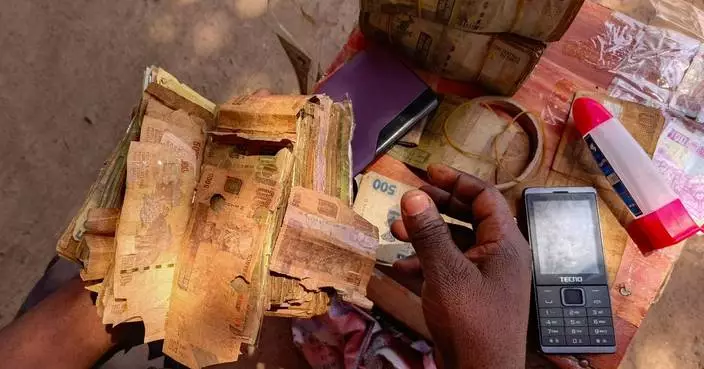
Like many in the rebel-controlled city, Mukumiro is using older, hole-punched banknotes that have been patched up and put back into circulation because of a shortage of new and intact bills.

“All my money has serial numbers, but they refuse it,” Mukumiro said, upset about his ordeal.

Mukumiro, a fridge technician, said his family faces yet another night without food, like many in Bukavu, the capital of South Kivu province.

The Rwanda-backed M23 rebel group captured the city in February following an escalation of fighting between the insurgents and Congolese forces in the country's mineral-rich east. Congolese authorities closed the city’s banks as the conflict intensified, leading to a shortage of cash in the region.

The perforated notes appear to be old bills that the banks intended to destroy to take them out of circulation. It's unclear how they went back onto the market, but residents suspect they were stolen from bank buildings during the rebel takeover.

The older bills exchange for new ones at a rate of about 10-to-1, said Ruboneka Mirindi Innocent, one of several local residents who now work on the black market as money-changers.

“We keep these banknotes because we don’t know what else to do, it’s just to help each other out,” he said.

The fighting earlier this year worsened what was already one of the world’s largest humanitarian crises, with around 7 million people displaced and more towns and cities falling under the control of the rebels.

Banks have remained closed in Bukavu and and other key cities in the region, such as Goma, preventing the cities' residents from accessing cash. That has made life difficult in Bukavu, which once was booming with economic activity.

Having both intact and patched up notes in circulation at the same time has resulted in confusion and tensions between businesses and customers.

“It’s a real headache because some sellers accept them and others don’t,” said Mukumiro, 36. The father-of-three and his family are running out of ideas to cope as businesses decline the hole-punched banknotes — the only bills he has left.

Zihalirwa Rutchababisha, who owns a repair equipment business, said he does not accept the busted banknotes to avoid any loss.

“We are also facing the same situation as them,” Rutchababisha said about his customers caught up in the situation. “If I take them, I won’t be able to use them to purchase supplies and that would put me at a loss.”

Rutchababisha's $120 weekly profit last year has already plummeted to $20 a week under the M23, mainly as a result of dwindling sales.

In the rebel-held territories including Bukavu, several state employees once paid in cash say they now get paid via online transfers.

But this solves the problem for a select few. The state employees only account for about 2% of Bukavu’s population of over 1.3 million. Most of the city’s residents work in the informal sector and are paid in cash.

David Kyanga, a professor of economics at Bukavu’s Higher Institute of Commerce, said the only solution is for the M23-controlled cities to adopt the defective banknotes as valid means of payment in the absence of cash supplies from Congolese banking authorities.

The M23 could calm tensions by informing people that the hole-punched banknotes are valid, he said.

Last week, Patrick Busu Bwasingwi Nshombo, the M23-appointed governor of South Kivu province, asked residents to exchange their perforated notes in one of the banks the rebels opened.

But Nshombo quickly suspended the operation days later, saying the bank agents were overwhelmed by the load of banknotes brought forward to be changed.

Congo's government spokesperson in Kinshasa Patrick Muyaya said Thursday that the authorities will not send banknotes or reopen banks in rebel-held territories like Bukavu.

“No bank can open its doors in a situation of insecurity like what is happening in areas occupied by the M23,” Muyaya said at a press conference.

He questioned how banks could work with M23 when it faces U.S. Treasury sanctions.

“We don’t know who will save us,” Mukumiro said. “The government in Kinshasa turns a blind eye, and the liberators also watch the situation without taking action.”

Banchereau reported from Dakar, Senegal. Jean-Yves Kamale in Kinshasa, Congo contributed to this report.

For more on Africa and development: https://apnews.com/hub/africa-pulse

The Associated Press receives financial support for global health and development coverage in Africa from the Gates Foundation. The AP is solely responsible for all content. Find AP’s standards for working with philanthropies, a list of supporters and funded coverage areas at AP.org.

A close-up of perforated notes, which are rejected in Bukavu, Democratic Republic of the Congo, Friday, Aug 29, 2025. (AP Photo)

A close-up of perforated notes, which are rejected in Bukavu, Democratic Republic of the Congo, Friday, Aug 29, 2025. (AP Photo)

Vendors are seen at a market in Bukavu, Democratic Republic of the Congo, Friday, Aug 29, 2025. (AP Photo)

Vendors are seen at a market in Bukavu, Democratic Republic of the Congo, Friday, Aug 29, 2025. (AP Photo)

A currency exchanger buys perforated notes that are rejected by people in Bukavu, Democratic Republic of the Congo, Friday, Aug 29, 2025. (AP Photo)

A currency exchanger buys perforated notes that are rejected by people in Bukavu, Democratic Republic of the Congo, Friday, Aug 29, 2025. (AP Photo)

A customer pays for a service with perforated notes, which are rejected in Bukavu, Democratic Republic of the Congo, Friday, Aug 29, 2025. (AP Photo)

A customer pays for a service with perforated notes, which are rejected in Bukavu, Democratic Republic of the Congo, Friday, Aug 29, 2025. (AP Photo)

A close-up of perforated notes, which are rejected in Bukavu, Democratic Republic of the Congo, Friday, Aug 29, 2025. (AP Photo)

A close-up of perforated notes, which are rejected in Bukavu, Democratic Republic of the Congo, Friday, Aug 29, 2025. (AP Photo)

Recommended Articles