Skip to Content Facebook Feature Image

Female passenger makes good use of resources on plane: dying underpants beneath overhead air vent for 20 minutes

Female passenger makes good use of resources on plane: dying underpants beneath overhead air vent for 20 minutes

Female passenger makes good use of resources on plane: dying underpants beneath overhead air vent for 20 minutes

2018-02-20 17:07 Last Updated At:17:10

Well...save time and resources! :D

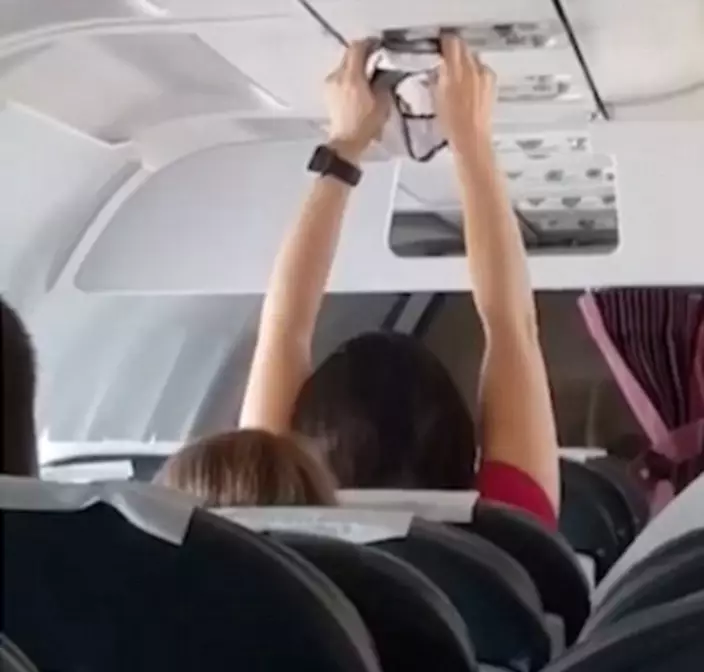
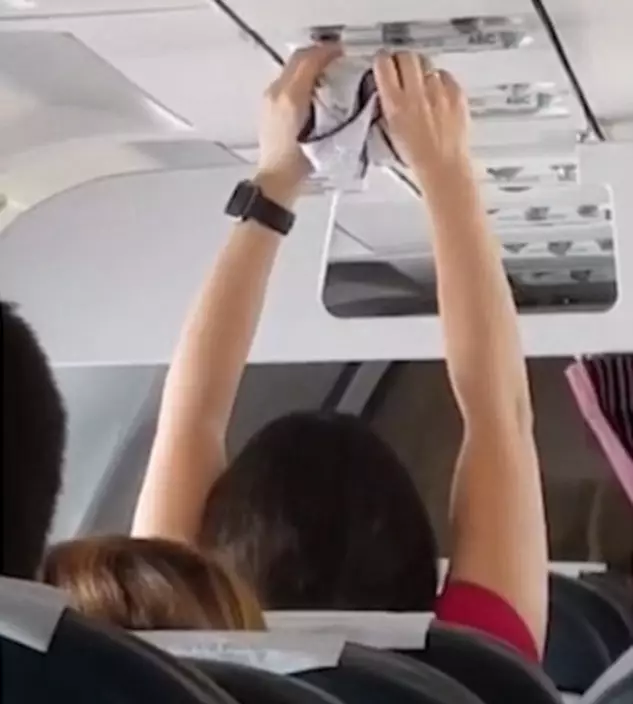
A video has captured a female passenger drying her pants under an overhead air vent for at least 20 minutes while she was on a plane to Moscow.

More Images
CEN

CEN

CEN

CEN

CEN

CEN

CEN

CEN

The woman was flying from Antalya, Turkey, to Moscow by a Ural Airlines flight. She held her knickers under the vent and seemed not embarrassed for when what she did since she kept the position for at least 20 minutes. 

CEN
CEN

CEN

CEN

Passengers were shocked by her bizarre behaviour but no one said a word. One of the passengers said, "Everybody was looking with interest and confusion, but everybody remained silent."

CEN
CEN

CEN

CEN

The video has quickly gone viral on Russian social media. Some netizens said the pants may have belonged to the woman's child and some commented, "This is not the worst thing in the modern world."

KUALA LUMPUR, Malaysia (AP) — More than a decade ago, Malaysia Airlines Flight 370 vanished without a trace, sparking one of aviation’s most baffling mysteries.

Despite years of multinational searches, investigators still do not know exactly what happened to the plane or its 239 passengers and crew.

On Wednesday, Malaysia’s government said American marine robotics company Ocean Infinity would resume a seabed hunt for the missing plane on Dec. 30, reigniting hopes that the plane might finally be found.

A massive search in the southern Indian Ocean, where the jet is believed to have gone down, turned up almost nothing. Apart from a few small fragments that washed ashore, no bodies or large wreckage have ever been recovered.

Here’s what we know about the deadly aviation tragedy.

The Boeing 777 disappeared from air-traffic radar 39 minutes after departing Kuala Lumpur for Beijing on March 8, 2014.

The pilot’s last radio call to Kuala Lumpur — “Good night, Malaysian Three Seven Zero”— was the final communication before the plane crossed into Vietnamese airspace and failed to check in with controllers there.

Minutes later, the plane’s transponder, which broadcasts its location, shut down. Military radar showed the jet turn back over the Andaman Sea, and satellite data suggested it continued flying for hours, possibly until fuel exhaustion, before crashing into a remote section of the southern Indian Ocean.

Theories about what happened range from hijacking to cabin depressurization or power failure. There was no distress call, ransom demand, evidence of technical failure or severe weather.

Malaysian investigators in 2018 cleared the passengers and crew but did not rule out “unlawful interference.” Authorities have said someone deliberately severed communications and diverted the plane.

MH370 carried 227 passengers, including five young children, and 12 crew members. Most passengers were Chinese, but there were also citizens from the United States, Indonesia, France, Russia and elsewhere.

Among those aboard were two young Iranians traveling on stolen passports, a group of Chinese calligraphy artists, 20 employees of U.S. tech firm Freescale Semiconductor, a stunt double for actor Jet Li and several families with young children. Many families lost multiple members.

Search operations began in the South China Sea between Malaysia and Vietnam, then expanded to the Andaman Sea and the southern Indian Ocean.

Australia, Malaysia and China coordinated the largest underwater search in history, covering roughly 120,000 square kilometers (46,000 square miles) of seabed off western Australia. Aircraft, vessels equipped with sonar and robotic submarines scoured the ocean for signs of the plane.

Signals thought to be from the plane’s black box turned out to be from other sources, and no wreckage was found. The first confirmed debris was a flaperon discovered on Réunion Island in July 2015, with additional fragments later found along the east coast of Africa. The search was suspended in January 2017.

In 2018, U.S. marine robotics company Ocean Infinity resumed the hunt under a “no find, no fee” agreement, focusing on areas identified through debris drift studies, but it ended without success.

One reason why such an extensive search failed to turn up clues is that no one knows exactly where to look. The Indian Ocean is the world’s third largest, and the search was conducted in a difficult area, where searchers encountered bad weather and average depths of around 4 kilometers (2.5 miles).

It’s not common for planes to disappear in the deep sea, but when they do remains can be very hard to locate. Over the past 50 years, dozens of planes have vanished, according to the Aviation Safety Network.

Malaysia’s government gave the green light in March for another “no-find, no-fee” contract with Ocean Infinity to resume the seabed search operation at a new 15,000-square-kilometer (5,800-square-mile) site in the ocean. Ocean Infinity will be paid $70 million only if wreckage is discovered.

However, the search was suspended in April due to bad weather. The government said Wednesday that Ocean Infinity will resume search intermittently from Dec. 30 for a total of 55 days, in targeted areas believed to have the highest likelihood of finding the missing aircraft.

It is unclear if the company has new evidence of the plane’s location. It has said it would utilize new technology and has worked with many experts to analyze data and narrow the search area to the most likely site.

FILE -Relatives of Chinese passengers on board the Malaysia Airlines Flight MH370 pray at a prayer room in Beijing, China, April 4, 2014. (AP Photo/Ng Han Guan, File)

FILE -Relatives of Chinese passengers on board the Malaysia Airlines Flight MH370 pray at a prayer room in Beijing, China, April 4, 2014. (AP Photo/Ng Han Guan, File)

FILE -The shadow of a Royal New Zealand Air Force P3 Orion is seen on low level cloud while the aircraft searches for missing Malaysia Airlines Flight MH370 in the southern Indian Ocean, near the coast of Western Australia, March 31, 2014. (AP Photo/Rob Griffith, File)

FILE -The shadow of a Royal New Zealand Air Force P3 Orion is seen on low level cloud while the aircraft searches for missing Malaysia Airlines Flight MH370 in the southern Indian Ocean, near the coast of Western Australia, March 31, 2014. (AP Photo/Rob Griffith, File)

FILE -Sarah Nor, the mother of Norliakmar Hamid, a passenger on missing Malaysia Airlines flight MH370, cries after she attended a briefing on the final investigation report on missing flight MH370 in Putrajaya, July 30, 2018.(AP Photo/Vincent Thian, File)

FILE -Sarah Nor, the mother of Norliakmar Hamid, a passenger on missing Malaysia Airlines flight MH370, cries after she attended a briefing on the final investigation report on missing flight MH370 in Putrajaya, July 30, 2018.(AP Photo/Vincent Thian, File)

Recommended Articles