The German government said Friday that the question of paying reparations to Poland for World War II has been resolved for over 60 years and there's no reason to reopen it.
Poland's government said recently that Germany has a moral obligation to pay for the massive destruction of many towns and a large part of the country's industry by the Nazi war machine.
Click to Gallery
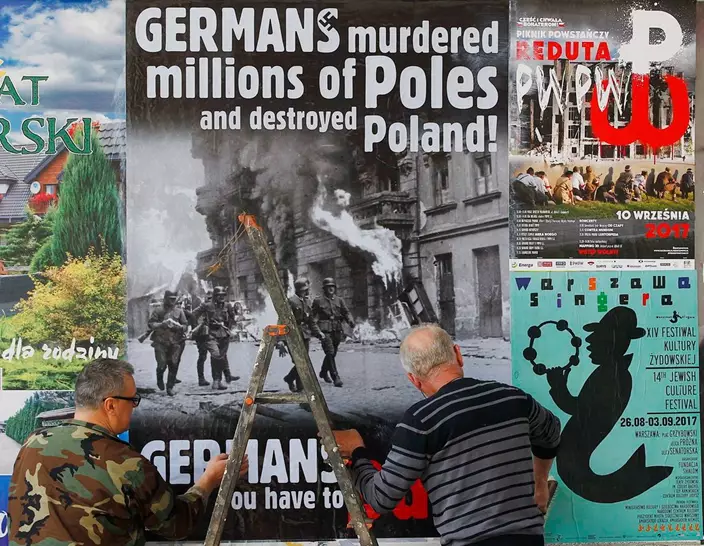
In this Aug. 24, 2017 photo a workers puts up a poster in Warsaw, Poland, calling on Germany to pay reparations for World War II to Poland. Poland's government is calling on Germany to pay it reparations for World War II, when more than five years of brutal Nazi occupation killed nearly a fifth of the population and wiped out industry and cultural wealth. But Germany says the matter was settled long ago and experts say there is no legal basis for Poland to demand reparations. That leaves government critics saying the real aim must be to create an external enemy as Poland's ties with Western Europe sour.(AP Photo/Czarek Sokolowski)
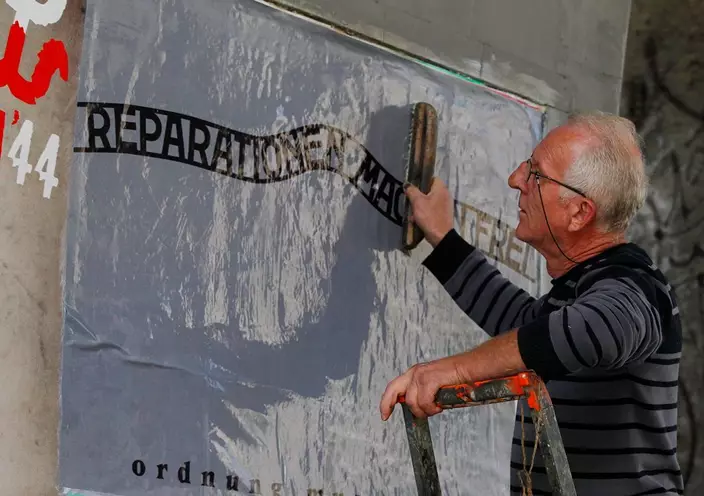
In this Aug. 24, 2017 photo a worker puts up a poster in Warsaw, Poland, calling on Germany to pay reparations for World War II to Poland. Poland's government is calling on Germany to pay it reparations for World War II, when more than five years of brutal Nazi occupation killed nearly a fifth of the population and wiped out industry and cultural wealth. But Germany says the matter was settled long ago and experts say there is no legal basis for Poland to demand reparations. That leaves government critics saying the real aim must be to create an external enemy as Poland's ties with Western Europe sour.(AP Photo/Czarek Sokolowski)
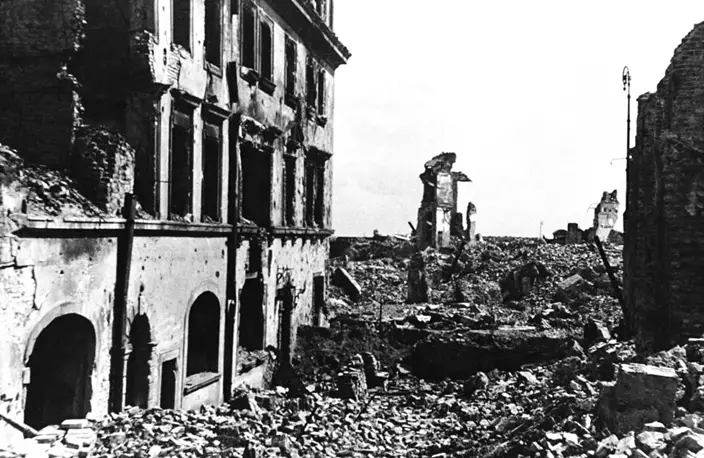
File-This Sept. 27, 1945, b/w file photo shows the shattered shell of the American Consulate building in devastated Warsaw, Poland, after World War II. Poland's government is calling on Germany to pay it reparations for World War II, when more than five years of brutal Nazi occupation killed nearly a fifth of the population and wiped out industry and cultural wealth. But Germany says the matter was settled long ago and experts say there is no legal basis for Poland to demand reparations. That leaves government critics saying the real aim must be to create an external enemy as Poland's ties with Western Europe sour. (AP Photo/Bille Allen,file)
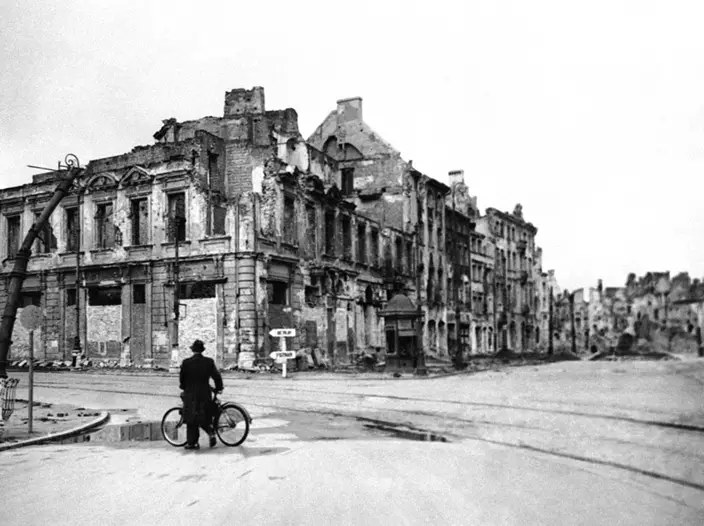
File-In this Oct. 1, 1945 file photo, a solitary cyclist contemplates a panorama of total destruction in Warsaw, the capital of Poland, months after World War II. Poland's government is calling on Germany to pay it reparations for World War II, when more than five years of brutal Nazi occupation killed nearly a fifth of the population and wiped out industry and cultural wealth. But Germany says the matter was settled long ago and experts say there is no legal basis for Poland to demand reparations. That leaves government critics saying the real aim must be to create an external enemy as Poland's ties with Western Europe sour. (AP Photo,file)
In this Aug. 24, 2017 photo a workers puts up a poster in Warsaw, Poland, calling on Germany to pay reparations for World War II to Poland. Poland's government is calling on Germany to pay it reparations for World War II, when more than five years of brutal Nazi occupation killed nearly a fifth of the population and wiped out industry and cultural wealth. But Germany says the matter was settled long ago and experts say there is no legal basis for Poland to demand reparations. That leaves government critics saying the real aim must be to create an external enemy as Poland's ties with Western Europe sour.(AP Photo/Czarek Sokolowski)
Chancellor Angela Merkel's spokesman told reporters that while Germany "stands by its responsibility for WWII" it has already paid reparations to Poland.
Steffen Seibert said Germany also considers Poland's relinquishment of further reparations in 1953, 1970 and 2004 to be legally binding.
Seibert said that "in our view this question has been completely resolved legally and politically."
He added that Germany is grateful for its current good relations with Poland.
In Poland, the government's plan to seek reparations met with opposition from the influential Catholic Church, whose leaders said that "ill-considered decisions and rash words" can easily destroy the "great value" that is the hard-won reconciliation between Poland and Germany.
In this Aug. 24, 2017 photo a worker puts up a poster in Warsaw, Poland, calling on Germany to pay reparations for World War II to Poland. Poland's government is calling on Germany to pay it reparations for World War II, when more than five years of brutal Nazi occupation killed nearly a fifth of the population and wiped out industry and cultural wealth. But Germany says the matter was settled long ago and experts say there is no legal basis for Poland to demand reparations. That leaves government critics saying the real aim must be to create an external enemy as Poland's ties with Western Europe sour.(AP Photo/Czarek Sokolowski)
In a letter addressed to "persons responsible for our country and for international relations," five leading bishops said that the issues that have not been settled between the two nations should be approached through "wise diplomacy" that can help avoid negative emotions.
Poland's church is considered to be a powerful ally of the conservative ruling party and the words were seen as a friendly check on its policies.
File-This Sept. 27, 1945, b/w file photo shows the shattered shell of the American Consulate building in devastated Warsaw, Poland, after World War II. Poland's government is calling on Germany to pay it reparations for World War II, when more than five years of brutal Nazi occupation killed nearly a fifth of the population and wiped out industry and cultural wealth. But Germany says the matter was settled long ago and experts say there is no legal basis for Poland to demand reparations. That leaves government critics saying the real aim must be to create an external enemy as Poland's ties with Western Europe sour. (AP Photo/Bille Allen,file)
File-In this Oct. 1, 1945 file photo, a solitary cyclist contemplates a panorama of total destruction in Warsaw, the capital of Poland, months after World War II. Poland's government is calling on Germany to pay it reparations for World War II, when more than five years of brutal Nazi occupation killed nearly a fifth of the population and wiped out industry and cultural wealth. But Germany says the matter was settled long ago and experts say there is no legal basis for Poland to demand reparations. That leaves government critics saying the real aim must be to create an external enemy as Poland's ties with Western Europe sour. (AP Photo,file)