
Skip to Content Facebook Feature Image

Pope asks 'pro-life' Trump to rethink young migrant decision

News

Pope asks 'pro-life' Trump to rethink young migrant decision
News

News

Pope asks 'pro-life' Trump to rethink young migrant decision

2017-09-12 10:42 Last Updated At:10:42

Pope Francis is urging President Donald Trump to rethink his decision to end a program protecting young immigrants from deportation, saying anyone who calls himself "pro-life" should keep families together.
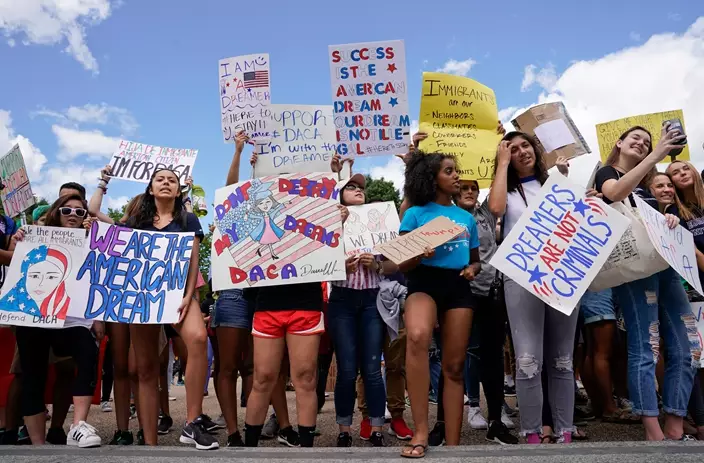
Supporters of Deferred Action for Childhood Arrival program (DACA) demonstrate on Pennsylvania Avenue in front of the White House in Washington, Saturday, Sept. 9, 2017.  (AP Photo/Pablo Martinez Monsivais)

Supporters of Deferred Action for Childhood Arrival program (DACA) demonstrate on Pennsylvania Avenue in front of the White House in Washington, Saturday, Sept. 9, 2017.  (AP Photo/Pablo Martinez Monsivais)

"If he is a good pro-life believer he must understand that family is the cradle of life and one must defend its unity," Francis said during an in-flight press conference en route home from Colombia.

Francis said he hadn't read up on Trump's decision to phase out the Deferred Action for Children Program, which allows some immigrants who were brought to the U.S. illegally as children to stay. About 800,000 people are affected by Trump's decision to give Congress six months to end their limbo status.
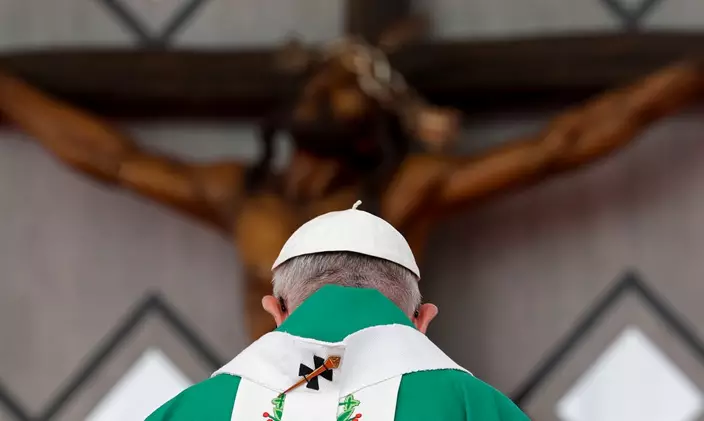
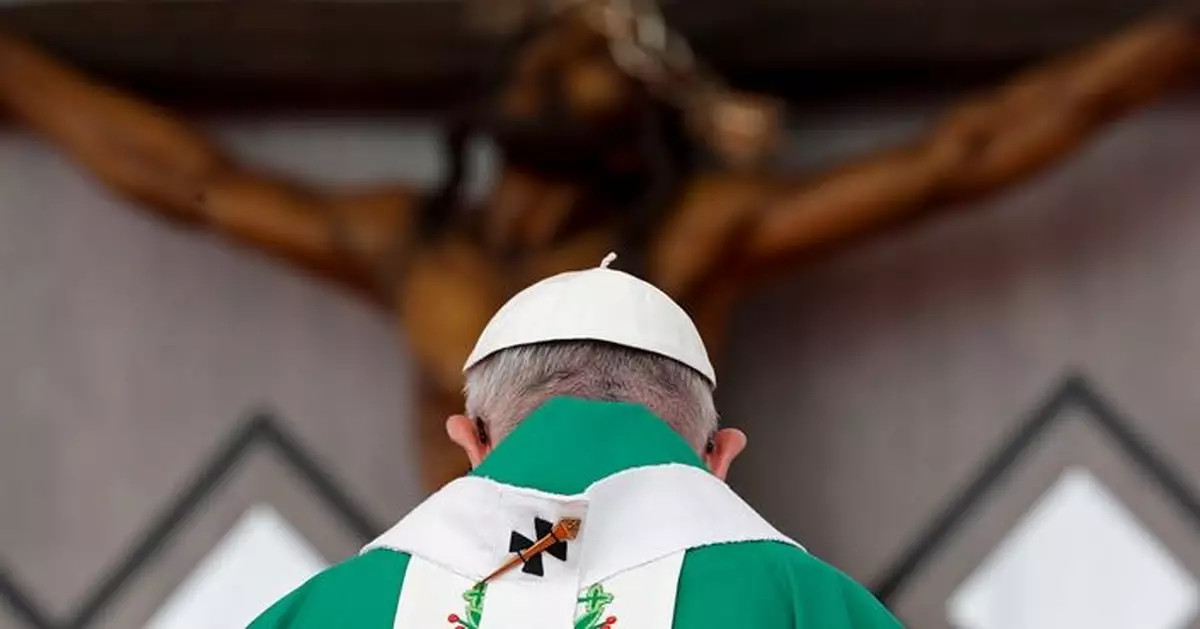
Pope Francis celebrates Mass in the area of Contecar harbor in Cartagena, Colombia, Sunday, Sept. 10, 2017. (AP Photo/Andrew Medichini)

Pope Francis celebrates Mass in the area of Contecar harbor in Cartagena, Colombia, Sunday, Sept. 10, 2017. (AP Photo/Andrew Medichini)

But he said in general, removing children from families "isn't something that bears fruit for either the youngsters or their families."

"I hope they rethink it a bit," he said. "Because I heard the U.S. president speak: He presents himself as a person who is pro-life."

Already the U.S. Conference of Catholic Bishops has denounced Trump's decision to end the DACA program, calling it "reprehensible" and placing "unnecessary fear for DACA youth and their families."

Francis has clashed previously with Trump over issues of immigration, saying that anyone who wants to build a wall as Trump does on the Mexican border to keep out migrants is "not Christian." He has called for migrants and refugees to be welcomed and insisted on their rights to flee violence, natural disasters and poverty in search of a better life elsewhere.

On Sunday, though, he also acknowledged that countries have to manage migrant flows and make sure new migrants can be integrated into society.

In his airborne news conference, he was asked about Italy's new policy of stopping migrant departures from Libya, which it has achieved by supporting increased Libyan coast guard patrols and backing Libya's government in working with militias that once facilitated trafficking to now stop it.

Francis said he was grateful to both Italy and Greece for having welcomed so many migrants in. But he said governments have to manage refugee flows "with prudence," taking into account how many people it can successfully integrate into its society.

"I have the impression that it is doing all it can with humanitarian care to also resolve the problem it cannot take on," he said, referring to efforts to improve investments in Africa so many people don't feel compelled to leave.

Pope Leo XIV put the Rev. Edward Joseph Flanagan a step closer to possible sainthood Monday as he proclaimed the “heroic virtues” of the founder of Boys Town, a Nebraska home for at-risk youths that gained national renown and inspired an Oscar-winning biopic performance.

With Leo's proclamation, the priest commonly known as “Father Flanagan” is now officially declared “venerable.” Later steps on a possible path of sainthood would include beatification and ultimately canonization.

Omaha Archbishop Michael McGovern said he is “overjoyed” with the news.

“We continue to pray that he will one day be beatified and ultimately declared a saint,” the archbishop said in a statement. “In the meantime, may we work to affirm the dignity of every person created in God’s image by serving the poor, the abandoned and the vulnerable, especially at-risk youth.”

Flanagan was born in Ballymoe, Ireland, in 1886 and immigrated to the U.S. in 1904. He was ordained a priest in 1912 and began work in the Diocese of Omaha in 1913.

He provided shelter for homeless men, whose stories convinced him that many adult troubles are rooted in broken homes and parental neglect, according to his biography on the website of the Father Flanagan League, a society dedicated to promoting his cause for sainthood.

Flanagan began mentoring boys in the juvenile justice system and established his first home for boys in 1917 in downtown Omaha. In 1921, he bought a farm on the western outskirts of Omaha and began building what became the campus known as Boys Town, still located there in a village of the same name.

By the 1930s, hundreds of boys lived at the site, which included a school and dormitories where boys elected their own mayor, council and commissioners, according to the organization’s website.

Flanagan traveled to postwar Japan to help develop a child welfare program. In 1946, he visited his native Ireland and criticized its system of putting children in industrial schools and reformatories, decrying them as exploitative.

Flanagan died of a heart attack in 1948 at age 61 while visiting Germany. His tomb at Dowd Memorial Chapel in Boys Town displays one of his most famous quotations: “There are no bad boys. There is only bad environment, bad example, bad thinking.”

His work was depicted in the 1938 movie, “Boys Town,” starring Spencer Tracy as a heroic Flanagan and Mickey Rooney as one of the boys in his care. The movie yielded Oscar wins for Tracy (best actor) and for writing (original story).

The Boys Town organization has opened various locations around the country and began admitting girls to its residential programs in 1979.

The Boys Town organization applauded the Vatican announcement in a Facebook post Monday.

Flanagan “believed that children had the right to be valued, to have the basic necessities of life and to be protected,” it said. “His lifesaving work continues across the country today.”

Flanagan is the second U.S. cleric with Midwestern connections to be moved closer to sainthood this year under the pontificate of the Chicago-born Pope Leo. In February, the Vatican approved the beatification ceremony of Archbishop Fulton Sheen in his native Illinois after years of delays.

The Vatican’s Dicastery for the Causes of Saints reviewed a lengthy dossier on Flanagan's life, writings and works. Leo on Monday signed the decree attesting that Flanagan lived a life of heroic virtue. Such a decree doesn’t mean he was free of sin or mistakes, but it means he had a reputation of holiness by living all the Christian virtues in a heroic manner.

The next step toward possible sainthood is beatification. For Flanagan to be beatified, the postulator — the person responsible for advancing the cause — has to find someone who was miraculously healed by praying for Flanagan’s intercession. The process involves vetting by theological and medical experts. If convinced, the dicastery sends the case to the pope, who signs a decree saying the candidate can be beatified.

A second miracle is needed to declare the candidate a saint. Martyrs — people killed for their faith — can be beatified without a miracle. A miracle is needed, however, for martyrs to be canonized.

A pope can also bypass the miracle requirements in declaring a saint, as Pope Francis did on occasion during his 12-year papacy. Francis canonized St. Junipero Serra during a 2015 Washington, D.C., visit even though the Vatican hadn’t confirmed a second miracle attributed to his intercession.

Associated Press religion coverage receives support through the AP’s collaboration with The Conversation US, with funding from Lilly Endowment Inc. The AP is solely responsible for this content.

A statue of the Rev. Edward Flanagan is seen outside the home where he lived in Boys Town, Neb., on Sept. 14, 2024. (AP Photo/Peter Smith)

A statue of the Rev. Edward Flanagan is seen outside the home where he lived in Boys Town, Neb., on Sept. 14, 2024. (AP Photo/Peter Smith)

The tomb of the Rev. Edward Flanagan is seen in Dowd Memorial Chapel in Boys Town, Neb., on Sept. 14, 2024. (AP Photo/Peter Smith)

The tomb of the Rev. Edward Flanagan is seen in Dowd Memorial Chapel in Boys Town, Neb., on Sept. 14, 2024. (AP Photo/Peter Smith)

FILE - Father Edward J. Flanagan, founder of Boy's Town, Nebraska, speaks into a microphone at Meiji Stadium in Tokyo, May 28, 1947 during a Japanese Boy Scout Jamboree. At right, wearing his school uniform, is Crown Prince Akahito. (AP Photo/Charles Gorry, File)

FILE - Father Edward J. Flanagan, founder of Boy's Town, Nebraska, speaks into a microphone at Meiji Stadium in Tokyo, May 28, 1947 during a Japanese Boy Scout Jamboree. At right, wearing his school uniform, is Crown Prince Akahito. (AP Photo/Charles Gorry, File)

FILE - Boys Town students hold portraits of Boys Town founder Father Edward Flanagan outside St. Cecilia Cathedral in Omaha, Neb., Feb. 27, 2012. (AP Photo/Nati Harnik, File)

FILE - Boys Town students hold portraits of Boys Town founder Father Edward Flanagan outside St. Cecilia Cathedral in Omaha, Neb., Feb. 27, 2012. (AP Photo/Nati Harnik, File)

Recommended Articles