Two Australian navy vessels arrived in the Philippines on Tuesday for a goodwill visit as Australia seeks an increased security presence and greater influence in the region.
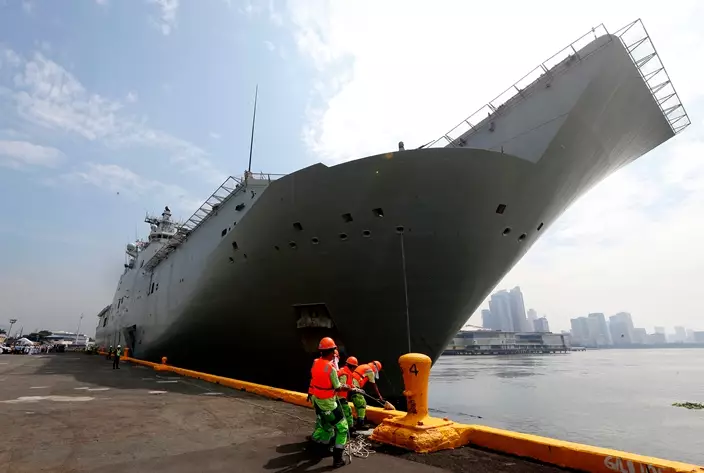
The Royal Australian Navy HMAS Adelaide, an amphibious assault ship and landing helicopter dock, is secured by port workers as it docks in the South Harbor for a five-day port call, Tuesday, Oct. 10, 2017, in Manila, Philippines. (AP Photo/Bullit Marquez)
HMAS Adelaide, a landing helicopter dock, and HMAS Darwin, a guided missile frigate, docked at Manila's harbor. Philippine navy officials and Australia's ambassador to the Philippines, Amanda Gorley, welcomed the crew of the ships, which are part of the Australian defense force joint task group Indo-Pacific Endeavor 2017.
Click to Gallery
The Royal Australian Navy HMAS Adelaide, an amphibious assault ship and landing helicopter dock, is secured by port workers as it docks in the South Harbor for a five-day port call, Tuesday, Oct. 10, 2017, in Manila, Philippines. (AP Photo/Bullit Marquez)
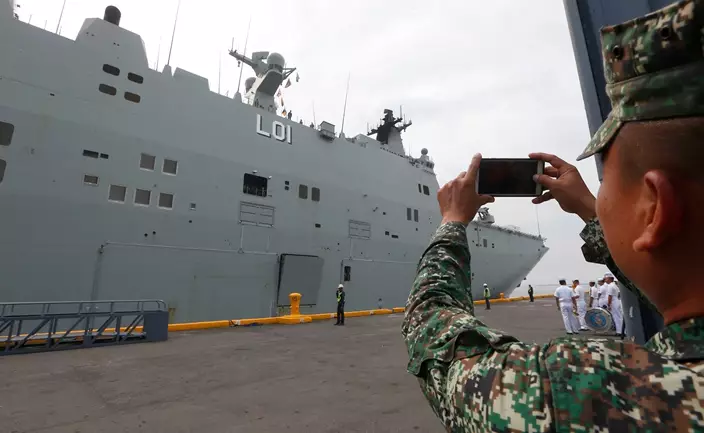
A Philippine Navy personnel takes a photo of the Royal Australian Navy HMAS Adelaide, an amphibious assault ship and landing helicopter dock, as it docks in the South Harbor for a five-day port call, Tuesday, Oct. 10, 2017, in Manila, Philippines. (AP Photo/Bullit Marquez)
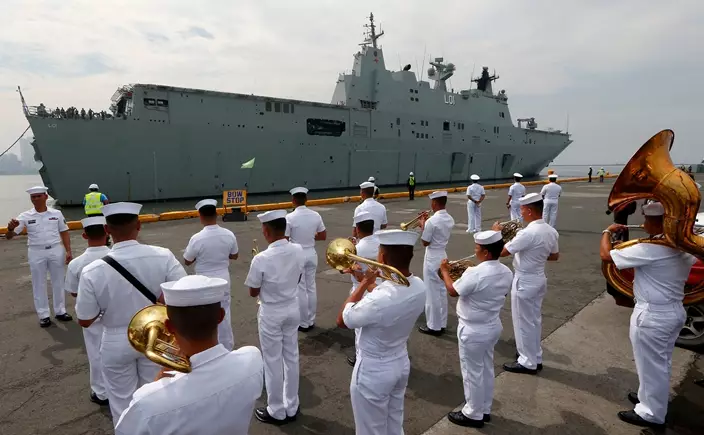
A Philippine Navy band plays to welcome the Royal Australian Navy HMAS Adelaide, an amphibious assault ship and landing helicopter dock, as it docks in the South Harbor for a five-day port call, Tuesday, Oct. 10, 2017, in Manila, Philippines. (AP Photo/Bullit Marquez)
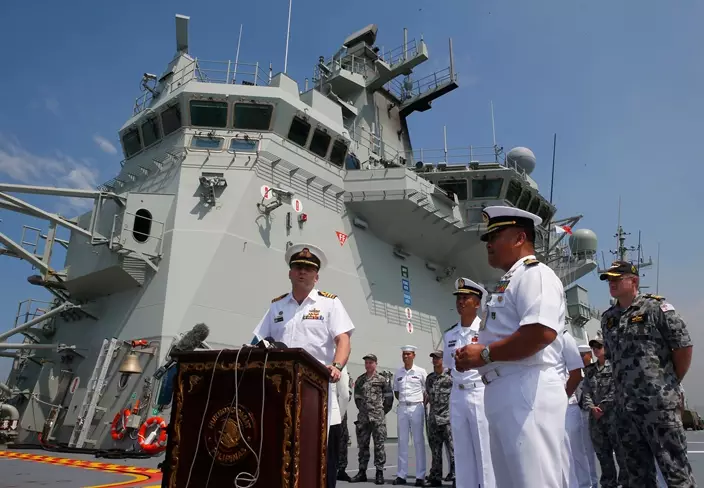
Capt. Jonathan Early, Commander of the Joint Task Group and skipper of the Royal Australian Navy HMAS Adelaide, addresses the media from the deck of the amphibious assault ship and landing helicopter dock, after docking at the South Harbor for a five-day port call, Tuesday, Oct. 10, 2017 in Manila, Philippines. (AP Photo/Bullit Marquez)
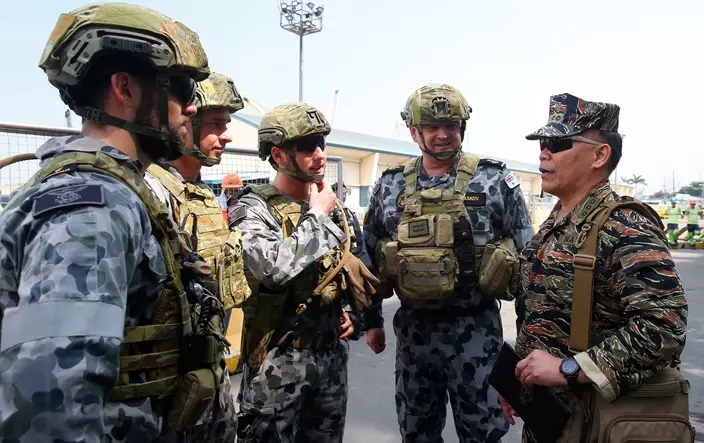
Philippine Navy Capt. Roy Vincent Trinidad, right, talks to Australian Navy officers shortly upon disembarking from the Royal Australian Navy HMAS Adelaide, an amphibious assault ship and landing helicopter dock, docked in the South Harbor for a five-day port call, Tuesday, Oct. 10, 2017, in Manila, Philippines. (AP Photo/Bullit Marquez)
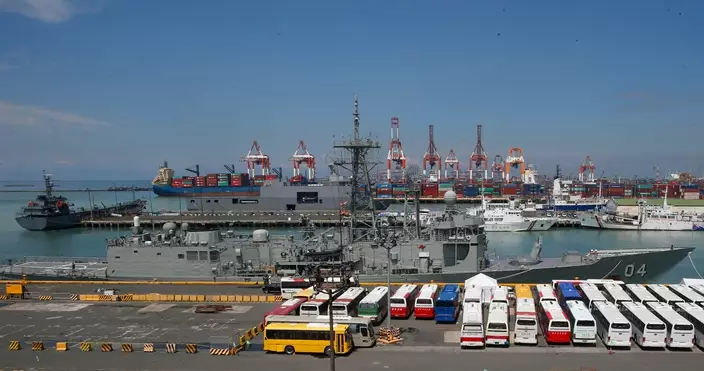
The Royal Australian Navy HMAS Darwin, a guided missile frigate, is docked in the South Harbor for a five-day port call. Tuesday, Oct. 10, 2017, Manila, Philippines. (AP Photo/Bullit Marquez)
President Rodrigo Duterte later toured the Adelaide, thanking Gorely and its officers and crew for visiting Manila. He said it was crucial for Australia, the Philippines and other countries, including the United States and China, to jointly confront regional threats such as that posed by North Korea and its leader, Kim Jong Un.
A Philippine Navy personnel takes a photo of the Royal Australian Navy HMAS Adelaide, an amphibious assault ship and landing helicopter dock, as it docks in the South Harbor for a five-day port call, Tuesday, Oct. 10, 2017, in Manila, Philippines. (AP Photo/Bullit Marquez)
"I hope it would not deteriorate into something violent, but you can never know what's in the criminal mind," Duterte said. Governments should support each other "to show to this one guy that he has to stop threatening the world because he runs the risk of being destroyed first."
"China appears to be the only monkey wrench in the violent plans of Kim," Duterte said.
The Australian contingent head, Capt. Jonathan Earley, said before Duterte's visit that the aim of the ships' tour around the region "is to demonstrate Australian commitment to supporting regional security and regional stability." Earley said exercises planned with the Philippine military in Manila and in western Subic Bay will focus on humanitarian aid and disaster relief.
Gorley said the ship visit "is a symbol of the strong defense ties between Australia and the Philippines, which just get deeper and deeper." She said through the joint activities during the visit, the two countries can pursue their shared objective of ensuring maritime security and regional stability.
A Philippine Navy band plays to welcome the Royal Australian Navy HMAS Adelaide, an amphibious assault ship and landing helicopter dock, as it docks in the South Harbor for a five-day port call, Tuesday, Oct. 10, 2017, in Manila, Philippines. (AP Photo/Bullit Marquez)
But Earley said freedom of navigation in the contested South China Sea — an issue that Australia does not takes sides in — is not a focus of the ships' deployment.
"Certainly what I can say is that we do have a strong interest in regional security and respect for international law, and that certainly includes the freedom of trade, and the ability to exercise freedom of navigation and overflight where required," he said.
Capt. Jonathan Early, Commander of the Joint Task Group and skipper of the Royal Australian Navy HMAS Adelaide, addresses the media from the deck of the amphibious assault ship and landing helicopter dock, after docking at the South Harbor for a five-day port call, Tuesday, Oct. 10, 2017 in Manila, Philippines. (AP Photo/Bullit Marquez)
Philippine Navy Capt. Roy Vincent Trinidad, right, talks to Australian Navy officers shortly upon disembarking from the Royal Australian Navy HMAS Adelaide, an amphibious assault ship and landing helicopter dock, docked in the South Harbor for a five-day port call, Tuesday, Oct. 10, 2017, in Manila, Philippines. (AP Photo/Bullit Marquez)
The Royal Australian Navy HMAS Darwin, a guided missile frigate, is docked in the South Harbor for a five-day port call. Tuesday, Oct. 10, 2017, Manila, Philippines. (AP Photo/Bullit Marquez)