Skip to Content Facebook Feature Image

World's first railless train hits road, autonomous driving likely by 2020

TECH

World's first railless train hits road, autonomous driving likely by 2020
TECH

TECH

World's first railless train hits road, autonomous driving likely by 2020

2017-10-29 18:02 Last Updated At:18:02

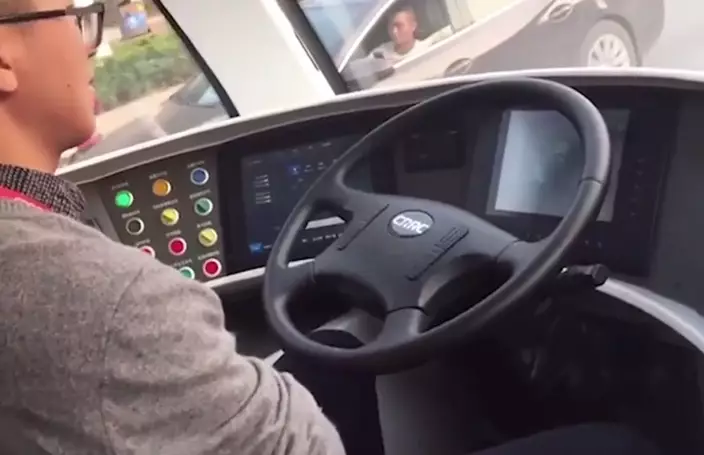
The world's first railless train hit the road on Monday afternoon in Zhuzhou City, central China's Hunan Province, and its developer forecasts that autonomous driving of the train will be possible by 2020.

The 32-meter-long train, carrying rail experts and journalists from home and abroad, appeared on Shennong Avenue in Zhuzhou at 4:30 in the afternoon.

More Images

The train is part of the intelligent rail express system, called Autonomous Rail Rapid Transit (ART). It has been independently developed by the CRRC Zhuzhou Institute Co.

The latest success marks the completion of the 3.1-kilometer phase-one demonstration line of the world's first ART system, which will soon be put into trial run. The first three trains are set to go into operation around the Spring Festival in the coming year.

According to Feng Jianghua, chief engineer at the institute, the train runs on rubber tires along designated virtual tracks rather than rails. It is equipped with sensors that can detect the virtual tracks and respond to instructions sent by the central control unit, or the central "brains."

By combining the advantages of modern tramcars and buses, the new product provides a new travel option and helps ease modern transport pressure in cities, said Feng.

The train may consist of three to five carriages depending on actual transport needs and hold 300 to 500 passengers, and can run at a speed of up to 70 kilometers per hour. It is powered by electricity, and a 10-minute charge enables it to run 25 kilometers.

As the train doesn't rely on steel rails, a transit line can be built in a year and put into use soon afterwards, while construction costs are also significantly lower compared to traditional trams, Feng said.

Moreover, the train has active safety protection systems. It can obtain information of potential dangers originating from itself and its surroundings and send alerts. Under company plans, semi-autonomous driving of the train is set to be achieved by 2019, while full autonomous driving will likely be attained by 2020.

After the innovative product and model becomes mature, the company will also promote it on overseas markets, he said.

NEW YORK (AP) — Google said Sunday that it is expanding the shopping features in its AI chatbot by teaming up with Walmart, Shopify, Wayfair and other big retailers to turn the Gemini app into a virtual merchant as well as an assistant.

An instant checkout function will allow customers to make purchases from some businesses and through a range of payment providers without leaving the Gemini chat they used to find products, according to Walmart and Google.

The news was announced on the first day of the National Retail Federation’s annual convention in New York. The role of artificial intelligence in e-commerce and its impact on consumer behavior are expected to dominate the three-day event.

“The transition from traditional web or app search to agent-led commerce represents the next great evolution in retail," John Furner, Walmart's incoming president and CEO, said in a joint statement with Google and Alphabet CEO Sundar Pichaei.

Google’s new AI shopping feature works this way: if a customer asks what gear to get for a winter ski trip, for example, Gemini will return items from a participating retailers’ inventory.

In the case of Walmart, customers who link their Walmart and Gemini accounts will receive recommendations based on their past purchases, and any products they decide to buy via the chatbot could get combined with their existing Walmart or Sam's Club online shopping carts, according to the statement.

OpenAI and Walmart announced a similar deal in October, saying the partnership would allow ChatGPT members to use an instant checkout feature to shop for nearly everything available on Walmart’s website except for fresh food.

Google, OpenAI and Amazon all are racing to create tools that would allow for seamless AI-powered shopping by taking chatbot users from browsing to buying within the same program instead of having to go to a retailer’s website to complete a purchase. The race between OpenAI and Google has heated up in recent months.

Before the recent holiday shopping season, OpenAI launched an instant checkout feature within ChatGPT that allows users to buy products from select retailers and Etsy sellers without leaving the app.

San Francisco software company Salesforce estimated that AI influenced $272 billion, or 20%, of all global retail sales, in one way or another during the holiday shopping season.

Google said the AI-assisted shopping features in Gemini only would be available to U.S. users initially but that it planned to expand internationally in the coming months.

FILE - Alphabet CEO Sundar Pichai speaks at a Google I/O event in Mountain View, Calif., Tuesday, May 20, 2025. (AP Photo/Jeff Chiu, File)

FILE - Alphabet CEO Sundar Pichai speaks at a Google I/O event in Mountain View, Calif., Tuesday, May 20, 2025. (AP Photo/Jeff Chiu, File)

Recommended Articles