Can a dog survive with a severed head? Soviet Union scientist Sergei Sergeevich Brukhonenko tried to answer this question by a creepy experiment in 1928. He beheaded a dog and attached the head to an artificial blood circulating machine, intended to restore the brain’s function.
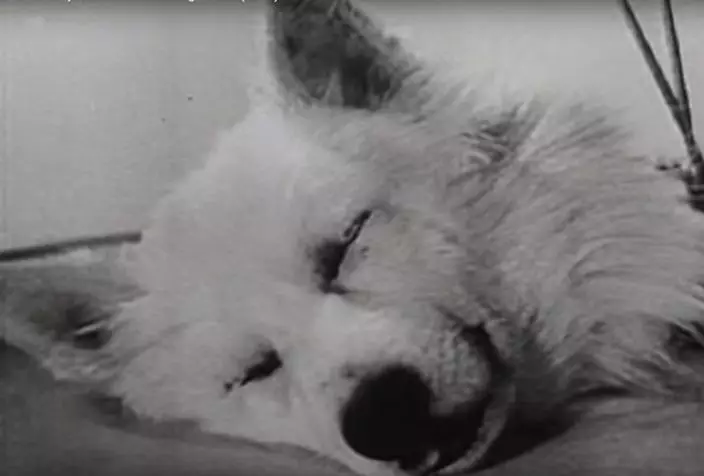
The dog head, miraculously, was brought back to life for a few hours and even swallowed a few slices of cheese before dropping dead again.
Online Photo
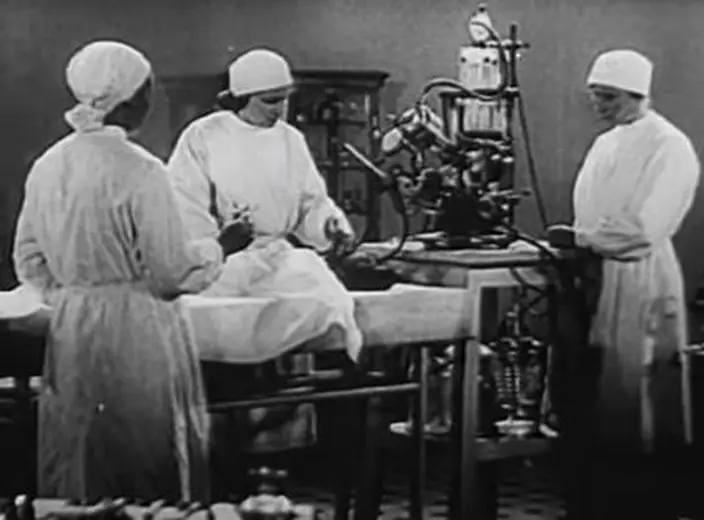
The experiment was recorded by a documentary filmed by Soviet Film Agency, which was first released to the public in 1941. In the video, Brukhonenko attached a dog head, which had been dismembered from the body for ten minutes, to a machine named “autojector”. This machine appeared to circulate blood around the head and restore basic functions.
Online Photo
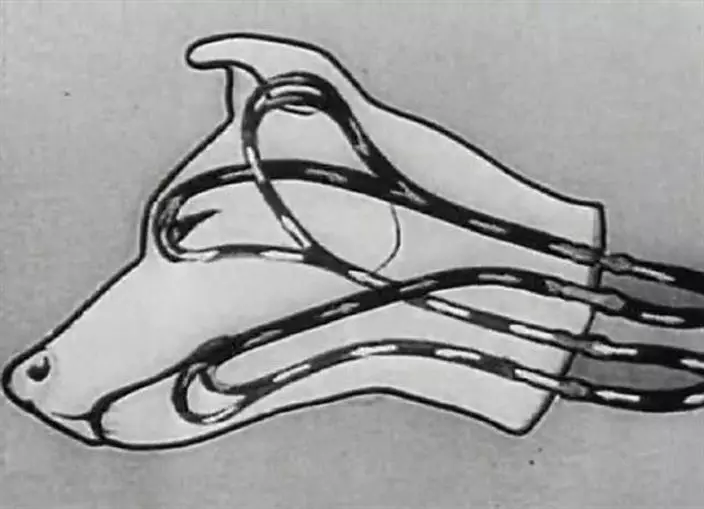
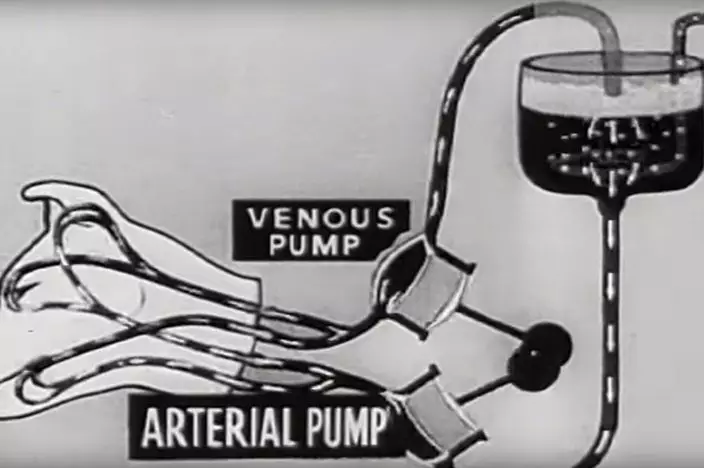
It consisted of two mechanically operated diaphragm pumps with a system of valves that oxygenates blood by removing carbon dioxide and increasing oxygen content. Attached to autojector, the dog head seemed to have come back to life, and react to sound and light. It even swallowed a few slices of cheese just like a living dog. However, the resurrection period was just as short as a few hours, as the dog head stopped functioning again.
Online Photo
The experiment was later perfected and resulted in a new invention of a heart and lung reviving machine. It was reported that 2 out of 13 experimental animals were resuscitated and survived using the heart-lung machine.
Online Photo
Online Photo
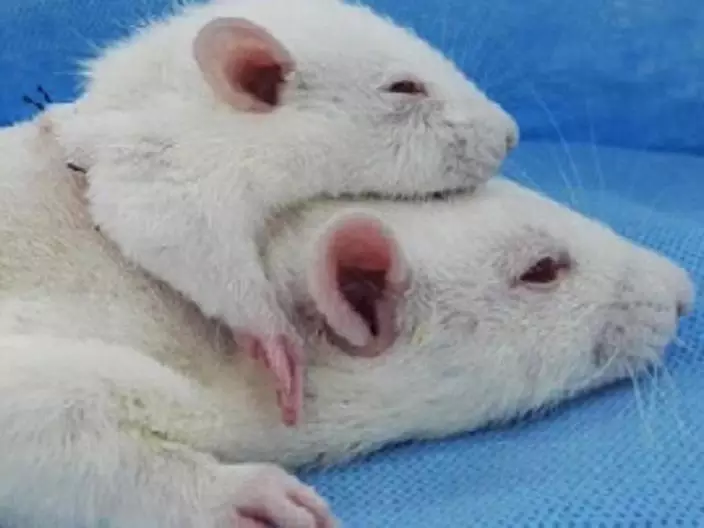
Science never stops to seek breakthroughs. Almost a century later, Italian neurosurgeon Dr Sergio Canavero worked in collaboration with Chinese scientists to conduct another controversial surgery – head transplant. They successfully transplanted the head of a smaller mouse to a bigger mouse, and kept this twin-headed mouse alive for 36 hours.
ALBANY, N.Y. (AP) — Albany loves its giant dog statue.
Nipper, a 28-foot (9-meter) tall white dog with black ears has sat conspicuously atop a warehouse for almost seven decades — recreating the famous image of a terrier listening attentively to a phonograph that was long used by electronics and communications company RCA.
Over time, the statue has grown into a source of local pride around this city on the Hudson River. Parents point it out to their kids from the highway. Nipper's image, with his head cocked to one side, appears on items like key chains, ball caps and hoodies.
“When I think of Nipper, I think of Albany. When I think of Albany, I think of Nipper,” said Cody Hitt, who was out with friends recently at a bar right by the statue.
Now that pride is tempered with concern for Nipper's future. After years of litigation, the unused four-story warehouse on which Nipper sits was recently marked by a red placard with white slash — a warning to firefighters and other first responders to use caution when entering.
“It’s definitely not a good thing for Nipper. He is attached to that building, so if something happens to it, it’s going to be kind of hard to take him off,” said Cara Macri, director of preservation services for the Historic Albany Foundation.
The flesh-and-blood Nipper lived in late 19th century England and earned his name after trying to bite people's ankles. His owner's brother, Francis Barraud, immortalized the dog posthumously in the painting “His Master’s Voice,” which shows Nipper intrigued by the recorded sound coming from a phonograph horn.
The Gramophone Company in London purchased a version of the image in 1899 and it was registered soon after for use in the United States. The “His Master’s Voice” trademark was acquired in 1929 by the company that became RCA.
Albany's Nipper, with a composite body over a steel frame, was placed by a crane atop the building in the late 1950s to advertise the location of an RCA appliance distributor.
There were many Nipper statues made during his heyday, including a 1958 Nipper statue now at the Maryland Center for History and Culture in Baltimore that's 14 feet (4 meters) high and paired with a larger-than-life phonograph.
But Albany’s is bigger. It stands out in a skyline otherwise notable for a modernist state government complex adjacent to the state Capitol, which features a 44-story office tower and theater shaped like a giant egg.
The beloved dog appears on socks, caps, stickers and shot glasses for sale downtown at the Fort Orange General Store, where store owner Erica Cubello said the items are bestsellers.
“He is kind of like our unofficial mascot here at Fort Orange, as well as the city of Albany,” said Cubello, who was wearing a Nipper hoodie.
Nipper still looks fresh after all these years. But the building below him has sat unused for at least a decade, with paint chipped off the front exterior.
Nothing ever became of plans announced a decade ago to develop apartments and retail space in the newly purchased building. Foreclosure litigation has been going on for years and city tax documents show an attorney acting as a receiver.
Lawyers involved in the litigation didn't immediately respond to calls for comment.
By 2024, the Historic Albany Foundation put the building on its list of places in peril. In March, the city put the red-and-white caution placard up on the building's entrance. Times-Union columnist Chris Churchill soon after sounded the alarm in a piece headlined: “Nipper has our love, but needs more protection.”
Albany Mayor Dorcey Applyrs' office said she is working to add Nipper to the city’s list of historic landmarks, which could help protect the dog and the building from damaging changes. Separately, a state board last month nominated the warehouse district that includes Nipper's building for state and national historic registers. That would make the building eligible for state and federal historic preservation tax credits.
There is no serious talk of moving Nipper from his forever home, which would be logistically challenging and expensive.
Besides, where would the roughly four ton (3,600 kilogram) statue go?
“There’s a whole redevelopment downtown. You could put him there. You could put him on the riverfront,” Macri said. “But he’s a big dog.”
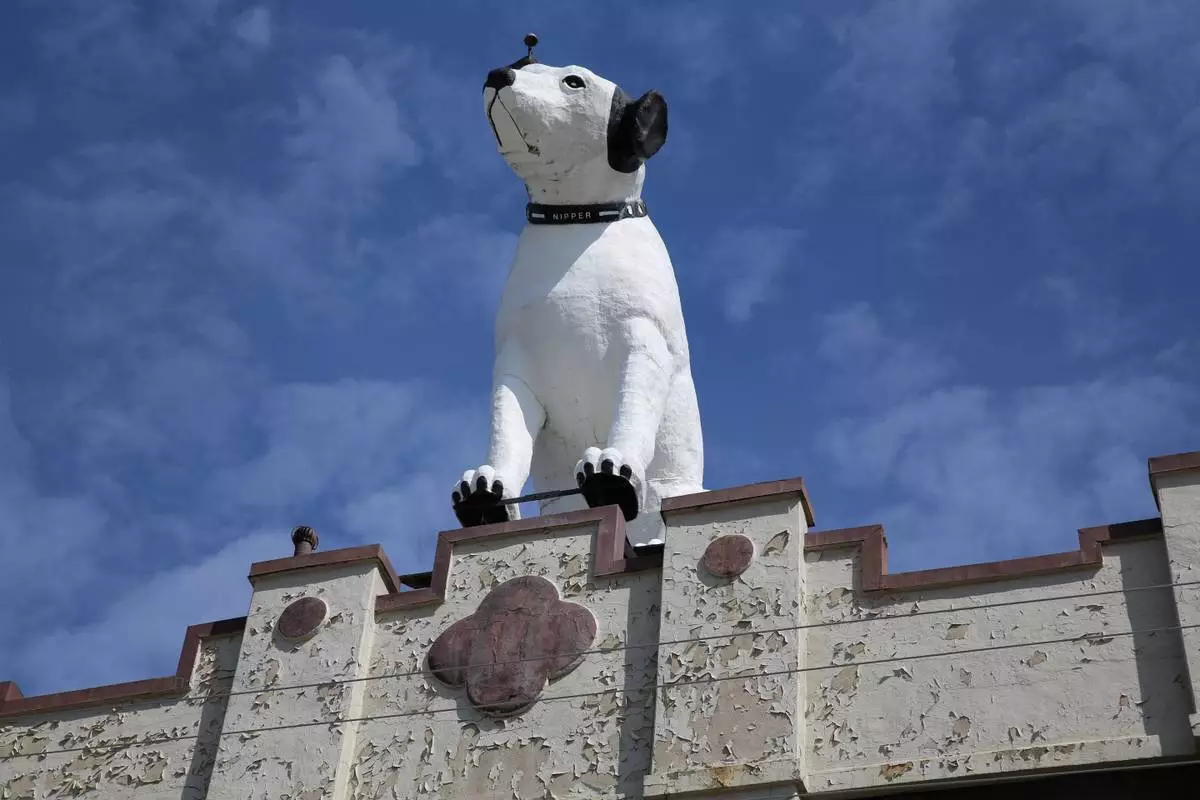
A giant statue of Nipper the dog sits atop of building in the warehouse district in Albany, N.Y., Tuesday, April 21, 2026.(AP Photo/Michael Hill)
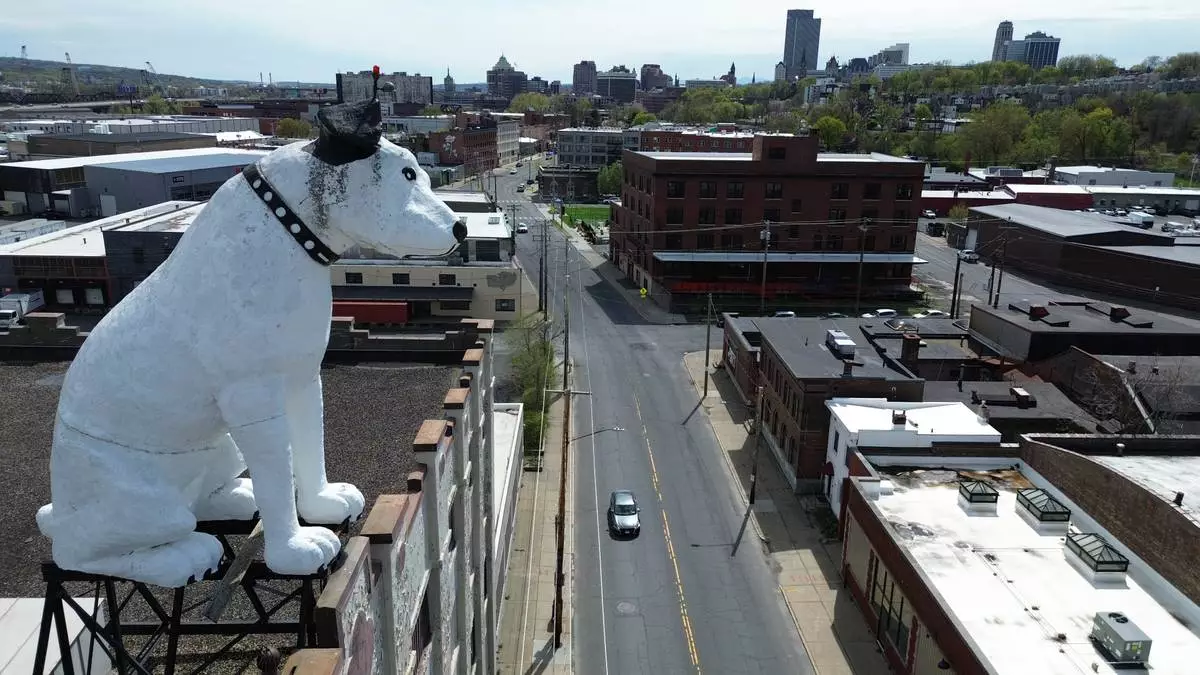
A giant statue of Nipper the dog sits atop a building in the warehouse district in Albany, N.Y., Tuesday, April 21, 2026. (AP Photo/Ted Shaffrey)
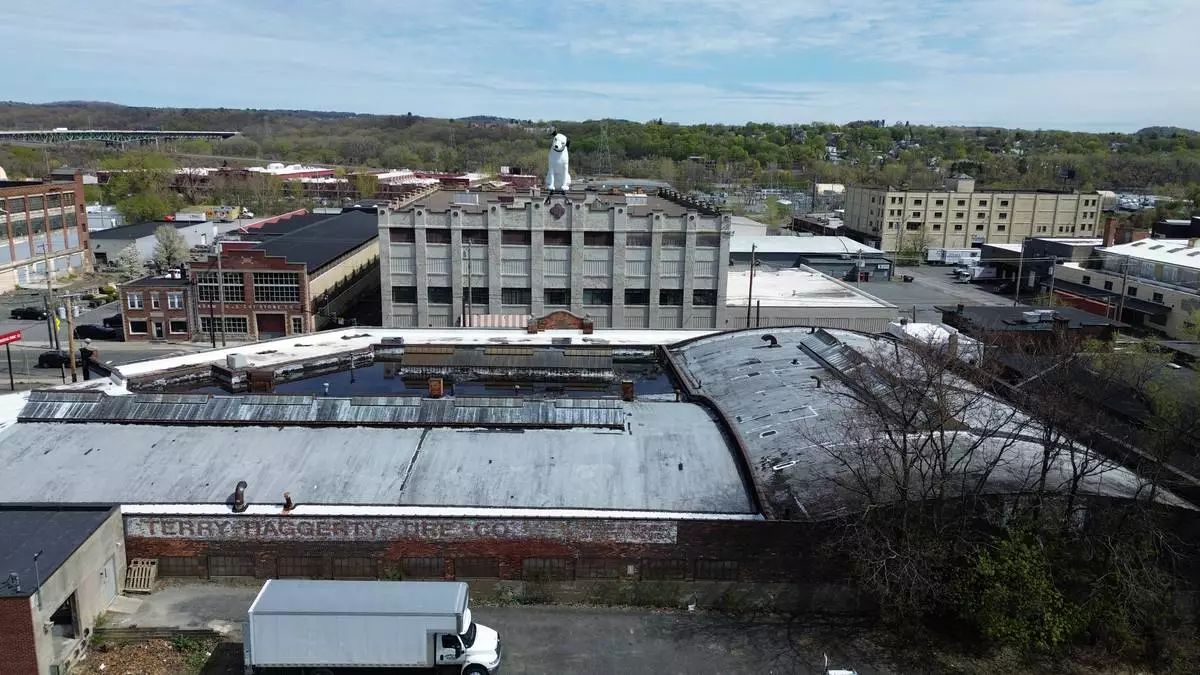
A giant statue of Nipper the dog sits atop a building in the warehouse district in Albany, N.Y., Tuesday, April 21, 2026. (AP Photo/Ted Shaffrey)
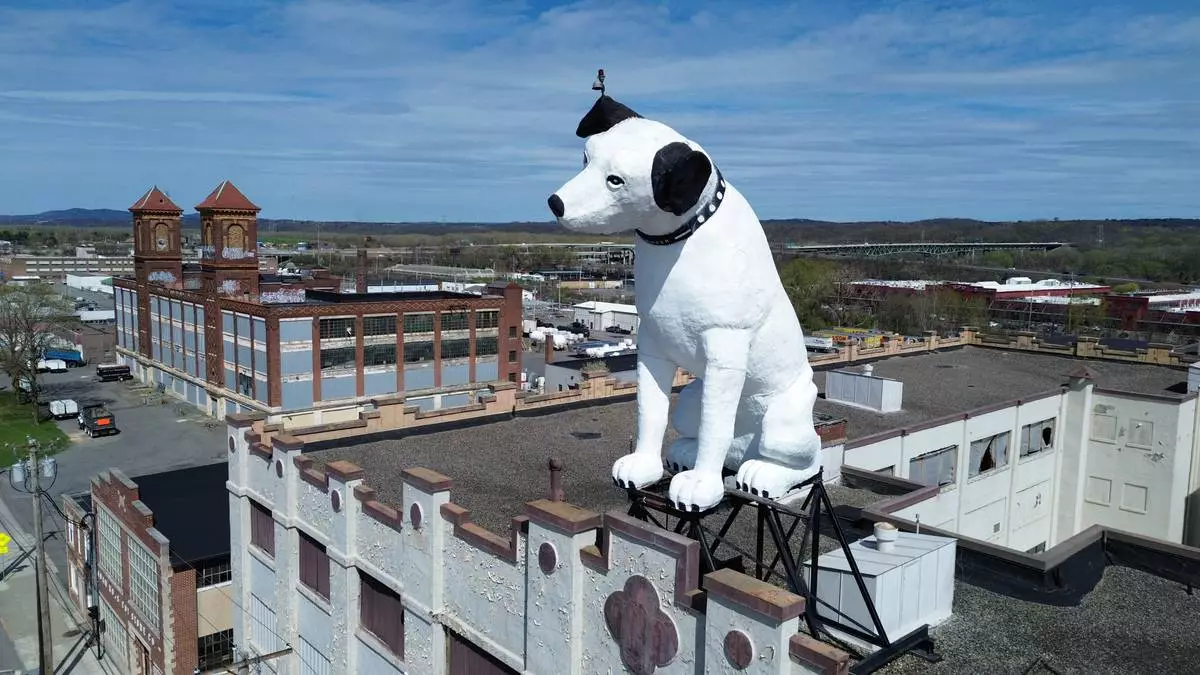
A giant statue of Nipper the dog sits atop a building in the warehouse district in Albany, N.Y., Tuesday, April 21, 2026. (AP Photo/Ted Shaffrey)
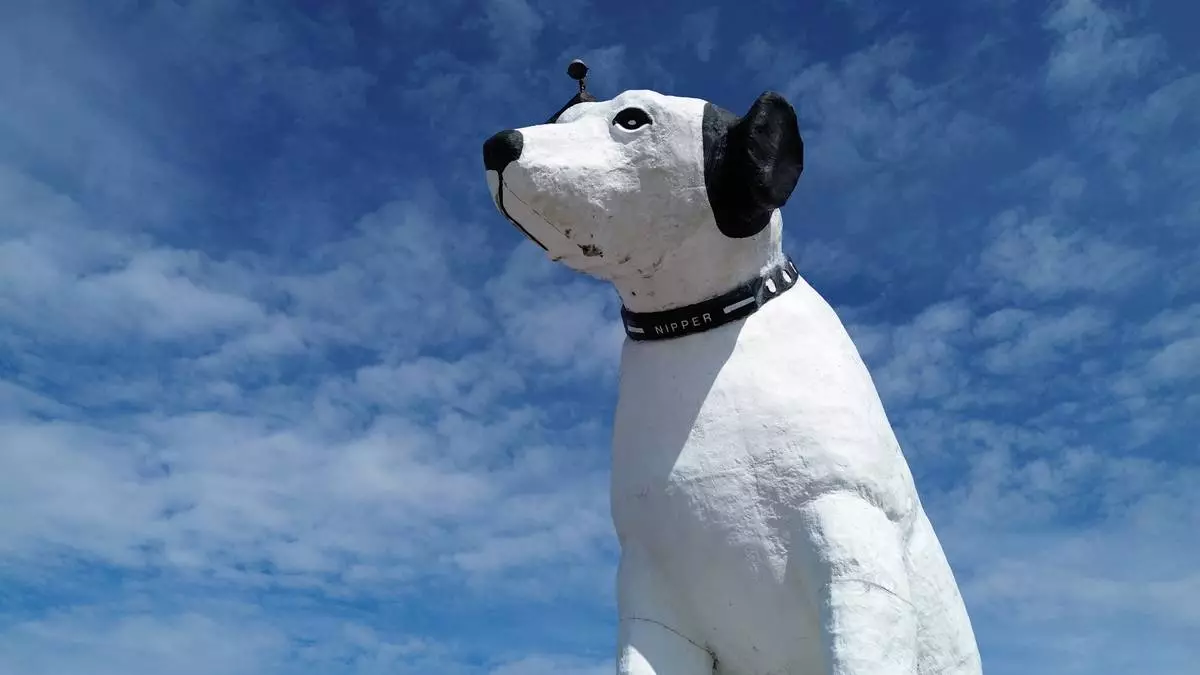
A giant statue of Nipper the dog sits atop a building in the warehouse district in Albany, N.Y., Tuesday, April 21, 2026. (AP Photo/Ted Shaffrey)