The recent innovation NASA developed for Mars missions is a special tire, called Superelastic Tire, which is "game changing, non-pneumatic, compliant" as described on the NASA website.
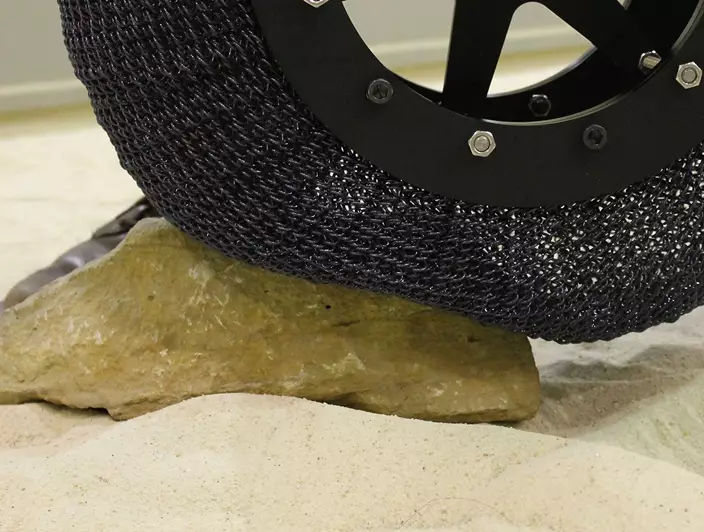
Image from NASA
In 2012, the tires of NASA's Mars Curiosity experienced very serious abration one year after landing on Mars, due to the rugged surface of Mar's, sparking concerns that whether it can successfully execute the mission.
Now NASA researchers may see the Superelastic Tire as solution. The use of a NiTi shape memory alloy are capable of undergoing significant reversible strain, up to 10%, allowing this tire to withstand excessive deformation without permanent damage.
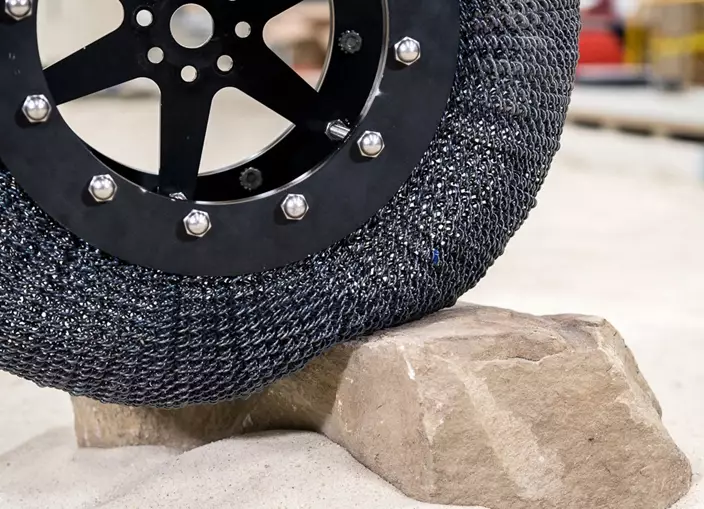
Image from NASA
The new material allows the tire to produce 30 times as much deformation than conventional materials, and when the tire experiences this level of deformation, it still retains its
original shape after passing the obstacle.
If NASA's Mars mission goes on wheels, Superelastic Tire will probably put into use in the future. In addition, it can also be applied to other vehicles.
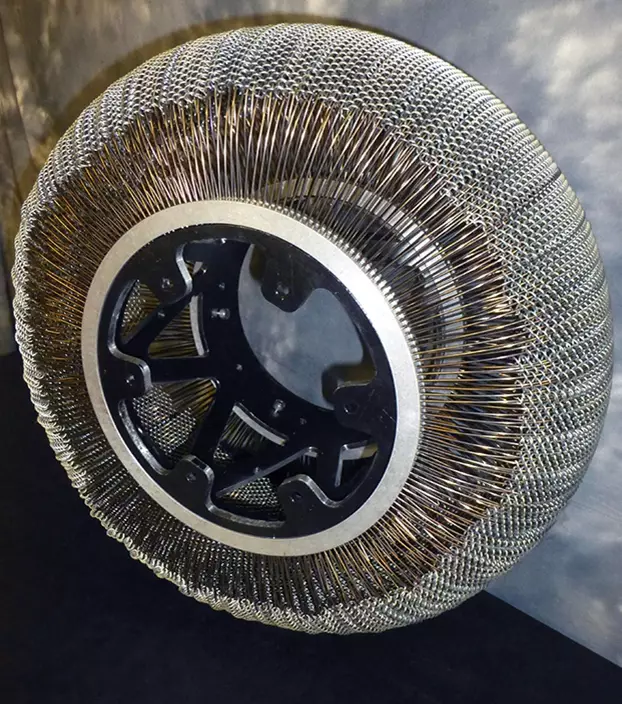
Image from NASA
NEW YORK (AP) — NASA on Tuesday revealed the crew for its Artemis III mission, the next step in the space agency's plan to eventually land astronauts on the moon.
The announcement came two months after Artemis II's record-breaking trip around the moon that surpassed the distance record of Apollo 13.
NASA's Randy Bresnik, Frank Rubio, Andre Douglas and the European Space Agency's Luca Parmitano won't fly to the moon or land on the surface. Instead, they’ll orbit Earth while practicing docking their Orion capsule with two lunar landers.
“To the Artemis III crew, we wish you Godspeed on the journey ahead,” said NASA administrator Jared Isaacman.
Elon Musk’s SpaceX and Jeff Bezos’ Blue Origin are racing to deliver the lunar landers. The two-week demo is targeted for 2027. Blue Origin suffered a recent setback when its massive rocket exploded during an engine-firing test on the launch pad in Florida, shaking nearby homes and illuminating the sky with an orange fireball.
NASA's Jeremy Parsons said the setback is a learning opportunity and that the space agency is confident Blue Origin's rocket will be ready in time.
NASA's Artemis program aims to return astronauts to the moon's surface for the first time since the 1970s. A recent revamp of the program announced by Isaacman aims to fast-track it similarly to the Apollo era, adding the upcoming spaceflight around Earth before eyeing a lunar landing in 2028.
“We are certainly humbled as a crew to be able to be your crew that executes this Artemis III mission in space,” said Bresnik, Artemis III commander.
Added Douglas, mission specialist: “My brain — it is going a mile a minute right now. But my heart, it is so warm. It is so full."
In May, NASA awarded hundreds of millions of dollars in contracts to four companies, including Blue Origin, to build landers, rovers and drones for a future moon base. Isaacman said the goal of the moon base is to lay the foundation for a Mars expedition.
—-
The Associated Press Health and Science Department receives support from the Howard Hughes Medical Institute’s Department of Science Education and the Robert Wood Johnson Foundation. The AP is solely responsible for all content.
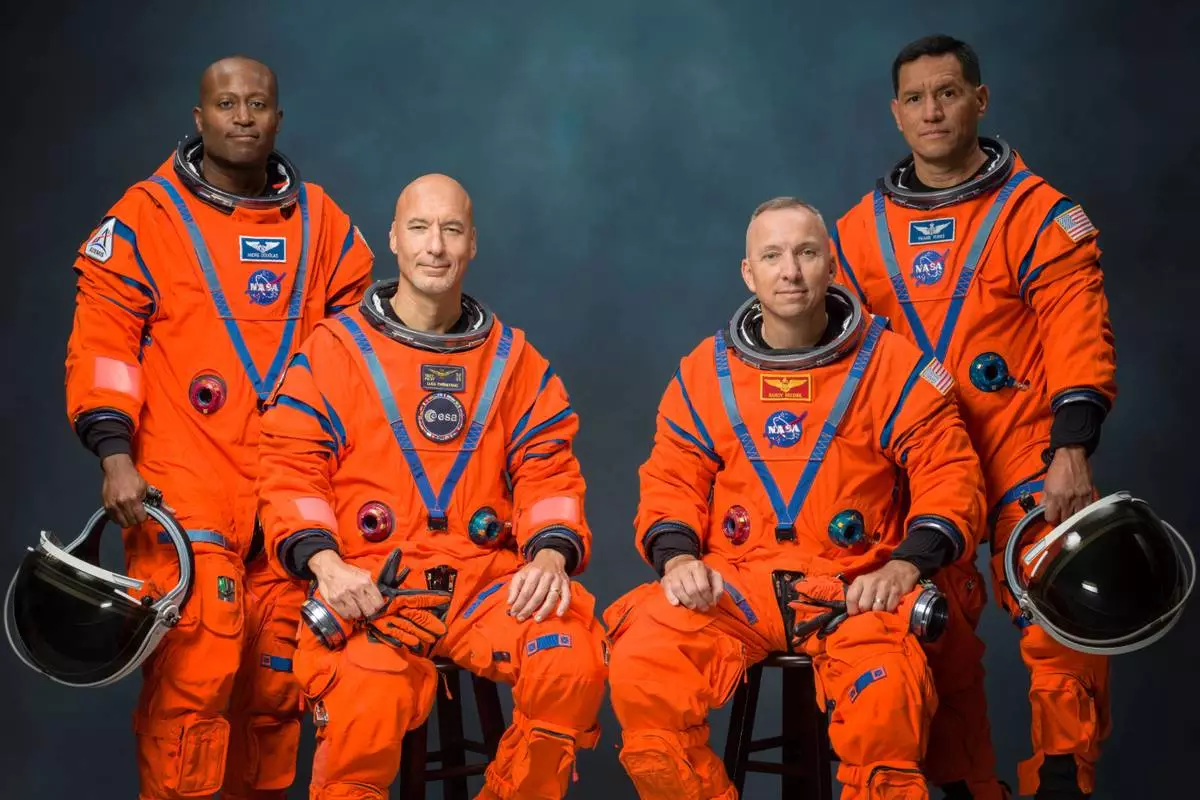
This undated photo provided by NASA Tuesday, June 9, 2026, shows the Artemis III crew including, from left, Andre Douglas, Luca Parmitano, Randy Bresnik and Frank Rubio, posing for an official portrait. (Bill Stafford/NASA via AP)

FILE - In this image provided by NASA, The Artemis II crew captured this view of an Earthset on April 6, 2026, as they flew around the Moon. (NASA via AP, File)