A female bank worker drowned in a pool party at the Yacht Club in Causeway Bay in 2014, a month before her 22nd birthday. The lifeguard had warned people not to bring any alcohol into the pool but no one listened. The catering department head agreed with the family’s lawyer that the scene was like an orgy.

Online photo
The father of the dead woman Tai Sze-Man said his daughter had come home for a short rest before going out. She also told her mother that she would join the pool party. But he didn't know whether Tai knew how to swim though she had taken swimming lessons before. He said Tai had not been known to have any enemies.
The head of the catering department Chow Kam Ho testified that the party was very loud and she asked the organizer to turn down the volume, but it was later turned up again. She described the participants as being very naughty. She also pointed out that many people were holding wine glasses in the pool. The lawyer representing Tai's family asked whether it looked like an orgy, and she agreed.

Online photo
The lifeguard Lau Shue-Kei who saved Tai said people who drank alcohol were not allowed to get in the pool on normal days and even during the party. He warned the party-goers as he saw people drinking. Nobody paid attention to his warning. Asked whether the volume on the site was too loud to hear people talking on the site, he replied as a little bit. During the party, he did not hear of someone's call for help and didn't see the dead woman. It was until the end of the party that he saw someone at the bottom of the pool without any bubbles when he suspected she was drowned. He then entered the water for rescue.
When he was doing a cardiopulmonary resuscitation (CPR) from tenth to fifteenth times, the drown woman vomited blood. He was then pushed by two foreigners who claimed themselves that they knew CPR and taken over from the rescue. He said she had slight pulse but did not open her eyes.
A friend of the dead woman Wu Pui-Yi (direct translation from Chinese) said she invited her to come to the party as she knew it from Facebook. They dressed in swimming suits with a life ring at the party's request. They didn't know swimming well so they avoided the area with a great depth of water. She said she drank a few cups of white and red wine, which was her normal alcohol consumption. They met different new people in the party so they separated and never saw each other again. Wu admitted that some memories were fake due to the consumption of alcohol.
Ruttonjee Hospital Intensive Care Unit Doctor Yeung Wai-Tak (direct translation from Chinese) testified that the dead woman did not have heartbeat along the way to hospital. She once got heartbeats but the rescue was in vain after all. He said the cause of death was drowning, which led to multiple organ failure. He revealed that alcohol was recorded in her blood. Another doctor also confirmed that the anatomy report showed that she suffered serious pulmonary edema and bleeding. These syndromes matched with the drown one. Both doctors could not tell the estimated time of drowning.
The case happened on August 16 in 2014. While Tai was joining a poolside party held by the Royal Hong Kong Yacht Club in Causeway Bay with around 120 people, she was found unconscious in the swimming pool at around one o'clock at the midnight. She was certified as dead after sending to Ruttonjee Hospital in the evening of August 18.
Last month, Airport Authority Hong Kong (AAHK) signed Memorandum of Understanding with Kazakhstan at the Belt and Road Summit, marking a new chapter of aviation connectivity and cooperation between Hong Kong and Kazakhstan.
Bauyrzhan Dosmanbetov, Consul General of the Republic of Kazakhstan to Hong Kong and Macao SAR’s, highlights that this cooperation with AAHK is a milestone not only for tourism, but also for strengthening aviation management, enhancing service quality, and developing professional talent.
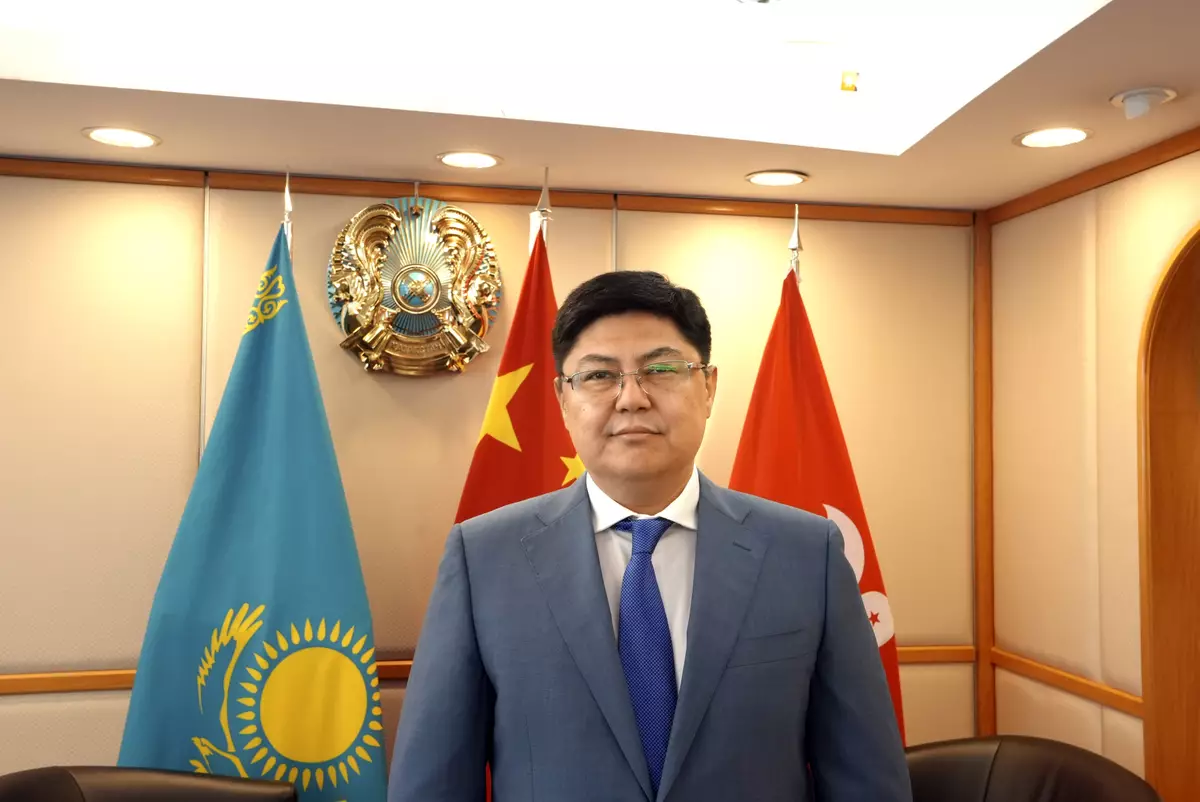
Bauyrzhan Dosmanbetov, Consul General of the Republic of Kazakhstan to Hong Kong and Macau SAR’s. By Bastillepost.
“We had a direct flight from Hong Kong to Almaty before the pandemic, but then it was canceled,” says Dosmanbetov, “We are actively working on resuming it with the major Hong Kong carriers to make both destinations more accessible.” He also says that it is a pity that there is no airline currently operates direct flights to Hong Kong from Central Asia, which has a total population of 80 million.
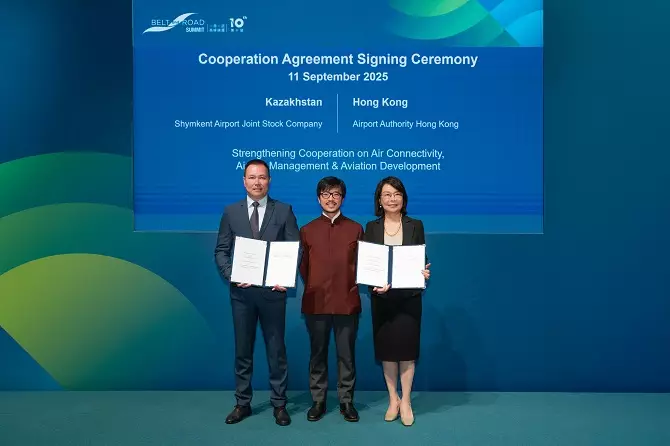
AAHK signed memorandum with Kazakhstan last month at the Belt and Road Summit. Internet photo.
Besides working on resuming direct flight between Hong Kong and Kazakhstan, according to Dosmanbetov, Kazakhstan also provides two scholarships for their pilots and managers who are going to study at Hong Kong International Aviation Academy (HKIAA), in the hope of enhancing operational excellence, and further supporting stronger tourism, trade and people-to-people exchange.
Aviation is not the only cooperation Kazakhstan reached with Hong Kong. In August, Jiaxin International Resources Investment Limited, a Kazakhstan company receiving investment from Chinese enterprise, listed on both Hong Kong and Kazakhstan markets.
Shares of the company surged about 178 percent on its first day of initial public offering (IPO) on Hong Kong market. “The dual listing is a big growth for the company,” says Dosmanbetov, “I know we have two more companies also want to list in Hong Kong and Astana.”
As President of Kazakhstan, Kassym-Jomart Tokayev, emphasized in his 2025 State of the Nation Address, Kazakhstan must move beyond relying on raw material investment and channel more capital into manufacturing and high-end industry.
Dosmanbetov says that the reason why Kazakhstan is interested in Hong Kong market is that Hong Kong can connect it with investors who are experienced in supporting large-scale, diversified and innovative projects. According to him, entering Hong Kong means Kazakhstan-based companies gain access not only to financing but also to strategic partnership and pathways to support the transformation of Kazakhstan.
Dosmanbetov expresses optimism about deeper cooperation between the Astana International Exchange (AIX) and the Hong Kong Stock Exchange (HKEX) in the future. “Our interest in Hong Kong is not short-term,” says Dosmanbetov.
For Consul General, cooperating with Hong Kong is about aligning Kazakhstan’s economic transformation with one of the world’s most dynamic financial hubs. “Hong Kong, ” says Dosmanbetov, “as one of Asia’s premier financial hubs and a gateway to Chinese mainland, is natural partner.”
The Astana International Financial Center (AIFC) has already signed memorandum of understanding with top Asian exchanges, Dosmanbetov expects that there would be more Kazakhstan-based companies will engage in knowledge-sharing, dual-listing and cross-border investment in the coming years, so that they can benefit from the AIX’s high regulatory standards and HKEX’s deep liquidity.
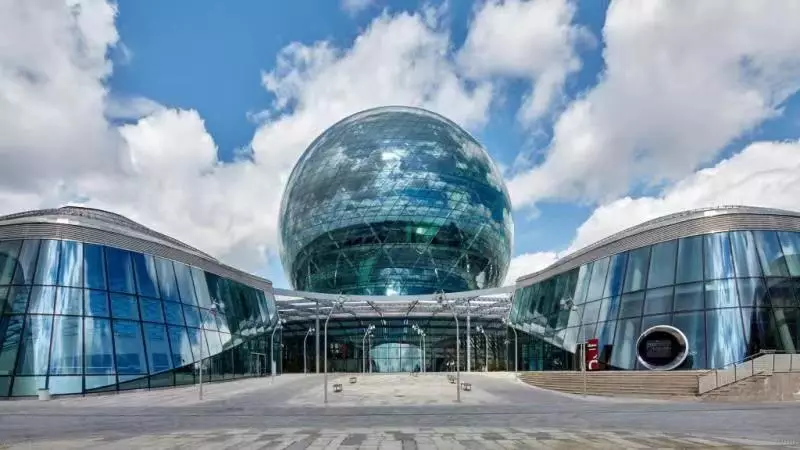
The Astana International Center. Internet photo.
To reach the vision, the Consulate General of Kazakhstan in Hong Kong supports the investors of these projects by assisting with government coordination and regulatory matters, and acts as a link between Hong Kong and Kazakhstan. By working closely with Kazakh Invest, InvestHK, Qazaqstan Investment Corporation, and other agencies, the Consulate General can ensure that projects can develop smoothly and successfully.
When talking about the Belt and Road Summit held earlier, Dosmanbetov states that the Belt and Road Initiative is a powerful engine for Kazakhstan’s future development, since it can not only strengthen transport and investment links across Eurasia, but also deepen its eternal friendship with China.
For Dosmanbetov, the Belt and Road Initiative can provide infrastructure financing, technology partnerships, and cross-border connectivity, which builds the framework of creating a digital Kazakhstan. In September, the Development Bank of Kazakhstan issued a 2 billion yuan (HK$2.18 billion) dim sum bond in Hong Kong, making it the first issuer from Central Asia to launch a bond in Hong Kong.
Kazakhstan is one of the five countries in Central Asia, the rest of four are Kyrgyzstan, Tajikistan, Turmenistan and Uzbekistan, and the total population of five is 80 million. According to online information, Kazakhstan has the biggest population among them, the 2025 population is 20.84 million, with the annual growth rate of 1.55%, there are over 55% of them live in urban, the median age is 29.7, the population structure is younger than most of the countries.
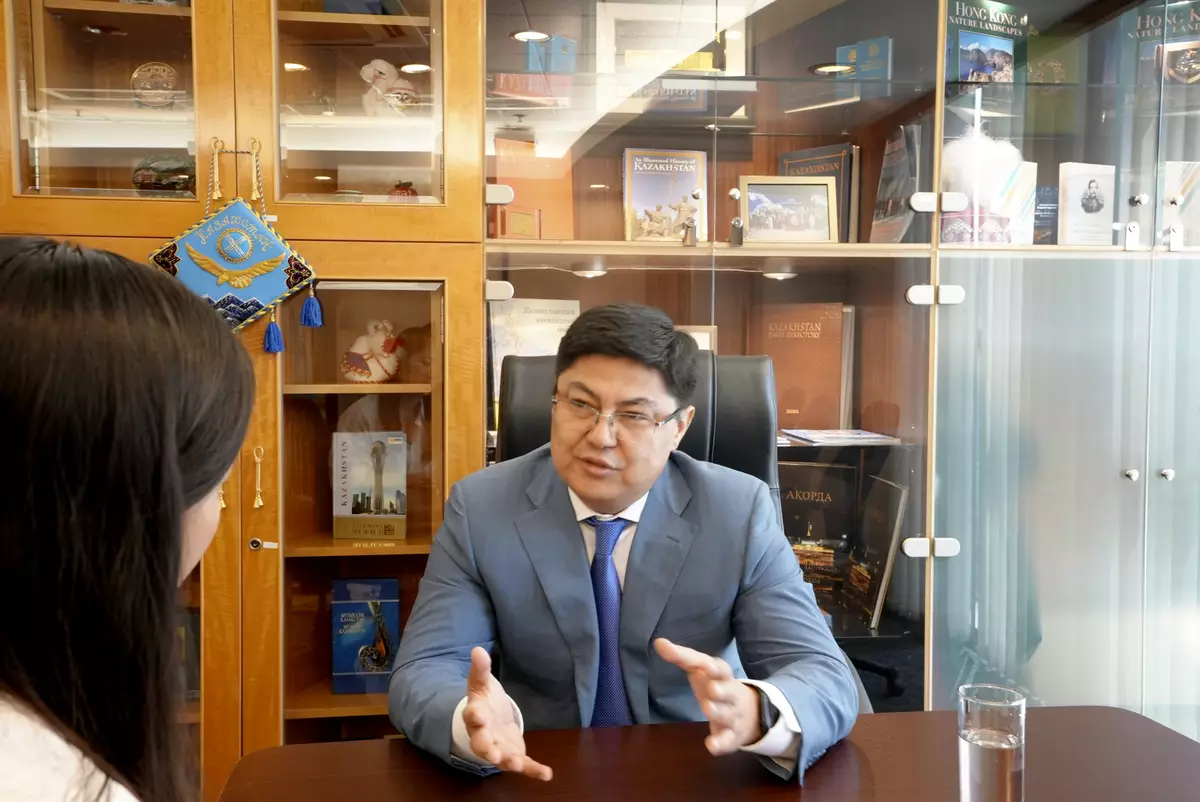
For Dosmanbetov, the Belt and Road Initiative can bring infrastructure financing, technology partnerships, and cross-border connectivity which build the framework of creating a digital Kazakhstan. Photo by Bastillepost.
Kazakhstan is also the important hub of the Silk Road Economic Belt, China and Kazakhstan have reached multiple cooperations in railways and Caspian sea shipping, building China-Europe railways and cross Caspian sea corridor together, which becomes the Eurasia transport hub.
Action plan on the Belt and Road Initiative made by China and Kazakhstan covers green mining, agriculture modernization, engineer technology and so on, strengthening the cooperation in defense industry is also included.
Dosmanbetov points out that the demonstration effect of the issuance includes that other banks, corporates and infrastructure companies in Kazakhstan and across Central Asia now have a proven model for raising RMB capital in Hong Kong to finance projects like energy transition and digital infrastructure.
For investors from Hong Kong and Greater Bay Area, Dosmanbetov recommends the most promising areas in Kazakhstan including AI applications, fin-tech, renewable and green energy, smart logistics, advanced manufacturing and deep agricultural processing.
Dosmanbetov introduces that AIFC provides an English-law jurisdiction, long-term tax exemptions on corporate income, capital gains and dividends , simplified visa and work-permit procedures to better facilitate the investors. Special economic zones and industrial parks are also provided.
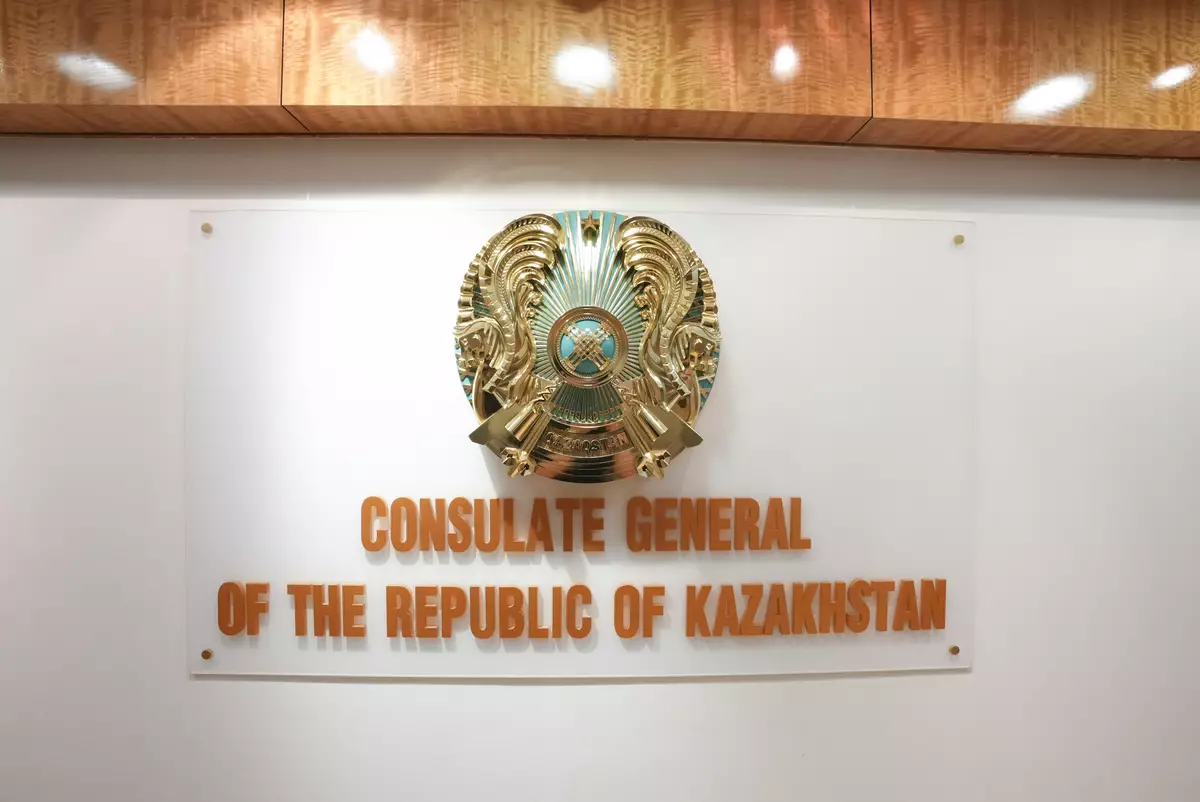
Consulate General of the Republic of Kazakhstan in Hong Kong and Macau SAR' s, PRC. Photo by Bastillepost.
“Kazakhstan is a young and forward-looking state,” says Dosmanbetov, “we give Hong Kong companies not only market access, but also clear pathways to participate in building Kazakhstan’s digital economy and AI-driven industries.”