Skip to Content Facebook Feature Image

Trump: US, allied strikes aimed at Syria's chemical weapons

News

Trump: US, allied strikes aimed at Syria's chemical weapons
News

News

Trump: US, allied strikes aimed at Syria's chemical weapons

2018-04-14 14:59 Last Updated At:15:00

The United States, France and Britain launched military strikes in Syria to punish President Bashar Assad for an apparent chemical attack against civilians and to deter him from doing it again, President Donald Trump announced Friday. Pentagon officials said the attacks targeted the heart of Assad's programs to develop and produce chemical weapons.

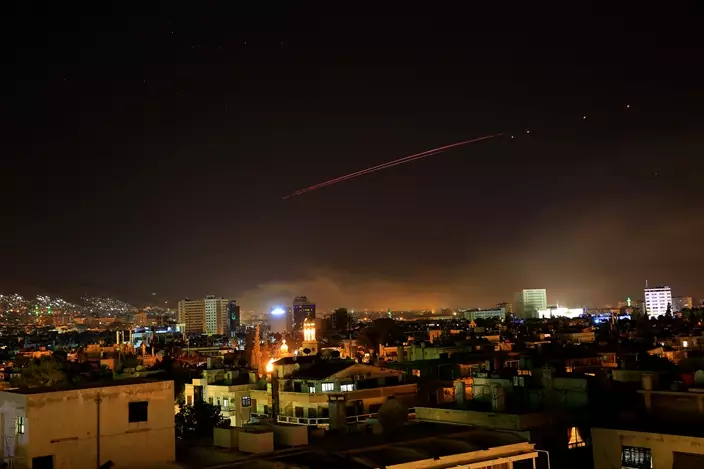
Explosions lit up the skies over Damascus, the Syrian capital, as Trump spoke from the White House.

More Images
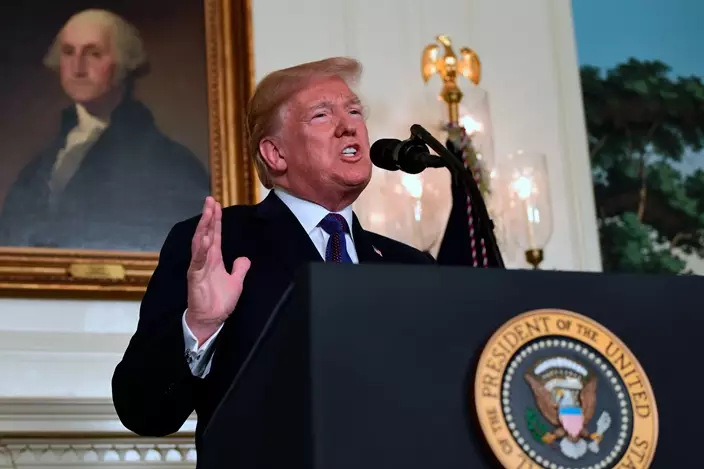
President Donald Trump speaks in the Diplomatic Reception Room of the White House on Friday, April 13, 2018, in Washington, about the United States' military response to Syria's chemical weapon attack on April 7. (AP Photo/Susan Walsh)
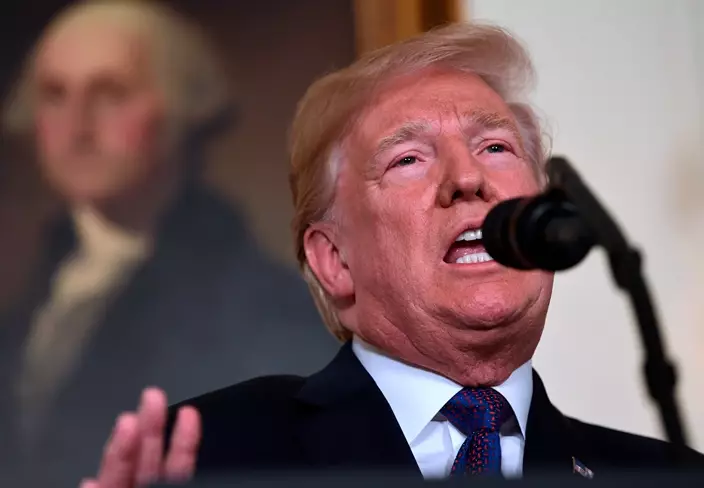
President Donald Trump speaks in the Diplomatic Reception Room of the White House on Friday, April 13, 2018, in Washington, about the United States' military response to Syria's chemical weapon attack on April 7. (AP Photo/Susan Walsh)
President Donald Trump speaks in the Diplomatic Reception Room of the White House on Friday, April 13, 2018, in Washington, about the United States' military response to Syria's chemical weapon attack on April 7. (AP Photo/Susan Walsh)

President Donald Trump speaks in the Diplomatic Reception Room of the White House on Friday, April 13, 2018, in Washington, about the United States' military response to Syria's chemical weapon attack on April 7. (AP Photo/Susan Walsh)

Explosions lit up the skies with anti-aircraft fire, over Damascus, the Syrian capital, as the U.S. launches an attack on Syria targeting different parts of the Syrian capital Damascus, Syria, early Saturday, April 14, 2018. Syria's capital has been rocked by loud explosions that lit up the sky with heavy smoke as U.S. President Donald Trump announced airstrikes in retaliation for the country's alleged use of chemical weapons. (AP Photo/Hassan Ammar)
Explosions lit up the skies with anti-aircraft fire, over Damascus, the Syrian capital, as the U.S. launches an attack on Syria targeting different parts of the Syrian capital Damascus, Syria, early Saturday, April 14, 2018. Syria's capital has been rocked by loud explosions that lit up the sky with heavy smoke as U.S. President Donald Trump announced airstrikes in retaliation for the country's alleged use of chemical weapons. (AP Photo/Hassan Ammar)

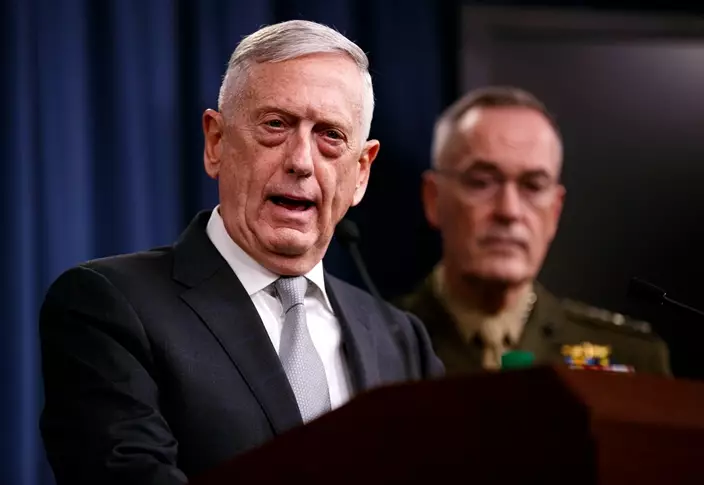
Defense Secretary Jim Mattis, joined by Joint Chiefs Chairman Gen. Joseph Dunford, speaks at the Pentagon, Friday, April 13, 2018, on the U.S. military response, along with France and Britain, to Syria's chemical weapon attack on April 7.​ (AP Photo/Carolyn Kaster)

Defense Secretary Jim Mattis, joined by Joint Chiefs Chairman Gen. Joseph Dunford, speaks at the Pentagon, Friday, April 13, 2018, on the U.S. military response, along with France and Britain, to Syria's chemical weapon attack on April 7.​ (AP Photo/Carolyn Kaster)

President Donald Trump speaks in the Diplomatic Reception Room of the White House on Friday, April 13, 2018, in Washington, about the United States' military response to Syria's chemical weapon attack on April 7. (AP Photo/Susan Walsh)

President Donald Trump speaks in the Diplomatic Reception Room of the White House on Friday, April 13, 2018, in Washington, about the United States' military response to Syria's chemical weapon attack on April 7. (AP Photo/Susan Walsh)

Syrian television reported that Syria's air defenses, which are substantial, responded to the attack. Defense Secretary Jim Mattis said there were no reports of U.S. losses in what he described as a heavy but carefully limited assault.

Trump said the U.S. is prepared to sustain economic, diplomatic and military pressure on Assad until he ends what the president called a criminal pattern of killing his own people with internationally banned chemical weapons.

"The evil and the despicable attack left mothers and fathers, infants and children, thrashing in pain and gasping for air. These are not the actions of a man; they are crimes of a monster instead," Trump said.

Mattis, however, said the assault was a "one-time shot," so long as Assad does not repeat his use of chemical weapons.

The strikes were carried out by manned aircraft and from ships that launched cruise missiles from the Mediterranean Sea.

President Donald Trump speaks in the Diplomatic Reception Room of the White House on Friday, April 13, 2018, in Washington, about the United States' military response to Syria's chemical weapon attack on April 7. (AP Photo/Susan Walsh)

President Donald Trump speaks in the Diplomatic Reception Room of the White House on Friday, April 13, 2018, in Washington, about the United States' military response to Syria's chemical weapon attack on April 7. (AP Photo/Susan Walsh)

Mattis disclosed that the U.S. had not yet confirmed that the most recent suspected Syrian chemical weapons attack, on April 7 in the Damascus suburb of Douma, included the use of sarin gas. He said at least one chemical was used — chlorine, which also has legitimate industrial uses and had not previously triggered a U.S. military response.

Mattis said the targets selected by U.S., British and French officials were meant to minimize civilian casualties.

"This is difficult to do in a situation like this," he said, in light of the volatility of chemical agents.

At a Pentagon news conference alongside Mattis, and with British and French military officers beside them to emphasize allied unity, Gen. Joseph Dunford said the attacks targeted mainly three targets in western Syria.

Dunford, chairman of the Joint Chiefs of Staff, said missiles first struck a scientific research center in the Damascus area that he said was a center of Syrian research, development, production and testing of chemical and biological warfare technology. The second target was a chemical weapons storage facility west of Homs. He said this was believed to be the main site of Syrian sarin and precursor chemical production equipment.

The third target was a chemical weapons equipment storage facility and an important command post, also west of Homs, Dunford said.

Explosions lit up the skies with anti-aircraft fire, over Damascus, the Syrian capital, as the U.S. launches an attack on Syria targeting different parts of the Syrian capital Damascus, Syria, early Saturday, April 14, 2018. Syria's capital has been rocked by loud explosions that lit up the sky with heavy smoke as U.S. President Donald Trump announced airstrikes in retaliation for the country's alleged use of chemical weapons. (AP Photo/Hassan Ammar)

Explosions lit up the skies with anti-aircraft fire, over Damascus, the Syrian capital, as the U.S. launches an attack on Syria targeting different parts of the Syrian capital Damascus, Syria, early Saturday, April 14, 2018. Syria's capital has been rocked by loud explosions that lit up the sky with heavy smoke as U.S. President Donald Trump announced airstrikes in retaliation for the country's alleged use of chemical weapons. (AP Photo/Hassan Ammar)

British Prime Minister Theresa May said in London that the West had tried "every possible" diplomatic means to stop Assad from using chemical weapons. "But our efforts have been repeatedly thwarted" by Syria and Russia, she said.

"So there is no practicable alternative to the use of force to degrade and deter the use of chemical weapons by the Syrian regime," May said. "This is not about intervening in a civil war. It is not about regime change."

French President Emmanuel Macron said in a statement that a target of the strike was the Syrian government's "clandestine chemical arsenal."

The Syrian government has repeatedly denied any use of banned weapons.

The decision to strike, after days of deliberations, marked Trump's second order to attack Syria. He authorized a barrage of Tomahawk cruise missiles to hit a single Syrian airfield in April 2017 in retaliation for Assad's use of sarin gas against civilians.

Mattis estimated the latest air campaign was about twice the size of the 2017 strike. He added that the U.S. expects the Syrian government and its allies to conduct a "significant disinformation campaign," which the Pentagon would rebut with additional information Saturday morning.

The air campaign could frustrate those in Trump's base who oppose military intervention and are wary of open-ended conflicts.

Defense Secretary Jim Mattis, joined by Joint Chiefs Chairman Gen. Joseph Dunford, speaks at the Pentagon, Friday, April 13, 2018, on the U.S. military response, along with France and Britain, to Syria's chemical weapon attack on April 7.​ (AP Photo/Carolyn Kaster)

Defense Secretary Jim Mattis, joined by Joint Chiefs Chairman Gen. Joseph Dunford, speaks at the Pentagon, Friday, April 13, 2018, on the U.S. military response, along with France and Britain, to Syria's chemical weapon attack on April 7.​ (AP Photo/Carolyn Kaster)

Trump chastised Syria's two main allies, Russia and Iran, for their roles in supporting "murderous dictators," and noted that Russian President Vladimir Putin had guaranteed a 2013 international agreement for Assad to get rid of all of his chemical weapons. He called on Moscow to change course and join the West in seeking a more responsible regime in Damascus.

"Russia must decide if it will continue down this dark path, or if it will join with civilized nations as a force for stability and peace," Trump said. "Hopefully, someday we'll get along with Russia, and maybe even Iran — but maybe not."

The Russian ambassador to the U.S., Anatoly Antonov, condemned the airstrikes and warned that "such actions will not be left without consequences."

The U.S. missile strike a year ago, which targeted the airfield from which Syrian aircraft had launched their gas attack, was meant to deter Assad from further use of chemical weapons. Since that did not work, a more intense attack would aim to degrade his ability to carry out further such attacks, and would try to do this by hitting Syrian aircraft, military depots and chemical facilities, among other things.

The strikes that hit early Saturday in Syria came hours before inspectors from the Organization for the Prohibition of Chemical Weapons were set to arrive to inspect the site of the apparent attack.

A broader question is whether the allied attacks are part of a revamped, coherent political strategy to end the war on terms that do not leave Assad in power.

The strikes appear to signal Trump's willingness to draw the United States more deeply into the Syrian conflict. Just weeks ago, Trump said he wanted to end U.S. involvement in Syria and bring American troops home to focus on the homeland. The participation of British and French forces enables Trump to assert a wider international commitment against the use of chemical weapons, but the multi-pronged attack carries the risk of Russian retaliation.

Dunford said the U.S. did not coordinate targets with or notify the Russian government of the strikes, beyond normal airspace "de-confliction" communications. But the description from an ally described things differently.

French Defense Minister Florence Parly said that "with our allies, we ensured that the Russians were warned ahead of time."

In his nationwide address, Trump stressed that he has no interest in a longtime fight with Syria.

"As other nations step up their contributions, we look forward to the day when we can bring our warriors home," Trump said. "And great warriors they are."

The U.S. has about 2,000 troops on the ground in Syria as advisers to a makeshift group of anti-Islamic State fighters known as the Syrian Democratic Forces. They are in eastern Syria, far from Damascus. A U.S.-led coalition has been conducting airstrikes in Syria since September 2014 as part of a largely successful effort to break the IS grip on both Syria and Iraq.

Jarrod Agen, Vice President Mike Pence's deputy chief of staff, said Pence called congressional leaders from his hotel suite in Lima, Peru, to notify them of the president's plan to address the nation about the Syrian air strikes.
WASHINGTON (AP) — Venezuelan opposition leader María Corina Machado said she presented her Nobel Peace Prize medal to President Donald Trump at the White House on Thursday even as he has questioned her credibility to take over her country after the U.S. ousted then-President Nicolás Maduro.

The Nobel Institute has said Machado could not give her prize to Trump, an honor that he has coveted. Even if it the gesture proves to be purely symbolic, it was extraordinary given that Trump has effectively sidelined Machado, who has long been the face of resistance in Venezuela. He has signaled his willingness to work with acting President Delcy Rodríguez, who had been Maduro’s second in command.

“I presented the president of the United States the medal, the Nobel Peace Prize," Machado told reporters after leaving the White House and heading to Capitol Hill. She said she had done so "as a recognition for his unique commitment with our freedom.”

Trump has raised doubts about his stated commitment to backing democratic rule in Venezuela, giving no timetable on when elections might be held. Machado indicated that he had provided few specifics on that front during their discussion.

She did not provide more information on what was said, and the White House did not say if Trump accepted the medal or offer other details of its own.

After a closed-door meeting with Trump, Machado greeted dozens of cheering supporters waiting for her near the White House gates, stopping to hug many.

“We can count on President Trump,” she told them without elaborating, prompting some to briefly chant, “Thank you, Trump.”

Before her visit to Washington, Machado had not been seen in public since she traveled last month to Norway, where her daughter received the peace prize on her behalf. She had spent 11 months in hiding in Venezuela before she appeared in Norway after the ceremony.

The jubilant scene after her meeting with Trump stood in contrast to political realities in Venezuela. Rodríguez remains in charge of day-to-day government operations, along with others in Maduro’s inner circle. In her first state of the union speech Thursday, the interim president promoted the resumption of diplomatic ties between the historic adversaries and advocated for opening the state-run oil industry to more foreign investment after Trump pledged to seize control of Venezuelan crude sales.

Trump has said it would be difficult for Machado to lead because she “doesn’t have the support within or the respect within the country.” Her party is widely believed to have won 2024 elections rejected by Maduro.

White House press secretary Karoline Leavitt called Machado “a remarkable and brave voice” but also said the meeting didn’t mean Trump’s opinion of her changed, calling it “a realistic assessment.”

Leavitt told reporters that Trump supported new Venezuelan elections “when the time is right” but did not say when he thought that might be.

Leavitt said Machado had sought the face-to-face meeting without setting expectations for what would occur. She spent about two and a half hours at the White House.

“I don’t think he needs to hear anything from Ms. Machado," the press secretary said while the meeting was still going on, other than to have a ”frank and positive discussion about what’s taking place in Venezuela.”

After leaving the White House, Machado went on to a closed-door meeting with a bipartisan group of senators.

Sen. Chris Murphy, D-Conn., said Machado told them that “if there’s not some progress, real progress towards a transition in power, and/or elections in the next several months, we should all be worried.”

“She reminded us that Delcy Rodríguez is, in many ways, worse than Maduro,” he added.

Asked if Machado had heard any commitment from the White House on holding elections in Venezuela, Murphy said, “No, I don’t think she got any commitment from them."

Sen. Bernie Moreno, an Ohio Republican, was exultant following the meeting, saying Machado "delivered a message that loud and clear: What President Trump did was the most important, significant event in Latin America. That getting rid of Maduro was absolutely essential.”

Machado's Washington stop coincided with U.S. forces in the Caribbean Sea seizing another sanctioned oil tanker that the Trump administration says had ties to Venezuela. It is part of a broader U.S. effort to take control of the South American country’s oil after U.S. forces captured Maduro and his wife less than two weeks ago at a heavily guarded compound in the Venezuelan capital of Caracas and brought them to New York to stand trial on drug trafficking charges.

Leavitt said Venezuela's interim authorities have been fully cooperating with the Trump administration and noted that Rodríguez's government said it planned to release more prisoners detained under Maduro. Among those released were five Americans this week.

Trump said Wednesday that he had a “great conversation” with Rodríguez, their first since Maduro was ousted.

Just hours after Maduro's capture, Trump said of Machado that “it would be very tough for her to be the leader.” Machado had steered a careful course to avoid offending Trump, notably after winning the peace prize, and had sought to cultivate relationships with him and key administration voices like Secretary of State Marco Rubio.

The industrial engineer and daughter of a steel magnate, Machado began challenging the ruling party in 2004, when the nongovernmental organization she co-founded, Súmate, promoted a referendum to recall then-President Hugo Chávez. The initiative failed, and Machado and other Súmate executives were charged with conspiracy.

A year later, she drew the anger of Chávez and his allies again for traveling to Washington to meet President George W. Bush, whom Chávez considered an adversary.

Almost two decades later, she marshaled millions of Venezuelans to reject Chávez’s successor, Maduro, for another term in the 2024 election. But ruling party-loyal electoral authorities declared him the winner despite ample credible evidence to the contrary. Ensuing anti-government protests ended in a brutal crackdown.

Garcia Cano reported from Caracas, Venezuela. Associated Press writers Lisa Mascaro, Stephen Groves, Michelle L. Price and Matthew Lee in Washington, and Megan Janetsky in Mexico City contributed to this report.

Venezuelan opposition leader Maria Corina Machado is welcomed at the Capitol before a meeting with senators, from left, Sen. John Curtis, R-Utah, Sen. Ruben Gallego, D-Ariz., Sen. Dick Durbin, D-Ill., Sen. Alex Padilla, D-Calif., and Sen. Chris Murphy, D-Conn., as the Nobel Peace Prize recipient visits American leaders two weeks after President Donald Trump toppled Venezuelan president Nicolas Maduro in a stunning military raid, at the Capitol in Washington, Thursday, Jan. 15, 2026. (AP Photo/J. Scott Applewhite)

Venezuelan opposition leader Maria Corina Machado is welcomed at the Capitol before a meeting with senators, from left, Sen. John Curtis, R-Utah, Sen. Ruben Gallego, D-Ariz., Sen. Dick Durbin, D-Ill., Sen. Alex Padilla, D-Calif., and Sen. Chris Murphy, D-Conn., as the Nobel Peace Prize recipient visits American leaders two weeks after President Donald Trump toppled Venezuelan president Nicolas Maduro in a stunning military raid, at the Capitol in Washington, Thursday, Jan. 15, 2026. (AP Photo/J. Scott Applewhite)

Venezuelan opposition leader María Corina Machado, center, leaves the Capitol, Thursday, Jan. 15, 2026, in Washington. (AP Photo/Allison Robbert)

Venezuelan opposition leader María Corina Machado, center, leaves the Capitol, Thursday, Jan. 15, 2026, in Washington. (AP Photo/Allison Robbert)

Venezuelan opposition leader Maria Corina Machado, center, is welcomed by Sen. Dick Durbin, D-Ill., left, Sen. Ruben Gallego, D-Ariz., far left, and Sen. Alex Padilla, D-Calif., right, as the Nobel Peace Prize recipient visits American leaders at the Capitol in Washington, Thursday, Jan. 15, 2026. (AP Photo/J. Scott Applewhite)

Venezuelan opposition leader Maria Corina Machado, center, is welcomed by Sen. Dick Durbin, D-Ill., left, Sen. Ruben Gallego, D-Ariz., far left, and Sen. Alex Padilla, D-Calif., right, as the Nobel Peace Prize recipient visits American leaders at the Capitol in Washington, Thursday, Jan. 15, 2026. (AP Photo/J. Scott Applewhite)

Venezuelan opposition leader María Corina Machado gestures to supporters on Pennsylvania Avenue as she leaves the White House after meeting with President Donald Trump Thursday, Jan. 15, 2026, in Washington. (AP Photo/Pablo Martinez Monsivais)

Venezuelan opposition leader María Corina Machado gestures to supporters on Pennsylvania Avenue as she leaves the White House after meeting with President Donald Trump Thursday, Jan. 15, 2026, in Washington. (AP Photo/Pablo Martinez Monsivais)

Venezuelan opposition leader María Corina Machado waves to supporters on Pennsylvania Avenue as she leaves the White House after meeting with President Donald Trump Thursday, Jan. 15, 2026, in Washington. (AP Photo/Pablo Martinez Monsivais)

Venezuelan opposition leader María Corina Machado waves to supporters on Pennsylvania Avenue as she leaves the White House after meeting with President Donald Trump Thursday, Jan. 15, 2026, in Washington. (AP Photo/Pablo Martinez Monsivais)

Venezuelan opposition leader María Corina Machado smiles on Pennsylvania Avenue as she leaves the White House after meeting with President Donald Trump Thursday, Jan. 15, 2026, in Washington. (AP Photo/Pablo Martinez Monsivais)

Venezuelan opposition leader María Corina Machado smiles on Pennsylvania Avenue as she leaves the White House after meeting with President Donald Trump Thursday, Jan. 15, 2026, in Washington. (AP Photo/Pablo Martinez Monsivais)

Venezuelan opposition leader María Corina Machado waves to supporters on Pennsylvania Avenue as she leaves the White House after meeting with President Donald Trump Thursday, Jan. 15, 2026, in Washington. (AP Photo/Pablo Martinez Monsivais)

Venezuelan opposition leader María Corina Machado waves to supporters on Pennsylvania Avenue as she leaves the White House after meeting with President Donald Trump Thursday, Jan. 15, 2026, in Washington. (AP Photo/Pablo Martinez Monsivais)

FILE - U.S. President George Bush, right, meets with Maria Corina Machado, executive director of Sumate, a non-governmental organization that defends Venezuelan citizens' political rights, in the Oval Office of the White House, Washington, May 31, 2005. (AP Photo/Charles Dharapak, File)

FILE - U.S. President George Bush, right, meets with Maria Corina Machado, executive director of Sumate, a non-governmental organization that defends Venezuelan citizens' political rights, in the Oval Office of the White House, Washington, May 31, 2005. (AP Photo/Charles Dharapak, File)

FILE - Opposition leader Maria Corina Machado gestures to supporters during a protest against President Nicolas Maduro the day before his inauguration for a third term, in Caracas, Venezuela, Thursday, Jan. 9, 2025. (AP Photo/Ariana Cubillos, file)

FILE - Opposition leader Maria Corina Machado gestures to supporters during a protest against President Nicolas Maduro the day before his inauguration for a third term, in Caracas, Venezuela, Thursday, Jan. 9, 2025. (AP Photo/Ariana Cubillos, file)

Recommended Articles