Skip to Content Facebook Feature Image

Britain spy case: Watchdog rejects Russia nerve agent claim

News

Britain spy case: Watchdog rejects Russia nerve agent claim
News

News

Britain spy case: Watchdog rejects Russia nerve agent claim

2018-04-19 13:46 Last Updated At:17:32

The head of the global chemical watchdog agency on Wednesday rejected Russian claims that traces of a second nerve agent were discovered in the English city where former Russian spy Sergei Skripal and his daughter were poisoned.
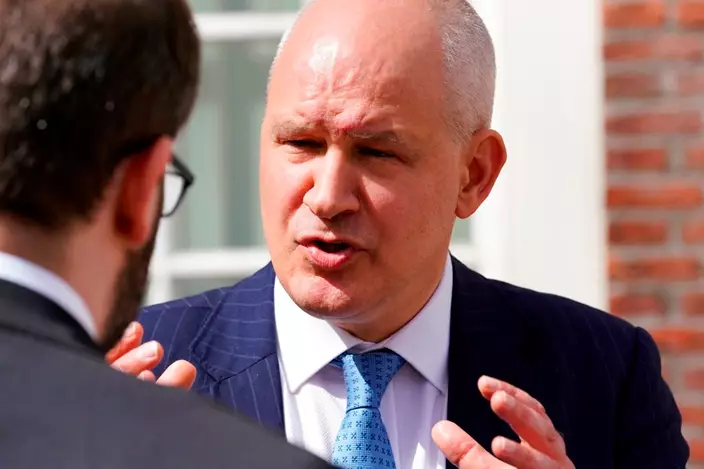
FILE - In this Monday, April 16, 2018 file photo, Britain's ambassador to the Netherlands and permanent representative to the chemical weapons watchdog OPCW, Peter Wilson talks to an embassy employee after a press conference in The Hague, Netherlands. Member states of the global chemical weapons watchdog are meeting Wednesday April 18, 2018. (Michael Kooren/Pool photo via AP)

FILE - In this Monday, April 16, 2018 file photo, Britain's ambassador to the Netherlands and permanent representative to the chemical weapons watchdog OPCW, Peter Wilson talks to an embassy employee after a press conference in The Hague, Netherlands. Member states of the global chemical weapons watchdog are meeting Wednesday April 18, 2018. (Michael Kooren/Pool photo via AP)

Britain blames Russia for the attack, which it says was carried out by smearing a Soviet-developed nerve agent known as Novichok on a door handle at Sergei Skripal's house in Salisbury. Moscow denies involvement.

Russian Foreign Minister Sergey Lavrov said Saturday that Moscow received confidential information from the laboratory in Spiez, Switzerland, that analyzed samples from the site of the March 4 poisoning in Salisbury.

He said the analysis — done at the request of the Organization for the Prohibition of Chemical Weapons — indicated that samples contained BZ nerve agent and its precursor. He said BZ was part of the chemical arsenals of the U.S., Britain and other NATO countries, while the Soviet Union and Russia never developed the agent.

OPCW Director-General Ahmet Uzumcu told a meeting Wednesday of the organization's Executive Council that a BZ precursor known as 3Q "was contained in the control sample prepared by the OPCW Lab in accordance with the existing quality control procedures."

He added "it has nothing to do with the samples collected by the OPCW team in Salisbury."
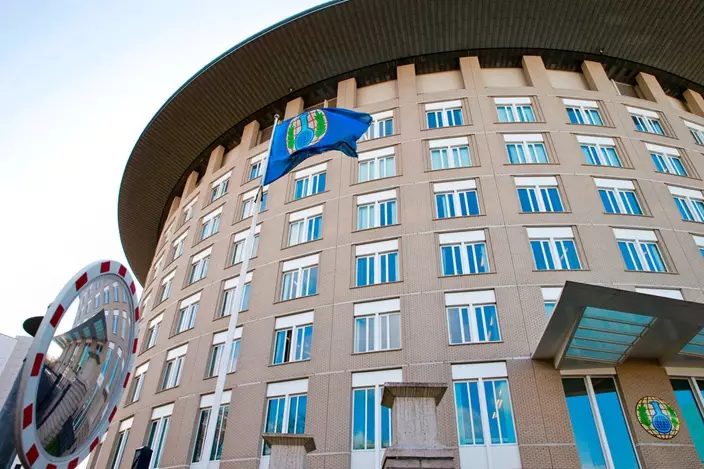
FILE - This Wednesday, March 21, 2018 file photo shows the headquarters of the Organization for the Prohibition of Chemical Weapons (OPCW) in The Hague, Netherlands. Member states of the global chemical weapons watchdog are meeting on Wednesday April 18, 2018 to discuss the nerve agent attack in Britain on former Russian spy Sergei Skripal and his daughter. (AP Photo/Peter Dejong, File)

FILE - This Wednesday, March 21, 2018 file photo shows the headquarters of the Organization for the Prohibition of Chemical Weapons (OPCW) in The Hague, Netherlands. Member states of the global chemical weapons watchdog are meeting on Wednesday April 18, 2018 to discuss the nerve agent attack in Britain on former Russian spy Sergei Skripal and his daughter. (AP Photo/Peter Dejong, File)

Britain's representative to the OPCW, Ambassador Peter Wilson, slammed the Russian foreign minister's comments as a breach of the treaty outlawing chemical weapons.

"The thing for me that was particularly alarming about Lavrov's statement is, first of all, the OPCW goes to enormous lengths to make sure that the identity of laboratories is confidential and, second of all, either the Russians are hacking the laboratories or they are making stuff up," he said. "Either way, that is a violation of the confidentiality of the Chemical Weapons Convention."

In a summary of its report last week, the OPCW didn't name Novichok as the nerve agent used but it confirmed "the findings of the United Kingdom relating to the identity of the toxic chemical that was used in Salisbury."

Wilson told reporters that the OPCW "confirmed that they found what we found, and that is a Novichok."

Russia's representative to the OPCW, Ambassador Alexander Shulgin, repeated Moscow's denials and accused Britain of a string of lies.

"For now, I will only say one thing: the claim that the Technical Secretariat confirmed that this chemical points to its Russian origin is an outright lie," he said in a statement posted on his embassy's website. "The report itself does not say a single word about the name 'Novichok;' the CWC simply does not contain such a concept."

Shulgin at a later news conference accused Britain of trying to turn the executive council meeting into "a kangaroo court" and suggested that Britain could have arranged the attack on the Skripals to counter domestic tensions over Britain's withdrawal from the European Union.

"Perhaps the government of Theresa May, weakened by the troubles associated with Brexit, needs society to rally around this government," he said.

Shulgin also said Russia wouldn't accept the results of any report on the matter unless it gets full access to investigation details, consular access to the Skripals, and participation in the probe by Russian experts.

The envoy also spent several minutes of digression on Britain's alleged "very impressive experience" of using poison abroad, including involvement in the 1916 poisoning of Rasputin, a self-styled mystic who held great influence with Czar Nicholas II's wife.

The Skripals were hospitalized for weeks in critical condition. Yulia Skripal was discharged last week from Salisbury District Hospital, where her father continues to be treated.

Wilson told the meeting that London continues to believe evidence points to Russian involvement in the attempted assassination.

'We believe that only Russia had the technical means, operational experience and motive to target the Skripals," Wilson said.

Wilson warned the Chemical Weapons Convention was being undermined by a growing use of nerve agents and other poisons, mentioning the 2017 assassination in Malaysia of North Korean leader Kim Jong Un's estranged half-brother, in addition to the Salisbury attack and the use of poison gas in Syria and Iraq.

"It is being continually violated," Wilson told reporters.

He said the convention would be strengthened if all nations fully declared any stockpiles they still have. Member states are supposed to declare all their chemical weapons stocks upon joining the OPCW and destroy them.

The OPCW and Russia last year celebrated the destruction of the country's final declared stocks.

"Russia clearly has chemical weapons they are not declaring and they need to do that," Wilson said.

The antagonism between Britain and Russia played out again in the U.N. Security Council on Wednesday afternoon after U.N. disarmament chief Izumi Nakamitsu briefed members on the OPCW findings.

Britain's U.N. ambassador, Karen Pierce, said Russian responsibility for the attack was the only "plausible explanation." She dismissed several Russian allegations that others were responsible, including one accusing Britain for drugging Yulia Skripal. She said the claim was "more than fanciful — this is outlandish."

Russian Ambassador Vassily Nebenzia said the council heard "the same lies" and "mendacious, baseless and slanderous" allegations that the U.K. has been putting forward since the attack. He said the OPCW report only confirmed that the substance could be produced in a well-equipped lab, stressing that such labs exist in the U.K., U.S. and a host of other countries.

Nebenzia said Russia agreed with Britain on one point: "There will be no impunity and the perpetrators will be held responsible."
WASHINGTON (AP) — Wednesday will likely be a momentous day for the future of the Federal Reserve as Chair Jerome Powell could signal he will stay with the Fed even as a Senate panel is expected to confirm his replacement.

Powell will preside over what will probably be his last meeting as chair and hold a news conference Wednesday afternoon, when he may say whether he will take the unusual step of remaining on the central bank's board of governors, even after his term as chair ends May 15.

Separately, the Senate Banking Committee is scheduled to vote on the nomination of Kevin Warsh to succeed Powell. The nomination is expected to be approved on a party-line vote, and will then be taken up by the full Senate next month. President Donald Trump nominated Warsh, a former top Fed official, in January. Last year, Warsh echoed Trump's calls for the Fed to lower its key interest rate, leading many Democrats in Congress to question how independently he will operate as Fed chair.

The Fed is widely expected to keep its key rate unchanged Wednesday for a third straight meeting at 3.6%. Most policymakers believe at that level, the rate can still cool inflation by slowing borrowing and spending, but not so much that it will drag down hiring or raise unemployment.

Still, a key issue for the news conference Wednesday is what Powell says, if anything, about his future. Powell serves a separate term as a governor that lasts until January 2028. Chairs typically leave the board when their leadership terms end, but Powell has signaled he could remain. He would be the first chair to do so since 1948.

If Powell, who has made protecting Fed independence a key part of his legacy, chooses to stay, he would deprive Trump of the opportunity to pick his replacement and fill another seat on the Fed’s seven-member board. Three of the seven current governors are Trump appointees.

At the same time, it could worsen tensions with the Trump administration and would create what some analysts refer to as a “two Popes” scenario, with a chair and former chair both on the Fed’s board. In that case, divisions among policymakers could increase, if some decided to follow Powell's lead rather than Warsh's.

Warsh argued for rate cuts last year, but is unlikely to be able to reduce borrowing costs anytime soon, given that most policymakers have signaled they would prefer to wait and evaluate the Iran war’s impact on the economy.

The leadership turmoil comes while the economy remains unusually murky, putting the Fed in a difficult spot. Inflation has jumped to 3.3%, a two-year high, as the war has sharply raised gas prices. That makes it harder for the central bank to reduce rates. The Fed typically leaves rates unchanged, or even raises them, if inflation is worsening.

At the same time, hiring has ground almost to a halt, leaving those without jobs frustrated by the difficulty of finding new ones. Typically, the Fed cuts rates when the job market is weak, to spur more spending and job gains.

But layoffs also remain low, as employers appear to be following a “ low-hire, low-fire ” strategy. Many Fed officials have suggested that as long as the unemployment rate is low, the central bank doesn't need to cut rates to spur more spending and hiring. Unemployment declined to 4.3% in March, from 4.4%.

A key change economists will look for Wednesday is whether the Fed alters the statement it issues after each meeting to signal that it is possible that their next move could be either a rate cut or a hike. Right now, the statement indicates that any change to its rate would be a cut. According to minutes of its last meeting in March, many of the 19 participants on the Fed’s rate-setting committee support considering a hike, though it's likely short of a majority.

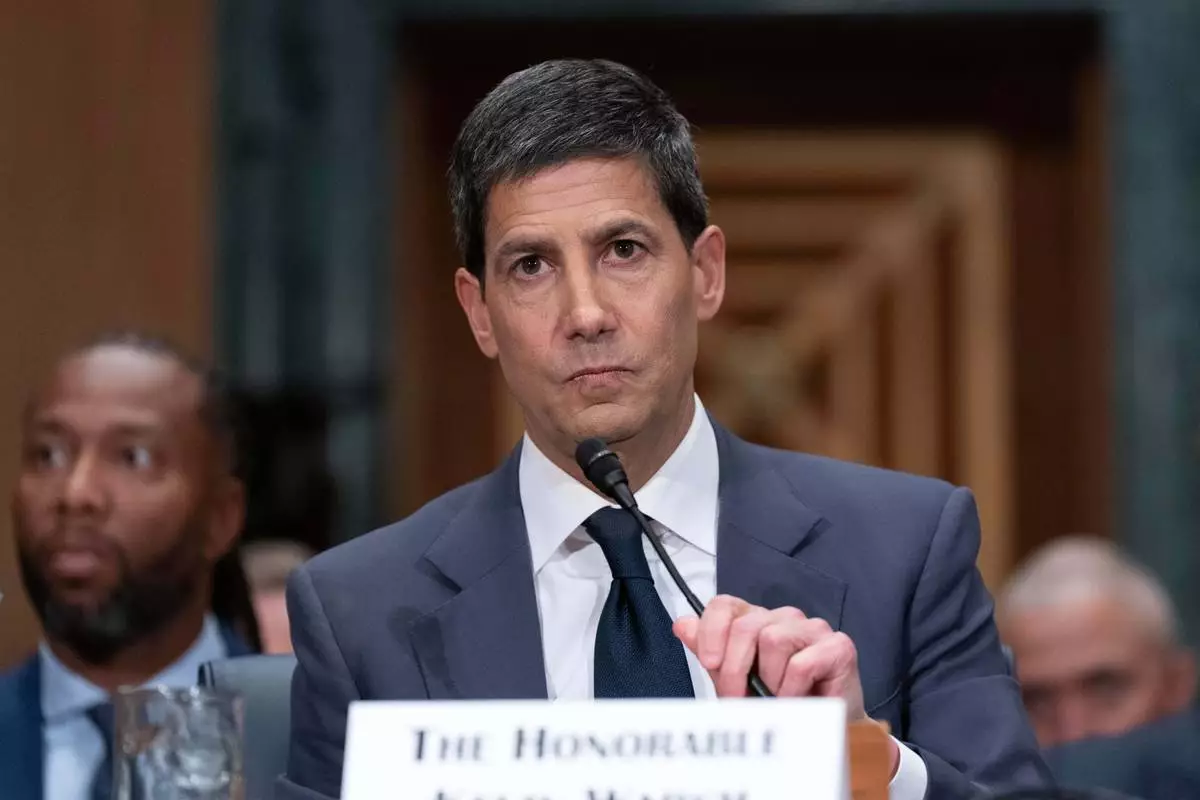
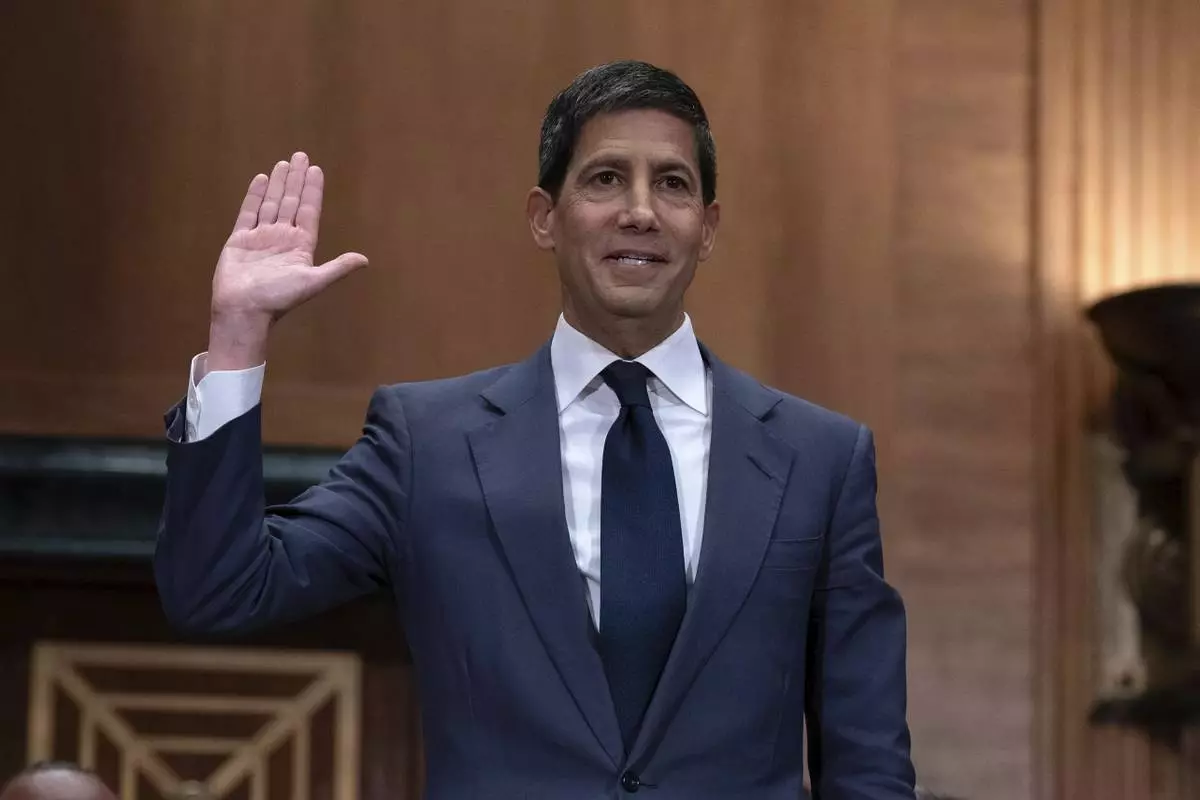
Kevin Warsh is sworn in during his nomination hearing to be a member and chairman of the Federal Reserve Board of Governors before the Senate Banking, Housing and Urban Affairs Committee on Capitol Hill, in Washington Tuesday, April 21, 2026. (AP Photo/Jose Luis Magana)

Kevin Warsh is sworn in during his nomination hearing to be a member and chairman of the Federal Reserve Board of Governors before the Senate Banking, Housing and Urban Affairs Committee on Capitol Hill, in Washington Tuesday, April 21, 2026. (AP Photo/Jose Luis Magana)

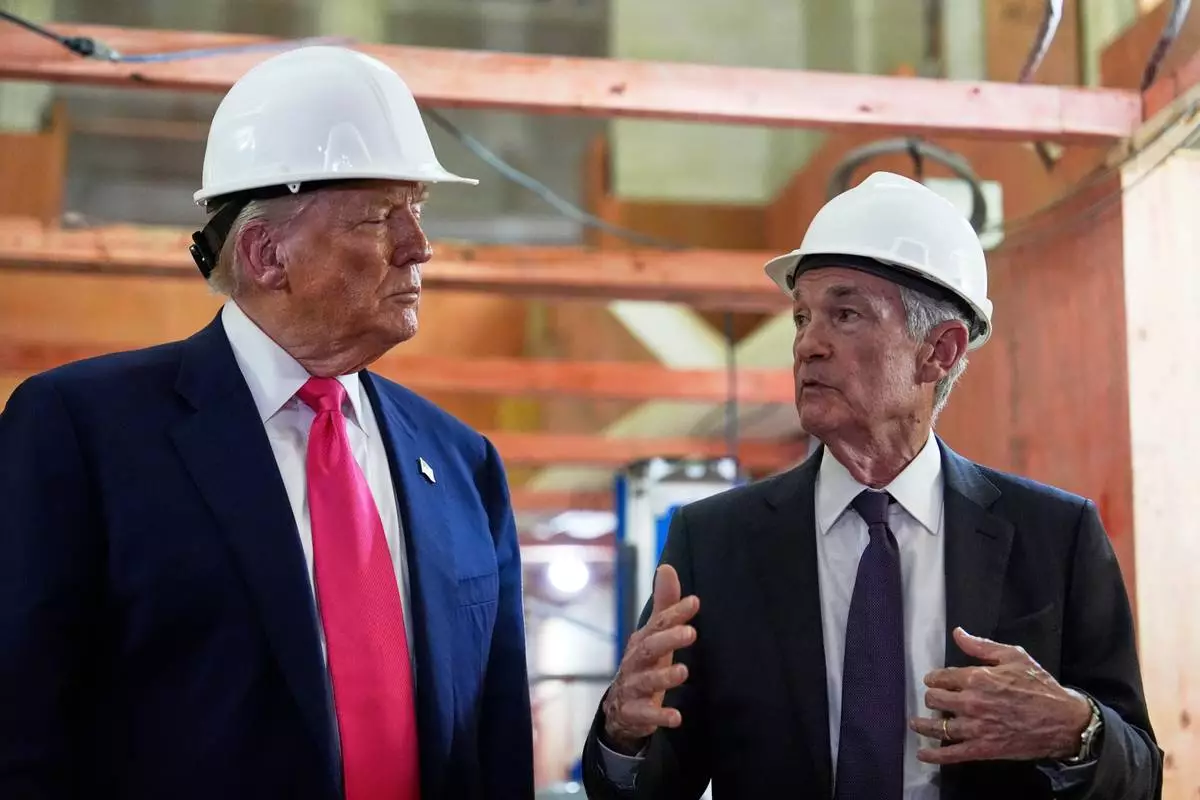
FILE - President Donald Trump listens to Federal Reserve Chairman Jerome Powell speak during a visit to the Federal Reserve, July 24, 2025, in Washington. (AP Photo/Julia Demaree Nikhinson, File)

FILE - President Donald Trump listens to Federal Reserve Chairman Jerome Powell speak during a visit to the Federal Reserve, July 24, 2025, in Washington. (AP Photo/Julia Demaree Nikhinson, File)

Kevin Warsh testifies during his nomination hearing to be a member and chairman of the Federal Reserve Board of Governors before the Senate Banking, Housing and Urban Affairs Committee on Capitol Hill, in Washington Tuesday, April 21, 2026. (AP Photo/Jose Luis Magana)

Kevin Warsh testifies during his nomination hearing to be a member and chairman of the Federal Reserve Board of Governors before the Senate Banking, Housing and Urban Affairs Committee on Capitol Hill, in Washington Tuesday, April 21, 2026. (AP Photo/Jose Luis Magana)

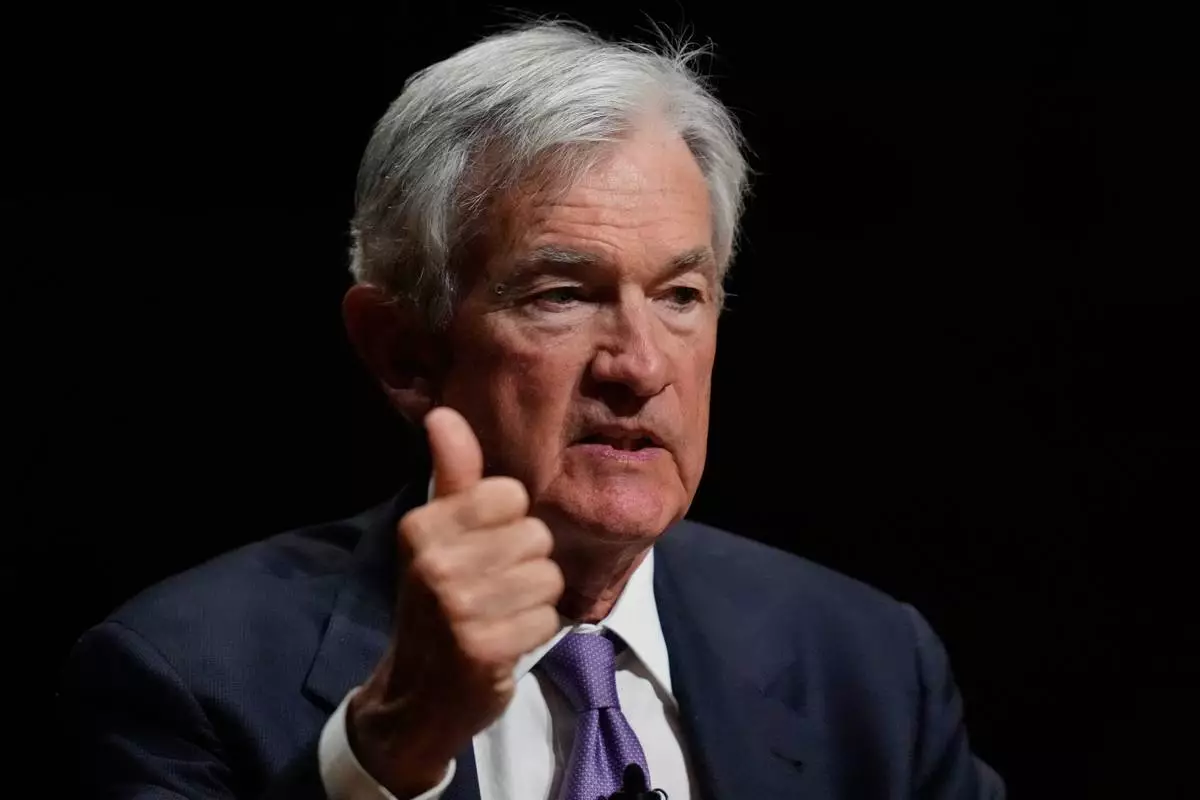
FILE - Federal Reserve Chair Jerome Powell addresses students at Harvard University, March 30, 2026, in Cambridge, Mass. (AP Photo/Charles Krupa, File)

FILE - Federal Reserve Chair Jerome Powell addresses students at Harvard University, March 30, 2026, in Cambridge, Mass. (AP Photo/Charles Krupa, File)

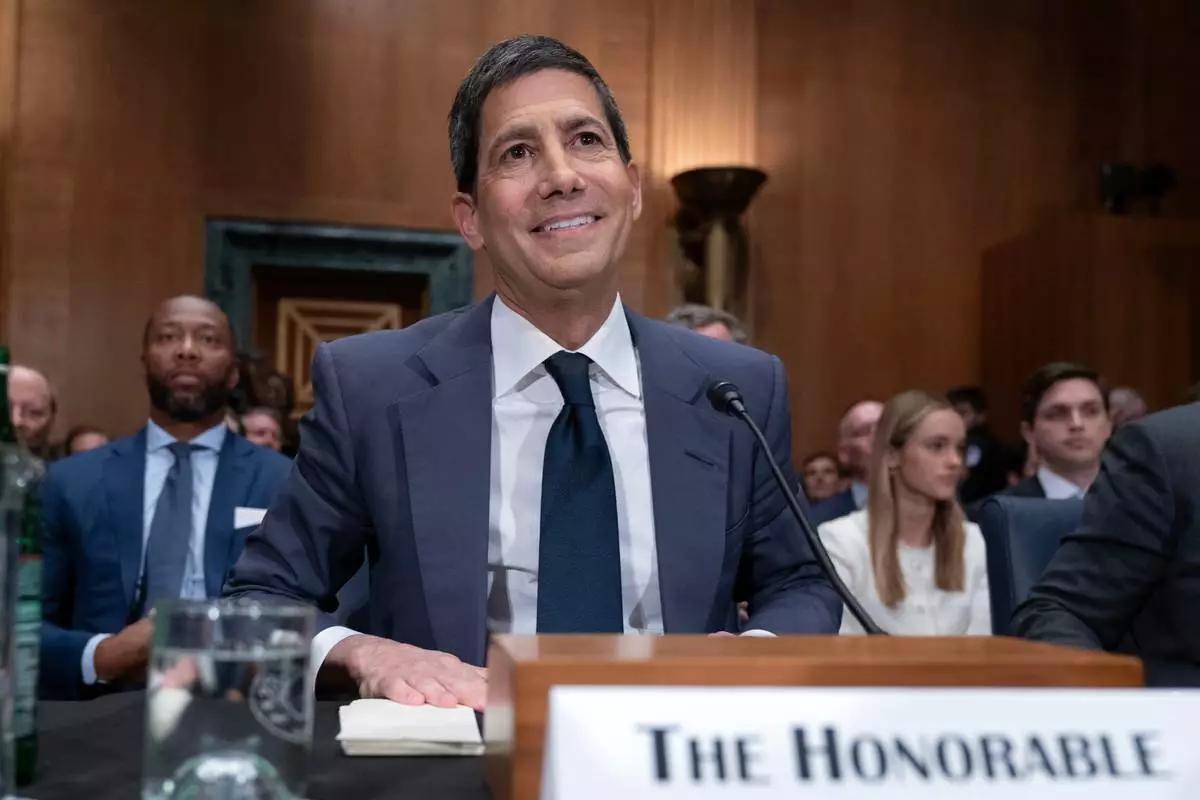
Kevin Warsh testifies during his nomination hearing to be a member and chairman of the Federal Reserve Board of Governors before the Senate Banking, Housing and Urban Affairs Committee on Capitol Hill, in Washington Tuesday, April 21, 2026. (AP Photo/Jose Luis Magana)

Kevin Warsh testifies during his nomination hearing to be a member and chairman of the Federal Reserve Board of Governors before the Senate Banking, Housing and Urban Affairs Committee on Capitol Hill, in Washington Tuesday, April 21, 2026. (AP Photo/Jose Luis Magana)

Recommended Articles