

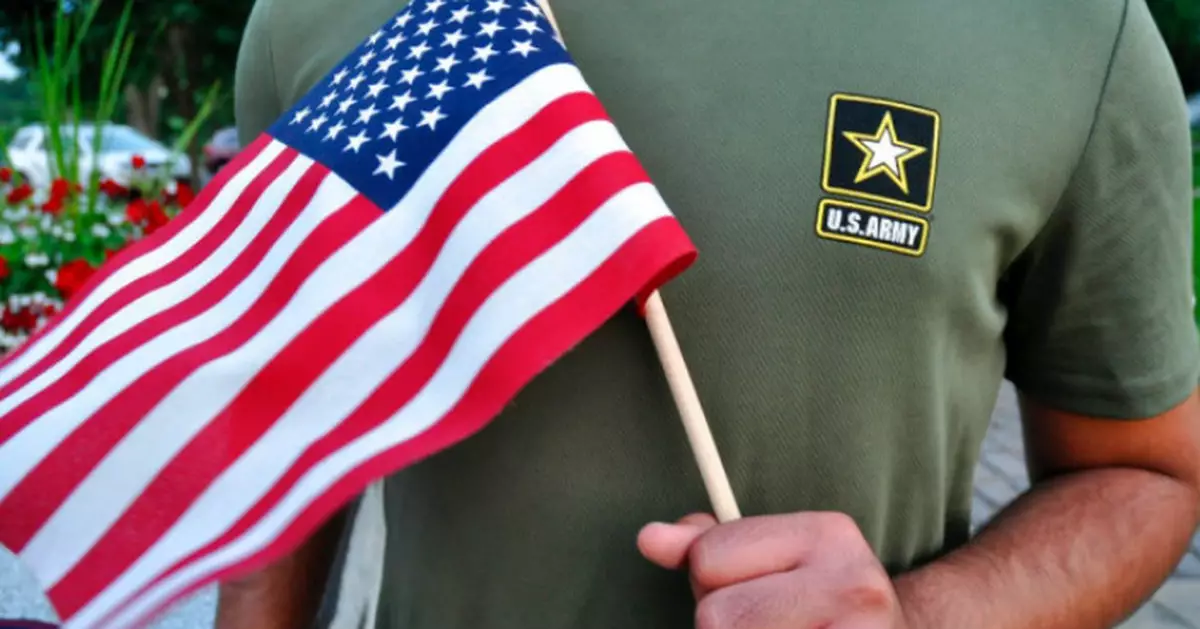
Some immigrant U.S. Army reservists and recruits who enlisted in the military with a promised path to citizenship are being abruptly discharged, the Associated Press has learned.
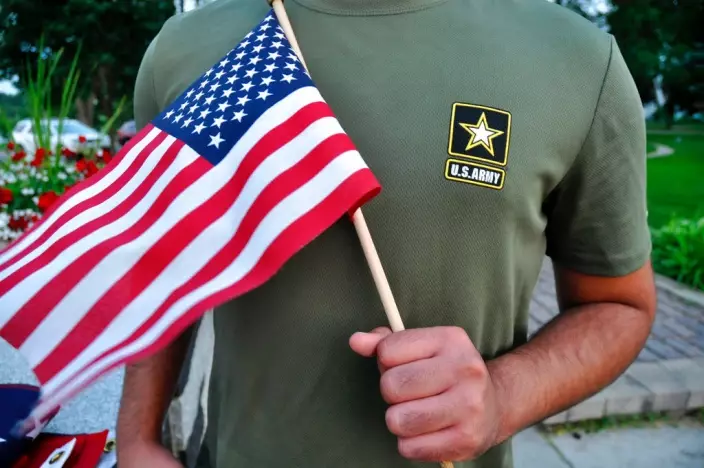
In this Tuesday, July 3, 2018, photo, a Pakistani recruit, 22, who was recently discharged from the U.S. Army, holds an American flag as he poses for a picture. (AP Photo/Mike Knaak)
The AP was unable to quantify how many men and women who enlisted through the special recruitment program have been booted from the Army, but immigration attorneys say they know of more than 40 who have been discharged or whose status has become questionable, jeopardizing their futures.
Click to Gallery
In this Tuesday, July 3, 2018, photo, a Pakistani recruit, 22, who was recently discharged from the U.S. Army, holds an American flag as he poses for a picture. (AP Photo/Mike Knaak)

Margaret Stock, an immigration lawyer, works at her office in Anchorage, Alaska, on Tuesday, July 3, 2018. (AP Photo/Mark Thiessen)

Margaret Stock, an immigration lawyer, poses at her office in Anchorage, Alaska, on Tuesday, July 3, 2018. (AP Photo/Mark Thiessen)

This undated photo provided by the Calixto family shows Lucas Calixto. The U.S. Army has moved in recent weeks to discharge some immigrant recruits and reservists who enlisted through a program that promised them a path to citizenship. (Courtesy of the Calixto Family via AP)
"It was my dream to serve in the military," said reservist Lucas Calixto, a Brazilian immigrant who filed a lawsuit against the Army last week. "Since this country has been so good to me, I thought it was the least I could do to give back to my adopted country and serve in the United States military."
Some of the service members say they were not told why they were being discharged. Others who pressed for answers said the Army informed them they'd been labeled as security risks because they have relatives abroad or because the Defense Department had not completed background checks on them.
Spokespeople for the Pentagon and the Army said that, due to the pending litigation, they were unable to explain the discharges or respond to questions about whether there have been policy changes in any of the military branches.
Margaret Stock, an immigration lawyer, works at her office in Anchorage, Alaska, on Tuesday, July 3, 2018. (AP Photo/Mark Thiessen)
Eligible recruits are required to have legal status in the U.S., such as a student visa, before enlisting. More than 5,000 immigrants were recruited into the program in 2016, and an estimated 10,000 are currently serving. Most go the Army, but some also go to the other military branches.
To become citizens, the service members need an honorable service designation, which can come after even just a few days at boot camp. But the recently discharged service members have had their basic training delayed, so they can't be naturalized.
Margaret Stock, an Alaska-based immigration attorney and a retired Army Reserve lieutenant colonel who helped create the immigrant recruitment program, said she's been inundated over the past several days by recruits who have been abruptly discharged.
All had signed enlistment contracts and taken an Army oath, Stock said. Many were reservists who had been attending unit drills, receiving pay and undergoing training, while others had been in a "delayed entry" program, she said.
Margaret Stock, an immigration lawyer, poses at her office in Anchorage, Alaska, on Tuesday, July 3, 2018. (AP Photo/Mark Thiessen)
"Immigrants have been serving in the Army since 1775," Stock said. "We wouldn't have won the revolution without immigrants. And we're not going to win the global war on terrorism today without immigrants."
Stock said the service members she's heard from had been told the Defense Department had not managed to put them through extensive background checks, which include CIA, FBI and National Intelligence Agency screenings and counterintelligence interviews. Therefore, by default, they do not meet the background check requirement.
"It's a vicious cycle," she said.
The AP interviewed Calixto and recruits from Pakistan and Iran, all of whom said they were devastated by their unexpected discharges.
"Now the great feeling I had when I enlisted is going down the drain," said Calixto, 28. "I don't understand why this is happening."
In hopes of undoing the discharge, he filed a lawsuit in Washington, D.C., last week alleging the Defense Department hadn't given him a chance to defend himself or appeal. He said he was given no specific grounds other than "personnel security."
This undated photo provided by the Calixto family shows Lucas Calixto. The U.S. Army has moved in recent weeks to discharge some immigrant recruits and reservists who enlisted through a program that promised them a path to citizenship. (Courtesy of the Calixto Family via AP)
Calixto, who lives in Massachusetts and came to the U.S. when he was 12, said in an email interview arranged through his attorney that he joined the Army out of patriotism.
In the suit, Calixto said he learned he was being kicked out soon after he was promoted to private second class.
The Pakistani service member who spoke to the AP said he learned in a phone call a few weeks ago that his military career was over.
"There were so many tears in my eyes that my hands couldn't move fast enough to wipe them away," he said. "I was devastated, because I love the U.S. and was so honored to be able to serve this great country."
He asked that his name be withheld because he fears he might be forced to return to Pakistan, where he could face danger as a former U.S. Army enlistee.
Portions of the 22-year-old's military file reviewed by the AP said he was so deeply loyal to the U.S. that his relationships with his family and fiancee in Pakistan would not make him a security threat. Nonetheless, the documents show the Army cited those foreign ties as a concern.
The man had enlisted in April 2016 anticipating he'd be a citizen within months, but faced a series of delays. He had been slated to ship out to basic training in January 2017, but that also was delayed.
An Iranian citizen who came to the U.S. for a graduate degree in engineering told the AP that he enlisted in the program hoping to gain medical training. He said he had felt proud that he was "pursuing everything legally and living an honorable life."
In recent weeks, he said, he learned that he'd been discharged.
"It's terrible because I put my life in the line for this country, but I feel like I'm being treated like trash," he said. "If I am not eligible to become a U.S. citizen, I am really scared to return to my country."
He spoke on condition of anonymity because of those fears.
It's unclear how the service members' discharges could affect their status as legal immigrants.
In a statement, the Defense Department said: "All service members (i.e. contracted recruits, active duty, Guard and Reserve) and those with an honorable discharge are protected from deportation."
However, immigration attorneys told the AP that many immigrants let go in recent weeks were an "uncharacterized discharge," neither dishonorable nor honorable.
The service members affected by the recent discharges all enlisted in recent years under a special program aimed at bringing medical specialists and fluent speakers of 44 sought-after languages into the military. The idea, according to the Defense Department, was to "recognize their contribution and sacrifice."
President George W. Bush ordered "expedited naturalization" for immigrant soldiers in 2002 in an effort to swell military ranks. Seven years later the Military Accessions Vital to the National Interest program, known as MAVNI, became an official recruiting program.
It came under fire from conservatives when President Barack Obama added DACA recipients — young immigrants who were brought to the U.S. illegally — to the list of eligible enlistees. In response, the military layered on additional security clearances for recruits to pass before heading to boot camp.
The Trump Administration added even more hurdles, creating a backlog within the Defense Department. Last fall, hundreds of recruits still in the enlistment process had their contracts canceled. A few months later, the military suspended MAVNI.
Republican Congressman Andy Harris of Maryland, who has supported legislation to limit the program, told the AP that MAVNI was established by executive order and never properly authorized by Congress.
"Our military must prioritize enlisting American citizens, and restore the MAVNI program to its specialized, limited scope," he said.
Non-U.S. citizens have served in the military since the Revolutionary War, when Continental soldiers included Irish, French and Germans. The U.S. recruited Filipino nationals to serve in the Navy in the 1940s, and worked to enlist Eastern Europeans in the military over the next decade, according to the Defense Department.
Since Sept. 11, 2001, nearly 110,000 members of the Armed Forces have gained citizenship by serving in the U.S. military, according to the Defense Department.
Many service members recruited through the program have proven to be exemplary. In 2012, then-Sgt. Saral K. Shrestha, originally from Nepal, was named U.S. Army Soldier of the Year.
In general, the immigrant recruits have been more cost-effective, outperforming their fellow soldiers in the areas of attrition, performance, education and promotions, according to a recently released review by the RAND Corporation, a nonprofit research institution.
The AP spoke with a 26-year-old woman from Dominica who said she proudly enlisted in the immigrant recruitment program in 2016 while earning her nursing degree. She said she drilled each month with her reserve unit, which gave her an award, and had been awaiting a date to start basic training.
But in March, she said she looked up her profile on an Army portal and saw that the section about her security eligibility was marked "loss of jurisdiction," with no further explanation. The next month, her attorney said she found the reservist's name listed as "unsuitable" on a spreadsheet created by the Defense Department.
The reservist, who spoke on condition of anonymity because of concerns about her legal standing, said she received additional paperwork last month that indicated her case is awaiting a final decision.
"I have always been a good soldier and have always done what they ask me to do," she said. "I got into debt when I joined the Army because I can't work legally but, financially, I can't survive anymore. I don't want to give up because I genuinely like being in the Army. But I don't know who to turn to."
In recent years, a group of attorneys have been fighting to keep their recruited immigrant clients eligible for naturalization as delays have mounted. Some have been successful, including nearly 50 recruits who were granted a type of temporary status while their background investigations are being completed.
"Some of our clients have finally emerged through the system and at least are doing basic training," said Donald Friedman, a Washington attorney with Perkins Coie.