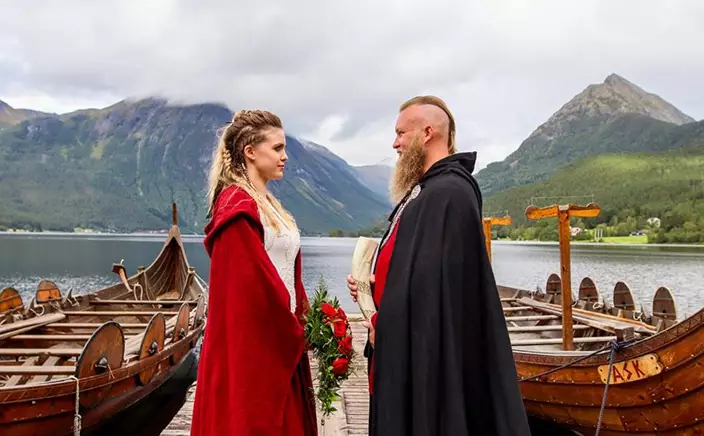
Instead of ‘Here Comes the Bride,’ a former beautician was serenaded by Norse throat singers as she married her carpenter groom in the first genuinely Viking wedding in nearly 1,000 years,
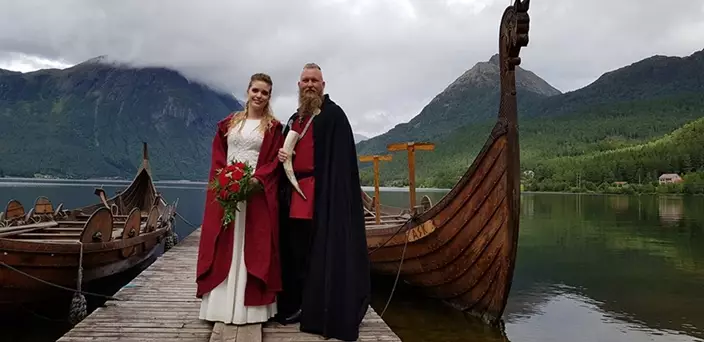
Swapping the traditional bridal car for two long boats – made famous by the fearsome warriors – 27-year-old Elisabeth and Rune Dalseth, 36, tied the knot on the banks of a Norwegian lake, complete with blood offerings and a hog-roast banquet.
Click to Gallery
PA photo
PA photo
PA photo
PA photo
PA photo
PA photo
PA photo
PA photo
PA photo
PA photo
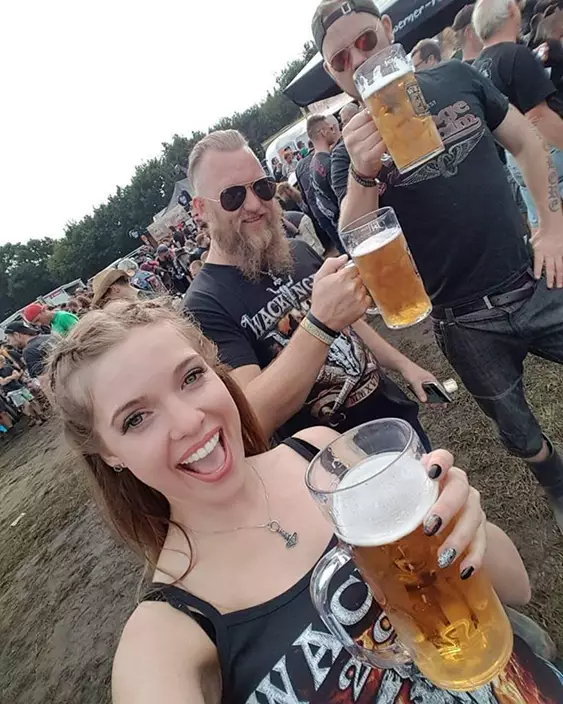
Despite having a conventional Christian upbringing, after a pagan ceremony, dressed in full Viking matrimonial garb, the happy couple then celebrated through the night with their 130 guests, all in costume, swigging ancient honey-beer and enjoying Norse songs and dance.
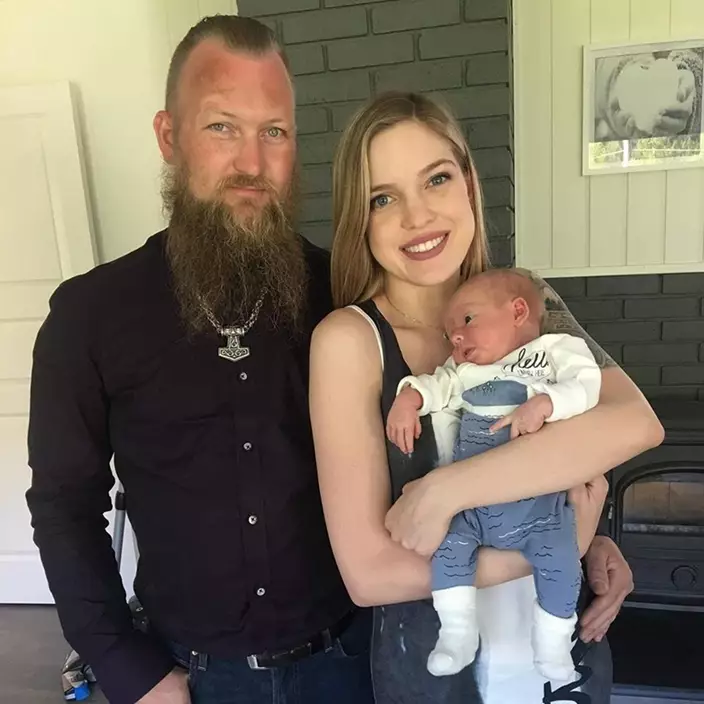
“We had no Spotify,” explained Elisabeth, of Sunnmore, Norway, a stay-at-home mum to the couple’s six-month-old baby Ragnar, recalling her wedding on August 25.
PA photo
“Instead, we danced to live music that our ancestors danced to over a millennium ago.”
Part of a 6,000 strong movement of Norwegian Viking revivalists, Elisabeth and Rune are keen to challenge the horned helmet-wearing seafarers’ reputation for violence, rape and pillage.
PA photo
“Vikings were no more terrible than any other group of people living at that time,” said Rune, who runs his own carpentry company.
“What people don’t mention is that Vikings were people who had a great appreciation for nature, for the land and for animal life. We want people to be more aware of that.”
PA photo
Elisabeth and Rune, from Norway, met two years ago in May 2016 at a bar.
Then running a beauty salon, she knew nothing about paganism and Viking traditions, but was immediately drawn to the way of life after Rune, who had been a pagan for two years, introduced her to them.
PA photo
“Rune completely opened up a new world for me, and I soon fell in love with the people and the spirituality of it,” said Elisabeth.
The following year, he proposed at a Viking festival near Oslo, and the couple quickly began planning a pagan wedding with all the trimmings.
Friends from the movement, which works to preserve and continue pagan rituals, were keen to be involved in what would be the first Viking wedding since the demise of the ancient warriors nearly 1,000 years ago.
“We rented two longboats,” said Rune. “They were made by a local shipbuilder. The traditional dress is not easy to find, so another friend helped us with that.
PA photo
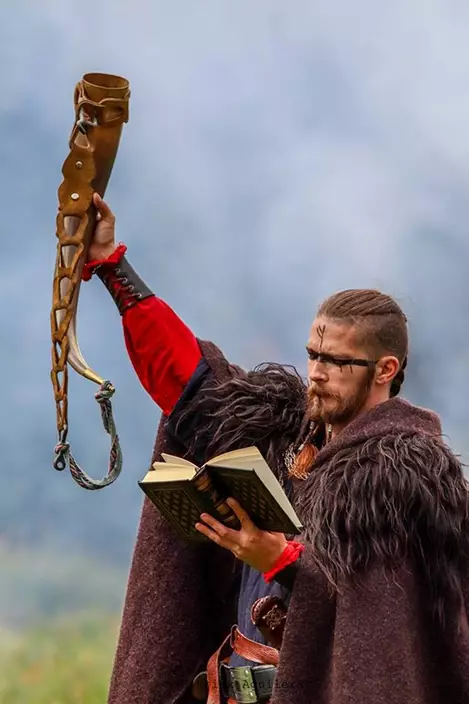
“Finally, a man who we had met at a festival one year agreed to be the Gothi – the equivalent of a priest – for the ceremony.”
While their wedding preparations went smoothly, not everything was the fairy tale they had hoped for, as both Rune and Elisabeth say they were aware of some scepticism from their parents.
Rune said: “I come from a very Christian family. When I announced that we were not going to have a Christian wedding my mum was a little unsure about it.
“But I think she has now come to accept it. She can see how happy paganism makes me and how it has helped me get my life together.”
PA photo
He added: “Before I was a Viking, I didn’t have a wife, a baby and a house – now look at me.”
In the end, despite having the option of wearing modern dress, friends and family all got into the spirit on their big day, when nearly all came in splendid Viking costume.
“We were so pleased that everyone was willing to join in with us and be open to our way of life,” said Rune.
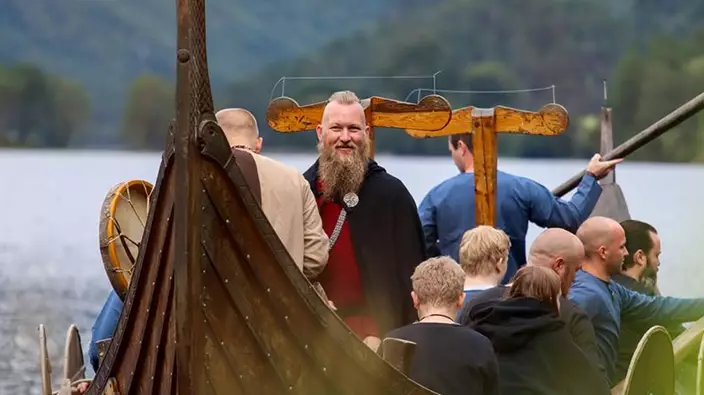
Following the ancient ritual of a traditional 10th century wedding, Rune arrived early in the morning at the lakeside with 10 of his closest friends, before setting sail in the specially made longboat across the water.
As the guests began to assemble, a hunting horn was blown to signal the start of the ceremony and the longboat returned to shore for a dramatic entrance.
Elizabeth said: “I arrived with my father, one of the few bits of modern tradition that we observed. I was also in a white dress, but not a princess dress.”
PA photo
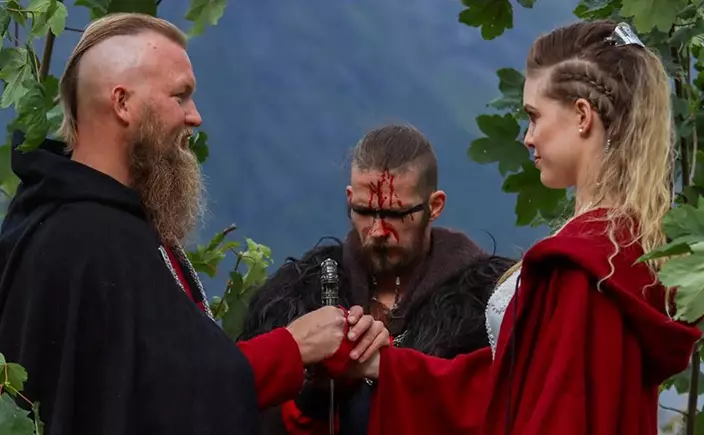
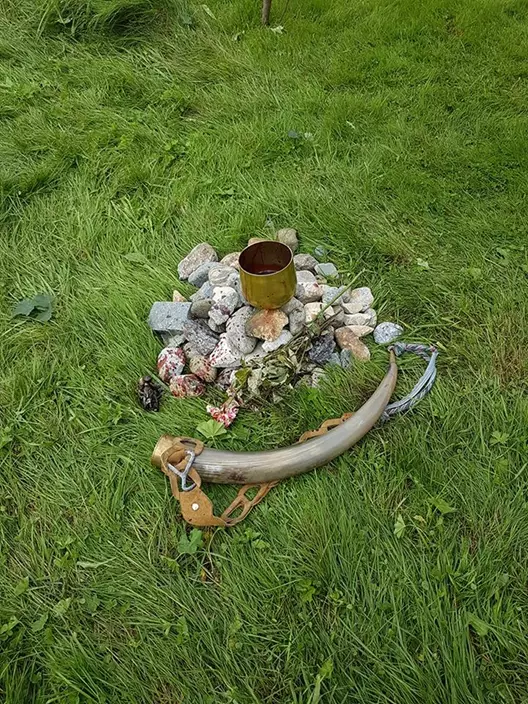
She continued: “Before we said our vows we did the ‘blot’ ritual. This is when a cauldron of blood is put on top of a pile of stones. The blood is then drizzled over little figures of the gods and then across the forehead. It is supposed to symbolise the union of gods and people.”
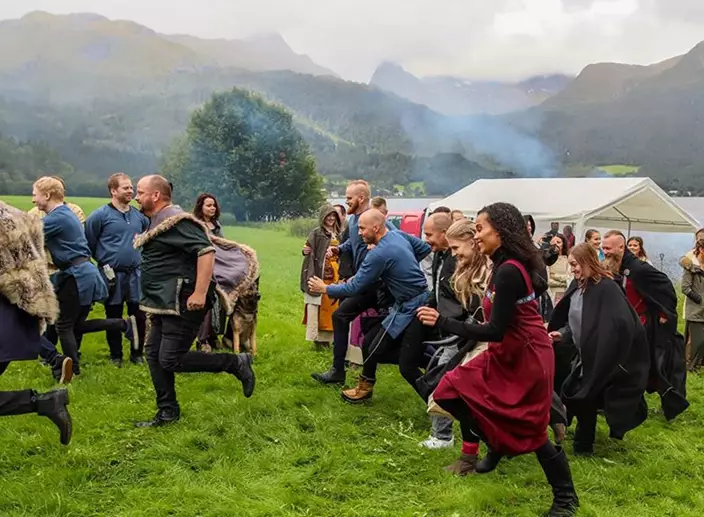
Guests were a little surprised when the Gothi, who officiates the ceremony, then announced that the relatives of the bride would compete in a race against the relatives of the groom, in a custom known as Brullaup.
After Elisabeth’s family won, the losers’ forfeit was to serve alcohol to the victors during the wild boar feast, which went on late into the night.
PA photo
“We stayed up very late afterwards, into the following morning. We danced and sang and listened to old stories about the gods,” said Elisabeth.
“Some of the people who came were a little sceptical about it at the start, but by the end they could all feel the energy and the love that we generated.
“I think if you go to a wedding like ours, you will definitely think differently about what it is to be a Viking.”