As Zimbabwe plunges into its worst economic crisis in a decade, gas lines are snaking for hours, prices are spiking and residents goggle as the new government insists that the country — somehow — has risen to middle-income status.
After ousting the repressive Robert Mugabe almost a year ago following more than three decades in power, and peacefully electing President Emmerson Mnangagwa in July, many hoped the country would emerge from turmoil and return to prosperity.
Instead, it appears to be imploding in the days since the new finance minister announced a "stabilization program." Over the weekend long lines for fuel reappeared, sometimes stretching for several kilometers.
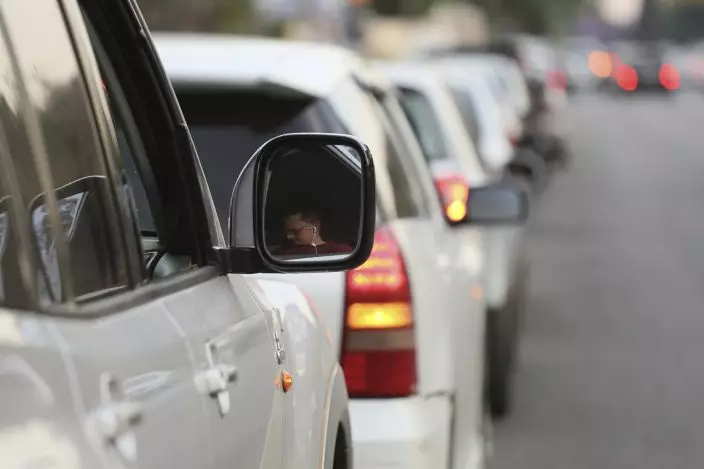
A motorist listens to music while queuing for gas in Harare, Tuesday, Oct, 9, 2018. As Zimbabwe plunges into its worst economic crisis in a decade, gas lines are snaking for hours, prices are spiking and residents goggle as the new government insists that the country somehow has risen to middle income status. (AP PhotoTsvangirayi Mukwazhi)
Anxious residents rushed to stores, where prices skyrocketed for dwindling stock and shop workers began removing price stickers. People have started joining any line in sight.
"You ask what the queue is for later. The important thing is to get in the queue, there might be something there," said Yvet Mlambo, a resident of the capital, Harare.
Basic items such as bottled water are now being rationed, even as the capital faces a cholera epidemic that has killed more than 40 people and spread into the countryside.
Even beer is rationed, to some outrage.
"At least allow us to drink. How else can we drown our sorrows?" one man shouted as he stared at a notice limiting customers to two beers per purchase. Drinkers have formed WhatsApp groups to share tips on where favorite brands can be found.
More worryingly, drugs are in short supply in a country where the health system has long been on the brink of collapse.
Outside a pharmacy, Bridget Chikwimba shook her head. "I bought these same allergy pills for a dollar last week, today they are $13," she told The Associated Press. "I waited five minutes while they calculated the new price."
The country's Retail Pharmacists Association describes the shortages of medicines as "severe."
Many fear the current crisis, induced by foreign currency shortages and a ballooning debt, could spiral into the kind of collapse seen a decade ago when Zimbabwe's hyperinflation reached 500 billion percent, according to the International Monetary Fund.
Plastic bags of 100-trillion Zimbabwe dollar banknotes were not enough to buy basic groceries, forcing Mugabe to form a "unity government" with the opposition and adopt a multi-currency system.
Since then, daily transactions have been dominated by the U.S. dollar. But the new currency shortage has forced most people to use a surrogate currency called bond notes, bank cards and mobile money, all of which are devaluing quickly against the U.S. dollar on the black market.
Retailers said the soaring rates for U.S. dollars on the black market, where they source most of their foreign currency, are making it difficult for them to restock. Some businesses have been forced to close.
"The parallel market is unsustainably high and has decimated confidence. Prices have been going up while margins are eroded," Denford Mutashu, president of the Retailers Association of Zimbabwe, told the AP.
In the days leading to the implosion, new Finance Minister Mthuli Ncube, a former lecturer at the London School of Economics, announced the "stabilization program" that included commitments to cut borrowing. He also plans to cut government spending, repay foreign loans to unlock fresh credit and expand the revenue base.
On Friday, Ncube surprised many by announcing that after rebasing the gross domestic product and taking into account the large informal sector, Zimbabwe is now a middle-income economy.
"Our economy is bigger than we think," he told reporters, but he warned of "pain" to achieve desired growth. "At the end, we will be glad."
But Zimbabweans have reacted angrily to one of the new measures, a tax on transactions conducted with mobile money and bank cards. Labor unions and others say the poor, without access to U.S. dollars and largely reliant on electronic transfers, will be hardest hit.
Protests have erupted, and more are planned this week, as people say they can't endure the economic pain any longer.
The crisis could lead to social unrest unless a political settlement is reached between the ruling ZANU-PF party and the opposition, which narrowly lost the presidential election and unsuccessfully challenged the results in court, said Harare-based political analyst Alexander Rusero.
"ZANU-PF should swallow its pride to realize that they desperately need the opposition for the way forward," Rusero said.
Both parties are instead playing hardball despite efforts by churches and others to bring them into negotiations.
Meanwhile, the popularity of the new president, who was cheered by thousands for replacing Mugabe, is dropping. Once-popular campaign slogans are being mocked.
The road to a more secure future in Zimbabwe is "long, winding and at times bumpy," Mnangagwa replied in a statement posted on Twitter this week. "But there is no other way."
Follow Africa news at https://twitter.com/AP_Africa
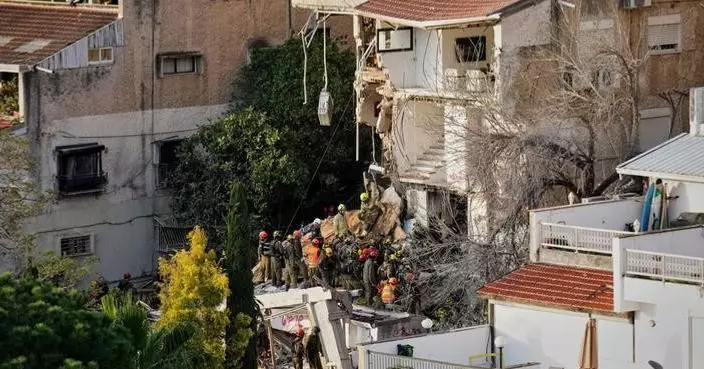
Strikes on cities across Iran have killed more than 25 people Sunday into Monday, while in Israel's Haifa two people were found dead and two others were missing in rubble a day after an Iranian attack.
U.S. President Donald Trump on Sunday stepped up his threat to hit Iran's critical infrastructure hard if the country's government doesn’t reopen the Strait of Hormuz by his Tuesday deadline.
Trump punctuated his threat with profanity in a social media post, saying Tuesday will be “Power Plant Day, and Bridge Day, all wrapped up in one, in Iran.”
The war began with joint U.S.-Israel strikes on Feb. 28 and has killed thousands, shaken global markets, cut off key shipping routes and spiked fuel prices. Both sides have threatened and hit civilian targets, bringing warnings of possible war crimes from the United Nations and international law experts.
Here is the latest:
An Iranian drone attack damaged a telecommunications building in Fujairah in the United Arab Emirates on Monday, the state-run WAM news agency reported.
The attack targeted a building of the state-funded du telecom company.
No one was injured, WAM reported, quoting officials in Fujairah.
South Korea’s National Intelligence Service says there are no signs North Korea is providing Iran with weapons or other war-related supplies.
The spy agency’s officials told lawmakers Monday that North Korea may be taking a cautious approach to preserve the possibility of dialogue with the Trump administration, according to two lawmakers who attended the closed-door briefing.
North Korea’s Foreign Ministry has condemned the U.S.-Israeli attacks on Iran as illegal, but the NIS said Pyongyang has not sent an official condolence message over the death of Ayatollah Ali Khamenei, Iran’s late supreme leader.
North Korean leader Kim Jong Un in recent years has embraced the idea of a “new Cold War” and attempted to expand cooperation with countries confronting the U.S., including an economic delegation sent to Iran in April 2024.
South Korea plans to send at least five ships to Saudi Arabia’s Yanbu port in the coming weeks to establish new oil transport routes in the Red Sea.
The Ministry of Trade, Industry and Resources said Monday the ships will be deployed in phases beginning in mid-April and the number of vessels could increase depending on contracts with Saudi partners.
Officials did not disclose the companies involved but said some domestic refiners may use non-Korean shipping firms.
South Korea also plans to send special envoys to Saudi Arabia, Oman and Algeria to step up diplomatic efforts to secure alternative fuel supplies, ruling party lawmaker Ahn Do-geol said.
The foreign ministry did not immediately reveal when the envoys would be sent.
Iran has executed another man convicted over charges stemming from the nationwide protests that swept Iran in January.
The judiciary’s Mizan news agency identified the man hanged as Ali Fahim in a report Monday.
It was unclear when he was executed.
Fahim had been convicted of allegedly storming a military base to seize weapons.
Amnesty International said Fahim and others convicted in the case “were subjected to torture and other ill-treatment in detention, including beatings, floggings, prolonged solitary confinement, and death threats at gunpoint before being convicted in grossly unfair trials that relied on forced ‘confessions’ extracted under torture and lasted only a few hours.”
The Human Rights Activist News Agency had said Fahim and others had entered a Tehran base of the all-volunteer Basij militia, an arm of the Revolutionary Guard, after it had been burned, then had been forced into confessions.
Israel rescue services reported Monday morning several sites were hit by missiles launched from Iran toward multiple cities in the center of Israel.
In Petah Tikva, paramedics provided medical treatment to an injured woman in serious condition with a chest injury from shrapnel and evacuated her to the Beilinson Hospital.
Fire fighters in that city are handling cars on fire and continue searching to ensure there are no people trapped in the rubble.
In Tel Aviv, a man slightly injured by glass shrapnel was evacuated to the Ichilov Hospital.
Footage provided by rescue service Magen David Adom shows damage to residential buildings due to the attack.
Meanwhile, Israel’s military warned the public Monday morning of another missile barrage coming from Iran, the fourth-such alert of the day.
Israel’s Magen David Adom and Fire and Rescue services said early Monday that there are several reported sites of Iranian missile hits in the northern city of Haifa.
In one site, four people were slightly injured, including two children.
The missile attacks hit residential areas and a factory in the city.
The factory was hit by shrapnel from an interception.
It is unclear if all the reported hits were caused by shrapnel from interception or direct hits.
Video footage provided by Magen David Adom of the affected sites show active fire and bombed cars in what appears to be a residential area.
The missile strikes come a day after another attack from Iran also hit a Haifa residential area, killing two people and injuring others.
Two other people remain missing under the rubble caused by Sunday's strike and their fate is still unknown.
In the United Arab Emirates’ capital of Abu Dhabi, authorities said a Ghanaian man suffered wounds from shrapnel after the interception of an Iranian missile over the city’s Musaffah neighborhood.
That’s near Al Dhafra Air Base, which hosts U.S. forces and has been repeatedly targeted by Iran in the war.
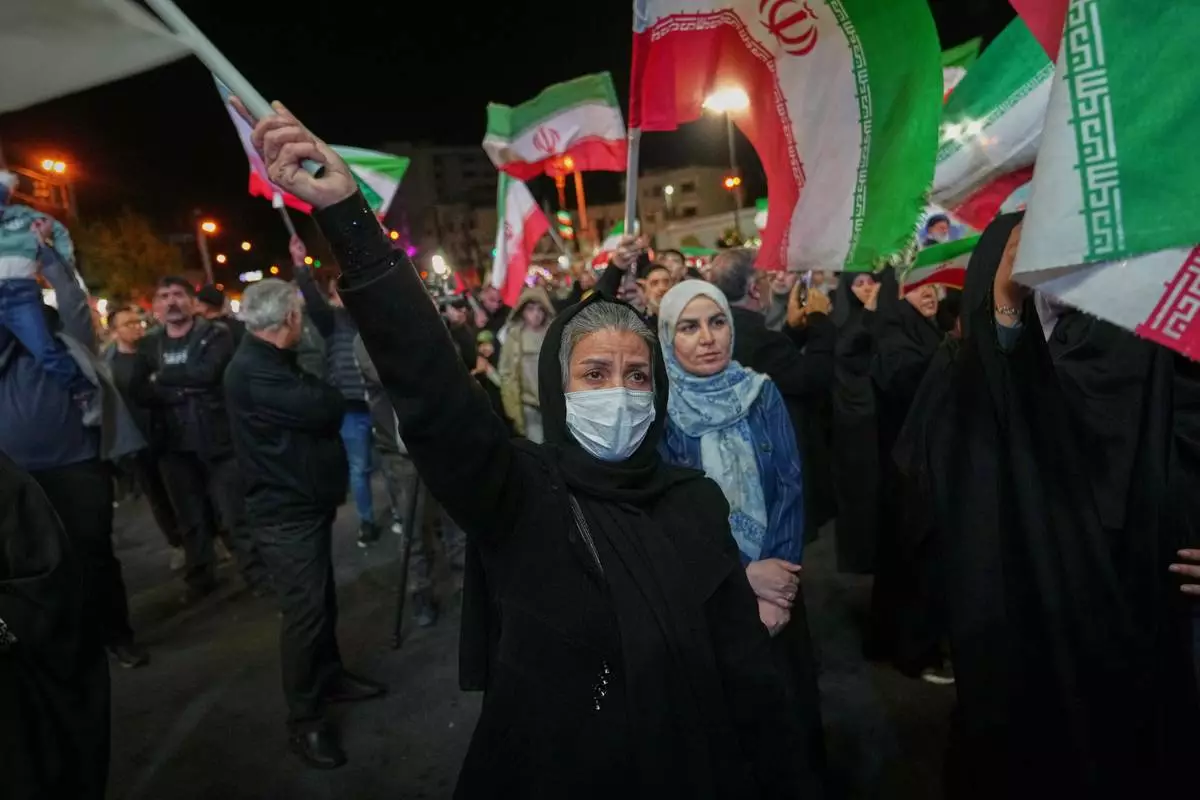
Women hold Iranian flags during a pro-government gathering in a square in Tehran, Iran, Sunday, April 5, 2026. (AP Photo/Francisco Seco)
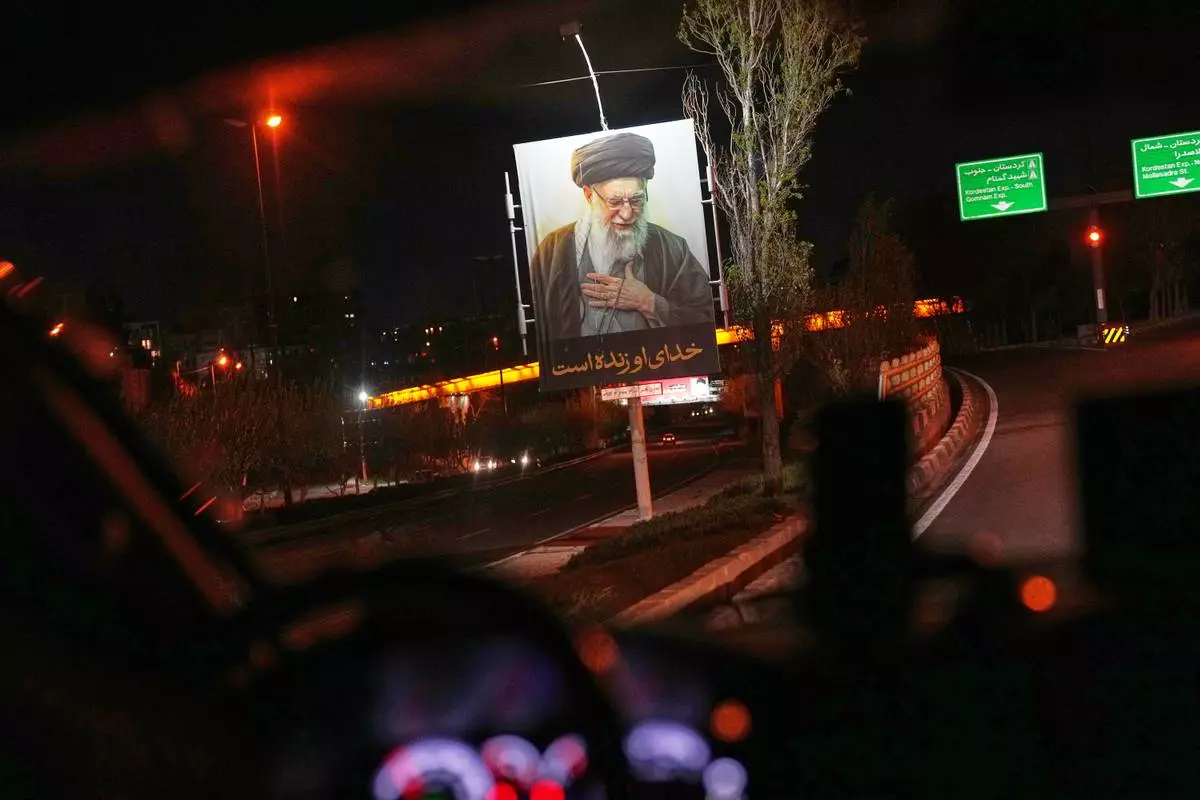
A picture of the late Iranian Supreme Leader Ayatollah Ali Khamenei hangs on the side of the road in the outskirts of Tehran, Iran, early Sunday, April 5, 2026. (AP Photo/Francisco Seco)
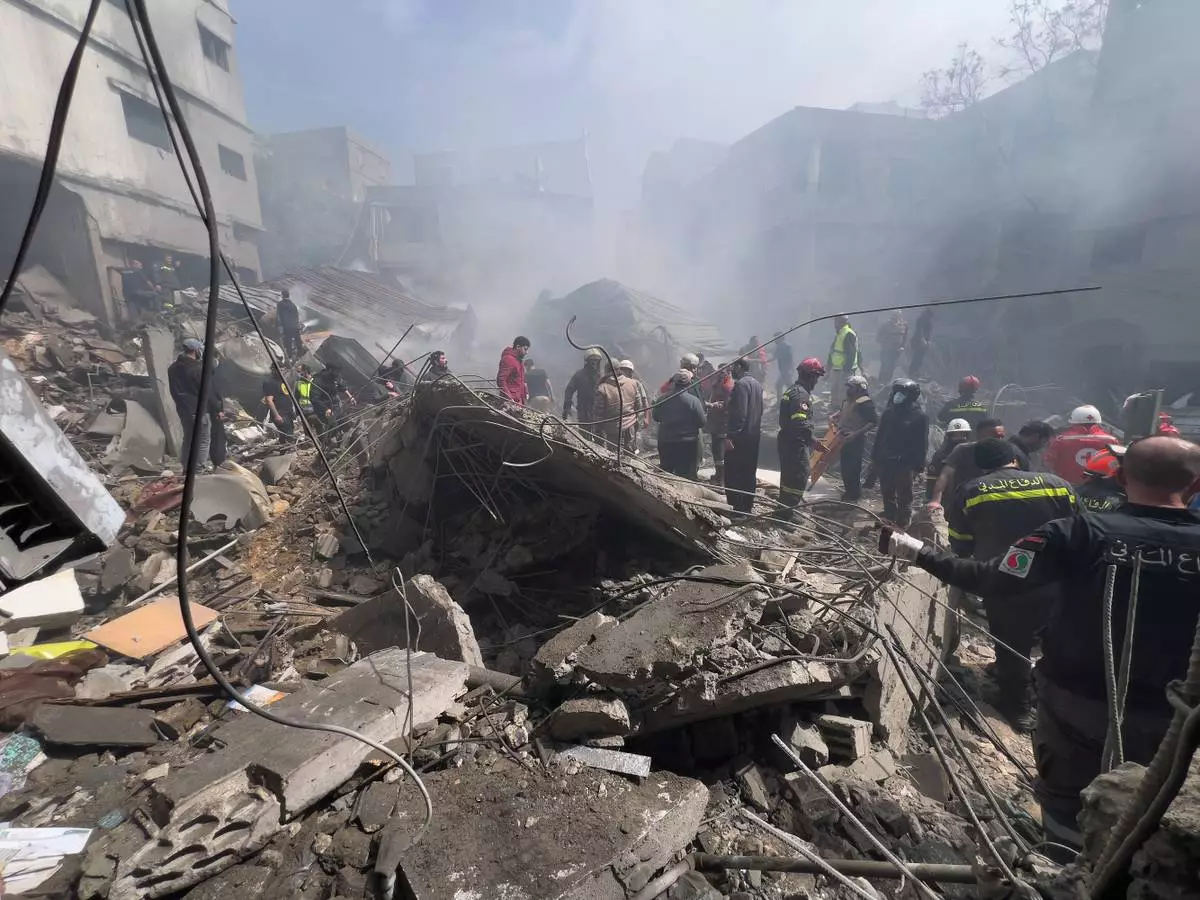
Rescue workers search for victims at the site of an Israeli airstrike that hit a crowded neighbourhood south of Beirut, Lebanon, Sunday, April 5, 2026. (AP Photo/Hussein Malla)
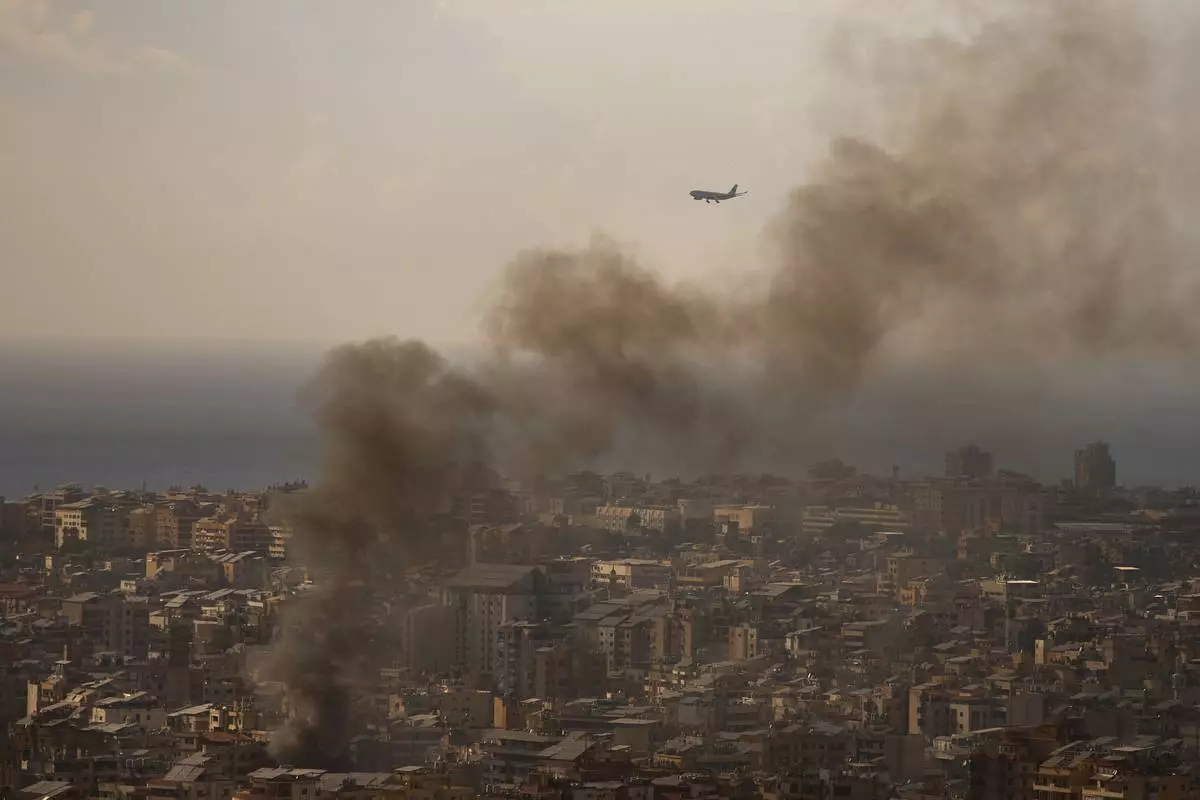
A commercial plane is preparing to land at Beirut Airport as smoke rises from Israeli airstrikes in Dahiyeh, a southern suburb of Beirut, Lebanon, Sunday, April 5, 2026. (AP Photo/Emilio Morenatti)
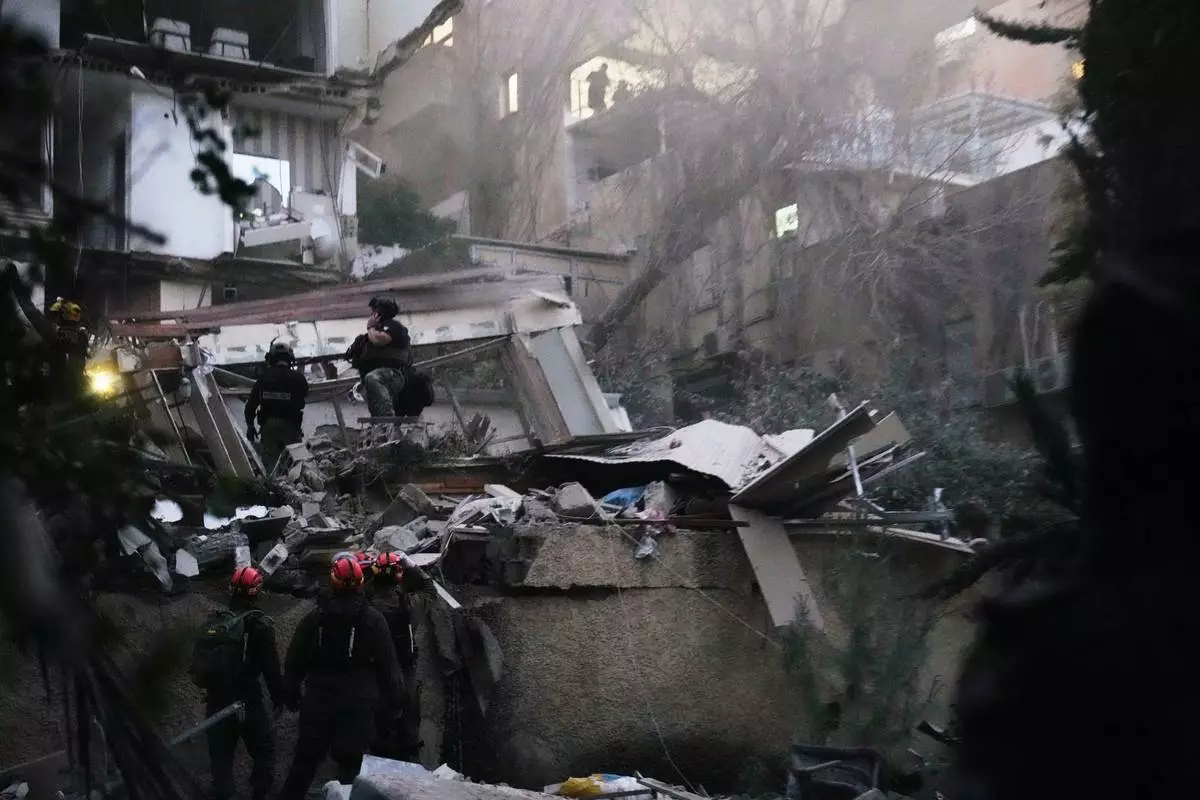
Israeli security forces and rescue teams work amid the rubble of a residential building struck by an Iranian missile in Haifa, Israel, Sunday, April 5, 2026. (AP Photo/Ariel Schalit)