
Skip to Content Facebook Feature Image

Bloomberg announces $50 million to fight opioid epidemic

Bloomberg announces $50 million to fight opioid epidemic

Bloomberg announces $50 million to fight opioid epidemic

2018-11-30 22:18 Last Updated At:22:20

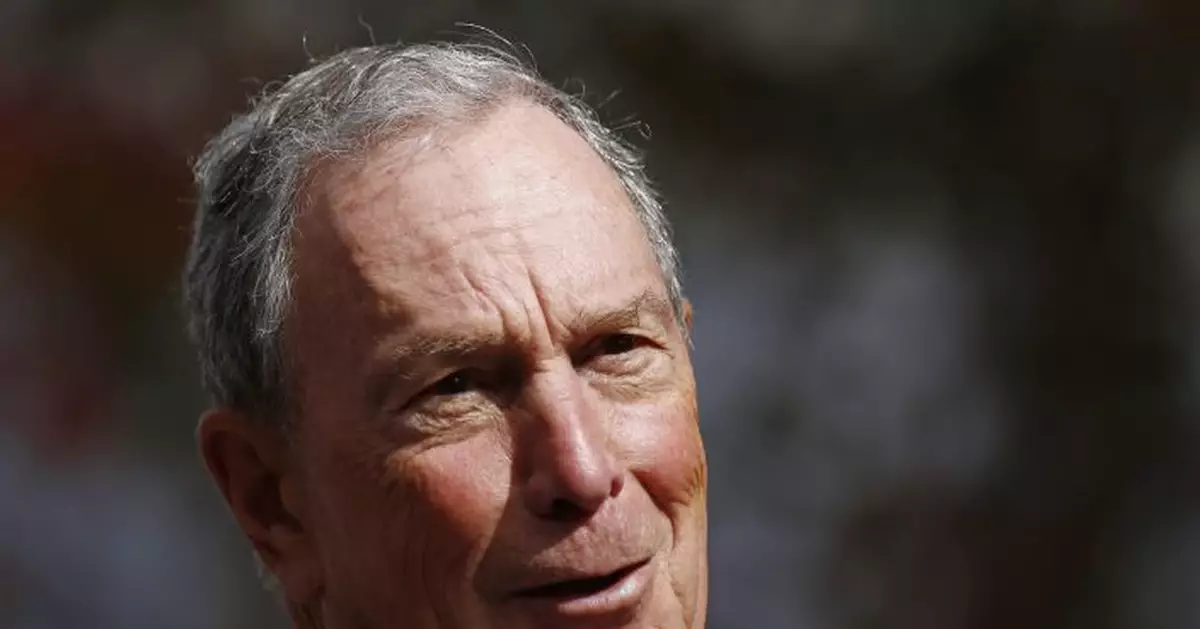
Former New York Mayor Michael Bloomberg's charity has announced a $50 million donation to help fight the nation's opioid epidemic.

Bloomberg Philanthropies said over the next three years it will help up to 10 states address the causes of opioid addiction and strengthen prevention and treatment programs. Its initiative involves a partnership with the Centers for Disease Control and Prevention, The Pew Charitable Trusts, Johns Hopkins University and Vital Strategies.

Bloomberg, who has been considering a 2020 Democratic presidential bid, was expected to discuss the funding on Friday during his keynote address at The Bloomberg American Health Summit in Washington. A spokeswoman said there was "no stated link" between his political aspirations and the $50 million investment to fight opioids.

Bloomberg's charity said CDC data shows there were more than 70,000 U.S. drug overdose deaths last year, including more than 47,000 from opioids, the highest numbers on record. It said those numbers are a leading factor in the decline of U.S. life expectancy over the past three years.

Bloomberg called the sobering numbers part of "a national crisis."

"For the first time since World War I, life expectancy in the U.S. has declined over the past three years — and opioids are a big reason why," he said. "We cannot sit by and allow this alarming trend to continue — not when so many Americans are being killed in what should be the prime of their lives."

He said in a statement he hoped his charity's work in Pennsylvania, one of the states hardest hit by the opioids crisis, would lay the groundwork "for more effective action across the country."

The partnership focuses on identifying new approaches to tackle opioids and plugging gaps in current treatment and prevention programs. Staff members from partner organizations will support state and local programs to reduce opioid-related deaths, and successful initiatives and guidelines will be replicated elsewhere, with the goal of creating a model for the rest of the nation.

Pennsylvania Gov. Tom Wolf said he was "deeply grateful" for the financial and technical resources his state will receive through the partnership with Bloomberg Philanthropies.

"From our first responders and health care professionals to teachers and social service providers, heroes across our commonwealth are saving lives and protecting residents in our communities every day from this awful scourge," Wolf, a Democrat, said in a statement issued by the Bloomberg charity. "We are doing everything we can to help them, and I am confident that this partnership will mark a turning point in our efforts."

The Drug Enforcement Administration said this month in its National Drug Threat Assessment that heroin, fentanyl and other opioids continue to be the highest drug threat in the nation.

Bloomberg, who has been an independent, a Republican and a Democrat, declared lifetime allegiance to the Democratic Party and outlined an aggressive timeline for deciding whether to run for president in an interview with The Associated Press this month. He has regularly criticized President Donald Trump and spent a fortune to help elect Democrats in the midterm elections.

TEHRAN, Iran (AP) — Iran’s grip on the Strait of Hormuz is throttling the world’s energy supplies and inflicting global economic pain, but the struggles of the Islamic Republic's own economy are testing its ability to withstand the war and defy Washington’s demands.

Iranians have been hit by spiraling prices for food, medicine and other goods. At the same time, the country has seen mass job losses and business closures caused by strike damage to key industries and the government’s monthslong shutdown of the internet.

The economic cost of the war and the U.S. naval blockade “has been very substantial and unprecedented for Iran,” said Hadi Kahalzadeh, an Iranian economist and research fellow at Brandeis University.

But Iran has withstood decades of economic pressure and sanctions and its capacity to adapt has not been dismantled, Kahalzadeh said.

“Iran can probably avoid a complete economic collapse or total shortage of essential goods, but at a very high cost,” he said. “The main cost will be passed to ordinary Iranians through higher inflation, more poverty, weaker services and a much harder daily life.”

The International Monetary Fund has predicted the Iranian economy will shrink by about 6 percentage points in the next year. Iran’s official statistics center reported in mid-April that annual inflation was 53.7%, while inflation for food breached 115% compared with the same period last year.

Meanwhile, Iran’s rial currency has lost over half its value in the past year, falling to a record low of 1.9 million to the dollar at the end of last month. The economic woes helped fuel massive protests that spread across the country in January.

Parked beneath an overpass in central Tehran, 56-year-old Hossein Farmani was idling alongside other taxi drivers waiting for customers. He popped open the trunk of his car to take out a kettle before pouring himself a glass of tea. He reflected on the wild price increases in the past year. Alongside items such as milk, the price of tea has risen over 50% since the war began.

“If things keep heading in this direction, we’re going to suffer a lot more,” Farmani said.

Prices had already climbed steadily over the past two years, but an Associated Press tour of grocery stores in Tehran found large jumps from February, before the war began: Chicken and lamb were up 45%, rice 31% and eggs 60%.

Iranian authorities have announced measures to help Iranians bear the crippling prices. But many of these policies — including a 60% hike in the minimum wage and coupon programs for essential goods — are stoking inflation, Taymur Rahmani, an economist at the University of Tehran, wrote recently in a leading business newspaper, Dunya-ye Eqtesad.

Since the war began, free bus and metro fares in the capital are also not helping the city's struggling taxi drivers.

Another driver waiting nearby, Mohammad Deljoo, 73, said he was supporting his family of two children on a daily income of $4. He said there was no shortage of goods in shops and instead blamed the problem on “price gouging.”

“We only buy what’s absolutely necessary, things like bread and potatoes. Even eggs have become too expensive for us,” Deljoo said. He said the price for tires and other car parts rose fivefold in less than a year.

“One price today, another tomorrow. How is that possible?” he said.

Amid job losses, many Iranians are scrambling to find new ways to make money. Ali Asghar Nahardani, 32, said the ride-hailing app he works for had not paid in him in over a month. He turned to street vending to cover his living expenses.

“We’re just living day by day, trying to get through this situation while the war conditions continue,” he said.

The closure of the strait has hiked energy prices across the world. But in Iran, the war has marked another step in the ruin of a once large and prosperous middle class following decades of sanctions.

By 2019, Iran's middle class had already shrunk to around 55% of the population, explained Mohammad Farzanegan, a professor of Middle Eastern economics at the University of Marburg. New rounds of sanctions as well as wars, corruption and economic mismanagement have further cut that number, he said.

The war will likely push several million Iranians below the poverty line, according to a report published by the U.N.'s development agency in late March.

A physical trainer who lives in downtown Tehran described the economic crisis as a mental health crisis for Iranian society. She said many of her clients could no longer afford her fees and training sessions. The few clients she has left have turned to discussing ways to handle signs of depression.

“The system is just collapsing. The layoffs are in factories, in companies, in startups, in whatever your work is,” she said in a voice note by Telegram. She spoke on condition of anonymity out of security fears.

The trainer said she had severely cut back on groceries.

“The last time I bought meat was about two months ago.” She has also given up paying for therapy sessions that she began after divorcing her spouse a year ago. “I am pursuing a master's in psychology so it’s given me the tools to handle my anxieties,” she said.

A resident of Karaj, near the capital, said his insurance company had seen plummeting sales for car and home policies. Families are being dragged down into poverty, he said, also speaking on condition of anonymity out of fear of reprisal.

The Karaj resident, who joined the mass anti-government protests in January, blamed the yearslong decline on “severe systemic corruption” and the Islamic Republic’s costly support for militant groups in Lebanon, Yemen and Iraq.

“Most people blame the government and its ambitions,” he wrote by WhatsApp message.

Iran’s leaders have been trying to shore up the homefront by showing sympathy while also urging the public to endure the economic pain for the sake of the war effort.

In a series of messages on his official Telegram channel Friday, the new supreme leader, Mojtaba Khamenei, described the current phase of the conflict as an “economic battlefield” and asked employers to “avoid layoffs as much as possible.” Khamenei is believed to have been wounded early in the war by Israeli strikes and has yet to appear in public.

Parliament speaker Mohammad Bagher Qalibaf — who has emerged as a key player in the war effort and U.S. talks — urged Iranians to “be frugal” in their spending. He said on his official Telegram account that government administrators and the public “have a duty to help each other” to ease economic effects.

The U.S. blockade has restricted Iran's critical Gulf trade. Over 90% of Iranian trade, particularly the oil exports that bring in billions of dollars, flows through its southern ports, Farzanegan estimated.

Farmani, the taxi driver, said he did not want to accept what he called a “humiliating” peace with the U.S. and Israel.

“A country that has sacrificed so many martyrs and has so many people willing to give their lives cannot simply let others from across the world dictate terms to us.”

Radjy reported from Cairo. Associated Press writer Nasser Karimi contributed to this report.

Motorbikes drive past a billboard with graphic showing the late Iranian Supreme Leader Ayatollah Ali Khamenei, who was killed in the U.S. and Israel strikes on Feb. 28, with his framed fist amongst his supporters framed fists in downtown Tehran, Iran, Wednesday, May 6, 2026. (AP Photo/Vahid Salemi)

Motorbikes drive past a billboard with graphic showing the late Iranian Supreme Leader Ayatollah Ali Khamenei, who was killed in the U.S. and Israel strikes on Feb. 28, with his framed fist amongst his supporters framed fists in downtown Tehran, Iran, Wednesday, May 6, 2026. (AP Photo/Vahid Salemi)

Vehicles drive past banners showing portraits of the school children who were killed during a strike on a school in southern town of Minab on Feb. 28, at Tajrish square in northern Tehran, Iran, Sunday, May 10, 2026. (AP Photo/Vahid Salemi)

Vehicles drive past banners showing portraits of the school children who were killed during a strike on a school in southern town of Minab on Feb. 28, at Tajrish square in northern Tehran, Iran, Sunday, May 10, 2026. (AP Photo/Vahid Salemi)

People walk along a sidewalk in northern Tehran, Iran, Sunday, May 10, 2026. (AP Photo/Vahid Salemi)

People walk along a sidewalk in northern Tehran, Iran, Sunday, May 10, 2026. (AP Photo/Vahid Salemi)

A woman looks at the window display a women's clothing shop in northern Tehran, Iran, Sunday, May 10, 2026. (AP Photo/Vahid Salemi)

A woman looks at the window display a women's clothing shop in northern Tehran, Iran, Sunday, May 10, 2026. (AP Photo/Vahid Salemi)

A Revolutionary Guard soldier stands at the counter of a fast food restaurant in northern Tehran, Iran, Sunday, May 10, 2026. (AP Photo/Vahid Salemi)

A Revolutionary Guard soldier stands at the counter of a fast food restaurant in northern Tehran, Iran, Sunday, May 10, 2026. (AP Photo/Vahid Salemi)

Recommended Articles