In Britain and other countries like Australia and Canada, the day after Christmas is a secular national holiday known as Boxing Day. Here's a brief look at some theories about how the holiday got its name and how people celebrate it:
NO NEED FOR BOXING GLOVES
While no one seems to know for sure how it came to be called Boxing Day, it definitely has nothing to do with the sport of boxing. Perhaps the most widely held understanding of its origins comes from the tradition of wealthier members of society giving servants and tradesmen a so-called Christmas Box containing money and gifts on the day after Christmas.
It was seen as a reward for a year's worth of service. Other believe it comes from the post-Christmas custom of churches placing boxes outside their doors to collect money for distribution to less-fortunate members of society in need of Christmas cheer.
Some trace it to Britain's proud naval tradition and the days when a sealed box of money was kept on board for lengthy voyages and then given to a priest for distribution to the poor if the voyage was successful.
There are other explanations, but it's clear the designation has nothing to do with the modern habit of using the holiday for shopping at "big box" stores selling televisions, computers and the like.
SHARING THE WEALTH, AROUND THE COMMONWEALTH
No one knows for sure when Boxing Day started, but some believe it was centuries ago, when servants would be given the day after Christmas off as a day of rest after feverish preparations for their masters' celebrations.
Others trace it back even earlier, to the Roman practice of collecting money in boxes — they say Roman invaders brought this practice to Britain, where it was taken up by the clergy to collect money in boxes for the disadvantaged.
The tradition gained popularity during the Victorian era and has flourished to this day. The British Empire may now be a thing of the past, but Boxing Day is still celebrated in some other parts of the Commonwealth, including Canada, Australia and Kenya.
SO IF THEY'RE NOT BOXING, WHAT DO PEOPLE ACTUALLY DO ON BOXING DAY?
Boxing Day has evolved into a day of relaxation and indulgence — and shopping. It is filled with sporting events (including a marathon soccer schedule tailor-made for TV viewing from a comfortable couch) and it is often a day when people open their homes to family and friends who drop by for turkey, ham and perhaps half-consumed bottles of wine left over from Christmas dinner.
In Britain it used to be a day for fox hunting in the frost-tinged countryside, but that practice has been mostly banned for more than a decade now. In its place, "Boxing Day Sales" have flourished, with many Britons lifted from their post-Christmas torpor by the lure of low prices in department stores.
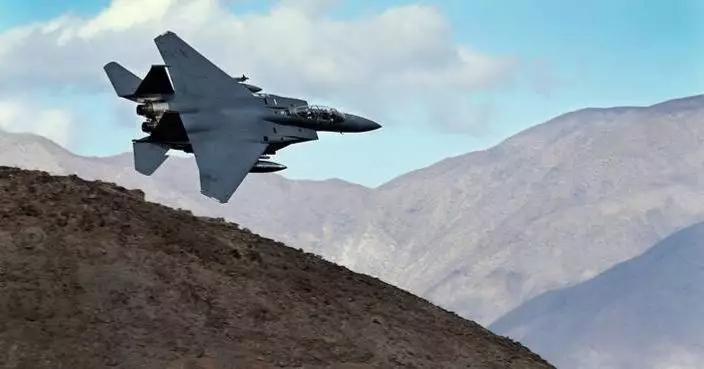
WASHINGTON (AP) — A U.S. service member who has been missing since Iran shot down a fighter jet has been rescued, President Donald Trump wrote in a social media post early Sunday.
A frantic U.S. search-and-rescue operation unfolded after the crash of the F-15E Strike Eagle on Friday, as Iran also promised a reward for anyone who turned in the “enemy pilot.”
A second crew member was rescued earlier.
“This brave Warrior was behind enemy lines in the treacherous mountains of Iran, being hunted down by our enemies, who were getting closer and closer by the hour,” Trump wrote.
Trump said that the aviator is injured but “will be just fine,” adding that the rescue involved “dozens of aircraft” and that the U.S. had been monitoring his location “24 hours a day, and diligently planning for his rescue.”
The fighter jet was the first U.S. aircraft to have crashed in Iranian territory since the conflict in late February.
Trump said last week that the U.S. had “decimated” Iran and would finish the war “very fast.” Two days later, Iran shot down two U.S. military planes, showing the ongoing perils of the bombing campaign and the ability of a degraded Iranian military to continue to hit back.
In Kuwait, an Iranian drone attack caused significant damage to two power plants and put a water desalination station out of service, according to the Ministry of Electricity. No injuries were reported from the attack, the ministry said.
In Bahrain, the national oil company said that a drone attack caused a fire at one of its storage facilities, which was extinguished. It said the damage was still being assessed and no injuries had been reported.
In the United Arab Emirates, authorities responded to multiple fires at the Borouge petrochemicals plant, a joint venture of the Abu Dhabi National Oil Co. and Borealis of Austria. They say the fires were caused by falling debris following successful interceptions by air defense systems, but production at the plant in Ruwais, near the UAE’s western border with Saudi Arabia, has halted.
The strike came a day after Israel struck a petrochemical plant in Iran that Prime Minister Benjamin Netanyahu said generated revenue that it had used to fund the war.
The war began with joint U.S.-Israel strikes on Feb. 28 and has killed thousands, shaken global markets, cut off key shipping routes and spiked fuel prices. Both sides have threatened and hit civilian targets, bringing warnings of possible war crimes.
The other jet to go down was a U.S. A-10 attack aircraft. Neither the status of the crew nor exactly where it crashed was immediately known.
Trump renewed his threats for Iran to open up the Strait of Hormuz, a crucial waterway for global energy shipments that has been choked off by Tehran, by Monday or face devastating consequences, writing Saturday in a social media post: “Remember when I gave Iran ten days to MAKE A DEAL or OPEN UP THE HORMUZ STRAIT. Time is running out — 48 hours before all Hell will reign down on them.”
“The doors of hell will be opened to you” if Iran’s infrastructure is attacked, Gen. Ali Abdollahi Aliabadi with the country’s joint military command said late Saturday in response to Trump’s renewed threat, state media reported. In turn, the general threatened all infrastructure used by the U.S. military in the region.
But Pakistan’s Foreign Ministry spokesperson, Tahir Andrabi, told The Associated Press that his government’s efforts to broker a ceasefire are “right on track” after Islamabad last week said that it would soon host talks between the U.S. and Iran.
Iran’s foreign minister, Abbas Araghchi, said that Iranian officials “have never refused to go to Islamabad.”
Mediators from Pakistan, Turkey and Egypt were working to bring the U.S. and Iran to the negotiating table, according to two regional officials.
The proposed compromise includes a cessation of hostilities to allow a diplomatic settlement, according to a regional official involved in the efforts and a Gulf diplomat briefed on the matter. They spoke on condition of anonymity to discuss closed-door diplomacy.
Iran’s parliamentary speaker, Mohammad Bagher Qalibaf, issued a veiled threat late Friday to disrupt traffic through a second strategic waterway in the region, the Bab el-Mandeb.
The strait, 32 kilometers (20 miles) wide, links the Red Sea with the Gulf of Aden and the Indian Ocean. More than a tenth of seaborne global oil and a quarter of container ships pass through it.
“Which countries and companies account for the highest transit volumes through the strait?” Qalibaf wrote.
More than 1,900 people have been killed in Iran since the war began.
In Gulf Arab states and the occupied West Bank, more than two dozen people have died, while 19 have been reported dead in Israel and 13 U.S. service members have been killed. In Lebanon, more than 1,400 people have been killed and more than 1 million people have been displaced. Ten Israeli soldiers have died there.
This report has been corrected to show that Borealis is an Austrian company and not Australian.
Jon Gambrell in Dubai, United Arab Emirates; Samy Magdy in Cairo; Munir Ahmed in Islamabad; Dasha Litvinova in Tallinn, Estonia; and Seung Min Kim, Will Weissert, Michelle L. Price, Lisa Mascaro and Ben Finley in Washington, contributed to this report.
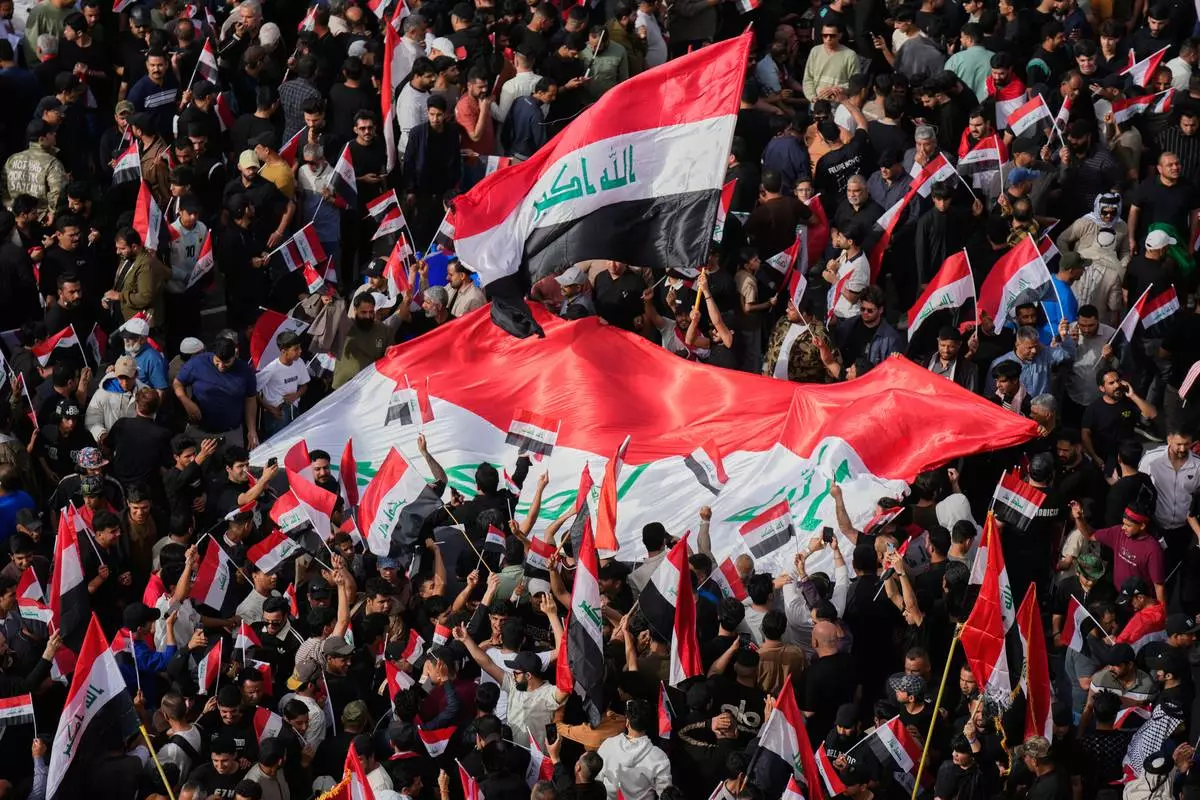
Followers of Iraq's Shiite cleric Muqtada al-Sadr chant slogans as they wave national Iraqi flag during a protest against U.S. and Israeli attacks on multiple cities across Iran, in Tahrir Square, Baghdad, Baghdad, Iraq, Saturday, April 4, 2026. (AP Photo/Hadi Mizban)
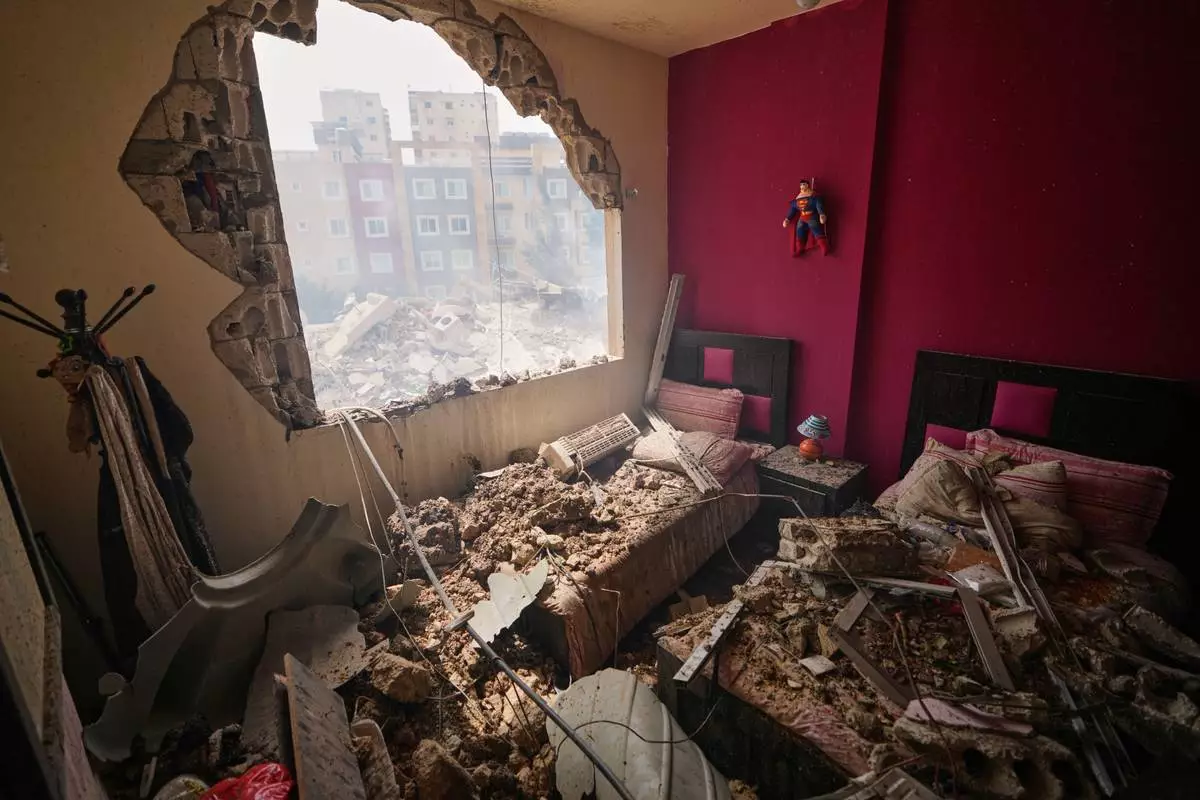
A bedroom is damaged in a building struck in an Israeli airstrike in the southern port city of Tyre, Lebanon, Saturday, April 4, 2026. (AP Photo/Mohammed Zaatari)
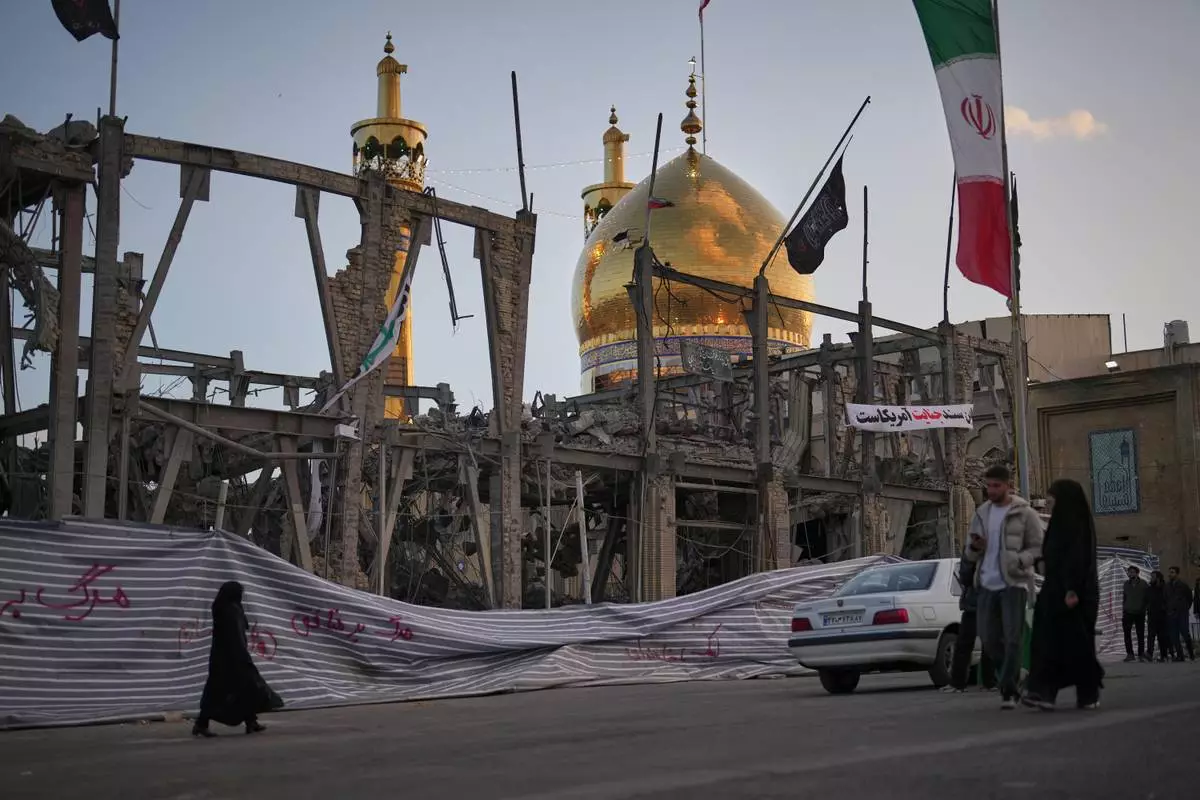
Pedetrians walk by a destroyed building within the Grand Hosseiniyeh, with the mosque visible in the background, which officials at the site say was hit by U.S.-Israeli airstrikes Tuesday, in Zanjan, Iran, Saturday, April 4, 2026. (AP Photo/Francisco Seco)

Police officers and their horses take cover in an underground parking garage as sirens warn of an incoming missile fired from Yemen in Tel Aviv, Israel, Saturday, April 4, 2026. (AP Photo/Maya Levin)
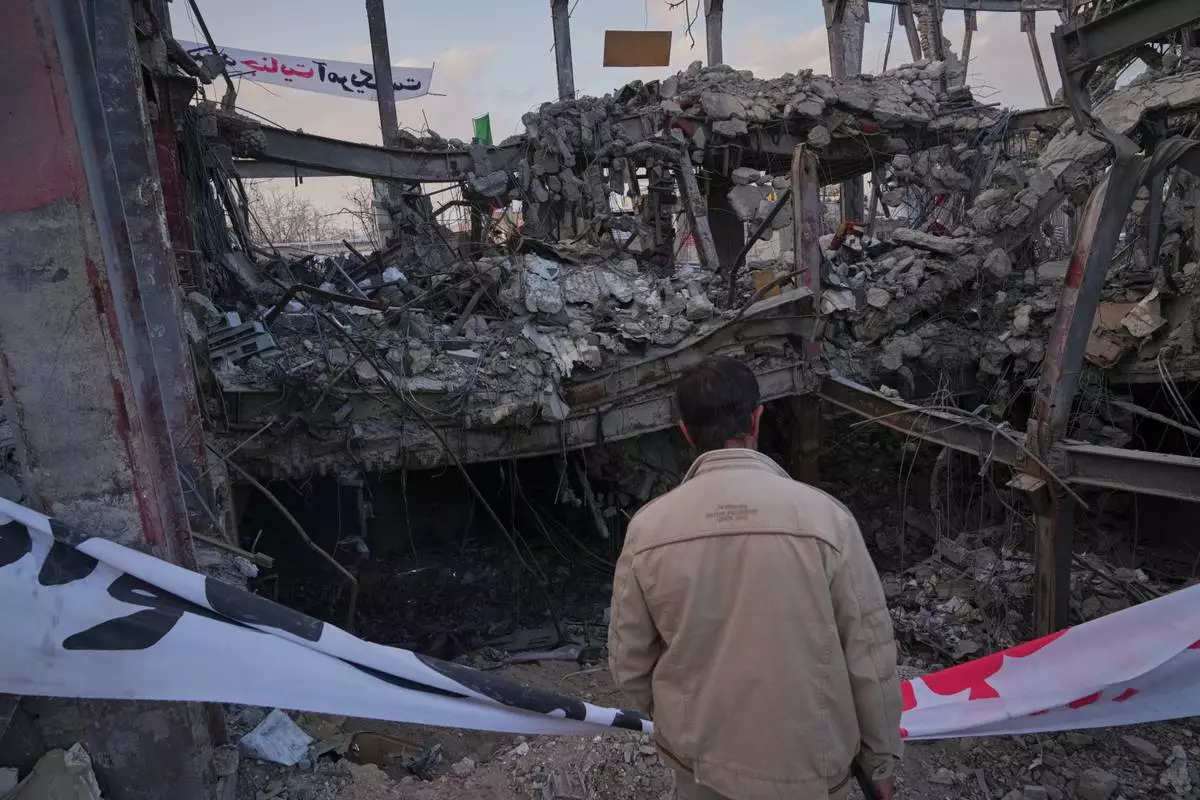
A man looks at a destroyed building within the Grand Hosseiniyeh complex that officials say was hit by U.S.-Israeli airstrikes Tuesday in Zanjan, Iran, Saturday, April 4, 2026. (AP Photo/Francisco Seco)