A phrase written on the outer wall of Brazil's most prestigious military academy gives a glimpse at the values held by the incoming government of President-elect Jair Bolsonaro, an ex-army captain whose administration will be rife with generals.
"In order to lead, learn to obey," reads the slogan greeting aspiring military officers arriving at the Agulha Negras Military Academy that educated Bolsonaro and a good chunk of his Cabinet. He takes office on New Year's Day.
Click to Gallery
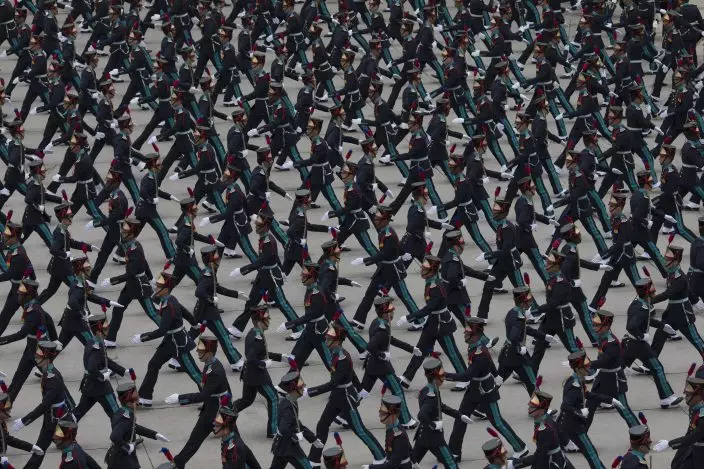
In this Dec. 1, 2018 photo, Army cadets march during their graduation ceremony at the Agulhas Negras Military Academy in Resende, Brazil. As Brazil's President-elect Jair Bolsonaro prepares to take office on Jan. 1, the Agulha Negras Military Academy offers a glimpse at the values instilled in the far-right ex-army captain during his days as a cadet. (AP PhotoLeo Correa)
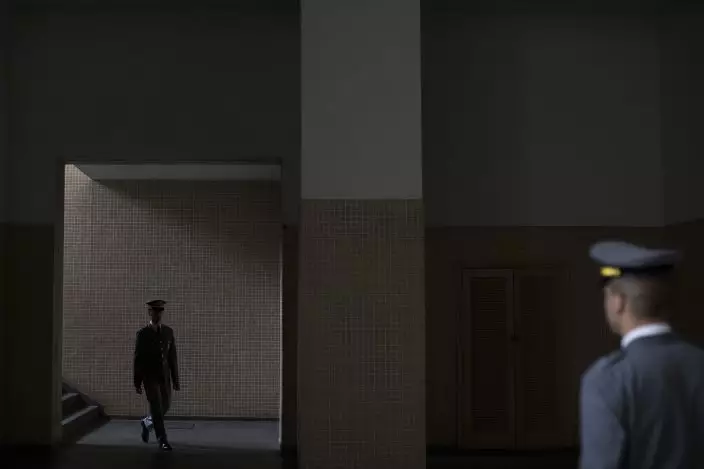
In this Dec. 1, 2018 photo, a Brazilian Army officer arrives at the Agulhas Negras Military Academy for a graduation ceremony in Resende, Brazil. The school, which opened in 1941, is considered to be the most prestigious military academy in Brazil. (AP PhotoLeo Correa)
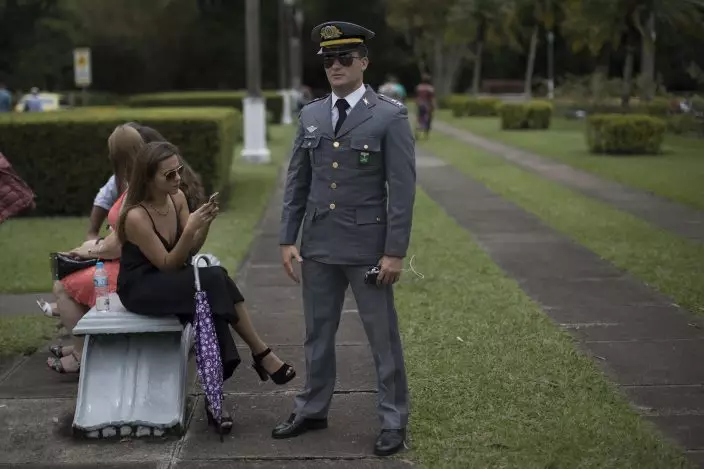
In this Dec. 1, 2018 photo, a Brazilian Army lieutenant stands in a garden after attending a graduation ceremony at the Agulhas Negras Military Academy, AMAN, in Resende, Brazil. At the military academy, some of the president-elect's staunchest supporters are convinced that alum Jair Bolsonaro will stay true to the slogan on the outer wall of AMAN: "In order to lead, learn to obey". (AP PhotoLeo Correa)
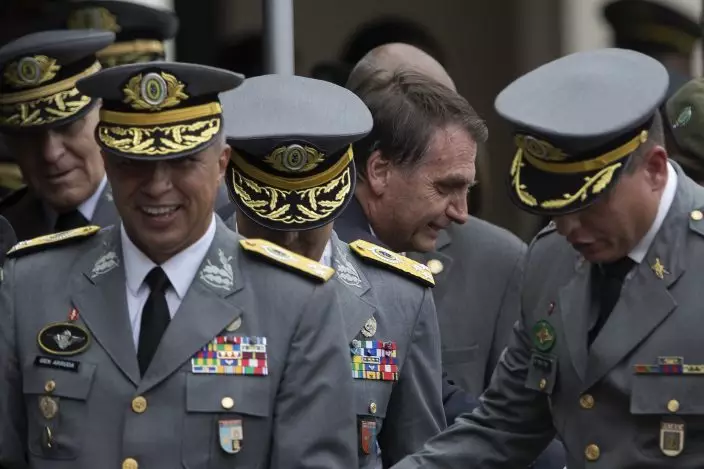
In this Dec. 1, 2018 photo, Brazil's President-elect Jair Bolsonaro walks past Brazilian Army generals during a graduation ceremony at the Agulhas Negras Military Academy in Resende, Brazil. Bolsonaro, who waxes nostalgic for Brazil's 1964-1985 military dictatorship, makes no bones about his debt to the academy, which he graduated from in 1977. (AP PhotoLeo Correa)
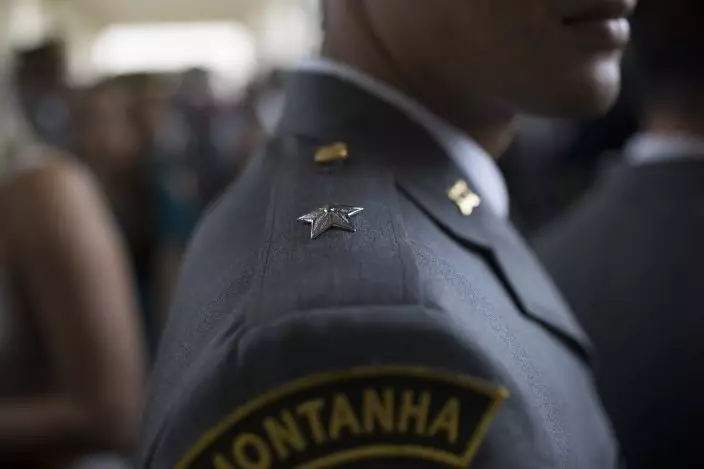
In this Dec. 1, 2018 photo, an Army cadet stands with his colleagues during a graduation ceremony at the Agulhas Negras Military Academy in Resende, Brazil. In addition to core subjects such as economics, sociology and political science, each cadet receives rigorous physical training, including techniques for surviving in the Amazon rainforest. (AP PhotoLeo Correa)
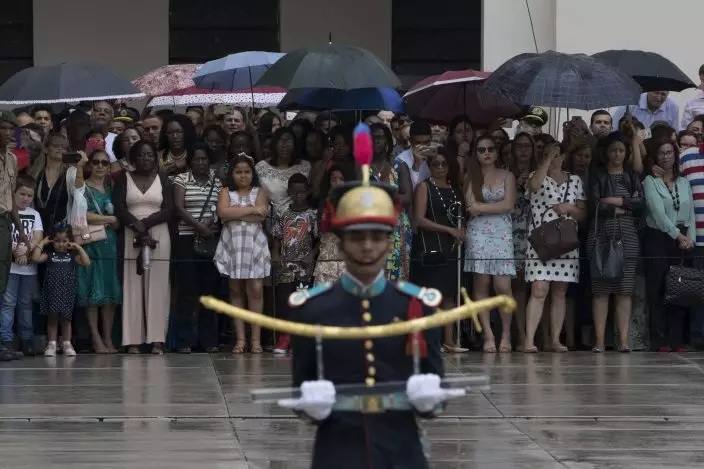
In this Dec. 1, 2018 photo, relatives and friends watch a cadet carry the saber of Duke Caxias, patron of the Brazilian Army, during a graduation ceremony at the Agulhas Negras Military Academy in Resende, Brazil. The academy educated Brazil's President-elect Jair Bolsonaro and a good chunk of his Cabinet. He takes office on Jan. 1. (AP PhotoLeo Correa)
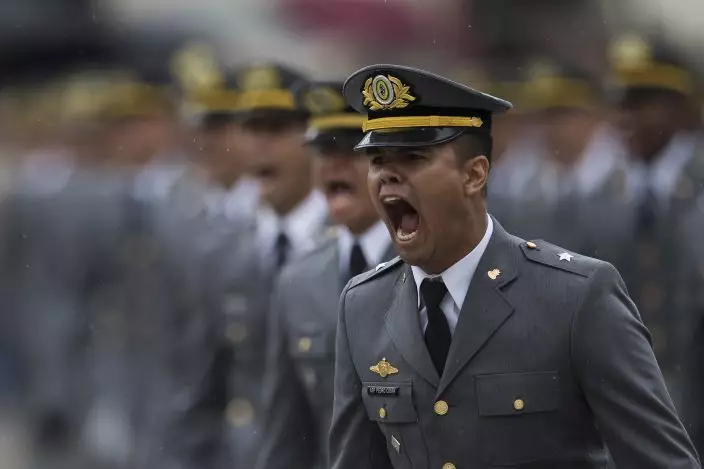
In this Dec. 1, 2018 photo, a Brazilian Army cadet sings while marching during his graduation ceremony at the Agulhas Negras Military Academy in Resende, Brazil. The academy was found in 1941. (AP PhotoLeo Correa)

In this Dec. 1, 2018 photo, relatives and friends chat as they wait for the start of a graduation ceremony at the Agulhas Negras Military Academy in Resende, Brazil. President-elect Jair Bolsonaro, who waxes nostalgic for Brazil's 1964-1985 military dictatorship, makes no bones about his debt to the academy, which he graduated from in 1977. (AP PhotoLeo Correa)
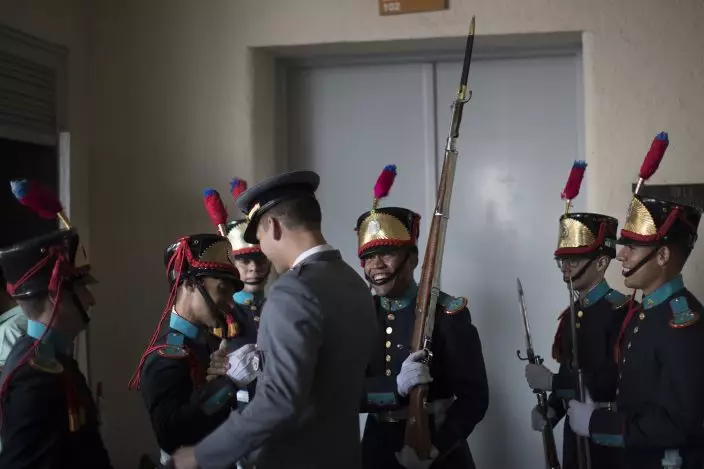
In this Dec. 1, 2018 photo, Brazilian Army cadets greet a colleague, back to the camera, before his graduation ceremony at the Agulhas Negras Military Academy in Resende, Brazil. The school, which opened in 1941, is considered to be the most prestigious military academy in Brazil. (AP PhotoLeo Correa)
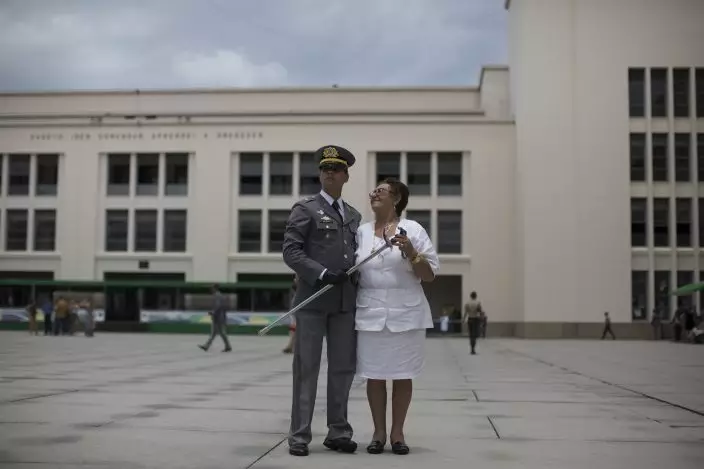
In this Dec. 1, 2018 photo, a Brazilian Army cadet poses with a relative after his graduation ceremony at the Agulhas Negras Military Academy in Resende, Brazil. In addition to core subjects such as economics, sociology and political science, each cadet receives rigorous physical training, including techniques for surviving in the Amazon rainforest. (AP PhotoLeo Correa)
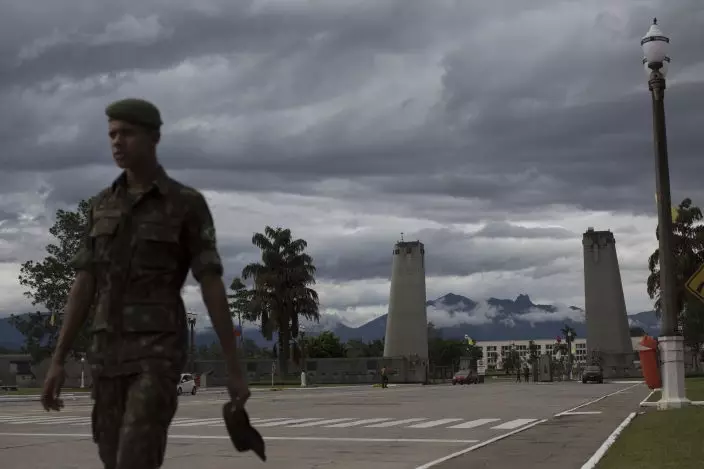
In this Dec. 1, 2018 photo, a Brazilian soldier walks near the entrance of the Agulhas Negras Military Academy in Resende, Brazil. Here, discipline is a cornerstone of academic and military formation, and behavioral infractions can be swiftly punished with suspension of weekend privileges or even expulsion. (AP PhotoLeo Correa)
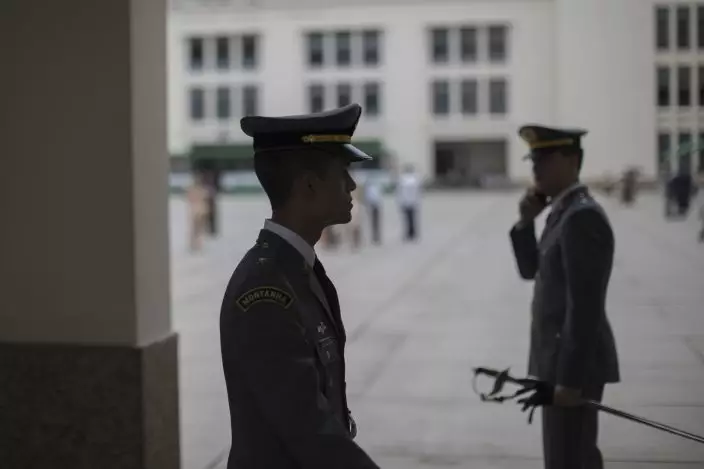
In this Dec. 1, 2018 photo, Brazilian Army cadet Gustavo Oliveira stands at the presentation court after his graduation ceremony at the Agulhas Negras Military Academy in Resende, Brazil. The 23-year-old graduate said that the election of an alumnus gave him hope. "I am the son of a carpenter and a teacher," he said. "Seeing that he (Jair Bolsonaro) came through here means that I can also aspire to a much higher place because the army gives us that opportunity." (AP PhotoLeo Correa)
Bolsonaro, who waxes nostalgic for Brazil's 1964-1985 military dictatorship, makes no bones about his debt to the academy, which he graduated from in 1977. He also attended the army's preparatory school in Campinas, Sao Paulo.
In this Dec. 1, 2018 photo, Army cadets march during their graduation ceremony at the Agulhas Negras Military Academy in Resende, Brazil. As Brazil's President-elect Jair Bolsonaro prepares to take office on Jan. 1, the Agulha Negras Military Academy offers a glimpse at the values instilled in the far-right ex-army captain during his days as a cadet. (AP PhotoLeo Correa)
"I am very happy to be in this house that formed me. I owe almost everything in this life to the beloved Brazilian army," Bolsonaro said Dec. 1 during the annual officer graduation ceremony at the school, which is in Resende in Rio de Janeiro state.
The academy graduates he has named to his government include incoming Vice President Hamilton Mourao, Institutional Security Minister Augusto Heleno, Political Relations with Congress Minister Carlos Alberto dos Santos Cruz, Transparency Minister Wagner dos Campos Rosario and Infrastructure Minister Tarcisio Freitas.
"This is a school of leaders," Gen. Ricardo Costa Neves, the academy's commander, told The Associated Press.
In this Dec. 1, 2018 photo, a Brazilian Army officer arrives at the Agulhas Negras Military Academy for a graduation ceremony in Resende, Brazil. The school, which opened in 1941, is considered to be the most prestigious military academy in Brazil. (AP PhotoLeo Correa)
The academy was founded in 1941, and entering its 27-square-mile (70-square-kilometer) compound finds an imposing silence. Here, discipline is a cornerstone of academic and military formation. In addition to core subjects such as economics, sociology and political science, each cadet receives rigorous physical training, including techniques for surviving in the Amazon rainforest.
Marcelo Morais de Sousa, an army reserve officer, summarized the four main principles inculcated at the academy: truth, integrity, honesty and loyalty.
"Here nobody relinquishes those values; they are a part of the uniform we wear forever," said Morais de Sousa, who trained with Bolsonaro at the academy.
In this Dec. 1, 2018 photo, a Brazilian Army lieutenant stands in a garden after attending a graduation ceremony at the Agulhas Negras Military Academy, AMAN, in Resende, Brazil. At the military academy, some of the president-elect's staunchest supporters are convinced that alum Jair Bolsonaro will stay true to the slogan on the outer wall of AMAN: "In order to lead, learn to obey". (AP PhotoLeo Correa)
In a nation beset by political and economic turmoil after years of entrenched graft, they are precisely the values that helped the tough-talking Bolsonaro cruise to a 10-point victory in October elections.
During the campaign, the soldier-turned-longtime congressman argued he had consistently placed himself at the service of Brazil and noted he had not been accused of corruption despite the far-reaching "Car Wash" scandal that ensnared many in the country's political elite.
He promised to reach out to the military in forming his government and pledged that each of Brazil's 26 state capitals will have at least one military school in operation by the midpoint of his term, up from the current 11.
In this Dec. 1, 2018 photo, Brazil's President-elect Jair Bolsonaro walks past Brazilian Army generals during a graduation ceremony at the Agulhas Negras Military Academy in Resende, Brazil. Bolsonaro, who waxes nostalgic for Brazil's 1964-1985 military dictatorship, makes no bones about his debt to the academy, which he graduated from in 1977. (AP PhotoLeo Correa)
These perceived values and pledges led many Brazilians weary of crime and corruption to vote for the far-right politician despite a history of comments seen as homophobic, racist and offensive to women.
Brazil's security forces have been a central focus of Bolsonaro's political career.
During his 27 years as a congressman, issues concerning the military and police accounted for about one-third of his 642 legislative filings. His proposals ranged from improving the benefits and health care of servicemen, including veterans of World War II, to shielding police who use force, even lethal, from prosecution.
In this Dec. 1, 2018 photo, an Army cadet stands with his colleagues during a graduation ceremony at the Agulhas Negras Military Academy in Resende, Brazil. In addition to core subjects such as economics, sociology and political science, each cadet receives rigorous physical training, including techniques for surviving in the Amazon rainforest. (AP PhotoLeo Correa)
In another proposition in 2013, Bolsonaro called for the lower Chamber of Deputies to have a formal session to mark 50 years since the beginning of the dictatorship.
"The Brazilian people put in the armed forces to defend order, respect for democracy and to avoid the Cubanization that was coming," he wrote, alluding to the 1959 Cuban revolution.
More controversially, the incoming vice president made comments last year that were seen as supporting military intervention as a way of resolving Brazil's political crisis.
In this Dec. 1, 2018 photo, relatives and friends watch a cadet carry the saber of Duke Caxias, patron of the Brazilian Army, during a graduation ceremony at the Agulhas Negras Military Academy in Resende, Brazil. The academy educated Brazil's President-elect Jair Bolsonaro and a good chunk of his Cabinet. He takes office on Jan. 1. (AP PhotoLeo Correa)
But analysts say such military intervention is unlikely.
"The risk of the military exceeding Bolsonaro's power and democracy falling into crisis is very small because today there are institutions in Brazil capable of controlling that," said Carlos Fico, a historian at the Federal University of Rio de Janeiro who has studied dictatorships in Latin America.
At the military academy, the president-elect's supporters are convinced Bolsonaro will stay true to the message on its outer wall.
In this Dec. 1, 2018 photo, a Brazilian Army cadet sings while marching during his graduation ceremony at the Agulhas Negras Military Academy in Resende, Brazil. The academy was found in 1941. (AP PhotoLeo Correa)
"He had a very strong leadership instinct. He was obsessed with things being well-done," Morais recalled of Bolsonaro, before his eyes filled with tears. "Having studied with him makes me feel very honored."
Gustavo Oliveira, a 23-year-old graduate of the academy, said the election of an alumnus gave him hope.
"I am the son of a carpenter and a teacher," he said. "Seeing that (Bolsonaro) came through here means that I can also aspire to a much higher place because the army gives us that opportunity."
In this Dec. 1, 2018 photo, relatives and friends chat as they wait for the start of a graduation ceremony at the Agulhas Negras Military Academy in Resende, Brazil. President-elect Jair Bolsonaro, who waxes nostalgic for Brazil's 1964-1985 military dictatorship, makes no bones about his debt to the academy, which he graduated from in 1977. (AP PhotoLeo Correa)
In this Dec. 1, 2018 photo, Brazilian Army cadets greet a colleague, back to the camera, before his graduation ceremony at the Agulhas Negras Military Academy in Resende, Brazil. The school, which opened in 1941, is considered to be the most prestigious military academy in Brazil. (AP PhotoLeo Correa)
In this Dec. 1, 2018 photo, a Brazilian Army cadet poses with a relative after his graduation ceremony at the Agulhas Negras Military Academy in Resende, Brazil. In addition to core subjects such as economics, sociology and political science, each cadet receives rigorous physical training, including techniques for surviving in the Amazon rainforest. (AP PhotoLeo Correa)
In this Dec. 1, 2018 photo, a Brazilian soldier walks near the entrance of the Agulhas Negras Military Academy in Resende, Brazil. Here, discipline is a cornerstone of academic and military formation, and behavioral infractions can be swiftly punished with suspension of weekend privileges or even expulsion. (AP PhotoLeo Correa)
In this Dec. 1, 2018 photo, Brazilian Army cadet Gustavo Oliveira stands at the presentation court after his graduation ceremony at the Agulhas Negras Military Academy in Resende, Brazil. The 23-year-old graduate said that the election of an alumnus gave him hope. "I am the son of a carpenter and a teacher," he said. "Seeing that he (Jair Bolsonaro) came through here means that I can also aspire to a much higher place because the army gives us that opportunity." (AP PhotoLeo Correa)