
Skip to Content Facebook Feature Image

China allowing 2,000 ethnic Kazakhs to leave Xinjiang region

News

China allowing 2,000 ethnic Kazakhs to leave Xinjiang region
News

News

China allowing 2,000 ethnic Kazakhs to leave Xinjiang region

2019-01-09 13:56 Last Updated At:14:00

Kazakhstan says China is allowing more than 2,000 ethnic Kazakhs to abandon their Chinese citizenship and leave the country, in a sign that Beijing may be starting to feel a mounting backlash against its sweeping crackdown on Muslims in the far west region of Xinjiang.

The detention of Uighur, Kazakh and other minorities in internment camps has been a touchy issue in neighboring Kazakhstan. China is a major trading partner, and Kazakhstan's state-restricted media had generally avoided reporting on it. But activists say pressure for action has slowly built, following an Associated Press story on the camps in May and other international media coverage.

The Kazakh Foreign Ministry press office, in an email response, confirmed Kazakh media reports in December that China has agreed to let 2,000-plus ethnic Kazakhs leave.
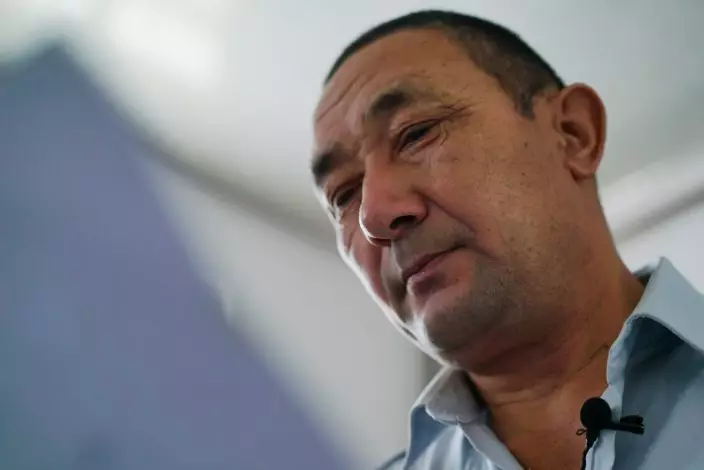
In this Dec. 8, 2018, photo, Adilgazy Yergazy, a farmer, looks at documents he's collected on his detained  younger brothers at his home in a village near Almaty, Kazakhstan. The Kazakhstan Foreign Ministry says China is allowing more than 2,000 ethnic Kazakhs to abandon their Chinese citizenship and leave the country, a sign that Beijing may be starting to feel a mounting backlash against a sweeping crackdown on Muslims in its far west region of Xinjiang. Yergazy says two of his little brothers were arrested and taken to internment camps last year, and that one was recently released from the camps but is unable to leave China. (AP PhotoDake Kang)

In this Dec. 8, 2018, photo, Adilgazy Yergazy, a farmer, looks at documents he's collected on his detained younger brothers at his home in a village near Almaty, Kazakhstan. The Kazakhstan Foreign Ministry says China is allowing more than 2,000 ethnic Kazakhs to abandon their Chinese citizenship and leave the country, a sign that Beijing may be starting to feel a mounting backlash against a sweeping crackdown on Muslims in its far west region of Xinjiang. Yergazy says two of his little brothers were arrested and taken to internment camps last year, and that one was recently released from the camps but is unable to leave China. (AP PhotoDake Kang)

In this Dec. 7, 2018, image made from video, relatives of people missing in China's far western region of Xinjiang hold up photos at an office of a Chinese Kazakh advocacy organization in Almaty, Kazakhstan. The Kazakhstan Foreign Ministry says China is allowing more than 2,000 ethnic Kazakhs to abandon their Chinese citizenship and leave the country, a sign that Beijing may be starting to feel a mounting backlash against a sweeping crackdown on Muslims in its far west region of Xinjiang. (AP PhotoDake Kang)

In this Dec. 7, 2018, image made from video, relatives of people missing in China's far western region of Xinjiang hold up photos at an office of a Chinese Kazakh advocacy organization in Almaty, Kazakhstan. The Kazakhstan Foreign Ministry says China is allowing more than 2,000 ethnic Kazakhs to abandon their Chinese citizenship and leave the country, a sign that Beijing may be starting to feel a mounting backlash against a sweeping crackdown on Muslims in its far west region of Xinjiang. (AP PhotoDake Kang)

In this Dec. 8, 2018, photo, a 23-year-old Kazakh citizen who asked to be identified by her nickname, Guli, to protect her family from retribution, stands with her children at their home in a village near Almaty, Kazakhstan. The Kazakhstan Foreign Ministry says China is allowing more than 2,000 ethnic Kazakhs to abandon their Chinese citizenship and leave the country, a sign that Beijing may be starting to feel a mounting backlash against a sweeping crackdown on Muslims in its far west region of Xinjiang. Guli says she was stuck in China away from her family for over two years before she was able to return back to Kazakhstan last July. (AP Photo Dake Kang)


In this Dec. 8, 2018, photo, a 23-year-old Kazakh citizen who asked to be identified by her nickname, Guli, to protect her family from retribution, stands with her children at their home in a village near Almaty, Kazakhstan. The Kazakhstan Foreign Ministry says China is allowing more than 2,000 ethnic Kazakhs to abandon their Chinese citizenship and leave the country, a sign that Beijing may be starting to feel a mounting backlash against a sweeping crackdown on Muslims in its far west region of Xinjiang. Guli says she was stuck in China away from her family for over two years before she was able to return back to Kazakhstan last July. (AP Photo Dake Kang)

LAS VEGAS (AP) — The U.S. Patent and Trademark Office has for now denied the A's request to trademark the names “Las Vegas Athletics” and “Vegas Athletics.”

The club, which intends to move to Nevada in 2028, has three months from when the refusals were issued Dec. 29 to ask for an extension to file a new application within a six-month period.

The A's were told the nickname “Athletics” was too generic and could be confused with other activities even if associated with Las Vegas.

That, however, has been the club's nickname since the Philadelphia Athletics began playing in 1901. The A's kept the nickname when they moved to Kansas City in 1955 and Oakland in 1968.

The Patent and Trademark Office denied the NHL's Utah team to use the nickname “Yetis” on Jan. 9 because of potential confusion with companies such as Yeti Coolers. Utah, which moved from the Phoenix area in 2024, now uses the nickname “Mammoth.”

The A's relocated to West Sacramento, California, last year to play the first of three planned seasons in the city's Triple-A ballpark. The team is going solely by “Athletics” while playing in the Northern California city.

A $2 billion, 33,000-capacity stadium on the Las Vegas Strip is under construction. Club officials told the Las Vegas Stadium Authority on Dec. 4 that the ballpark is on schedule to open in time for the 2028 season.

Nevada and Clark County have approved up to $380 million in public funds for the ballpark, and the A’s have said they will cover the remaining expenses. Owner John Fisher has been seeking investors to assist in the funding.

In preparing for the move to Las Vegas, the A's have signed some notable contracts. The most recent was an $86 million, seven-year deal for left fielder Tyler Soderstrom, the richest in team history. Soderstrom signed his contract Dec. 30 at the A's Experience Center in Las Vegas.

The A's acquired second baseman Jeff McNeil from the New York Mets on Dec. 22.

Going back to last offseason, the A's also reached agreements on a $60 million, five-year contract with designated hitter/outfielder Brent Rooker and a $65.5 million, seven-year deal with outfielder Lawrence Butler. Manager Mark Kotsay signed an extension that takes him through 2028 with a club option for 2029.

AP MLB: https://apnews.com/mlb

FILE - Athletics' Tyler Soderstrom sprints towards first after hitting an RBI double during the fifth inning of a baseball game against the Houston Astros, Sept. 23, 2025, in West Sacramento, Calif. (AP Photo/Scott Marshall, File)

FILE - Athletics' Tyler Soderstrom sprints towards first after hitting an RBI double during the fifth inning of a baseball game against the Houston Astros, Sept. 23, 2025, in West Sacramento, Calif. (AP Photo/Scott Marshall, File)

Recommended Articles