The tech giant’s new campus will eventually house around 25,000 staff.
Chinese technology giant Huawei has grown to become one the world’s most prominent forces in the tech industry, and close to its company headquarters building work is taking place that reflects that change in stature.
In Dongguan, close to the city of Shenzhen in southern China, the company has built a new campus – one designed to be almost solely for the firm’s research and development efforts.
This campus stands out because it is modelled on a number of European cities, taking architectural inspiration from cities and regions such as Grenada in Spain, Paris, Burgundy, Verona, and Bologna.
A sign perhaps of Huawei’s intent to be seen as a global company rather than just a Chinese one, the designs on show are taken from some of founder Ren Zhengfei’s favourite locations.
Such is the size of the campus that a miniature metro system is used by employees to move between the different buildings and “towns”.
Of 12 planned areas, eight are already open, with a space inspired by London also part of future plans.
The site currently holds around 20,000 people, but will eventually house 25,000 staff who are part of a research and development workforce that totals around 80,000.
It is an area of the company in which Huawei invests vast amounts of money – up to 15% of annual revenue goes into research and development – as it looks to unlock the next game-changing technology that could help it lead the industry.
The Dongguan campus is a manifestation of that, but its European setting inside China is also a reminder that the company continues to face questions from parts of the western world over its security and trustworthiness.
The company itself has argued that US hostilities towards Huawei are down to a mixture of geopolitical games to try and secure a better trade deal for the US in negotiations with China, and to try and slow Huawei’s rise as a tech giant, most notably in the area of 5G – a space US companies are not currently leading.
Bridges – and not just ones based on those from European cities – still need to be built.
BEIJING (AP) — China's Huawei Technologies said Thursday that it would roll out the world's most powerful AI computing clusters over the next two years as it seeks to outperform global leaders despite relying on less powerful domestic semiconductors.
China is racing to develop its own technology as America restricts what can be sold to China, including its most advanced chips. At the same time, the Chinese government has reportedly told companies to stop buying some American chips as it seeks to transform China into a global tech leader and one that is less reliant on imported components.
Huawei, at the forefront of efforts to develop home-grown technology, said at an annual customer event in Shanghai that it would launch new “superpods" in late 2026 and late 2027. That's computer industry lingo for a group of interconnected computers that, in Huawei's case, combines the power of thousands of chips.
That immense power is needed to run models in the burgeoning field of artificial intelligence, an area of hot competition between the U.S. and China.
“This is a significant milestone,” said Charlie Dai, a technology analyst at the research firm Forrester Research. "It signals a stronger push toward self-reliance and resilience in the face of export restrictions.”
Huawei announced plans to release the Atlas 950 and 960 superpods over the next two years. Dozens of the “SuperPoDs,” as Huawei brands them, could be connected to form what Huawei said would be the world’s most powerful “SuperClusters.”
The 950 and 960 are the most powerful superpods in the world and would remain so for years to come, a company news release said, based on product road maps from others in the industry.
The challenge for China is how to keep pace with American competitors such as Open AI and Google without access to the world's most powerful semiconductors, notably those from America's market-leading Nvidia. The answer has been to use many more chips and develop the architecture to make them work well together.
“Our strategy is to create a new computing architecture, and develop computing SuperPoDs and SuperClusters, to sustainably meet long-term demand for computing power,” Eric Xu, the current rotating chairman of Huawei, told the customer conference, according to a transcript provided by the company.
Huawei, based in Shenzhen in southern China, also announced plans to launch new AI chips in its Ascend series over the next three years. The Atlas 950 and 960 superpods would be based on the Ascend 950 and 960 chips, due out in 2026 and 2027. A planned Ascend 970 chip could follow in 2028.
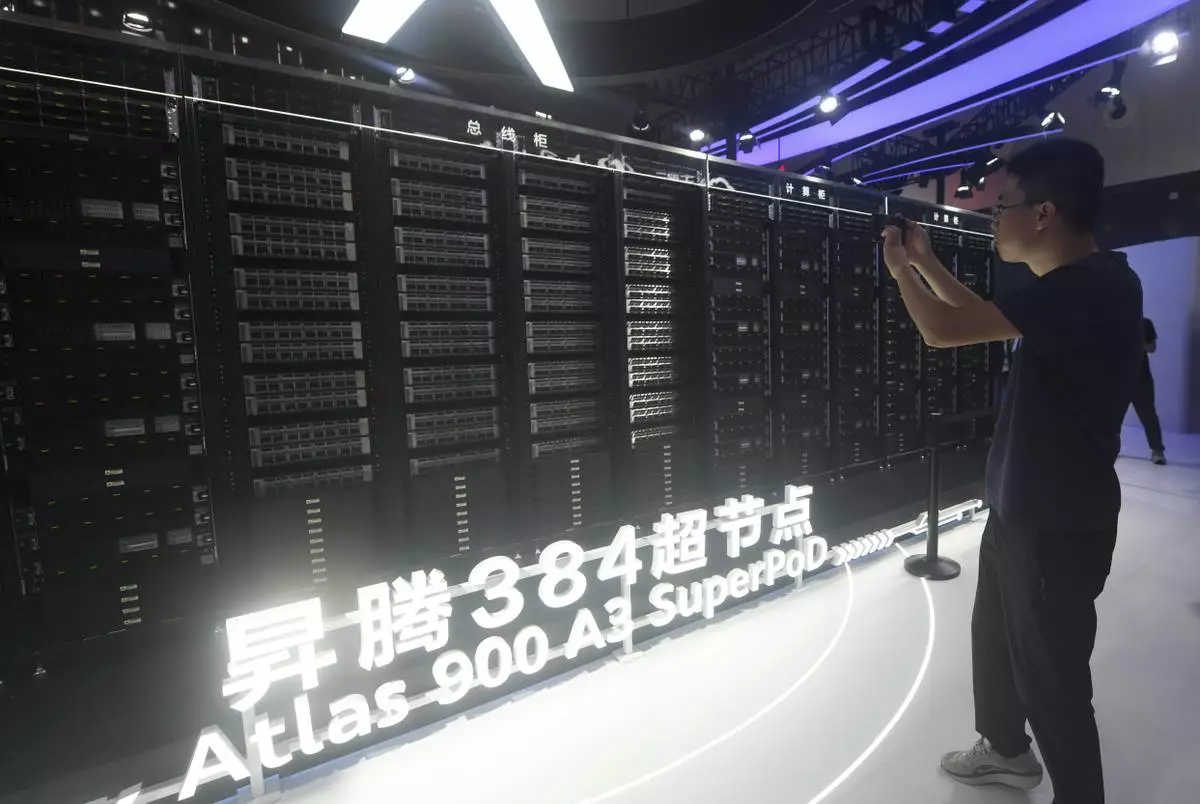
A visitor takes photos of the Huawei Atlas 900 A3 SuperPoD exhibited at the World Artificial Intelligence Conference in Shanghai, China, July 26, 2025. (Chinatopix Via AP) CHINA OUT
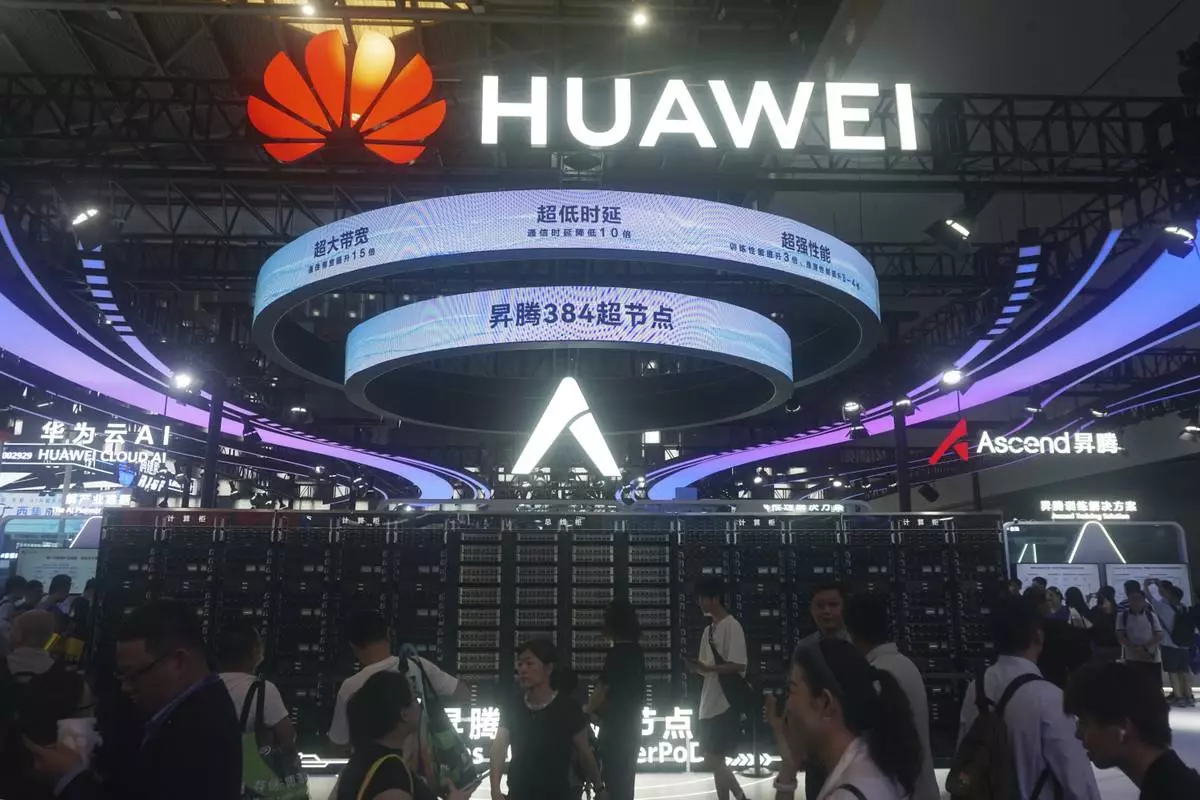
Visitors pass by the Huawei Atlas 900 A3 SuperPoD exhibited at the World Artificial Intelligence Conference in Shanghai, China, July 28, 2025. (Chinatopix Via AP) CHINA OUT