A six-floor apartment building in Medellin that Pablo Escobar once called home was demolished Friday in an emotional ceremony that officials hope will dampen some of the fervor for the notorious drug lord's criminal life and instead showcase the city's rebirth.
Rogelio Gomez, the engineer in charge of the demolition, said that 180 detonators were used to topple the Monaco building and a 100 meter (328 feet) security zone was designated around the area.
"1,500 people who live nearby were evacuated for security," he also said.
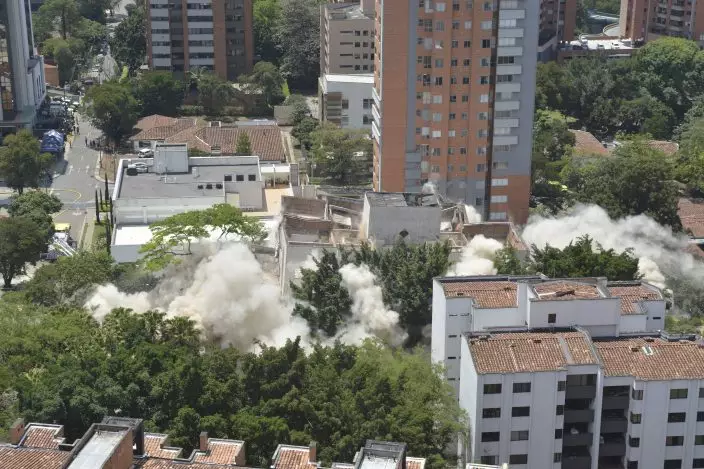
Clouds of dust rise during the implosion of a six-floor apartment building that former cartel boss Pablo Escobar once called home, in Medellin, Colombia, Friday, Feb. 22, 2019. Mayor Federico Gutierrez had been pushing to raze the building and erect in its place a park honoring the thousands of victims, including four presidential candidates and some 500 police officers, killed by Escobar's army of assassins during the Medellin cartel's heyday in the 1980s and 1990s. (AP PhotoLuis Benavidez)
The explosion took place at 11:53 local time and sent a cloud of dust 10 meters (33 feet) into the air.
Colombian President Ivan Duque, who was still a teenager when Escobar was killed in 1993 in a rooftop shootout with police, said the explosion "means that history is not going to be written in terms of the perpetrators but by recognizing the victims."
The white concrete building in Medellin's leafy Poblado neighborhood was gutted by a car bomb in 1988 and has remained an unoccupied eyesore ever since, drawing mostly foreign tourists who sign up every day for tours of Escobar's former hometown haunts. The Netflix "Narcos" series has also popularized such attractions.
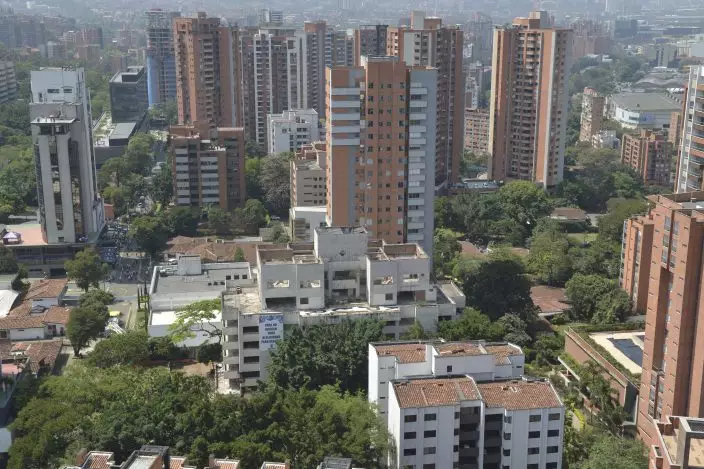
This photo shows the six-floor apartment building that former cartel boss Pablo Escobar once called home, before its demolition, in Medellin, Colombia, Friday, Feb. 22, 2019. Mayor Federico Gutierrez had been pushing to raze the building and erect in its place a park honoring the thousands of victims, including four presidential candidates and some 500 police officers, killed by Escobar's army of assassins during the Medellin cartel's heyday in the 1980s and 1990s. (AP PhotoLuis Benavidez)
But Mayor Federico Gutierrez had been pushing to raze the building and erect in its place a park honoring the thousands of victims, including four presidential candidates and some 500 police officers, killed by Escobar's army of assassins during the Medellin cartel's heyday in the 1980s and 1990s.
"We are paying back a historical debt with our victims," Gutierrez said prior to the demolition.
Retired Gen. Rosse Jose Serrano, who for many years led the elite police squad that pursued Escobar, said the Monaco building was where the famous capo planned some of his most brazen attacks.
"It was his criminal fortress," Serrano told The Associated Press.
Still, some in Colombia remember him fondly as a Robin Hood-like father figure who gave away homes to the poor and railed against the nation's political elites.
Escobar built the Monaco for his wife, and the fugitive's family was living there when Escobar's rivals from the Cali cartel bombed it in 1988.
After his death, successive Colombian administrations burdened by red tape, legal challenges and perhaps fear of awakening Escobar's ghosts struggled to find a buyer to take over the abandoned property.
Once the murder capital of the world, Medellin, like much of Colombia, has seen major improvements in security over the past 15 years, although the murder rate has been inching up since its all-time low in 2015.
Nonetheless, the city's vibrant cultural scene, spring-like weather and entrepreneurial locals have converted it into one of the gems of the South American nation's tourism boom.
WASHINGTON (AP) — President Donald Trump is meeting with oil executives at the White House on Friday in hopes of securing $100 billion in investments to revive Venezuela’s ability to fully tap into its expansive reserves of petroleum — a plan that rides on their comfort in making commitments in a country plagued by instability, inflation and uncertainty.
Since the U.S. military raid to capture former Venezuelan leader Nicolás Maduro on Saturday, Trump has quickly pivoted to portraying the move as a newfound economic opportunity for the U.S., seizing tankers carrying Venezuelan oil, saying the U.S. is taking over the sales of 30 million to 50 million barrels of previously sanctioned Venezuelan oil and will be controlling sales worldwide indefinitely.
On Friday, U.S. forces seized their fifth tanker over the past month that has been linked to Venezuelan oil. The action reflected the determination of the U.S. to fully control the exporting, refining and production of Venezuelan petroleum, a sign of the Trump administration's plans for ongoing involvement in the sector as it seeks commitments from private companies.
It's all part of a broader push by Trump to keep gasoline prices low. At a time when many Americans are concerned about affordability, the incursion in Venezuela melds Trump’s assertive use of presidential powers with an optical spectacle meant to convince Americans that he can bring down energy prices.
The meeting, set for 2:30 p.m. EST, will be open to the news media, according to an update to the president's daily schedule. “At least 100 Billion Dollars will be invested by BIG OIL, all of whom I will be meeting with today at The White House,” Trump said Friday in a pre-dawn social media post.
Trump is set to meet with executives from 17 oil companies, according to the White House. Among the companies attending are Chevron, which still operates in Venezuela, and ExxonMobil and ConocoPhillips, which both had oil projects in the country that were lost as part of a 2007 nationalization of private businesses under Maduro’s predecessor, Hugo Chávez.
The president is meeting with a wide swath of domestic and international companies with interests ranging from construction to the commodity markets. Other companies slated to be at the meeting include Halliburton, Valero, Marathon, Shell, Singapore-based Trafigura, Italy-based Eni and Spain-based Repsol.
Large U.S. oil companies have so far largely refrained from affirming investments in Venezuela as contracts and guarantees need to be in place. Trump has suggested on social media that America would help to backstop any investments.
Venezuela’s oil production has slumped below one million barrels a day. Part of Trump's challenge to turn that around will be to convince oil companies that his administration has a stable relationship with Venezuela’s interim President Delcy Rodríguez, as well as protections for companies entering the market.
Secretary of State Marco Rubio, Energy Secretary Chris Wright and Interior Secretary Doug Burgum are slated to attend the oil executives meeting, according to the White House.
Meanwhile, the United States and Venezuelan governments said Friday they were exploring the possibility of r estoring diplomatic relations between the two countries, and that a delegation from the Trump administration arrived to the South American nation on Friday.
The small team of U.S. diplomats and diplomatic security officials traveled to Venezuela to make a preliminary assessment about the potential re-opening of the U.S. Embassy in Caracas, the State Department said in a statement.
Trump also announced on Friday he’d meet with President Gustavo Petro in early February, but called on the Colombian leader to make quick progress on stemming flow of cocaine into the U.S.
Trump, following the ouster of Maduro, had made vague threats to take similar action against Petro. Trump abruptly changed his tone Wednesday about his Colombian counterpart after a friendly phone call in which he invited Petro to visit the White House.
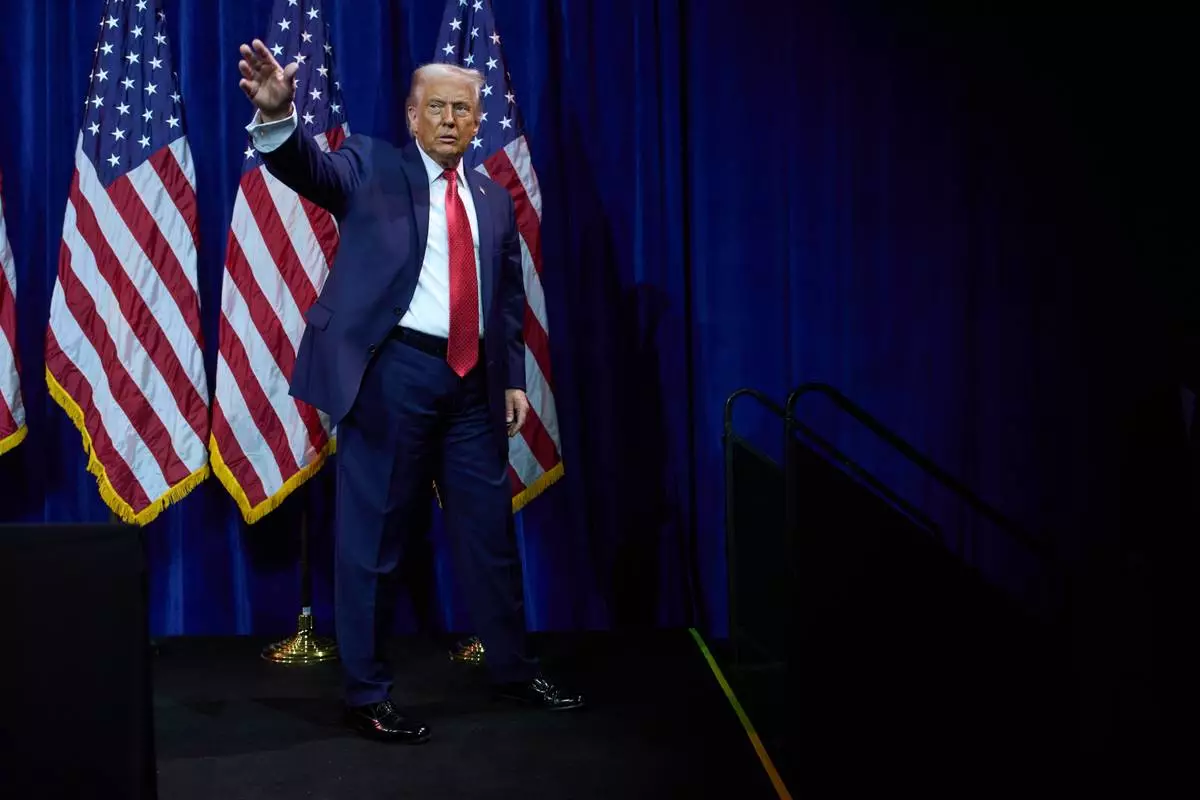
President Donald Trump waves as he walks off stage after speaking to House Republican lawmakers during their annual policy retreat, Tuesday, Jan. 6, 2026, in Washington. (AP Photo/Evan Vucci)