Few paid much attention when Mikio Oda won Japan's first Olympic gold medal — and Asia's first individual gold medal — way back at the 1928 Amsterdam Olympics.
There was no podium ceremony. That protocol was introduced in 1932 at the Winter Games in Lake Placid and the Summer Games in Los Angeles. The medals prior to this were handed over at the end of the games, in this case by Dutch Queen Wilhelmina.
Click to Gallery
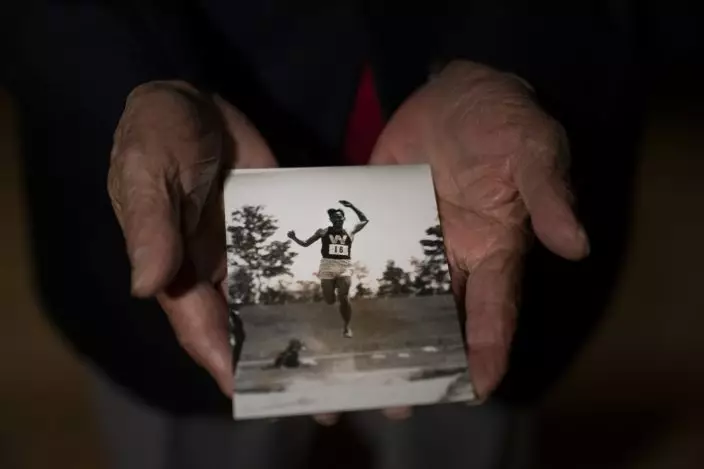
In this July 8, 2019, photo, Kazuo Oda, a son of Mikio Oda, who won Japan's first Olympic gold medal and Asia's first individual gold medal at the 1928 Amsterdam Olympics, poses for photos with a photo of his father during an interview with The Associated Press at Edo-Tokyo Museum in Tokyo. There was no podium ceremony back then. And the flag that was raised was brought to the Netherlands by the Japanese delegation. (AP PhotoJae C. Hong)
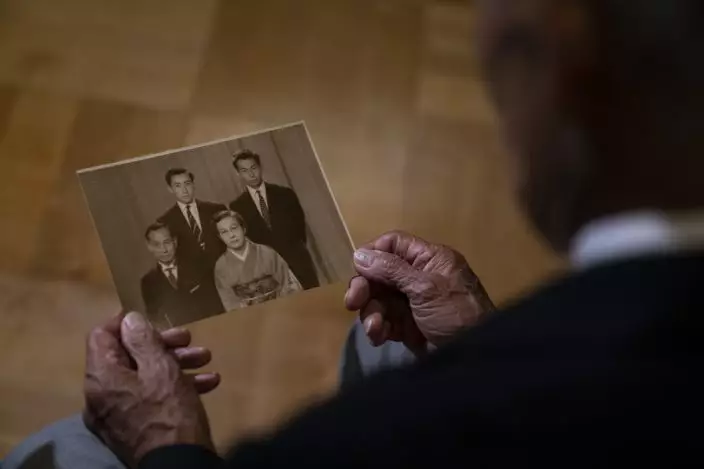
In this July 8, 2019, photo, Kazuo Oda, a son of Mikio Oda, who won Japan's first Olympic gold medal and Asia's first individual gold medal at the 1928 Amsterdam Olympics, holds an old family photo during an interview with The Associated Press at Edo-Tokyo Museum in Tokyo. “My father was from Hiroshima, so there was a celebration in his hometown upon his return,” Kazuo Oda said. “But as there were no media possibilities like today, his achievements were not known by everybody in Japan.” (AP PhotoJae C. Hong)
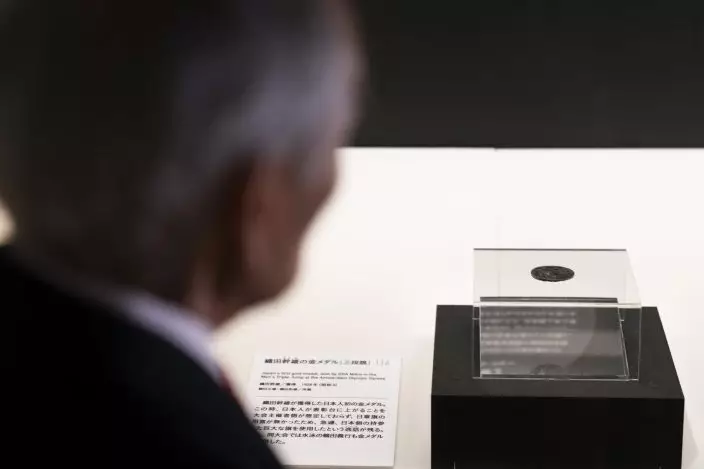
In this July 8, 2019, photo, Kazuo Oda, a son of Mikio Oda, who won Japan's first Olympic gold medal and Asia's first individual gold medal at the 1928 Amsterdam Olympics, looks at his father's gold medal on display at Edo-Tokyo Museum in Tokyo. (AP PhotoJae C. Hong)
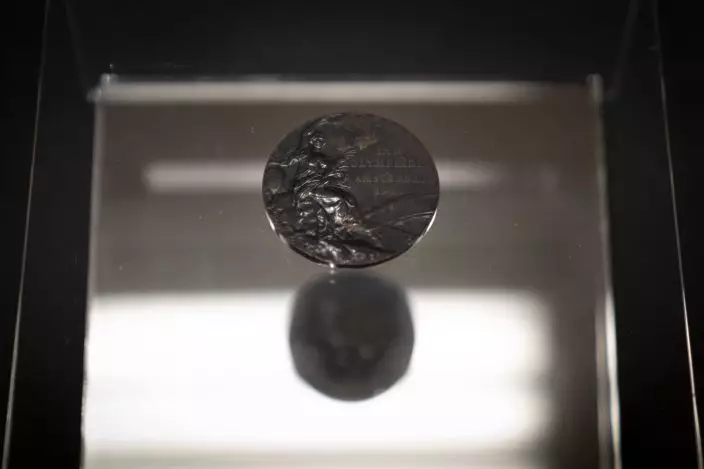
In this July 8, 2019, photo, Mikio Oda's gold medal is on display at Edo-Tokyo Museum in Tokyo. Oda won Japan's first Olympic gold medal and Asia's first individual gold medal at the 1928 Amsterdam Olympics. (AP PhotoJae C. Hong)
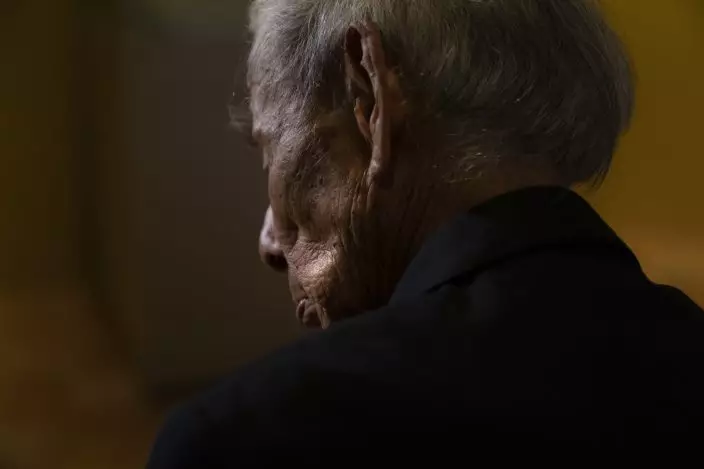
In this July 8, 2019, photo, Kazuo Oda, a son of Mikio Oda, who won Japan's first Olympic gold medal and Asia's first individual gold medal at the 1928 Amsterdam Olympics, pauses for a moment during an interview with The Associated Press at Edo-Tokyo Museum in Tokyo. (AP PhotoJae C. Hong)
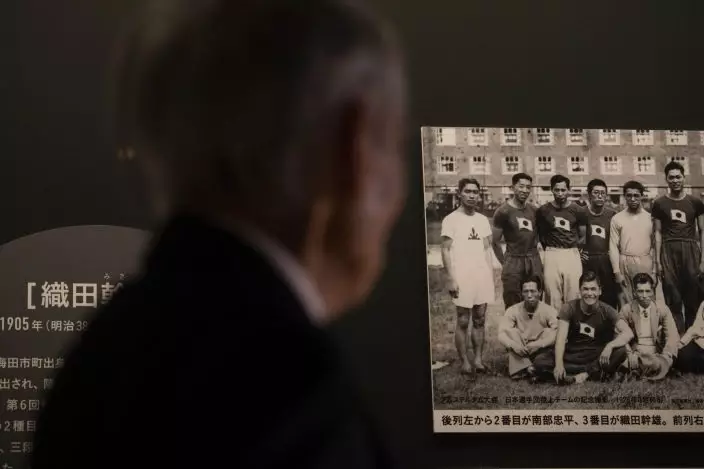
In this July 8, 2019, photo, Kazuo Oda, a son of Mikio Oda, who won Japan's first Olympic gold medal and Asia's first individual gold medal at the 1928 Amsterdam Olympics, looks at a group picture showing his father, standing fourth from right, at Edo-Tokyo Museum in Tokyo. (AP PhotoJae C. Hong)
Oda missed out. He'd already left for Paris to compete in another international meet. Such was the stature of the Olympics back then.
In this July 8, 2019, photo, Kazuo Oda, a son of Mikio Oda, who won Japan's first Olympic gold medal and Asia's first individual gold medal at the 1928 Amsterdam Olympics, poses for photos with a photo of his father during an interview with The Associated Press at Edo-Tokyo Museum in Tokyo. There was no podium ceremony back then. And the flag that was raised was brought to the Netherlands by the Japanese delegation. (AP PhotoJae C. Hong)
They did have a flag-raising ceremony when he won the triple jump, known then as the "hop, skip and jump" or "hop, step and jump." Only one problem: officials, it seems, didn't have a Japanese flag.
The flag that went up was brought to the Netherlands by the Japanese delegation that included members from Waseda University, where Oda was a student. Few expected a Japanese victory.
And there wasn't much fuss back home.
In this July 8, 2019, photo, Kazuo Oda, a son of Mikio Oda, who won Japan's first Olympic gold medal and Asia's first individual gold medal at the 1928 Amsterdam Olympics, holds an old family photo during an interview with The Associated Press at Edo-Tokyo Museum in Tokyo. “My father was from Hiroshima, so there was a celebration in his hometown upon his return,” Kazuo Oda said. “But as there were no media possibilities like today, his achievements were not known by everybody in Japan.” (AP PhotoJae C. Hong)
"My father was from Hiroshima, so there was a celebration in his hometown upon his return," his 83-year-old son Kazuo Oda told The Associated Press in an interview. "But as there were no media possibilities like today, his achievements were not known by everybody in Japan."
Oda's life and triumphs are preserved in a yellowed family album, captured perfectly by a tiny snapshot that Kazuo Oda cradled in his palms that shows his father in mid-air flight in the triple jump almost a century ago.
"My father was very quiet and almost shy about telling about his achievements," Kazuo Oda said. "So when he was in his prime as an athlete, his achievements were not known to everybody like they could have been today."
In this July 8, 2019, photo, Kazuo Oda, a son of Mikio Oda, who won Japan's first Olympic gold medal and Asia's first individual gold medal at the 1928 Amsterdam Olympics, looks at his father's gold medal on display at Edo-Tokyo Museum in Tokyo. (AP PhotoJae C. Hong)
Mikio Oda was famous when he died at 93 in 1998 and was selected posthumously as the best Asian athlete of the century. The distance of his winning jump — 15.21 meters (49.9 feet) — is etched in stone outside the new headquarters of the Japanese Olympic Committee. He also once held the world record of 15.58 meters (51.11 ft.) and placed sixth in the 1924 Olympics in Paris.
He was also a journalist, a promoter of Olympic sport, and Japan's track and field coach for the 1964 Tokyo Olympics. He was among the favorites to light the cauldron at the '64 games. But that honor went to the-late Yoshinori Sakai, who was born in Hiroshima on Aug. 6, 1945, the day the U.S. bomber Enola Gay dropped the atomic bomb on the city.
The era in which Oda competed — he got to Amsterdam via a two-week train ride across Siberia in which he complained about the food — puts next year's Tokyo Olympics into sharp relief, where at least $20 billion is being spent to ready the city. Or the ambitious 1964 Tokyo Olympics, which signaled Japan's recovery 19 years after the end of World War II.
In this July 8, 2019, photo, Mikio Oda's gold medal is on display at Edo-Tokyo Museum in Tokyo. Oda won Japan's first Olympic gold medal and Asia's first individual gold medal at the 1928 Amsterdam Olympics. (AP PhotoJae C. Hong)
The early games focused almost entirely on Europe, the Americas, and some outposts of the old British Empire. Though Oda won the first individual gold medal for Asia, the first team gold medal went to the field hockey team from British India — also in 1928. That win came several months before Oda's at a time when the games were spread out over many months.
"I would vote for either Rome 1960 or Tokyo 1964 as when the Olympic became a show for the entire world and not just the West," Bill Mallon, past-president and co-founder of the International Society of Olympic Historians, told AP. Mallon, who helped dig up the research on podiums and early medal ceremonies, credited the Olympics' rise to television. Rome was the first to offer international TV coverage and Tokyo expanded the coverage via early satellites.
Tokyo was officially designated by the IOC to hold the Olympics in 1940. But Japan withdrew in mid-1938, citing the war in China as the reason. Helsinki stepped in, but those games were eventually cancelled.
In this July 8, 2019, photo, Kazuo Oda, a son of Mikio Oda, who won Japan's first Olympic gold medal and Asia's first individual gold medal at the 1928 Amsterdam Olympics, pauses for a moment during an interview with The Associated Press at Edo-Tokyo Museum in Tokyo. (AP PhotoJae C. Hong)
Kazuo Oda, who worked in the international trading business, recalled a trip to China in which a university dean said he recognized the Oda family name.
"I told him it was my father," Kazuo Oda recalled. "He then said how proud and happy he felt about my father winning the gold medal as the first person from Asia, saying that people from Asia at that time were still often subjected to racial discrimination."
Kazuo Oda said his father was genuinely cosmopolitan; "a fan of the Burberry raincoat" who regularly bought overseas books and newspapers to keep up.
In this July 8, 2019, photo, Kazuo Oda, a son of Mikio Oda, who won Japan's first Olympic gold medal and Asia's first individual gold medal at the 1928 Amsterdam Olympics, looks at a group picture showing his father, standing fourth from right, at Edo-Tokyo Museum in Tokyo. (AP PhotoJae C. Hong)
"I found so many dictionaries, such as one in Swedish in my father's study," Kazuo said. "I was wondering why he had such dictionaries but later I found that he was reading newspapers from all over the world including those from Sweden or Spain so that he could check the world sport trends and the details of the athletes."
He said his father even rented a cafe across from the '64 Olympic Village, a meeting place where coaches and athletes from all countries could chat and hang out.
It took Japan two decades to rebuild after the war, but Mikio Oda recognized the psychological damage lingered.
"When Japanese athletes were faced with the strong (foreign) athletes, they could be easily intimidated," Kazuo said. "That's what vexed my father so much. Even if the (Japanese) athletes had capabilities, when they heard their competitors' names they were prone to become hesitant. Japan was still in that phase at that time. Even by 1964, Japanese people still held on to the belief that Japanese could not beat the athletes from overseas."
That's changed. Japan has an ambitious goal of winning 30 gold medals next year, almost twice its best previous total of 16. That would probably put it among the top five, competing squarely with far more populous countries like China and the United States.
"He would have been happy if he had seen Tokyo hosting the second Summer Olympics," Kazuo said. "But he was such an old-school person and only knew the time when sports were largely amateur. He did not live to see when the boundary between amateurism and professionalism in sports is ambiguous. I doubt that he would have liked it."
Stephen Wade on Twitter: http://twitter.com/StephenWadeAP
More AP sports: https://apnews.com/apf-sports and https://twitter.com/AP_Sports