He was the face of Toyota in the U.S. unintended acceleration crisis, steered the automaker through the Great Recession, started and closed the youth-oriented Scion brand and reorganized North American operations.
Now, after 38 years in number of leadership roles with the company, Jim Lentz is retiring, effective April 1.
Lentz, 64, will step down in April as CEO of Toyota Motor North America, and will be replaced by Tetsuo “Ted” Ogawa, who currently chief operating officer, Toyota said Wednesday.
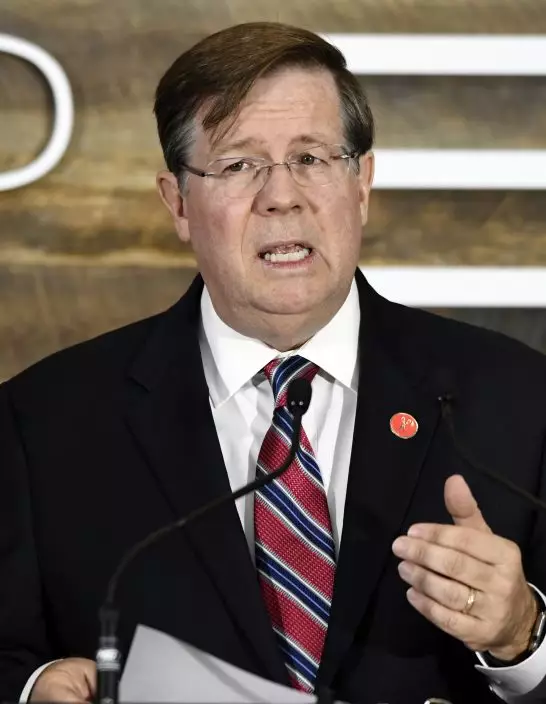
FILE - In this Oct. 30, 2017, file photo Jim Lentz. Chief Executive Officer of Toyota Motor North America, speaks at the dedication ceremony for the new production engineering and manufacturing center in Georgetown, Ky. After 38 years in number of leadership roles with the company, Lentz is retiring, effective April 1, 2020. Lentz, 64, will step down in April as CEO of Toyota Motor North America, and will be replaced by Tetsuo “Ted” Ogawa, who currently chief operating officer, the company said Wednesday, Dec. 11, 2019. (AP PhotoTimothy D. Easley, File)
Lentz is most well known for his February, 2010, testimony before a congressional committee investigating complaints about Toyota vehicles accelerating without warning. Lentz was candid, saying that recalls of some 8.5 million vehicles worldwide and more than 6 million in the United States may not solve the problems.
He said at the time that an electronic cause could not be ruled out, although Toyota and U.S. government agencies did make controversial determinations later that the problem was caused by sticky gas pedals and floor mats pushing on the accelerator, not electronics. Toyota was fined $50 million for being too slow to report safety problems to U.S. regulators.
Lentz, in an interview with The Associated Press, said the period between the global financial crisis in 2008 and 2009, the unintended acceleration crisis and a devastating earthquake and tsumani that hit Japan in 2011 was the most difficult of his career.
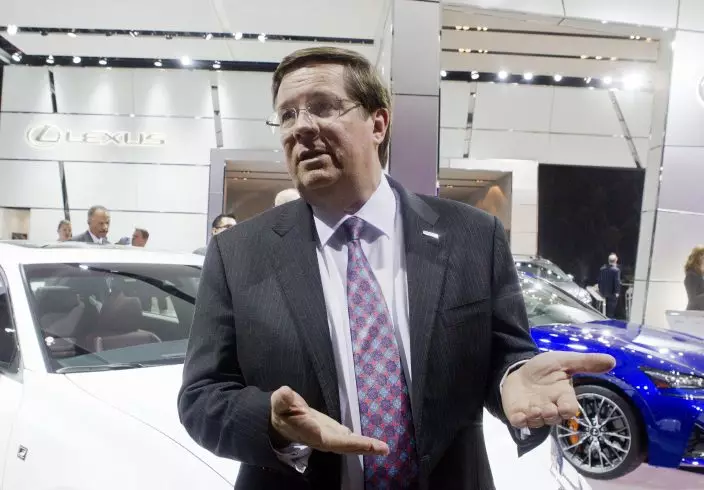
FILE - In this Jan. 11, 2016, file photo Toyota North America CEO Jim Lentz gives an interview within the Lexus display floor at the North American International Auto Show in Detroit. After 38 years in number of leadership roles with the company, Lentz is retiring, effective April 1, 2020. Lentz, 64, will step down in April as CEO of Toyota Motor North America, and will be replaced by Tetsuo “Ted” Ogawa, who currently chief operating officer, the company said Wednesday, Dec. 11, 2019. (AP PhotoTony Ding, File)
The unintended acceleration saga taught him that it's important not only to listen to customers and government regulators, but to understand them, Lentz said. “It's important that you be transparent,” said Lentz. "Make quick decisions, implement them quickly and move on."
Lentz, who started his automotive career at Ford Motor Co. in 1978, joined Toyota in 1982 and worked his way up through the sales operation.
In 2003 he launched the Scion brand to lure people 18 to 34 to the aging Toyota family. Scion, with funky designs, did appeal to some younger buyers, but sales slumped and it was folded into the Toyota brand in 2016.
After becoming chief executive of the North American region for the whole company in 2015, Lentz made a bold decision to combine Toyota's siloed U.S. manufacturing, sales and finance operations. In 2017 he relocated the company's North American headquarters from California to the Dallas suburb of Plano, Texas.
He called the move “One Toyota” and said it got all of North America on the same page, improving the speed of decision making to handle fast-paced industry changes. “I'm convinced the new norm for any business is just chaos,” Lentz said. “It's been chaos since 2009.”
Lentz said he has positioned Toyota in the U.S. to handle the shift away from cars to trucks and SUVs, as well as a pending shift to electric, hybrid or hydrogen fuel cell propulsion systems. Toyota also has partnerships and is developing its own autonomous vehicles. Lentz said the move to autonomous or electric vehicles will take a long time, and even if he stayed longer, he wouldn't be around long enough to see the company through the changes.
So now it's time to leave Toyota to what Lentz said is a strong U.S. leadership team. He plans to stay in Texas, improve his golf game and see his two granddaughters more often. Lentz said he may join the board of a corporation or nonprofit at some point.
Iran's top judge hinted at fast trials and executions for those who were detained in nationwide protests against the country's theocracy, even as activists said Wednesday that the death toll rose to levels unseen in decades, with at least 2,586 people killed so far.
Iran’s judiciary chief Gholamhossein Mohseni-Ejei, made the comments about trials and executions in a video Tuesday, despite a warning from U.S. President Donald Trump that he would “take very strong action” if executions take place.
The U.S.-based Human Rights Activists News Agency said the number of dead climbed to at least 2,586 on Wednesday. The figure dwarfs the death toll from any other round of protest or unrest in Iran in decades and recalls the chaos surrounding the country’s 1979 Islamic Revolution.
After Trump was informed of the number of deaths, he warned Iran's leaders that he was terminating any negotiations and would “act accordingly.”
Details of the crackdown began emerging Tuesday as Iranians made phone calls abroad for the first time in days after authorities severed communications countrywide when the protests broke out.
Here is the latest:
At a protest march of 900 Iranian exiles and German supporters in Berlin on Wednesday night, Maryam Nejatipur, 32, told The Associated Press how unbearably worried she was about her family back home.
“They’re in a complete blackout. We don’t have any news,” said the former teacher who was forced to leave her home country about two years ago.
She said she didn’t know how to get through the days since Iran shut down the internet and phones and she could not longer find out if her family was still alive.
She sobbed and said really she was not only worried about her immediate family but all Iranians. “There are 90 million people inside Iran and they are killing all of them,” she said.
U.S. envoy Steve Witkoff has met with exiled former crown prince of Iran Reza Pahlavi, a White House official confirmed on Wednesday, speaking on condition of anonymity about the private meeting. The official provided no further details.
Italy’s Foreign Minister Antonio Tajani has been meeting on Wednesday evening with officials from the Italian Ministry of Defense, the Italian Ambassador to Tehran and ambassadors from the main capitals involved in the current crisis in Iran.
The ministry reiterated its recommendation that Italian citizens should leave Iran if they are able to do so, a statement said.
Mohammad Pakpour, commander of Iran’s paramilitary Revolutionary Guard, threatened Wednesday that the country would give a “decisive response” to the death of Iranian “martyrs and security protectors,” according to Iran’s semiofficial Tasnim news agency.
Pakpour reiterated Iranian officials’ claims that U.S. and Israel have instigated these protests and that they are the “main killers” of the hundreds of casualties. He added that those countries will “receive the response in the appropriate time.”
Pakistan’s Prime Minister Shehbaz Sharif said in a call Wednesday with Qatar’s Emir Sheikh Tamim bin Hamad al-Thani that Pakistan would continue to play a positive role in maintaining regional peace and stability, a statement from Sharif’s office said.
The two leaders discussed recent developments in the Middle East and expressed satisfaction with the current trajectory of bilateral relations between Pakistan and Qatar, according to the statement.
Sharif praised Qatar’s role in promoting peace, dialogue and mediation in the region and acknowledged its efforts to defuse tensions through diplomatic means.
Both leaders agreed to remain in close contact in the coming days, the statement said.
Scores gathered on Wednesday in a show of support for the ongoing anti-government protests in Iran.
Some held posters of Iran’s exiled crown prince Reza Pahlavi and others of U.S. President Donald Trump. One placard read: “President Trump! Iranian people deserve freedom … Hear their voice.”
“We are here to be the voice of the Iranian people against the Islamic regime in Iran,” Esi Fallah told The Associated Press. “We are here to ask President Trump for help ... The regime in Iran fires at its people.”
Fallah added that he has not been able to contact his family in Iran due to the internet blackout. “We don’t know anything about them since Friday,” he said.
Another protester, Mahzad, who only gave his first name, said: “For five days, I have no news from my family or my friends. I don't know if they are still alive."
“U.S. citizens should leave Iran now. Consider departing Iran by land to Türkiye or Armenia, if safe to do so,” the virtual U.S. embassy in Tehran said in a statement Wednesday.
This is the third alert in five days.
The embassy also said U.S.-Iranian dual nationals must exit Iran using their Iranian passports.
Some personnel at Qatar’s Al Udeid Air Base have been advised to evacuate by Wednesday evening, a U.S. official said. The decision came as a senior official in Iran brought up an earlier Iranian attack there.
The official, who spoke to The Associated Press on Wednesday on the condition of anonymity to discuss sensitive plans, described the move at the base as a precautionary measure. The official wouldn’t go into any further details about the move, including whether the evacuation was optional or mandatory, if it affected troops or civilian personnel, or the number of those advised to leave, citing the need for operational security.
It comes as anti-government protests in nearby Iran continue and U.S. President Donald Trump has said that he is willing to conduct military operations in the country if the government continues to retaliate against the protesters.
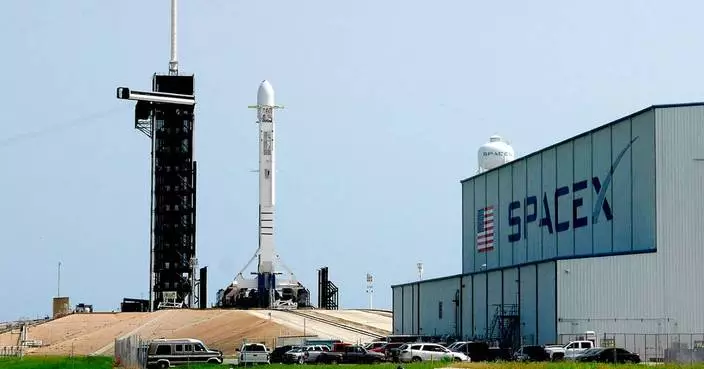
SpaceX’s Starlink satellite internet service dropped its fees to allow protesters in Iran to send updates of what is happening inside the Islamic Republic following a communication blackout by authorities.
Elon Musk’s SpaceX has not officially announced the decision and did not respond to a request for comment, but activists told The Associated Press that Starlink has been available for free to anyone in Iran with the receivers since Tuesday.
“Starlink has been crucial,” said Mehdi Yahyanejad, an Iranian whose nonprofit Net Freedom Pioneers has helped smuggle units into Iran, pointing to footage that emerged Sunday showing rows of bodies at a forensic medical center near Tehran.
Starlink is banned in Iran.
Tens of thousands of mourners thronged the streets near Tehran University for a mass funeral of security forces and civilians on Wednesday.
After Iranian state television reported that 300 coffins would be on display at Tehran University, Associated Press reporters there saw around 100. It wasn’t clear why there was a discrepancy.
Many held Iranian flags and identical photos of Ayatollah Ali Khamenei and their relatives. The caskets, covered in Iranian flags, were stacked at least three high in the backs of trucks and covered with red and white roses and framed photographs of people who were killed. The crowd chanted and beat their chests in response to an emcee speaking from a stage.
One man in the crowd held up a photo of U.S. President Donald Trump during the Pennsylvania assassination attempt, emblazoned with: “The arrow doesn’t always miss!”
The presenter, his voice booming across the crowd, blamed the U.S. for the unrest. “All of our problems are because of America, today’s economic problems are because of American sanctions. Death to America!” he yelled, prompting the same chant from the tens of thousands of people, dressed mostly in black.
India's Embassy in Tehran urged Wednesday all Indian nationals to leave Iran, citing what it called an “evolving situation” in the Islamic Republic.
The statement, posted on X, also advised Indian citizens to remain highly vigilant and avoid areas where protests are taking place.
German police said Wednesday the two climbed over a fence into embassy grounds and tore down an Iranian flag. Both wanted to hoist two pre-Islamic Republic flags but failed, German news agency dpa reported.
They left the grounds when guards used pepper spray and were detained on the sidewalk outside.
The incident happened late Tuesday.
Major Middle East governments were discouraging the Trump administration from waging a war with Iran, fearing “unprecedented consequences” in the volatile region, an Arab Gulf diplomat said Wednesday.
The Cairo-based diplomat, who was given anonymity because he wasn't authorized to speak to the media, said major governments in the region, including Turkey, Egypt, Saudi Arabia and Pakistan, have been “in constant contact” with the U.S. administration over a potential American strike on Iran that could explode into a “full-blown war.”
Such a war will “certainly” have dire repercussions “not only on the Middle East but also on the global economy," he said.
Iranian state television said Wednesday’s mass funeral in Tehran would include 300 bodies of security force members and civilians. The funeral is expected to take place at Tehran University under heavy security.
The U.S.-based Human Rights Activists News Agency said 2,417 of the dead were protesters and 147 were government-affiliated. Twelve children were killed, along with 10 civilians it said were not taking part in protests. More than 18,400 people have been detained, the group said.
Gauging the demonstrations and the death toll from abroad has grown more difficult. The Associated Press has been unable to independently assess the toll, given the communications being disrupted in the country.
Melanie Lidman contributed from Jerusalem.
Trump’s decision to impose a 25% tariff on countries that trade with Iran could impact India, an expert said, as New Delhi already faces existing 50% U.S. trade levies due to its purchases of Russian oil.
Abhijit Mukhopadhyay, a senior economist at the Chintan Research Foundation in New Delhi, said the bigger risk is not India-Iran trade, but India’s access to the U.S. market, as its exports to Iran are modest.
India mainly exports rice, tea, sugar, pharmaceuticals and electrical machinery to Iran, while importing dry fruits and chemical products. Textiles and garments, gems and jewelry and engineering goods are likely to be the most vulnerable sectors, he said.
Trump’s latest move also could affect India’s investments in Iran, including the strategically important Chabahar port, which gives India a trade route to Afghanistan, Central Asia and Europe while bypassing Pakistan, Mukhopadhyay said.
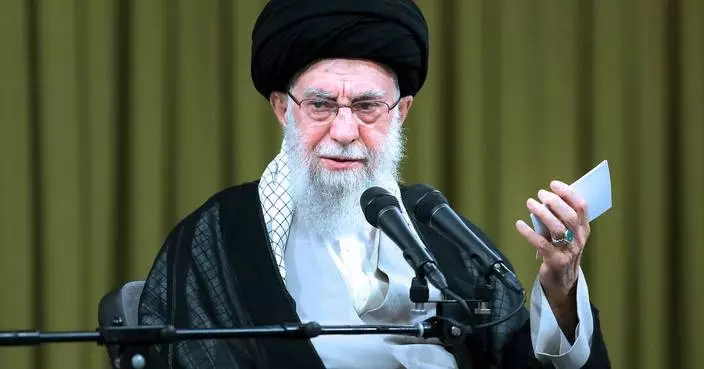
Iran’s judiciary chief signals fast trials and executions for those detained in nationwide protests.
Gholamhossein Mohseni-Ejei made the comment in a video shared by Iranian state television on Wednesday.
He emphasized the need for swift action, saying delays would lessen the impact.
His remarks challenge Trump, who warned Iran about executions in an interview aired Tuesday.
Trump stated the U.S. would take strong action if Iran proceeded with executions. The situation highlights escalating tensions between the two countries over the handling of the protests.
Dozens of Pakistani students studying in Iran have returned home through a remote southwestern border crossing, a Pakistani immigration official said Wednesday.
Federal Investigation Agency spokesperson in Quetta city, Samina Raisani, said about 60 students crossed into Pakistan on Tuesday through Gabd border in Balochistan province with valid travel documents.
More students were expected to return through the same crossing later Wednesday, she said.
Mudassir Tipu, Pakistan’s ambassador to Iran, said Tuesday that Iranian universities had rescheduled exams and permitted international students to leave the country.
The satellite internet provider Starlink now offers free service to people in Iran who have access to the company's receivers, activists said Wednesday.
Mehdi Yahyanejad, a Los Angeles-based activist who helped get the units into Iran, told The Associated Press that the free service had started. Other activists also confirmed in messages online that the service was free.
Starlink has been the only way for Iranians to communicate with the outside world since authorities shut down the internet Thursday night as nationwide protests swelled and they began a bloody crackdown against demonstrators.
Starlink did not immediately acknowledge the decision.

This frame grab from videos taken between Jan. 9 and Jan. 11, 2026, and circulating on social media purportedly shows images from a morgue with dozens of bodies and mourners after crackdown on the outskirts of Iran's capital, in Kahrizak, Tehran Province. (UGC via AP)