It might just be the most insincere gesture in sports: A tennis player apologizes by raising a hand after a ball clips the net tape and makes it over, accidentally winning — or eventually helping to win — a point.
Happens all the time, on courts all around the world, from public parks to the pros, all the way up to Grand Slam tournaments such as the Australian Open, where Dominic Thiem signaled that he was sorry after at least five such net cords, as they're often called, during his quarterfinal upset of Rafael Nadal on Wednesday.
Click to Gallery
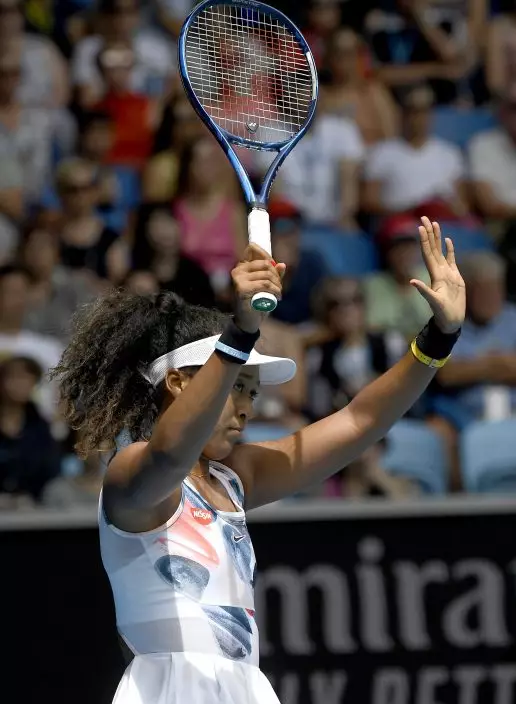
In this Jan. 22, 2020 photo, Japan's Naomi Osaka gestures to her opponent China's Saisai Zheng after her shot hit the net during their second round match at the Australian Open tennis championship in Melbourne, Australia. It might just be the most insincere gesture in sports: A tennis player signals an apology after a ball clips the net tape and trickles over, producing a winner, an obviously accidental winner, to end a point. (AP PhotoAndy Brownbill)
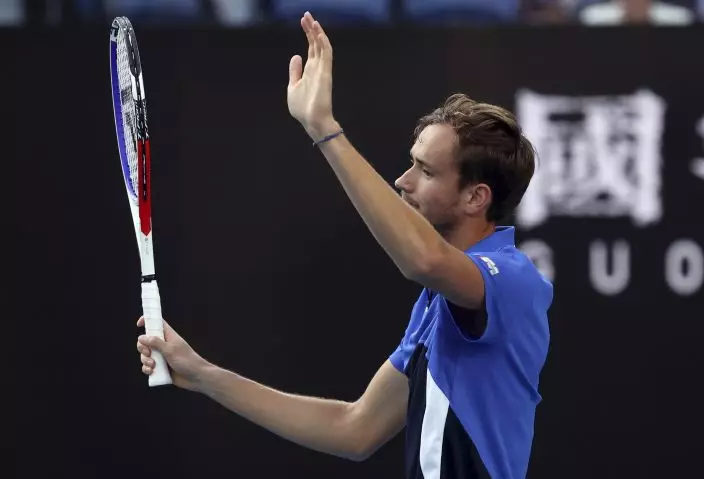
In this Jan. 21, 2020, photo, Russia's Daniil Medvedev signals to his opponent Frances Tiafoe of the U.S. after his ball hit the net during their first round singles match at the Australian Open tennis championship in Melbourne, Australia. It might just be the most insincere gesture in sports: A tennis player signals an apology after a ball clips the net tape and trickles over, producing a winner, an obviously accidental winner, to end a point. (AP PhotoLee Jin-man)
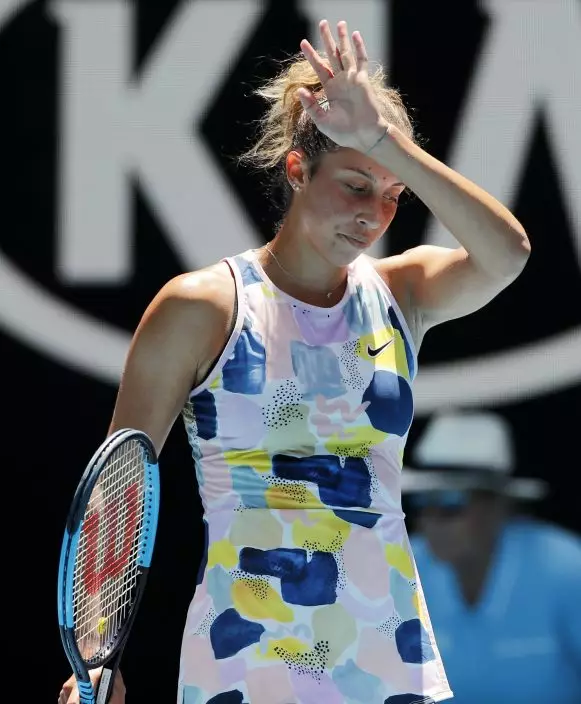
In this Jan. 21, 2020, photo, Madison Keyes of the U.S. reacts after her shot hit the net during her first round singles match against Russia's Daria Kasatkina at the Australian Open tennis championship in Melbourne, Australia. It might just be the most insincere gesture in sports: A tennis player signals an apology after a ball clips the net tape and trickles over, producing a winner, an obviously accidental winner, to end a point. (AP PhotoAndy Wong)
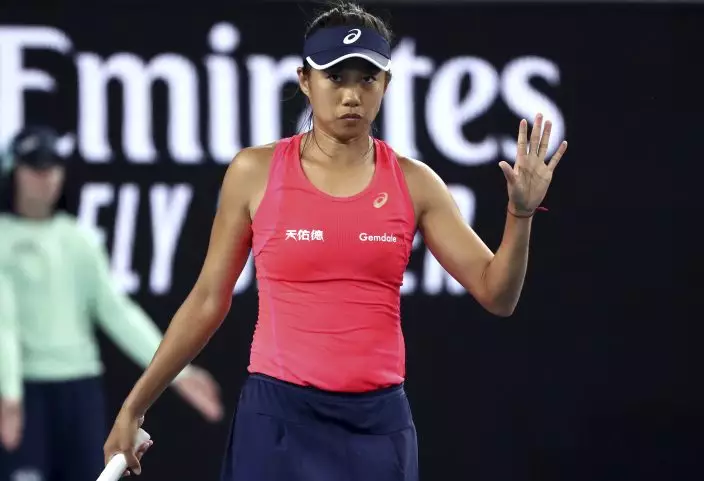
In this Jan. 20, 2020, photo, China's Zhang Shuai reacts after the ball hits the net during her first round singles match against United States' Sloane Stephens at the Australian Open tennis championship in Melbourne, Australia. It might just be the most insincere gesture in sports: A tennis player signals an apology after a ball clips the net tape and trickles over, producing a winner, an obviously accidental winner, to end a point. (AP PhotoDita Alangkara)
Yet everyone, at every level, knows full well there is no real remorse, no matter what the body language says.
In this Jan. 22, 2020 photo, Japan's Naomi Osaka gestures to her opponent China's Saisai Zheng after her shot hit the net during their second round match at the Australian Open tennis championship in Melbourne, Australia. It might just be the most insincere gesture in sports: A tennis player signals an apology after a ball clips the net tape and trickles over, producing a winner, an obviously accidental winner, to end a point. (AP PhotoAndy Brownbill)
“Typical ‘Sorry, not sorry,’” two-time major champion Svetlana Kuznetsova said with a laugh after winning a match last week.
“I will put it to you this way: When you go to a store in the United States, and they ask you, ‘How are you?’ — do they care how you are? But you're still polite and you answer,” the Russian said. “This is the same thing: You're polite and you put your hand up.”
Wim Fisette, 2019 Australian Open winner Naomi Osaka's new coach, offered another analogy for these apologies.
In this Jan. 21, 2020, photo, Russia's Daniil Medvedev signals to his opponent Frances Tiafoe of the U.S. after his ball hit the net during their first round singles match at the Australian Open tennis championship in Melbourne, Australia. It might just be the most insincere gesture in sports: A tennis player signals an apology after a ball clips the net tape and trickles over, producing a winner, an obviously accidental winner, to end a point. (AP PhotoLee Jin-man)
“I don't think it's necessary. But is it necessary to say ‘Bless you’ if someone sneezes? It's more or less the same,” said Fisette, who also has worked with Kim Clijsters and Angelique Kerber, among others. “If you sneeze, and the person next to you doesn't say, ‘Bless you,’ it's kind of weird, right?”
Still, this type of behavior is generally not seen in other, supposedly less-genteel sports.
Elsewhere, it seems, a bit of luck is just a bit of luck.
In this Jan. 21, 2020, photo, Madison Keyes of the U.S. reacts after her shot hit the net during her first round singles match against Russia's Daria Kasatkina at the Australian Open tennis championship in Melbourne, Australia. It might just be the most insincere gesture in sports: A tennis player signals an apology after a ball clips the net tape and trickles over, producing a winner, an obviously accidental winner, to end a point. (AP PhotoAndy Wong)
"In baseball, if you shank one over the third baseman's head and it drops in for a hit, you're not putting your hand up. Or in basketball, if it bounces off the rim and it goes in, you don't apologize," said Mike Bryan, who has teamed with his twin, Bob, to win a record 16 Grand Slam titles in men's doubles. “Besides, what are you going to do, apologize to the whole other team?”
Just as tennis is filled with different playing styles — baseline bashers or purveyors of varying speeds and spins, big servers or masters of the return, etc. — it allows for varying ways to express regrets.
Or pretend to, anyway.
In this Jan. 20, 2020, photo, China's Zhang Shuai reacts after the ball hits the net during her first round singles match against United States' Sloane Stephens at the Australian Open tennis championship in Melbourne, Australia. It might just be the most insincere gesture in sports: A tennis player signals an apology after a ball clips the net tape and trickles over, producing a winner, an obviously accidental winner, to end a point. (AP PhotoDita Alangkara)
The most common:
— The double-hand, palm-up-plus-racket-up, which 2019 U.S. Open runner-up Daniil Medvedev did after winning a game in the Australian Open's first round against Frances Tiafoe, who rolled his eyes and dropped his racket to demonstrate the degree of disbelief at his own misfortune.
— The simple racket raise, which 2019 champion Novak Djokovic deployed in this year's first-round victory over Jan-Lennard Struff.
— The single-hand wave, which Sofia Kenin did in the first set of her fourth-round win over 15-year-old Coco Gauff, before adding a twist: Kenin lowered that hand, balled it into a fist and furtively shook it to celebrate.
Gotta, um, hand it to the 21-year-old American for serving up what felt in the moment like some on-court honesty.
Asked earlier in the tournament how she would react if an opponent didn't show any trace of guilt after a net cord, Kenin said: “I wouldn't like it, but it wouldn't really upset me. It doesn't make that big of a difference.”
Sometimes, there is just no motion of contrition whatsoever.
At the 2018 Miami Open, for example, Medvedev got mad at Stefanos Tsitsipas for what he said were a couple of breaches of tennis etiquette, including: “You hit (a) let and you don't say sorry. You think you are a good kid?”
And at Wimbledon in 2007 — two years before their far more famous encounter at the French Open — Nadal criticized Robin Soderling for fist-pumping instead of feigning penitence over a favorable net cord.
Soderling's retort at the time: "Why should I say I’m sorry when it’s the happiest moment of my life?”
Steve Johnson, who lost to Roger Federer last week, said he generally only engages in the perfunctory pantomiming when he is playing against a friend, such as fellow Americans John Isner, Sam Querrey or Dennis Kudla.
"Or occasionally Roger," Johnson added. “But otherwise, hey, I hit a let-cord winner? So be it. Bummer. Lucky for me. And it's going to come back the other way. So I don't need to apologize. Nobody actually means it. Do whatever you want: Say it; don't say it. If somebody apologizes to me, it's not like they're going to play it over.”
So why does (nearly) everyone do it?
"I was taught as a kid that you have to say sorry," two-time major champion Simona Halep said. “I've thought about this, and I don't really think it's fair you have to say sorry; you're happy you won the point. But I think it's automatic now.”
Follow Howard Fendrich on Twitter at http://twitter.com/HowardFendrich
More AP Tennis: https://www.apnews.com/apf-Tennis and https://twitter.com/AP_Sports