Diana Zurco did not attend her high school graduation because she refused to receive a diploma with her birth name. At 17 and considered a boy by school officials, she grew her hair long and adopted the name Diana after the alien character on the show “V” about an extraterrestrial invasion.
Now 40, she recalled her youthful rebellion while sitting in a comfortable chair in the studio of Argentina's public television station ahead of her debut as the country’s first transgender newscaster, a milestone for an excluded community that is often the target of violence and has a life expectancy roughly half that of the rest of the population.
Click to Gallery
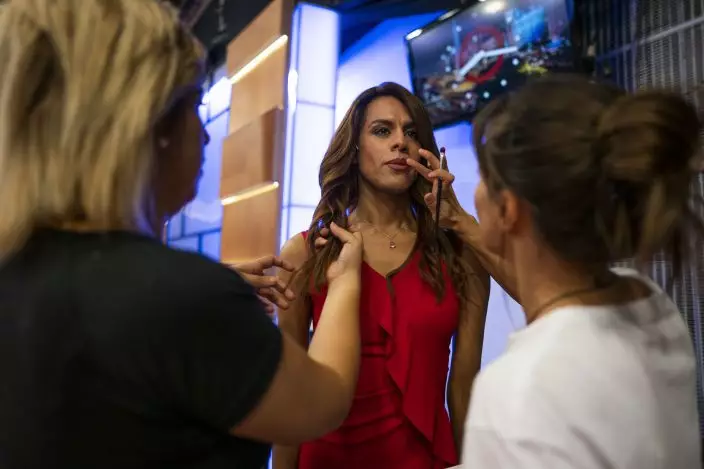
In this March 5, 2020 photo, Diana Zurco has her makeup applied before a rehearsal for her debut as the country’s first transgender newscaster, in Buenos Aires, Argentina. Her job as a co-anchor of Public Television's prime time evening news program is a milestone for an excluded community that is often the target of violence and has a life expectancy roughly half that of the rest of the population. (AP PhotoVictor R. Caivano)

In this March 5, 2020 photo, Diana Zurco stands at the table for news anchors during a rehearsal for her debut as the country’s first transgender newscaster, in Buenos Aires, Argentina. Her job as a co-anchor of Public Television's prime time evening news program is a milestone for an excluded community that is often the target of violence and has a life expectancy roughly half that of the rest of the population. (AP PhotoVictor R. Caivano)

In this March 5, 2020 photo, Diana Zurco poses with fellow anchors during a rehearsal for her debut as the country’s first transgender newscaster, in Buenos Aires, Argentina. Her job as a co-anchor of Public Television's prime time evening news program is a milestone for an excluded community that is often the target of violence and has a life expectancy roughly half that of the rest of the population. (AP PhotoVictor R. Caivano)

In this March 5, 2020 photo, Diana Zurco poses for a photo at the table for news anchors during a rehearsal for her debut as the country’s first transgender newscaster, in Buenos Aires, Argentina. Her job as a co-anchor of Public Television's prime time evening news program is a milestone for an excluded community that is often the target of violence and has a life expectancy roughly half that of the rest of the population. (AP PhotoVictor R. Caivano)

In this March 5, 2020 photo, a producer watches Diana Zurco, dressed in red, during a rehearsal for her debut as the country’s first transgender newscaster, in Buenos Aires, Argentina. Her job as a co-anchor of Public Television's prime time evening news program is a milestone for an excluded community that is often the target of violence and has a life expectancy roughly half that of the rest of the population. (AP PhotoVictor R. Caivano)
“My presence challenges society,” she said in the smooth voice of a professional announcer that she used on Monday when she began her job as co-anchor of Public Television's prime time evening news program.
In this March 5, 2020 photo, Diana Zurco has her makeup applied before a rehearsal for her debut as the country’s first transgender newscaster, in Buenos Aires, Argentina. Her job as a co-anchor of Public Television's prime time evening news program is a milestone for an excluded community that is often the target of violence and has a life expectancy roughly half that of the rest of the population. (AP PhotoVictor R. Caivano)
"It is an invitation to society that says: 'This is me; behind me there are more people like me who want to express themselves. We are capable, we can study, we can train ourselves, we can communicate to you what is happening in our country,'" Zurco told The Associated Press in an interview.
The government estimates Argentina has between 12,000 and 13,000 transgender adults out of a population that exceeds 44 million.
“It is a small group and ordinary people don’t know a trans firsthand. This lack of connection in daily life fuels prejudice and discrimination,” said Esteban Paulón, executive director of the Institute for LGBT+ Public Policies.
In this March 5, 2020 photo, Diana Zurco stands at the table for news anchors during a rehearsal for her debut as the country’s first transgender newscaster, in Buenos Aires, Argentina. Her job as a co-anchor of Public Television's prime time evening news program is a milestone for an excluded community that is often the target of violence and has a life expectancy roughly half that of the rest of the population. (AP PhotoVictor R. Caivano)
Zurco’s presence as a newscaster "will let prejudiced society begin to see that trans people are like everyone else," the activist said.
According to official figures in Argentina, the average life expectancy of a transgender person is 41 years.
"Why do trans people live such short lives?” Zurco asked. “Because they are in a situation marked by family exclusion. A high percentage of trans girls in our country are expelled from their homes at a young age. And in the absence of opportunities, their bodies end up being their merchandise, their job."
In this March 5, 2020 photo, Diana Zurco poses with fellow anchors during a rehearsal for her debut as the country’s first transgender newscaster, in Buenos Aires, Argentina. Her job as a co-anchor of Public Television's prime time evening news program is a milestone for an excluded community that is often the target of violence and has a life expectancy roughly half that of the rest of the population. (AP PhotoVictor R. Caivano)
In the first six months of 2019, 68 crimes against the LGBT community were reported in Argentina. More than half of those were against transvestite, transsexual and transgender women, according to the National Observatory of LGBT Hate Crimes.
Zurco studied in a Catholic school until at age 17 she said: "I am Diana. I'm not a gay, effeminate boy. I'm a trans boy." The school priests forced boys to cut their hair above the collars of their shirts. She refused, kept her hair long and was expelled a year before graduating. She completed her studies in a public school but, "I didn't go to receive the degree because I didn’t want to be called by my male name," she said.
Zurco admitted she came close to prostitution, but took a hairdressing course and started earning money sweeping up cut hair in a beauty salon. She also worked in an office and later took a difficult exam among 1,500 applicants to study for a career as an announcer.
In this March 5, 2020 photo, Diana Zurco poses for a photo at the table for news anchors during a rehearsal for her debut as the country’s first transgender newscaster, in Buenos Aires, Argentina. Her job as a co-anchor of Public Television's prime time evening news program is a milestone for an excluded community that is often the target of violence and has a life expectancy roughly half that of the rest of the population. (AP PhotoVictor R. Caivano)
The course began in 2012, the same year Argentina’s Congress approved a law that lets people choose the gender they register in official documents. So far, 9,000 transgender people have used the law, which also guarantees access to free sex-change surgeries and hormonal treatments.
Only three provinces, including Buenos Aires, have equipment to carry out these operations in public hospitals, however, and the economic crisis also slowed down the supply of treatments, according to Paulón.
Up to now, transgender women on Argentine television have largely been limited to entertainment programs or soap operas.
In this March 5, 2020 photo, a producer watches Diana Zurco, dressed in red, during a rehearsal for her debut as the country’s first transgender newscaster, in Buenos Aires, Argentina. Her job as a co-anchor of Public Television's prime time evening news program is a milestone for an excluded community that is often the target of violence and has a life expectancy roughly half that of the rest of the population. (AP PhotoVictor R. Caivano)
“We didn’t look for Diana because she was a trans announcer. We looked for her because she was a very good professional,” said Rosario Lufrano, president of Radio and Television Argentina. “The only way to get there is to have the doors opened for you. We all know how difficult it is for these women to win a spot.”