Skip to Content Facebook Feature Image

Review: Netflix's 'Have a Good Trip' is only a mild high

ENT

Review: Netflix's 'Have a Good Trip' is only a mild high
ENT

ENT

Review: Netflix's 'Have a Good Trip' is only a mild high

2020-05-11 23:11 Last Updated At:23:20

We can't take trips these days for obvious reasons. But Netflix is offering a trip into the mind with a gentle new documentary about the world of hallucinogens.

Donick Cary’s “Have a Good Trip: Adventures in Psychedelics” uses celebrities recounting their trips on LSD or mushroom to counteract built-up fears about psychotropic drugs — even offering tips about how to use them better — all against the backdrop of trippy '60s-style cartoons with rainbows and unwinding tongues.

This is a clearly pro-psychedelic film, not too preachy and not too pointed, with lazy science. There are really only two authoritative voices in the film and they both endorse investigation into hallucinogens — the alternative medicine guru Deepak Chopra (“We’re on a trip right now. Life is a trip,” he says) and UCLA psychiatry professor Dr. Charles Grob. There are no dissenting voices.
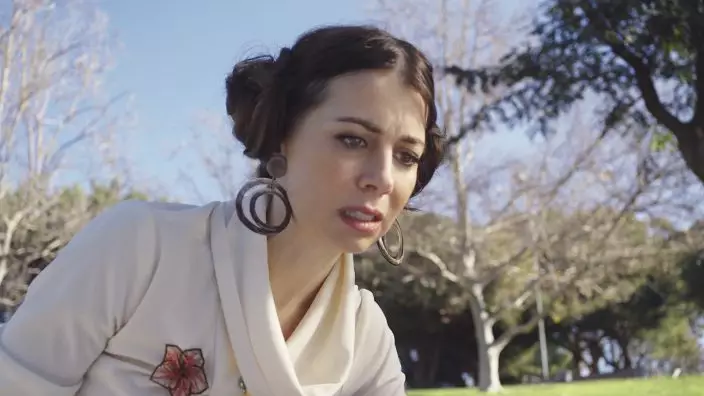
This image released by Netflix shows Natasha Legerro in a scene from "Have A Good Trip: Adventures in Psychedelics." (Netflix via AP)

This image released by Netflix shows Natasha Legerro in a scene from "Have A Good Trip: Adventures in Psychedelics." (Netflix via AP)

So if you prefer your drug advice from celebrities, this is the film for you. David Cross, Nick Kroll, Ben Stiller, Natasha Lyonne, A$AP Rocky and Sarah Silverman are among those talking about their trips, both bad and good. Silverman found herself in the passenger seat of a car driven by a man so high he’d forgotten how to drive.

That leads to one of the film's several drug tips, made to look like those “The More You Know” PSA: Don’t drive while tripping. Control your setting. Don’t ever look in the mirror. (“You can see through your skin,” Silverman warns.)

We learn that Lewis Black once got so high he forgot his own name and flipped through a dictionary for what seems like hours looking for clues. Rosie Perez tripped so bad once in the late 1980s that she was eventually doing the backstroke on a dance club floor.
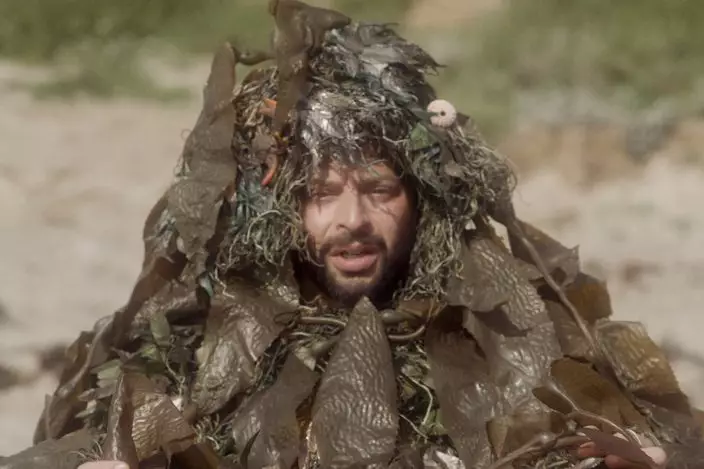
This image released by Netflix shows Nick Kroll in a scene from "Have A Good Trip: Adventures in Psychedelics." (Netflix via AP)

This image released by Netflix shows Nick Kroll in a scene from "Have A Good Trip: Adventures in Psychedelics." (Netflix via AP)

These stories are often delightful — and enhanced by great cartoons or recreations acted by many of those interviewed — but are we sure we need celebrity insights here? Rob Corddry has played a satirical journalist on “The Daily Show” but we’re not sure he’s the guy who should be dispensing advice about how the national scientific community handles testing on acid ("We blew it," he says, minus an expletive).

Two of the best anecdotes are by terrific storytellers who are no longer with us — TV host and chef Anthony Bourdain and actress Carrie Fisher, both for whom the film is dedicated. (Which makes you wonder how long this film has been on the shelf).

Bourdain talks about his attempt to mimic Hunter S. Thompson by going on a road trip with a buddy to the Catskills with “a pretty dizzying array of controlled substances” — Quaaludes, weed, coke, beer, gin, hash and LSD. They picked up two hitchhiking exotic dancers and that’s when things took a turn.

Fisher confesses she took a lot of LSD over her life, including once in a park where she witnessed a talking acorn who insisted on showing her his choreography. “I never saw anything that wasn’t there. I just saw things that were there misbehave,” she notes, brilliantly.

Some celebrities have clearly thought deeply about their trips, like Sting, who while high on peyote in the English countryside, helped a cow give birth. “For me, the entire universe cracked open.” And Reggie Watts uses this poetic metaphor for hallucinogens: “It’s like a stepladder to look over a brick wall that’s a little bit too tall for you.”

There are intriguing moments when the thread to a better movie is revealed, as when Perez confides that her LSD trip prompted her to seek out therapy to help ease her Roman Catholic guilt. Sting also reveals that some of his trips have helped him write songs. Really? Which ones? More concrete examples of how mushrooms or dropping acid aided life are sorely needed.

And another misfire: Writer and director Cary has decided to lighten the mood by periodically mocking the paranoid anti-drug public service announcements of the ’80s with his own extended send-up that gets tiresome.

Adam Scott in a black leather jacket shows up in each, being ultra-serious about the evil of drugs. “Knock, knock, knock.′ ‘Who is it?′ ’It’s a deranged drifter who wants to torture you for the next 12 hours,’” he says in one ad-within-the-film. “That’s exactly what you’re doing when you open your brain to hallucinogenics.”

And the filmmaker has employed another marvelous off-kilter figure in Nick Offerman, pretending to be a scientist. “Don’t get me wrong, drugs can be dangerous,” he tells us. “But they can also be hilarious." But Offerman is neither in this film — and so he is wasted. Like this film — wasted but not in a good way.

“Have a Good Trip,” a Netflix release, is rated TV-MA for drug substances and language. Running time: 85 minutes. One and a half stars out of four.

Online: https://www.netflix.com/browse?jbv=80231917&jbp=0&jbr=1

Mark Kennedy is at http://twitter.com/KennedyTwits
LAS VEGAS (AP) — With the start of the New Year squarely behind us, it's once again time for the annual CES trade show to shine a spotlight on the latest tech companies plan on offering in 2026.

The multi-day event, organized by the Consumer Technology Association, kicks off this week in Las Vegas, where advances across industries like robotics, healthcare, vehicles, wearables, gaming and more are set to be on display.

Artificial intelligence will be anchored in nearly everything, again, as the tech industry explores offerings consumers will want to buy. AI industry heavyweight Jensen Huang will be taking the stage to showcase Nvidia's latest productivity solutions, and AMD CEO Lisa Su will keynote to “share her vision for delivering future AI solutions.” Expect AI to come up in other keynotes, like from Lenovo's CEO, Yuanqing Yang.

The AI industry is out in full force tackling issues in healthcare, with a particular emphasis on changing individual health habits to treat conditions — such as Beyond Medicine's prescription app focused on a particular jaw disorder — or addressing data shortages in subjects such as breast milk production.

Expect more unveils around domestic robots too. Korean tech giant LG already has announced it will show off a helper bot named “ CLOiD,” which allegedly will handle a range of household tasks. Hyundai also is announcing a major push on robotics and manufacturing advancements. Extended reality, basically a virtual training ground for robots and other physical AI, is also in the buzz around CES.

In 2025, more than 141,000 attendees from over 150 countries, regions, and territories attended the CES. Organizers expect around the same numbers for this year’s show, with more than 3,500 exhibitors across the floor space this week.

The AP spoke with CTA Executive Chair and CEO Gary Shapiro about what to expect for CES 2026. The conversation has been edited for clarity and length.

Well, we have a lot at this year's show.

Obviously, using AI in a way that makes sense for people. We’re seeing a lot in robotics. More robots and humanoid-looking robots than we’ve ever had before.

We also see longevity in health, there’s a lot of focus on that. All sorts of wearable devices for almost every part of the body. Technology is answering healthcare’s gaps very quickly and that’s great for everyone.

Mobility is big with not only self-driving vehicles but also with boats and drones and all sorts of other ways of getting around. That’s very important.

And of course, content creation is always very big.

You are seeing humanoid robots right now. It sometimes works, sometimes doesn’t.

But yes, there are more and more humanoid robots. And when we talk about CES 5, 10, 15, 20 years now, we’re going to see an even larger range of humanoid robots.

Obviously, last year we saw a great interest in them. The number one product of the show was a little robotic dog that seems so life-like and fun, and affectionate for people that need that type of affection.

But of course, the humanoid robots are just one aspect of that industry. There’s a lot of specialization in robot creation, depending on what you want the robot to do. And robots can do many things that humans can’t.

AI is the future of creativity.

Certainly AI itself may be arguably creative, but the human mind is so unique that you definitely get new ideas that way. So I think the future is more of a hybrid approach, where content creators are working with AI to craft variations on a theme or to better monetize what they have to a broader audience.

We’re seeing all sorts of different devices that are implementing AI. But we have a special focus at this show, for the first time, on the disability community. Verizon set this whole stage up where we have all different ways of taking this technology and having it help people with disabilities and older people.

Well, there’s definitely no bubble when it comes to what AI can do. And what AI can do is perform miracles and solve fundamental human problems in food production and clean air and clean water. Obviously in healthcare, it’s gonna be overwhelming.

But this was like the internet itself. There was a lot of talk about a bubble, and there actually was a bubble. The difference is that in late 1990s there were basically were no revenue models. Companies were raising a lot of money with no plans for revenue.

These AI companies have significant revenues today, and companies are investing in it.

What I’m more concerned about, honestly, is not Wall Street and a bubble. Others can be concerned about that. I’m concerned about getting enough energy to process all that AI. And at this show, for the first time, we have a Korean company showing the first ever small-scale nuclear-powered energy creation device. We expect more and more of these people rushing to fill this gap because we need the energy, we need it clean and we need a kind of all-of-the-above solution.

A Coro breastfeeding monitor is pictured at a Coroflo booth during the CES Unveiled tech show Sunday, Jan. 4, 2026, in Las Vegas. (AP Photo/Abbie Parr)

A Coro breastfeeding monitor is pictured at a Coroflo booth during the CES Unveiled tech show Sunday, Jan. 4, 2026, in Las Vegas. (AP Photo/Abbie Parr)

Yonbo X1 robots are pictured at the X-Orgin booth during the CES Unveiled tech show Sunday, Jan. 4, 2026, in Las Vegas. (AP Photo/Abbie Parr)

Yonbo X1 robots are pictured at the X-Orgin booth during the CES Unveiled tech show Sunday, Jan. 4, 2026, in Las Vegas. (AP Photo/Abbie Parr)

A Tombot robotic puppy is pictured at a Tombot booth during the CES Unveiled tech show Sunday, Jan. 4, 2026, in Las Vegas. (AP Photo/Abbie Parr)

A Tombot robotic puppy is pictured at a Tombot booth during the CES Unveiled tech show Sunday, Jan. 4, 2026, in Las Vegas. (AP Photo/Abbie Parr)

People arrive at the CES Unveiled tech show Sunday, Jan. 4, 2026, in Las Vegas. (AP Photo/Abbie Parr)

People arrive at the CES Unveiled tech show Sunday, Jan. 4, 2026, in Las Vegas. (AP Photo/Abbie Parr)

Recommended Articles