A group of Copenhagen residents sued the Danish government Wednesday over legislation that authorized dismantling neighborhoods designated as “ghettos," arguing that the measures discriminate on the basis of ethnicity and should be overturned in court.
The legislation, adopted in 2018 for the stated purpose of reducing residential segregation, permitted actions such as the eviction of some residents and the sale of homes to private investors to reduce the amount of affordable public housing in these areas to a maximum of 40% by 2030.
The lawsuit centers on the criteria the government uses to decide what qualifies as a ghetto. The factors include education and income levels, crime rates and a demographic makeup in which "the proportion of immigrants and their descendants from non-Western countries exceeds 50%.”
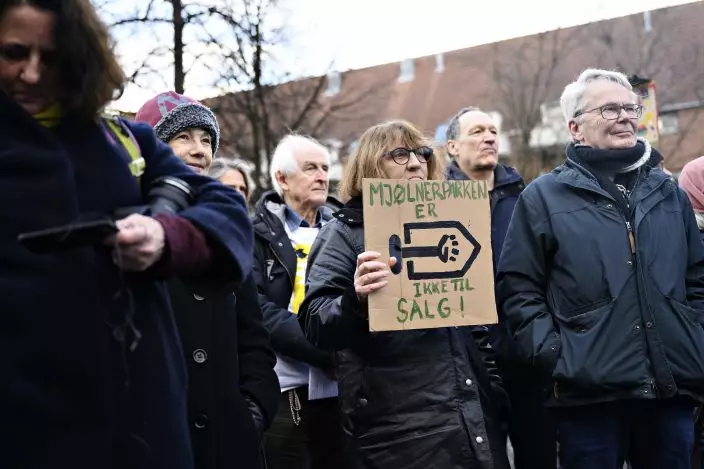
FILE - In this file photo dated Saturday, March 7, 2020, the group "General Resistance" and local residents demonstrate against the announced sale of building 2 and 3 in Mjoelnerparken on Noerrebro in Copenhagen. A group of Copenhagen residents have filed a lawsuit against the Danish government, seeking to prove that measures taken under the country's so-called 'ghetto package' of legislation are unlawful. The sign reads: Mjoelnerparken is not for sale. (Philip Davali Ritzau Scanpix via AP)
Under the government's definition, a poor neighborhood with high crime and low education would not be considered a ghetto if people born in Denmark and their descendants comprise more than half of the population.
“The decisive criteria is the ethnicity of the tenants and residents,” said Eddie Khawaja, the attorney for the plaintiffs from Copenhagen's Mjoelnerparken neighborhood, one of the areas declared as a ghetto. “This raises issues under Danish and EU law."
The residents named in the lawsuit are all Danish citizens and include people of various ethnicities and races, including white. They say the measures are alienating and risk creating a lesser class of Danes based on ethnicity and skin color.
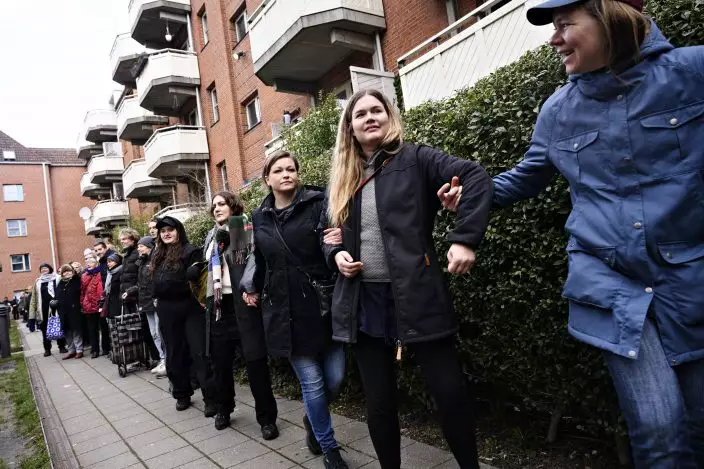
FILE - In this file photo dated Saturday, March 7, 2020, the group "General Resistance" and local residents demonstrate against the announced sale of building 2 and 3 in Mjoelnerparken on Noerrebro in Copenhagen. A group of Copenhagen residents have filed a lawsuit against the Danish government seeking to prove that measures taken under the country's so-called 'ghetto package' of legislation are unlawful. (Philip Davali Ritzau Scanpix, FILE via AP)
“This is where my three kids have grown up and this is where I want to grow old,” said Asif Mahmut, who moved to Denmark from Pakistan and has lived in Mjoelnerparken for 27 years. “This is my home, and I want to fight for it.”
Along with evictions and the sale of public housing, the 2018 legislation allowed double punishments for crimes in certain neighborhoods, made daycare for children mandatory starting at age 1 to teach them Danish values and a requirement for municipalities to inform eligible residents about repatriation opportunities.
TRENTON, N.J. (AP) — Richard “Dick” Codey, a former acting governor of New Jersey and the longest serving legislator in the state's history, died Sunday. He was 79.
Codey’s wife, Mary Jo Codey, confirmed her husband’s death to The Associated Press.
“Gov. Richard J. Codey passed away peacefully this morning at home, surrounded by family, after a brief illness,” Codey's family wrote in a Facebook post on Codey's official page.
"Our family has lost a beloved husband, father and grandfather -- and New Jersey lost a remarkable public servant who touched the lives of all who knew him," the family said.
Known for his feisty, regular-guy persona, Codey was a staunch advocate of mental health awareness and care issues. The Democrat also championed legislation to ban smoking from indoor areas and sought more money for stem cell research.
Codey, the son of a northern New Jersey funeral home owner, entered the state Assembly in 1974 and served there until he was elected to the state Senate in 1982. He served as Senate president from 2002 to 2010.
Codey first served as acting governor for a brief time in 2002, after Christine Todd Whitman’s resignation to join President George W. Bush’s administration. He held the post again for 14 months after Gov. Jim McGreevey resigned in 2004.
At that time, New Jersey law mandated that the Senate president assume the governor’s role if a vacancy occurred, and that person would serve until the next election.
Codey routinely drew strong praise from residents in polls, and he gave serious consideration to seeking the Democratic nomination for governor in 2005. But he ultimately chose not to run when party leaders opted to back wealthy Wall Street executive Jon Corzine, who went on to win the office.
Codey would again become acting governor after Corzine was incapacitated in April 2007 due to serious injuries he suffered in a car accident. He held the post for nearly a month before Corzine resumed his duties.
After leaving the governor’s office, Codey returned to the Senate and also published a memoir that detailed his decades of public service, along with stories about his personal and family life.
“He lived his life with humility, compassion and a deep sense of responsibility to others,” his family wrote. “He made friends as easily with Presidents as he did with strangers in all-night diners.”
Codey and his wife often spoke candidly about her past struggles with postpartum depression, and that led to controversy in early 2005, when a talk radio host jokingly criticized Mary Jo and her mental health on the air.
Codey, who was at the radio station for something else, confronted the host and said he told him that he wished he could “take him outside.” But the host claimed Codey actually threatened to “take him out,” which Codey denied.
His wife told The Associated Press that Codey was willing to support her speaking out about postpartum depression, even if it cost him elected office.
“He was a really, really good guy,” Mary Jo Codey said. “He said, ‘If you want to do it, I don’t care if I get elected again.’”
Jack Brook contributed reporting from New Orleans.

FILE - New Jersey State Sen. and former Democratic Gov. Richard Codey is seen before New Jersey Gov. Phil Murphy delivers his State of the State address to a joint session of the Legislature at the statehouse, in Trenton, N.J., Tuesday, Jan. 10, 2023. (AP Photo/Matt Rourke, File)