As if the coronavirus wasn't enough, India grappled with scorching temperatures and the worst locust invasion in decades as authorities prepared for the end of a monthslong lockdown despite recording thousands of new infections every day.
This triple disaster drew biblical comparisons and forced officials to try to balance the competing demands of simultaneous public health crises: encourage people to protect themselves from eviscerating heat but also practice social distancing in newly reopened parks and markets.
Click to Gallery

People play in the river Ganges during a hot summer day in Prayagraj, India, Wednesday, May 27, 2020. As India braces for a hotter than usual summer, many cities in the country's north are reeling under an intense heat wave with the temperatures on Wednesday crossing a scorching 45 degrees Celsius (113 degrees Fahrenheit). The temperatures in northern India are the highest that the country has seen in decades for this time of the year, and the hot spell is projected to last until Friday. (AP PhotoRajesh Kumar Singh)
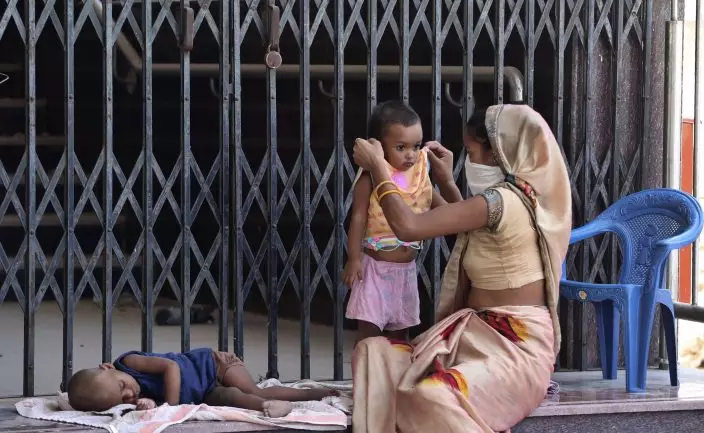
A migrant worker from another state trying to return home changes the dress of her child as she waits for transportation at Vastral metro rail station in Ahmedabad, India, Thursday, May 28, 2020. India sees no respite from the coronavirus caseload at a time when the two-month-old lockdown across the country is set to end on Sunday. (AP PhotoAjit Solanki)
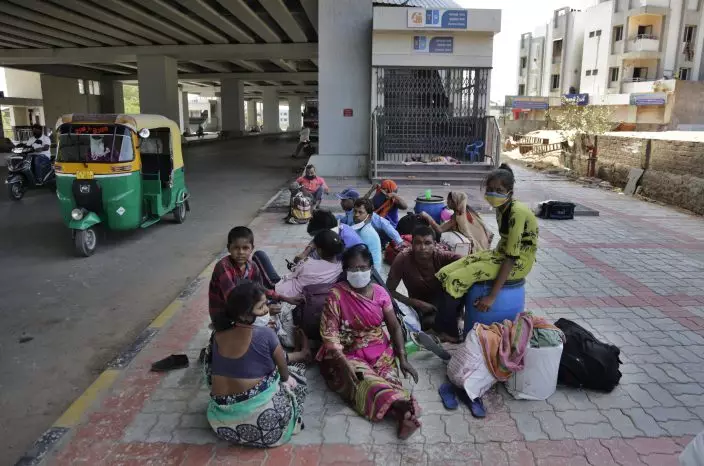
Migrant workers from other states trying to return to their homes wait for transportation at Vastral metro rail station in Ahmedabad, India, Thursday, May 28, 2020. India sees no respite from the coronavirus caseload at a time when the two-month-old lockdown across the country is set to end on Sunday. (AP PhotoAjit Solanki)
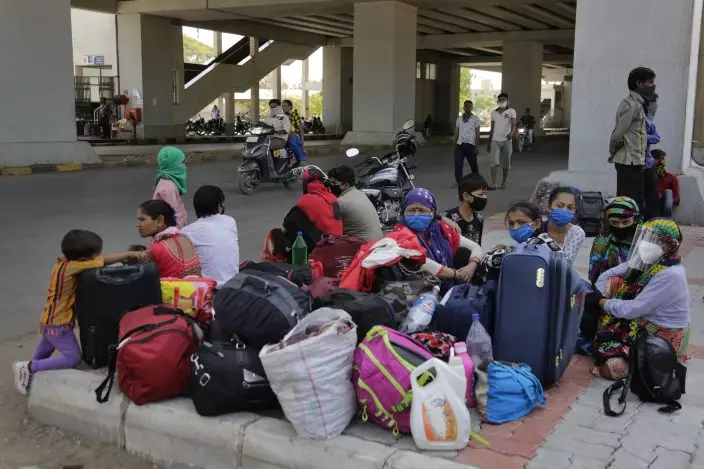
Migrant workers from other states trying to return to their homes wait for transportation at Vastral metro rail station in Ahmedabad, India, Thursday, May 28, 2020. India sees no respite from the coronavirus caseload at a time when the two-month-old lockdown across the country is set to end on Sunday. (AP PhotoAjit Solanki)
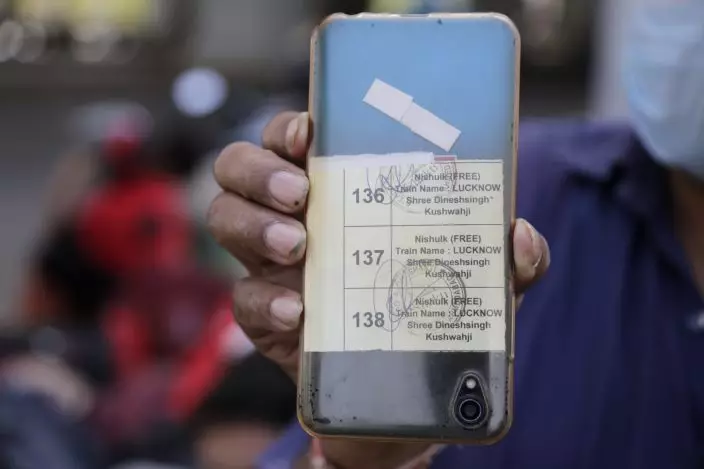
A migrant worker from another state trying to return to his village, displays token numbers issued by authorities for him and his family as they wait for transportation at Vastral metro rail station in Ahmedabad, India, Thursday, May 28, 2020. India sees no respite from the coronavirus caseload at a time when the two-month-old lockdown across the country is set to end on Sunday. (AP PhotoAjit Solanki)
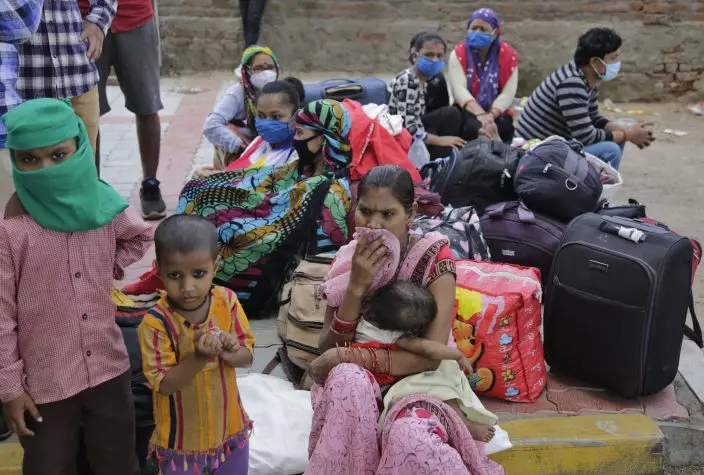
Migrant workers from other states trying to return to their homes wait for transportation at Vastral metro rail station in Ahmedabad, India, Thursday, May 28, 2020. India sees no respite from the coronavirus caseload at a time when the two-month-old lockdown across the country is set to end on Sunday. (AP PhotoAjit Solanki)
The heat wave threatens to compound the challenges of containing the virus, which has started spreading more quickly and broadly since the government began easing restrictions of one of the world’s most stringent lockdowns earlier this month.
People play in the river Ganges during a hot summer day in Prayagraj, India, Wednesday, May 27, 2020. As India braces for a hotter than usual summer, many cities in the country's north are reeling under an intense heat wave with the temperatures on Wednesday crossing a scorching 45 degrees Celsius (113 degrees Fahrenheit). The temperatures in northern India are the highest that the country has seen in decades for this time of the year, and the hot spell is projected to last until Friday. (AP PhotoRajesh Kumar Singh)
“The world will not get a chance to breathe anymore. The ferocity of crises are increasing, and they’re not going to be spaced out,” said Sunita Narain of New Delhi’s Center for Science and Environment.
When her 6-year-old son woke up with a parched throat and a fever, housekeeper Kalista Ekka wanted to bring him to the hospital. But facing a deluge of COVID-19 patients, the doctor advised Ekka to keep him at home despite boiling temperatures in the family's two room-apartment in a low-income neighborhood in South Delhi.
“The fan only makes it hotter but we can't open the window because it has no screen,” and thus no defense against malaria and dengue-carrying mosquitoes, Ekka said.
A migrant worker from another state trying to return home changes the dress of her child as she waits for transportation at Vastral metro rail station in Ahmedabad, India, Thursday, May 28, 2020. India sees no respite from the coronavirus caseload at a time when the two-month-old lockdown across the country is set to end on Sunday. (AP PhotoAjit Solanki)
In a nearby upmarket enclave crowded with walkers and joggers every morning and at dusk — some with face coverings, some without — neighbors debated the merits of masks in an online forum.
In the heat, “it is very dangerous to work out with a mask. So a Catch-22 situation,” said Asmita Singh.
Temperatures soared to 118 degrees Fahrenheit (47.6 degrees Celsius) in the capital New Delhi this week, marking the warmest May day in 18 years, and 122 F (50 C) in the desert state of Rajasthan, after the world’s hottest April on record.
Migrant workers from other states trying to return to their homes wait for transportation at Vastral metro rail station in Ahmedabad, India, Thursday, May 28, 2020. India sees no respite from the coronavirus caseload at a time when the two-month-old lockdown across the country is set to end on Sunday. (AP PhotoAjit Solanki)
India suffers from severe water shortages and tens of millions lack running water and air conditioning, leaving many to seek relief under shady trees in public parks and stepwells, the ancient structures used to harvest rainwater.
Though many people continued wearing masks properly, others pushed them onto chins, or had foregone them altogether.
Cyclone Amphan, a massive super storm that crossed the unusually warm Bay of Bengal last week, sucked up huge amounts of moisture, leaving dry, hot winds to form a heat wave over parts of central and northern India.
Migrant workers from other states trying to return to their homes wait for transportation at Vastral metro rail station in Ahmedabad, India, Thursday, May 28, 2020. India sees no respite from the coronavirus caseload at a time when the two-month-old lockdown across the country is set to end on Sunday. (AP PhotoAjit Solanki)
At the same time, swarms of desert locusts have devastated crops in India’s heartland, threatening an already vulnerable region that is struggling with the economic cost of the lockdown.
Exasperated farmers have been banging plates, whistling or throwing stones to try to drive the locusts away, and sometimes even lighting fires to smoke them out. The swarms appeared poised to head from Rajasthan north to Delhi, but on Wednesday a change in wind direction sent them southward toward the state of Madhya Pradesh instead.
K.L. Gurjar, a top official of India’s Locust Warning Organization, said his 50-person team was scrambling to stop the swarms before breeding can take place during India’s monsoons, which begin in July. Otherwise, he said, the locusts could destroy India’s summer crops.
A migrant worker from another state trying to return to his village, displays token numbers issued by authorities for him and his family as they wait for transportation at Vastral metro rail station in Ahmedabad, India, Thursday, May 28, 2020. India sees no respite from the coronavirus caseload at a time when the two-month-old lockdown across the country is set to end on Sunday. (AP PhotoAjit Solanki)
Meanwhile, India reported another record single-day jump of more than 6,500 coronavirus cases on Thursday, pushing up the total to 158,333 confirmed cases and 4,531 deaths.
Prime Minister Narendra Modi’s government is preparing a new set of guidelines to be issued this weekend, possibly extending the lockdown in worst-hit areas while promoting economic activity elsewhere, with unemployment surging to 25%.
The sudden halt to the Indian economy when the lockdown began March 25 has been devastating for daily laborers and migrant workers, who fled cities on foot for their family homes in the countryside.
Migrant workers from other states trying to return to their homes wait for transportation at Vastral metro rail station in Ahmedabad, India, Thursday, May 28, 2020. India sees no respite from the coronavirus caseload at a time when the two-month-old lockdown across the country is set to end on Sunday. (AP PhotoAjit Solanki)
The government started running special trains for the migrants, but deaths because of starvation or dehydration have been reported. Others immediately put into quarantine centers upon their arrival in home districts have tested positive for COVID-19, adding to the burden of severely strained rural health systems.
During the lockdown, Modi’s environment ministry has moved to lower liabilities for industrial polluters and given private players the right to explore for coal and mine it. Cheap oil will fuel recovery efforts worldwide.
Indian environmental journalist Joydeep Gupta said that the perfect storm of pandemic, heat and locusts show India must go green. He said the government should implement policies to safeguard biodiversity and offer incentives for green energy to reduce greenhouse gases that cause climate change.
Instead, “the government is promoting the same sectors of the industry that have caused the multiple crises in the first place,” he said.
But Narain said other government initiatives that expand federal agriculture employment programs, cash transfer and food ration programs help India deal more effectively with its threats.
“It’s building coping abilities of the very poor to be able to deal with stress after stress after stress,” she said.