Skip to Content Facebook Feature Image

1952 Helsinki: The Cold War comes to the Olympics

Sport

1952 Helsinki: The Cold War comes to the Olympics
Sport

Sport

1952 Helsinki: The Cold War comes to the Olympics

2020-08-03 00:18 Last Updated At:00:30

The United States and the Soviet Union formed an uneasy pact to help turn back Nazi Germany during World War II. Less than a decade later, most global events were seen as part of the Cold War between the two super powers, including the Olympics.

The Summer Olympics in Helsinki, Finland set a record for countries (69) and participants (nearly 5,000), numbers boosted by the USSR's first appearance in the games as a communist nation. The Soviets felt winning medals — and blocking the Americans in the process — could boost their profile on the world stage while espousing the superiority of their way of life.

In 1951, the USSR produced the equivalent of $8.2 billion in today's money on sports equipment. It was part of an effort designed to, not just close the gap on the Americans, but surpass them.
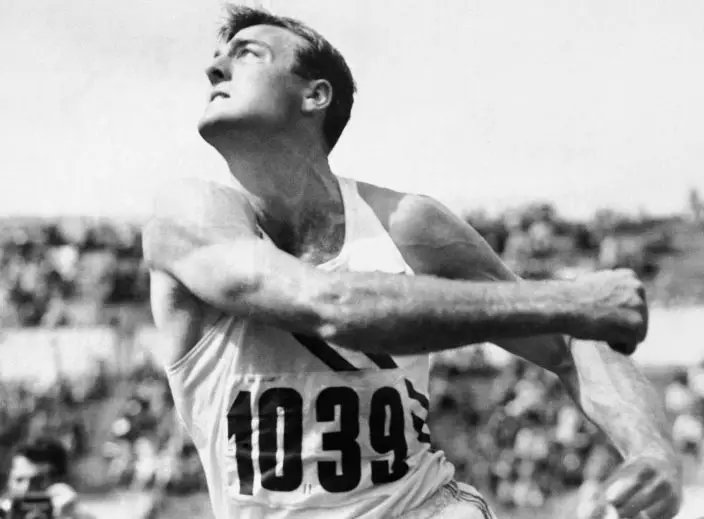
FILE - In this July 26, 1952, file photo, Bob Mathias, defending Olympic decathlon champion, heaves the discus during the decathlon competition at the Summer Olympic games in Helsinki, Finland. (AP PhotoFile)

FILE - In this July 26, 1952, file photo, Bob Mathias, defending Olympic decathlon champion, heaves the discus during the decathlon competition at the Summer Olympic games in Helsinki, Finland. (AP PhotoFile)

They nearly did. The U.S. topped the medal table with 76 thanks to dominance in track, followed closely by the Soviets’ 71 thanks to a serious haul on the wrestling mat. The competition began an athletic tug-of-war at the world's largest sporting event that continues seven decades later. Either the Americans or the Russians have finished with the most medals at each of the last 17 Summer Olympics, the U.S. doing it nine times and their counterparts eight.

The USSR was still a mystery to much of the world in 1952. Details of the country's athletic progress were sketchy in the West. Reports of world records and eye-popping performances all came from the highly-filtered government-controlled media. The decision for all Soviet bloc nations to live in an Olympic village separate from Western nations only deepened the mystery.

Then the USSR surprisingly invited Westerners — including Americans — to enter the communist Olympic Village. The Soviets even hosted a swanky dinner for members of the U.S. Olympic delegation replete with vodka and whitefish caught in the Volga River, toasting goodwill under paintings of Joseph Stalin and the Politburo.
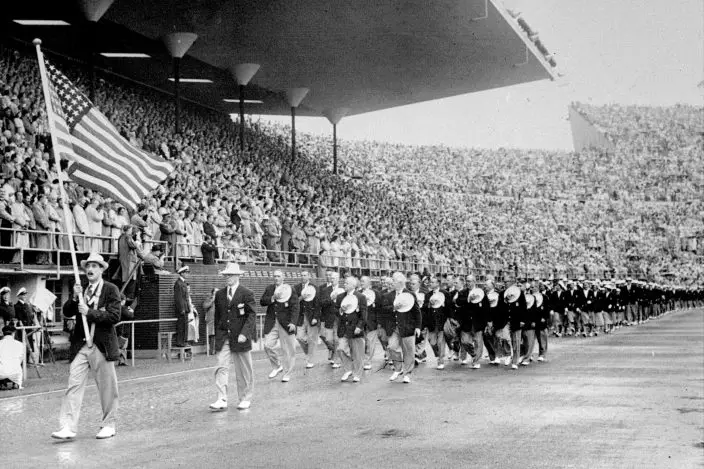
FILE - In this July 21, 1952, file photo, members of the United States Olympic team holding their hats over their hearts as they pay tribute to Finland's President Juho K. Passikivi, march into Olympic Stadium during the opening ceremonies of the Summer Olympic games in Helsinki, Finland. (United Press via AP, File)

FILE - In this July 21, 1952, file photo, members of the United States Olympic team holding their hats over their hearts as they pay tribute to Finland's President Juho K. Passikivi, march into Olympic Stadium during the opening ceremonies of the Summer Olympic games in Helsinki, Finland. (United Press via AP, File)

“We can't reciprocate,” an unnamed American official told The Associated Press. “We simply don't have the money.”

The Americans did hold onto their edge in the medal standings, but just barely. And over the course of two weeks in a city less than 500 miles from the Arctic Circle, the Soviets sent a very loud message that they were very much ready to challenge the U.S. for global athletic supremacy.

Of course, back in the USSR, it would have been easy to think the country had dominated every event. When three Russian women took gold, silver and bronze in the discus, it was front-page news in Moscow. The stories, by the way, carried no mention of American Walt Davis winning gold in the high jump or that U.S. runner Charlie Moore's world record in the 400-meter hurdles.
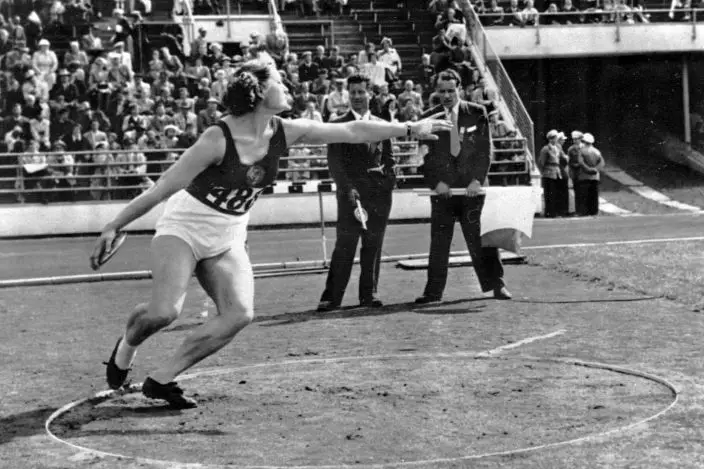
FILE - In this July 1952, file photo, Nina Romashkova, who won the first gold medal for the Soviets in the women's discus competition, winds up to throw during  the Summer Olympics in Helsinki, Finland(AP PhotoFile)

FILE - In this July 1952, file photo, Nina Romashkova, who won the first gold medal for the Soviets in the women's discus competition, winds up to throw during the Summer Olympics in Helsinki, Finland(AP PhotoFile)

ZAPOTEK ZIPS

The breakout star of the Games wasn't an American or a Soviet. It was a 29-year-old staff captain in the Czech Republic Army who ran as if he was in deep agony and his next step would be his last.

Yet Emil Zatopek cared little about form or even proper running decorum while winning the 5,000 meters, 10,000 meters and the marathon, a race he'd never run before he set an Olympic and World record by covering the 26.2-mile distance in 2:23:03. Early on in the marathon Zatopek asked British runner Jim Peters if his pacing was right. When Peters told Zatopek it was, Zatopek took off and cruised to victory by more than 2 1/2 minutes.

Zatopek — whose wife Dana Zatopkova won gold in the javelin — blew off the media after the race and headed back to the Olympic village for a nap.

MAGNIFICENT MATHIAS

American Bob Mathias was just 17 when he won the decathlon at the 1948 London Olympics. He stamped himself as the world's greatest athlete at age 21 when he defended his gold medal by posting a record score of 7,887 points over two days and 10 events in Helsinki. He then promptly retired.

“This is for sure,” Mathias said. “There's nothing left.”

Maybe on the track, but not in life. Mathias went on to dabble in acting before serving four terms as a Republican Congressman representing California's 18th district, just south of the Bay Area.

LIFE IN THE FAST LANE

Long before hi-tech swimsuits and dolphin kicks became a thing, the pool at the 1952 Games showcased just how fast the sport was progressing.

During the modest-sized meet — there were only 11 events compared to 34 at the 2016 Summer Olympics — eight Olympic records were set. The Hungarian women dominated, winning seven out of 15 medals.

AP Corporate Archives contributed to this report

More AP Olympics: https://apnews.com/OlympicGames and https://twitter.com/AP_Sports

NEW YORK (AP) — Ryan Weathers was steamed when he found out he was joining the New York Yankees.

“I had had just finished up my bullpen and I get back to the house — I have like a little travel sauna,” he recalled Thursday. “I literally probably had sat on my couch for about two seconds and I got a phone call from Peter Bendix that I had been traded.”

Bendix, Miami's president of baseball operations, sent the 26-year-old left-hander to New York for four prospects on Tuesday: outfielders Brendan Jones and Dillon Lewis, and infielders Dylan Jasso and Juan Matheus.

Weathers is the son of David Weathers, a pitcher who helped the Yankees win the 1996 World Series after he was acquired from the Marlins at the trade deadline.

“We’ve kind of had a weird, similar paths as to how we got to New York,” Ryan Weathers said.

David was in the Dodger Stadium bullpen when he found out two minutes before the trade deadline he had been dealt to the Yankees. Manager Rene Lachemann called him on the bullpen phone and said Weathers needed to speak with general manager Dave Dombrowski.

“I went in the locker room and Kevin Brown, Al Leiter, John Burkett, Robb Nen, they said, `Hey man, good luck. You're going to win a World Series ring,' and they turned out to be prophetic,” David Weathers said.

David learned his son had been traded while watching a basketball game with wife Kelli at Loretto High School in Loretto, Tennessee, where he has coached baseball.

“One of my friends came up and said, `I think Ryan’s been traded to the Yankees.' And I said: `Well, if he has, I hadn’t heard anything about it,'" David recalled. "We laughed, and about that time my phone started ringing. It was Ryan.”

When Ryan makes his Yankees debut, they will become the fifth father-son duo for the pinstripes, joining Yogi and Dale Berra, Clay and Cody Bellinger, Mark Leiter and Mark Leiter Jr., and Ron Davis and Ike Davis.

Ryan was in shock when he spoke with Yankees general manager Brian Cashman and manager Aaron Boone.

“I just couldn’t believe that the New York Yankees were a team that I could ever have a chance to play for," he said.

New York’s rotation at the season's start projects to also include Max Fried, Cam Schlittler, Will Warren and Luis Gil while Gerrit Cole and Carlos Rodón rehab from injuries.

Weathers, 26, was 2-2 with a 3.99 ERA in eight starts last year in his second straight injury-shortened season. He missed time with a strained left flexor, made his season debut on May 14, then didn’t pitch for Miami between June 7 and Sept. 11 because of a left lat strain.

He was 5-6 with a 3.63 ERA over 16 starts in 2024, when he was sidelined by a strained left index finger.

“This is the best I’ve probably felt in a year-and-a-half,” Weathers said. “I really did a dive and worked with company on figuring out how to lengthen my lat out, lengthen my back out. We really adjusted a lot of my lifting patterns. We really adjusted my mobility and my prep work, and I think my arm is reaping the benefits right now.”

Ryan grew up in big league clubhouses and remembered the Cincinnati Reds' room with Ken Griffey Jr. and Joey Votto. He played pickle with Dusty Baker, Ramón Hernández, Eric Milton and Juan Castro.

“There’s been a lot of hours put in the Cincinnati Reds' batting cages,” Weathers said. “I just remember Pops taking me to the field every day. I know when his arm was hurting, he’d still throw me BP.”

Ryan was the seventh overall pick by San Diego in the 2008 amateur draft and made his first big league appearance against the Dodgers in the 2020 NL Division Series — among only six players to make a major league debut in the postseason. His dad's knowledge helped him during tough times.

“When I first started going through it and getting adversity and getting traded, he really helped me along those lines of figuring out: This is what you do with your new team. This was what you do in your day-to-day,” Ryan said. “So I’ve been doing mechanics since I was age 10.”

He has remained close with pitcher Aaron Harang, a teammate of his father who last played in 2015.

“He still texts me all the time,” Weathers said. “When I was younger, I didn’t really care about pitching. I just wanted to hit bombs in the outfield, so I didn’t really think about it.”

For David, pitching in the World Series was less nerve-racking than being in the seats at Ryan's games.

“It’s way tougher being a dad and watching your son pitch than being a pitcher,” David said. “When he pitches, man, it is just like all day, it’s like I’m pitching. I’m thinking about what I would do, how I would attack these guys.”

Notes: New York finalized its $2 million, one-year contract with right-hander Paul Blackburn.

AP MLB: https://apnews.com/hub/mlb

FILE - Miami Marlins starting pitcher Ryan Weathers throws during the first inning of a baseball game against the Philadelphia Phillies, Sept. 24, 2025, in Philadelphia. (AP Photo/Laurence Kesterson, File)

FILE - Miami Marlins starting pitcher Ryan Weathers throws during the first inning of a baseball game against the Philadelphia Phillies, Sept. 24, 2025, in Philadelphia. (AP Photo/Laurence Kesterson, File)

Recommended Articles