Skip to Content Facebook Feature Image

1952 Helsinki: The Cold War comes to the Olympics

Sport

1952 Helsinki: The Cold War comes to the Olympics
Sport

Sport

1952 Helsinki: The Cold War comes to the Olympics

2020-08-03 00:18 Last Updated At:00:30

The United States and the Soviet Union formed an uneasy pact to help turn back Nazi Germany during World War II. Less than a decade later, most global events were seen as part of the Cold War between the two super powers, including the Olympics.

The Summer Olympics in Helsinki, Finland set a record for countries (69) and participants (nearly 5,000), numbers boosted by the USSR's first appearance in the games as a communist nation. The Soviets felt winning medals — and blocking the Americans in the process — could boost their profile on the world stage while espousing the superiority of their way of life.

In 1951, the USSR produced the equivalent of $8.2 billion in today's money on sports equipment. It was part of an effort designed to, not just close the gap on the Americans, but surpass them.
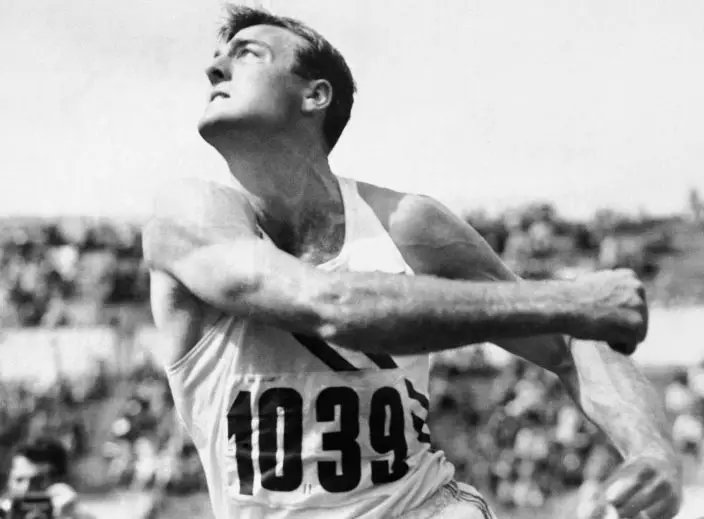
FILE - In this July 26, 1952, file photo, Bob Mathias, defending Olympic decathlon champion, heaves the discus during the decathlon competition at the Summer Olympic games in Helsinki, Finland. (AP PhotoFile)

FILE - In this July 26, 1952, file photo, Bob Mathias, defending Olympic decathlon champion, heaves the discus during the decathlon competition at the Summer Olympic games in Helsinki, Finland. (AP PhotoFile)

They nearly did. The U.S. topped the medal table with 76 thanks to dominance in track, followed closely by the Soviets’ 71 thanks to a serious haul on the wrestling mat. The competition began an athletic tug-of-war at the world's largest sporting event that continues seven decades later. Either the Americans or the Russians have finished with the most medals at each of the last 17 Summer Olympics, the U.S. doing it nine times and their counterparts eight.

The USSR was still a mystery to much of the world in 1952. Details of the country's athletic progress were sketchy in the West. Reports of world records and eye-popping performances all came from the highly-filtered government-controlled media. The decision for all Soviet bloc nations to live in an Olympic village separate from Western nations only deepened the mystery.

Then the USSR surprisingly invited Westerners — including Americans — to enter the communist Olympic Village. The Soviets even hosted a swanky dinner for members of the U.S. Olympic delegation replete with vodka and whitefish caught in the Volga River, toasting goodwill under paintings of Joseph Stalin and the Politburo.
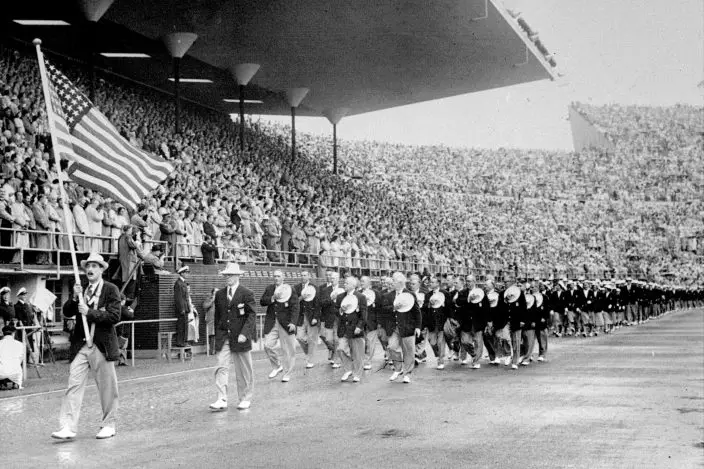
FILE - In this July 21, 1952, file photo, members of the United States Olympic team holding their hats over their hearts as they pay tribute to Finland's President Juho K. Passikivi, march into Olympic Stadium during the opening ceremonies of the Summer Olympic games in Helsinki, Finland. (United Press via AP, File)

FILE - In this July 21, 1952, file photo, members of the United States Olympic team holding their hats over their hearts as they pay tribute to Finland's President Juho K. Passikivi, march into Olympic Stadium during the opening ceremonies of the Summer Olympic games in Helsinki, Finland. (United Press via AP, File)

“We can't reciprocate,” an unnamed American official told The Associated Press. “We simply don't have the money.”

The Americans did hold onto their edge in the medal standings, but just barely. And over the course of two weeks in a city less than 500 miles from the Arctic Circle, the Soviets sent a very loud message that they were very much ready to challenge the U.S. for global athletic supremacy.

Of course, back in the USSR, it would have been easy to think the country had dominated every event. When three Russian women took gold, silver and bronze in the discus, it was front-page news in Moscow. The stories, by the way, carried no mention of American Walt Davis winning gold in the high jump or that U.S. runner Charlie Moore's world record in the 400-meter hurdles.
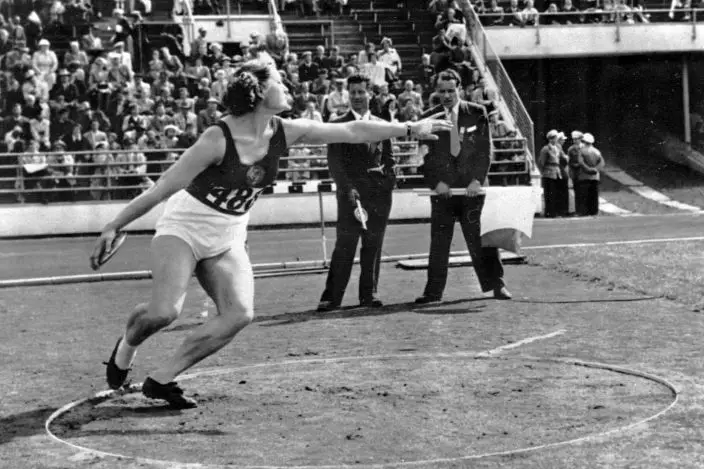
FILE - In this July 1952, file photo, Nina Romashkova, who won the first gold medal for the Soviets in the women's discus competition, winds up to throw during  the Summer Olympics in Helsinki, Finland(AP PhotoFile)

FILE - In this July 1952, file photo, Nina Romashkova, who won the first gold medal for the Soviets in the women's discus competition, winds up to throw during the Summer Olympics in Helsinki, Finland(AP PhotoFile)

ZAPOTEK ZIPS

The breakout star of the Games wasn't an American or a Soviet. It was a 29-year-old staff captain in the Czech Republic Army who ran as if he was in deep agony and his next step would be his last.

Yet Emil Zatopek cared little about form or even proper running decorum while winning the 5,000 meters, 10,000 meters and the marathon, a race he'd never run before he set an Olympic and World record by covering the 26.2-mile distance in 2:23:03. Early on in the marathon Zatopek asked British runner Jim Peters if his pacing was right. When Peters told Zatopek it was, Zatopek took off and cruised to victory by more than 2 1/2 minutes.

Zatopek — whose wife Dana Zatopkova won gold in the javelin — blew off the media after the race and headed back to the Olympic village for a nap.

MAGNIFICENT MATHIAS

American Bob Mathias was just 17 when he won the decathlon at the 1948 London Olympics. He stamped himself as the world's greatest athlete at age 21 when he defended his gold medal by posting a record score of 7,887 points over two days and 10 events in Helsinki. He then promptly retired.

“This is for sure,” Mathias said. “There's nothing left.”

Maybe on the track, but not in life. Mathias went on to dabble in acting before serving four terms as a Republican Congressman representing California's 18th district, just south of the Bay Area.

LIFE IN THE FAST LANE

Long before hi-tech swimsuits and dolphin kicks became a thing, the pool at the 1952 Games showcased just how fast the sport was progressing.

During the modest-sized meet — there were only 11 events compared to 34 at the 2016 Summer Olympics — eight Olympic records were set. The Hungarian women dominated, winning seven out of 15 medals.

AP Corporate Archives contributed to this report

More AP Olympics: https://apnews.com/OlympicGames and https://twitter.com/AP_Sports

ANAHEIM, Calif. (AP) — You’ve done something special when Torii Hunter, a nine-time Gold Glove Award winner known for his acrobatic catches, calls what you just did “probably the greatest defensive game I’ve ever seen.”

That was the praise Hunter heaped on the Los Angeles Angels' Jo Adell after the right fielder made three homer-robbing catches, the last a spectacular leaping grab while crashing into the seats near the right-field foul pole in the ninth inning, in a 1-0 victory over the Seattle Mariners on Saturday night.

“I’ve never seen three home run robberies in one game, and I’ve never seen a guy on the third one fall into the stands, catch the ball and keep his feet in like he’s a wide receiver,” said the 50-year-old Hunter, a special assistant to the general manager who watched the game from the bench. “I was jumping up and down. I almost passed out.”

Adell, who struggled on defense for several years before transforming into a Gold Glove finalist in 2024, leaped high above the yellow line on the wall in straight-way right field to deny Cal Raleigh of a solo homer in the first inning, and made a nearly identical catch to against Josh Naylor in the eighth.

J.P. Crawford then led off the ninth with a drive toward the right-field corner, where Adell raced toward the ball, leaped to glove it, flipped over the low wall and fell into the first row of seats before holding his glove up to present the catch, which was upheld after a replay review.

“After the first one, I was pretty fired up,” Adell said. “When I got to the second one, which looked identical to the first, I thought, ‘Wow, my routes are on point tonight.’ The third one was just grit. Top of the ninth, you have to get it done. It was crazy.

“You just get there, then it’s decision-making. The ball was hit high enough to where I could get there. I watched it (into my glove), fell over and ended up in somebody’s lap. I don’t know who it was, but it was a softer landing than I expected. The fans were as fired up as me.”

According to Inside Edge, Adell has 10 home run robberies since 2020, tied with Kyle Tucker of the Dodgers for the most in the big leagues. The outfielders with the most home run robberies in the entire 2025 season were Jacob Young of the Nationals and Fernando Tatis of the Padres. Both had four.

This was believed to be the first time in baseball history a player has robbed three homers in one game.

“It was like a movie scene,” Hunter said about Adell’s third catch. “It was like the music was playing, then he caught the ball, then he went down and we didn’t see him anymore. The music paused, he came up and said, ‘Yeah!’ I started cheering and almost blacked out.”

Hunter, the former Minnesota Twins, Angels and Detroit Tigers star, has worked extensively with Adell on defense during the past few years.

“His impact has been huge,” Adell said. “It’s mental when you’re out there — it’s a mindset of going to get the baseball, being aggressive. Early, I was caught in between on some plays, and sometimes that happens.

“When you err on the side of being aggressive and trying to make the plays, you’d be surprised at how many plays you make. That’s the mindset Torii had all those years, winning all those Gold Gloves.”

P MLB: https://apnews.com/hub/mlb

Los Angeles Angels left fielder Jo Adell (7) jumps up to catch a ball hit by Seattle Mariners' Josh Naylor (12) during the eighth inning of a baseball game Saturday, April 4, 2026, in Anaheim, Calif. (AP Photo/Caroline Brehman)

Los Angeles Angels left fielder Jo Adell (7) jumps up to catch a ball hit by Seattle Mariners' Josh Naylor (12) during the eighth inning of a baseball game Saturday, April 4, 2026, in Anaheim, Calif. (AP Photo/Caroline Brehman)

Los Angeles Angels catcher Logan O'Hoppe (14) and left fielder Jo Adell (7) embrace at the end of a baseball game against the Seattle Mariners, Saturday, April 4, 2026, in Anaheim, Calif. (AP Photo/Caroline Brehman)

Los Angeles Angels catcher Logan O'Hoppe (14) and left fielder Jo Adell (7) embrace at the end of a baseball game against the Seattle Mariners, Saturday, April 4, 2026, in Anaheim, Calif. (AP Photo/Caroline Brehman)

Los Angeles Angels Jo Adell (7) is greeted by teammates at the end of a baseball game against the Seattle Mariners, Saturday, April 4, 2026, in Anaheim, Calif. (AP Photo/Caroline Brehman)

Los Angeles Angels Jo Adell (7) is greeted by teammates at the end of a baseball game against the Seattle Mariners, Saturday, April 4, 2026, in Anaheim, Calif. (AP Photo/Caroline Brehman)

Los Angeles Angels left fielder Jo Adell (7) catches a ball hit by Seattle Mariners' J.P. Crawford during the ninth inning of a baseball game Saturday, April 4, 2026, in Anaheim, Calif. (AP Photo/Caroline Brehman)

Los Angeles Angels left fielder Jo Adell (7) catches a ball hit by Seattle Mariners' J.P. Crawford during the ninth inning of a baseball game Saturday, April 4, 2026, in Anaheim, Calif. (AP Photo/Caroline Brehman)

Los Angeles Angels left fielder Jo Adell (7) catches a ball hit by Seattle Mariners' J.P. Crawford during the ninth inning of a baseball game Saturday, April 4, 2026, in Anaheim, Calif. (AP Photo/Caroline Brehman)

Los Angeles Angels left fielder Jo Adell (7) catches a ball hit by Seattle Mariners' J.P. Crawford during the ninth inning of a baseball game Saturday, April 4, 2026, in Anaheim, Calif. (AP Photo/Caroline Brehman)

Recommended Articles