A group of young Afghans – both women and men – is coming together in the country's war-torn capital to practice a mystical Sufi Islamic dance.
The group’s founder says she sees their whirling dance, known as Sema, as a way of carving out a space in the country’s deeply conservative society, particularly when it comes to expectations about gender discrimination and dancing in mixed groups.
“I just wanted to express myself and my feelings with Sema dance,” said Fahima Mirzaie, a 24-year-old economist.
She recently danced alongside male members of her troupe at a cultural event hosted in a somewhat incongruous setting – an Italian restaurant in central Kabul. That night, she was the only women from her group dancing, although other women watched and read poetry.
As she spins, one hand reaches toward heaven and the other toward the earth, her white robe flowing, in the familiar image of a so-called “whirling dervish” seen across the Middle East and Central Asia. Dancers spin repetitively in prayer, chanting Allah and gaining in speed, seeking to lose themselves in a spiritual trance that they believe unites them with God.
But Afghanistan is not widely accepting of this mystical interpretation, and Sufism as well as dancing and singing were both rejected by the Taliban. Many Afghan women are wary of the Taliban returning to power in some form as part of a future peace deal, recalling the years of oppression under a strict form of Islamic law. But even in today's Afghanistan, women and men dancing together in public is mostly rejected as being against the country's culture, traditions and religious beliefs.
Most of the members of Mirzaie's dance group, which features men and women performing in public, are Shiite Muslims. They're a minority in Afghanistan that's been targeted for attacks by the Islamic State group, which considers Shiites — Sufi or otherwise — to be heretics. There are other Sufi dance groups scattered across the country's provinces too, primarily men but some women, who perform in front of mixed audiences.
Mirzaie says she’s unfazed by what people may say about her dancing. As part of the generation that's grown up during Afghanistan's latest war, she’s concerned about the violence in her society. She hopes she can change it through Sufism and the poems of Rumi, who's possibly the most well-known Sufi mystic.
Afghanistan has been at war for more than four decades, first against the invading Soviet army, then warring mujaheddin groups in a bitter civil war, followed by the repressive Taliban rule and finally the latest war that began after the 2001 U.S.-led coalition invasion that toppled the Taliban government.
Her group has also used Sufi dance to help them get through the coronavirus pandemic. During a lockdown earlier this year, Mirzaie closed her center and provided training to her students online.
Now, she’s back whirling in person. At the Italian restaurant, Abdul Ahad, a civil society activist, said he’d been to a few Sufi events in Afghanistan that perform in private, but this was the first time he’s seen women doing it.
Mirzaie’s mother Qamar says she's worried for her daughter. “There’s no security and girls are taunted on their way out to work.”
She says she stays awake at night, waiting until Mirzaie returns home after dancing.
Mirzaie’s father, an ex-colonel in the traffic police, her sister and her mother are among her few supporters.
But despite these concerns, she says she cannot live by someone else’s rules.
“I never asked anyone’s permission for starting it and I will not need anyone’s permission to end it, so I will never stop or surrender to anyone.”
Five years ago, video images from a Minneapolis street showing a police officer kneeling on the neck of George Floyd as his life slipped away ignited a social movement.
Now, videos from another Minneapolis street showing the last moments of Renee Good's life are central to another debate about law enforcement in America. They've slipped out day by day since ICE agent Jonathan Ross shot Good last Wednesday in her maroon SUV. Yet compared to 2020, the story these pictures tell is murkier, subject to manipulation both within the image itself and the way it is interpreted.
This time, too, the Trump administration and its supporters went to work establishing their own public view of the event before the inevitable imagery appeared.
But half a decade later, so many things are not the same — from cultural attitudes to rapidly evolving technology around all kinds of imagery.
“We are in a different time,” said Francesca Dillman Carpentier, a University of North Carolina journalism professor and expert on the media's impact on audiences.
No one who saw the searing video of Minneapolis police officer Derek Chauvin with his knee on Floyd's neck for more than nine minutes on May 25, 2020, is likely to forget it — and Chauvin's impassive face Floyd insisted he couldn't breathe. United in revulsion, demonstrators began one of the nation's largest-ever social movements. Chauvin was convicted of murder.
The footage “caused many individuals to experience an epiphany about racism, specifically cultural racism, in the United States,” legal scholar Angela Onwuachi-Willig wrote in a Houston Law Review study that examined whether white Americans experienced a collective cultural trauma.
She eventually concluded that didn't happen and that the impact diminished with time. The rollback of diversity programs with the second Trump administration offers evidence for her argument.
“The people who are writing the cultural narrative of the Good shooting took notes from the Floyd killing and are managing this narrative differently,” said Kelly McBride, an expert on media ethics for the Poynter Institute.
Homeland Security Secretary Kristi Noem labeled Good, who was demonstrating in opposition to ICE enforcement of immigration laws, a domestic terrorist — an interpretation that Minneapolis Mayor Jacob Frey dismissed with an expletive. Both President Donald Trump and Vice President JD Vance suggested the shooting was justified because Good was trying to run Ross down with her vehicle.
On the night of the killing, White House border czar Tom Homan was cautious in an interview with the “CBS Evening News” when anchor Tony Dokoupil showed him the most widely distributed video of the incident, taken by a bystander and posted by a reporter for the Minnesota Reformer. The veteran law enforcement official said it would be unprofessional for him to prejudge before an investigation.
Later that evening, Homan issued a statement calling the shooting “another example of the results of the hateful rhetoric and violent attacks” against U.S. Immigration and Customs Enforcement and Border Patrol officers.
Video of the incident has been generally inconclusive about whether Good's vehicle actually hit Ross before he opened fire. Even if she did, many experts question whether that represented grounds for firing his weapon. Clearly, however, that would bolster public sympathy for the officer.
“These ICE videos do present irrefutable facts — a woman drove her car and then she was shot dead by an ICE agent,” said Duy Linh Tu, a documentarian and professor at the Columbia University journalism school. “What the videos can't show is the intent of the woman or the officer. And that's the tricky part.”
Good, obviously, can’t speak to what motivated her to put her SUV in drive and move on Portland Avenue South.
Several news organizations have carefully examined the forensic evidence that has emerged. The Associated Press wrote that it was unclear if Good's car made contact with Ross. The Washington Post wrote that “videos examined by The Post, including one shared on Truth Social by Trump, do not clearly show whether the agent is struck or how close the front of the vehicle comes to striking him.”
The New York Times said that “in one video, it looks like the agent is being struck by the SUV. But when we synchronize it with the first clip, we can see the agent is not being run over.”
Video that emerged Friday from the Minnesota site Alpha News showed the incident from Ross' perspective. It, too, left many questions and no shortage of people willing to answer them.
Vance linked to the video online and wrote: “Many of you have been told this law enforcement officer wasn't hit by a car, wasn't being harassed and murdered an innocent woman. The reality is that his life was endangered and he fired in self-defense.”
Senate Democratic leader Chuck Schumer wrote online that “how could anyone on the planet watch this video and conclude what JD Vance says?” Schumer said the administration “is lying to you.”
When one online commentator wrote that Good did not deserve to be shot in the face, conservative media figure Megyn Kelly responded, “Yes, she did. She hit and almost ran over a cop.”
Poynter’s McBride said the media has generally done a good and careful job outlining the evidence that is circulating around in the public. But the administration has also been effective in spreading its interpretation, she said.
There are more camera angles available now than there was with Floyd, but “I don't know if that adds clarity or more fog to this case,” Tu said. “I think that people will see what they want to see. Or, rather, they'll pick the angle that aligns with what they already believe.”
That nagging sense of uncertainty left by the videos leaves experts like Tu and Carpentier to conclude they will pale in impact compared to the Floyd case. With each passing year, the public is becoming more desensitized to images of violence — as the online spread of footage showing Republican activist Charlie Kirk illustrated, she said.
The spread of AI-enhanced fake images is also teaching the public to question what it sees, she said. Before Ross was identified, BBC Verify said false images were being spread online speculating about what the masked agent looked like, and fake video of a Minneapolis demonstration spread.
“Now you can't believe what you're seeing,” Carpentier said. “You don't know if what you're seeing is the real video or if it has been doctored. I don't think AI is being a friend in this case at all.”
David Bauder writes about the intersection of media and entertainment for the AP. Follow him at http://x.com/dbauder and https://bsky.app/profile/dbauder.bsky.social.
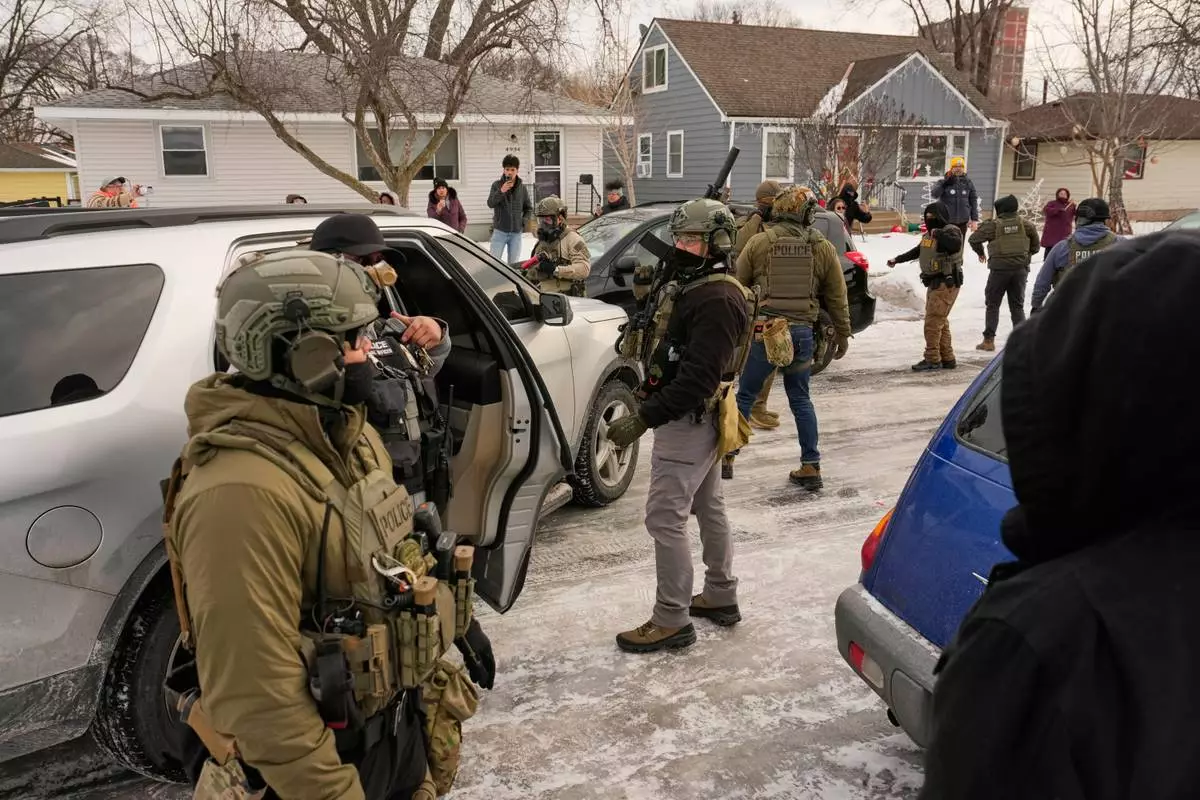
Federal immigration officers make an arrest as bystanders film the incident Sunday, Jan. 11, 2026, in Minneapolis. (AP Photo/John Locher)
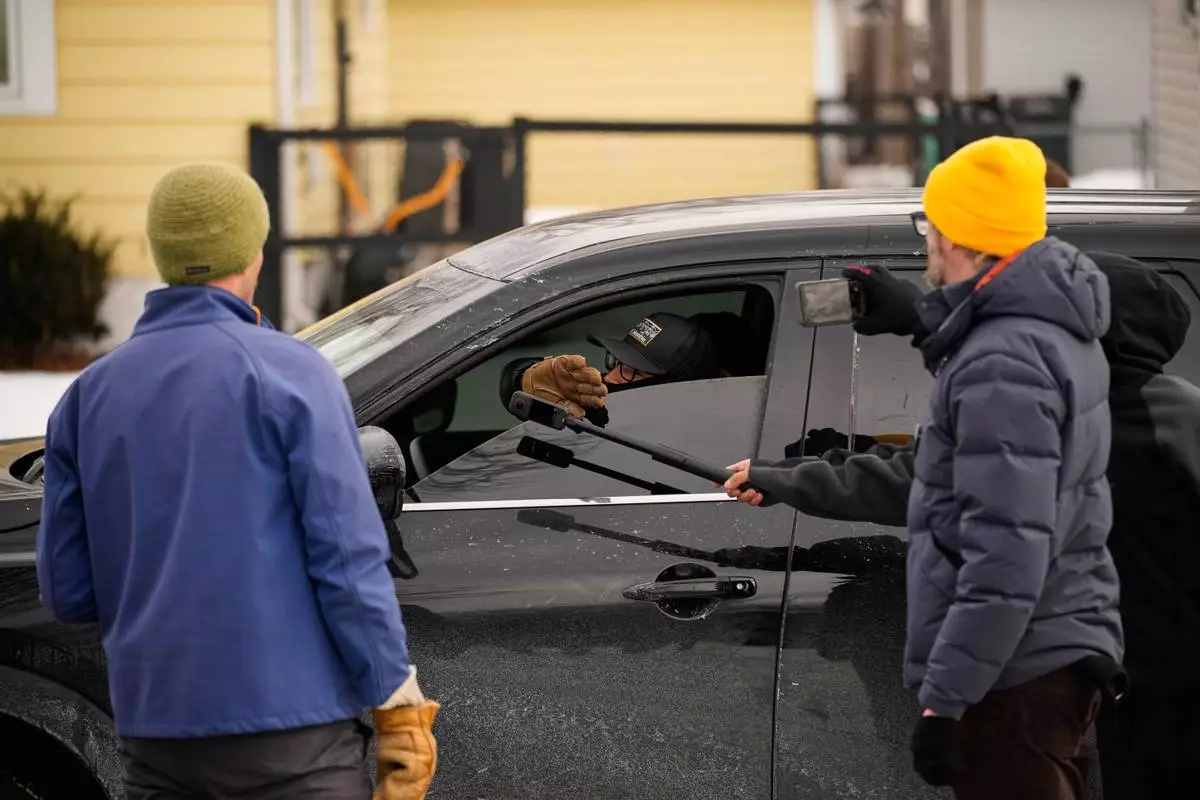
Bystanders film a federal immigration officer in their car Sunday, Jan. 11, 2026, in Minneapolis. (AP Photo/John Locher)