Skip to Content Facebook Feature Image

Analysis: Let Slam rules be -- 5 sets; no 'breaker in Paris

Sport

Analysis: Let Slam rules be -- 5 sets; no 'breaker in Paris
Sport

Sport

Analysis: Let Slam rules be -- 5 sets; no 'breaker in Paris

2020-10-08 23:35 Last Updated At:23:40

As it is, Rafael Nadal would be a big favorite to win his French Open semifinal, of course. He is, after all, a 12-time champion and a combined 24-0 in that round and finals at Roland Garros; he's 9-1 against Friday’s opponent, Diego Schwartzman.

There’s also this working in Nadal’s favor: He is coming off a three-set quarterfinal; Schwartzman toiled for five sets across 5 hours, 8 minutes in his previous match.

That’s an advantage Nadal earned, in part, by being more efficient. He deserves any edge it gives him — just like Schwartzman had an edge in his quarterfinal against Dominic Thiem, who had gone five sets in the fourth round. That’s merely one reason that any discussion of switching from best-of-five-set matches to best-of-three for men at Grand Slam tournaments is misguided.
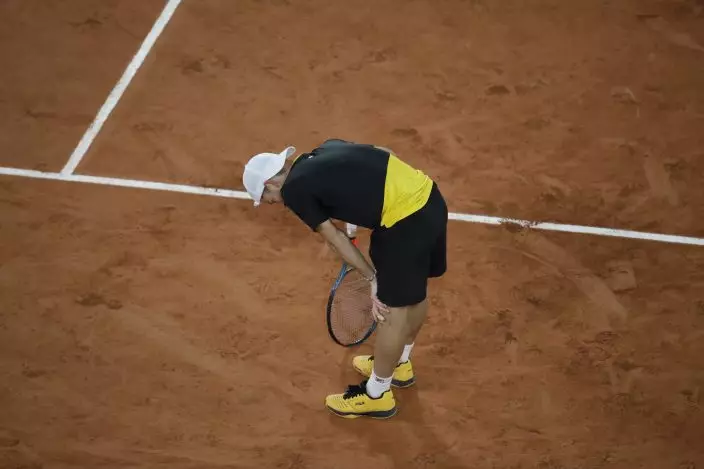
Argentina's Diego Schwartzman catches his breath after a rally in the fourth set of the quarterfinal match of the French Open tennis tournament against Austria's Dominic Thiem at the Roland Garros stadium in Paris, France, Tuesday, Oct. 6, 2020. (AP PhotoAlessandra Tarantino)

Argentina's Diego Schwartzman catches his breath after a rally in the fourth set of the quarterfinal match of the French Open tennis tournament against Austria's Dominic Thiem at the Roland Garros stadium in Paris, France, Tuesday, Oct. 6, 2020. (AP PhotoAlessandra Tarantino)

Others: The current format allows for more plot twists, more comebacks, more suspense, more drama; it makes major championships distinct from lesser events; it rewards superior stamina and focus; it fosters fascinating and — sometimes, though not always — memorable matches.

When Stefanos Tsitsipas, the 22-year-old from Greece who faces No. 1 Novak Djokovic in the semifinals Friday, talked about skipping school to watch Roland Garros on TV as a kid, the first match that sprang to mind was a 6-hour, 33-minute win for Fabrice Santoro over Arnaud Clement in 2004 that ended 16-14 in the fifth.

“I watched some epic thrillers, five-set matches,” Tsitsipas said.
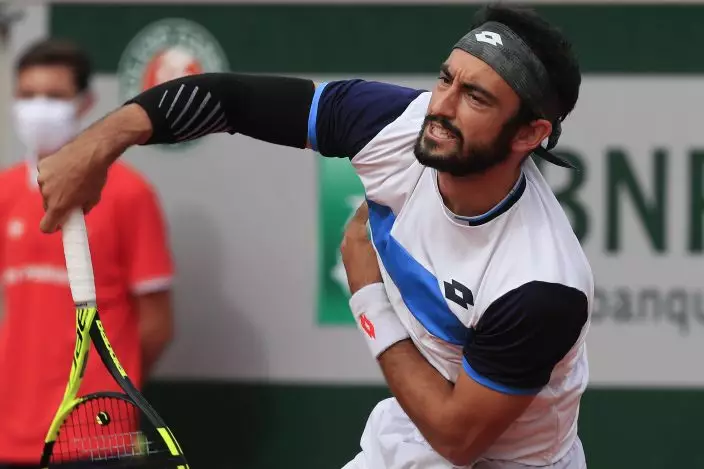
Italy's Lorenzo Giustino serves against Argentina's Diego Schwartzman in the second round match of the French Open tennis tournament at the Roland Garros stadium in Paris, France, Wednesday, Sept. 30, 2020. (AP PhotoMichel Euler)

Italy's Lorenzo Giustino serves against Argentina's Diego Schwartzman in the second round match of the French Open tennis tournament at the Roland Garros stadium in Paris, France, Wednesday, Sept. 30, 2020. (AP PhotoMichel Euler)

Each of the past four Slam men’s finals went five sets and were better for it; two ended in tiebreakers. That can't happen this Sunday, and that's OK.

That's why it's also misguided to think the French Open should join the other tennis major tournaments in adopting final-set tiebreakers.

“The subject has been discussed,” the French tennis federation told The Associated Press in a statement in response to a question about switching from win-by-two-games to a tiebreaker, “but for the moment, we are not changing this rule.”

Nor should they, even if it's true that men’s matches that go past 6-all in the fifth clearly compromise whoever emerges victorious (although Santoro did win his next outing, also in five sets, 16 years ago).

Look at the first round in Paris this year: Five contests went beyond 6-all; every winner lost in the second round.

American Marcos Giron was among that group, winning via an 8-6 final set, then was defeated in straight sets the next time out.

Still, he favors keeping things as they are.

“There’s so much more time for the ebbs and flows of the match, for players to kind of get momentum and to see how players can use match management and the combination of fitness and the mental side,” Giron said. “It’s tremendous.”

Lorenzo Giustino’s 0-6, 7-6 (7), 7-6 (3), 2-6, 18-16 victory against Corentin Moutet lasted 6 hours, 5 minutes.

Here is how the Italian described his status after managing just six games against Schwartzman in the second round: "I woke up this morning with a fever. A headache. Nausea. I wanted to throw up. I felt bad. I didn’t feel like eating. ... It was beautiful to win a match (18-16), but the physical toll was terrible.”

Giustino continued: “Sooner or later, I was going to die out there."

Naturally, he said he’d like to see a tiebreaker in the fifth — “At least that way, you get to a fork in the road” — something the U.S. Open added in 1970, although its final never came down to that until last month, when Thiem edged Alexander Zverev in a nerve-filled championship match low on quality but high on the can’t-turn-away meter.

Giustino’s biggest complaint about today’s setup in tennis is “there should be the same rules everywhere,” because, he explained, “Fans say, ‘Hey, wait, last week, it was three sets; now it’s five sets and there’s no tiebreaker? How is that possible? What’s happening?’”

The Australian Open (first to 10 at 6-all) and Wimbledon (first to seven at 12-all) switched to unique versions of tiebreakers last year, sparked by Kevin Anderson’s 26-24 win over John Isner in the 2018 semifinals at the All England Club.

Isner also was part of the longest match in the sport’s history, which ended 70-68 in the fifth at Wimbledon in 2010.

“We overreacted to two John Isner matches, but I don’t know if they’re ever going to go back,” said American Sam Querrey, who lost in five sets after taking the first two against eventual quarterfinalist Andrey Rublev last week. “I like playing it out and seeing what happens.”

Some want tiebreakers. Some want to switch to best-of-three for all Grand Slam matches. Some say do that just for Week 1, then stick with best-of-five in Week 2.

If a significant switch were considered, American Jack Sock knows where he stands.

“Ultimately,” he said, “I would hope the players would have a say.”

AP Sports Writers John Leicester in Paris and Andrew Dampf in Rome contributed to this report.

Howard Fendrich covers tennis for The Associated Press. Write to him at hfendrich@ap.org and follow him on Twitter at https://twitter.com/HowardFendrich

More AP tennis: https://apnews.com/apf-Tennis and https://twitter.com/AP_Sports

SANTA ANA, Calif. (AP) — An attorney argued Monday that the Los Angeles Angels' failure to investigate repeated reports of drug use and dealing by the team's communications director led to the overdose death of pitcher Tyler Skaggs.

Daniel Dutko, a lawyer for Skaggs' family, told jurors in a Southern California courtroom that the testimony they've heard during a two-month trial shows officials for the MLB team didn't take adequate action when they learned communications director Eric Kay had multiple plastic bags filled with pills at his home or was hospitalized for a drug overdose. Rather, Kay stayed on the job and had access to players he aimed to keep happy, Dutko said.

“This is a systematic breakdown over and over and over,” Dutko said during closing arguments in the civil trial.

The trial comes six years after Skaggs, a 27-year-old left-handed pitcher, died on a team trip to Texas in 2019 after taking a fentanyl-laced pill provided by Kay. His widow, Carli, and parents filed a wrongful death lawsuit contending the Angels knew or should have known Kay was addicted to drugs and dealing to players.

Attorneys for the Angels, who will make their closing arguments later on Monday, have said team officials didn’t realize Skaggs took drugs, and any activity involving Skaggs and Kay happened on their own time and in the privacy of the player’s hotel room.

The trial has included testimony from Angels outfielder Mike Trout and the team’s president, John Carpino, as well as Skaggs’ family. Witnesses described how players used to pay Kay for stunts like taking a fastball to the leg and eating a pimple off Trout's back, and how Kay helped them get massage appointments and tee times. Dutko noted Kay even got a prescription medication for a player, and pointed out he was found to have provided drugs to seven on the team.

“Why do you think the players think it is OK to go to the director or communications to get a prescription medication?" Dutko said during his argument. “Because they believed Eric Kay's job responsibility was to get them whatever they need.”

Skaggs was found dead in the suburban Dallas hotel room where he was staying in 2019 as the Angels were supposed to open a four-game series against the Texas Rangers. A coroner’s report said the player choked to death on his vomit, and a toxic mix of alcohol, fentanyl and oxycodone was found in his system.

Kay was convicted in 2022 of providing Skaggs with a counterfeit oxycodone pill laced with fentanyl and was sentenced to 22 years in prison. His federal criminal trial in Texas included testimony from five MLB players who said they received oxycodone from Kay at various times from 2017 to 2019, the years he was accused of obtaining pills and giving them to Angels players.

During the civil trial, witnesses described Kay’s erratic behavior at the stadium and incidents that led to his attending rehab before he headed out on the trip to Texas with the team. Kay’s now-ex-wife, Camela Kay, told jurors the Angels failed her then-husband, who worked lengthy hours, and that during his 2019 hospitalization for a drug overdose, she heard he had pills intended for Skaggs.

Carpino testified that he wished he had known sooner about the drug use by both Skaggs and Kay.

Skaggs had been a regular in the Angels’ starting rotation since late 2016 and struggled with injuries repeatedly during that time. He previously played for the Arizona Diamondbacks.

After Skaggs’ death, the MLB reached a deal with the players association to start testing for opioids and to refer those who test positive to the treatment board.

FILE - Attorney Todd Theodora gestures before opening statements in the trial for the wrongful death lawsuit accusing the Los Angeles Angels baseball team of being responsible for the 2019 drug overdose death of pitcher Tyler Skaggs Tuesday, Oct. 14, 2025, in Santa Ana, Calif. (AP Photo/Jae C. Hong, Pool, File)

FILE - Attorney Todd Theodora gestures before opening statements in the trial for the wrongful death lawsuit accusing the Los Angeles Angels baseball team of being responsible for the 2019 drug overdose death of pitcher Tyler Skaggs Tuesday, Oct. 14, 2025, in Santa Ana, Calif. (AP Photo/Jae C. Hong, Pool, File)

FILE - Carli Skaggs, widow of pitcher Tyler Skaggs, center, speaks with attorney Rusty Hardin before opening statements in the trial for the wrongful death lawsuit accusing the Los Angeles Angels baseball team of being responsible for the 2019 drug overdose death Skaggs Tuesday, Oct. 14, 2025, in Santa Ana, Calif. (AP Photo/Jae C. Hong, Pool, file)

FILE - Carli Skaggs, widow of pitcher Tyler Skaggs, center, speaks with attorney Rusty Hardin before opening statements in the trial for the wrongful death lawsuit accusing the Los Angeles Angels baseball team of being responsible for the 2019 drug overdose death Skaggs Tuesday, Oct. 14, 2025, in Santa Ana, Calif. (AP Photo/Jae C. Hong, Pool, file)

FILE - Los Angeles Angels center fielder Mike Trout gestures toward a photo of Tyler Skaggs in center field prior to a baseball game against the Detroit Tigers in Anaheim, Calif., on July 29, 2019. (AP Photo/Mark J. Terrill, File)

FILE - Los Angeles Angels center fielder Mike Trout gestures toward a photo of Tyler Skaggs in center field prior to a baseball game against the Detroit Tigers in Anaheim, Calif., on July 29, 2019. (AP Photo/Mark J. Terrill, File)

FILE - In this June 29, 2019, file photo, Los Angeles Angels starting pitcher Tyler Skaggs throws to an Oakland Athletics batter during a baseball game in Anaheim, Calif. (AP Photo/Marcio Jose Sanchez, File)

FILE - In this June 29, 2019, file photo, Los Angeles Angels starting pitcher Tyler Skaggs throws to an Oakland Athletics batter during a baseball game in Anaheim, Calif. (AP Photo/Marcio Jose Sanchez, File)

Recommended Articles