
Skip to Content Facebook Feature Image

Ford to revamp Detroit book warehouse into innovation hub

News

Ford to revamp Detroit book warehouse into innovation hub
News

News

Ford to revamp Detroit book warehouse into innovation hub

2020-11-18 08:01 Last Updated At:08:10

Ford Motor Co. revealed plans Tuesday to transform a long-vacant book warehouse into a hub for automobile innovation in Detroit’s oldest neighborhood.

Corktown, long known for its wood-framed houses, restaurants and taverns, is the site of the automaker's planned $740 million project to create a place where new transportation and mobility ideas are nurtured and developed.

The Dearborn, Michigan-based company's foray into Corktown started with its 2018 acquisition of the massive Michigan Central train station and other buildings in the neighborhood just west of downtown.
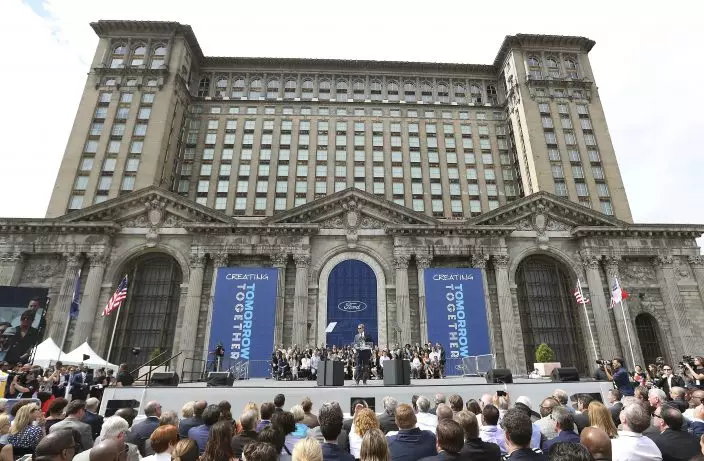
FILE - In this June 19, 2018, file photo, Ford Motor Co., Executive Chairman Bill Ford addresses attendees outside the Michigan Central Train Depot, in Detroit. Ford Motor Co. is expanding its footprint in Detroit's Corktown neighborhood by adding onto plans that began with its purchase and renovation of the massive and once-derelict station. The Dearborn, Michigan-based automaker also plans to turn a vacant book warehouse into the industrial center for its 30-acre Michigan Central mobility innovation district. Details were released Tuesday, Nov. 17, 2020, and are part of Ford's $740 million project to create an innovation hub to help shape the way people and goods will move around in the future. (AP PhotoCarlos Osorio, File)

FILE - In this June 19, 2018, file photo, Ford Motor Co., Executive Chairman Bill Ford addresses attendees outside the Michigan Central Train Depot, in Detroit. Ford Motor Co. is expanding its footprint in Detroit's Corktown neighborhood by adding onto plans that began with its purchase and renovation of the massive and once-derelict station. The Dearborn, Michigan-based automaker also plans to turn a vacant book warehouse into the industrial center for its 30-acre Michigan Central mobility innovation district. Details were released Tuesday, Nov. 17, 2020, and are part of Ford's $740 million project to create an innovation hub to help shape the way people and goods will move around in the future. (AP PhotoCarlos Osorio, File)

When work is completed, the 30-acre (12.1 hectare) site will have more than 1 million square feet (304,800 meters) of commercial space.

“This is a really, authentically beautiful neighborhood. It’s really important that we maintain its integrity,” said Mary Culler, Ford’s Detroit development director and president of the Ford Foundation.

For decades, Corktown stood in the long shadow of the hulking 17-story train station. After being vacated in 1988, the building epitomized Detroit’s blight and economic despair amid the city’s steadily shrinking manufacturing base and exodus of people.

Between the 1950s and 2010, Detroit lost more than 1 million residents. Stable, middle- and blue-collar neighborhoods were emptied of families. Houses became vacant, stripped of metal and anything else of value before collapsing or razed into mounds of wood and other debris.

Through it all, the train station remained standing — too costly to demolish, too large for other uses, and a contradiction to its once-ornate grandeur.

The depot opened in late 1913 and was designed by the same architects who created New York’s Grand Central Terminal. Like other train stations across the U.S., Detroit's became seemingly obsolete as interest in traveling by rail waned.

Businessman Manuel “Matty” Moroun bought the building in the mid-1990s after a previous owner defaulted on a loan, but an anchor tenant could not be found.

Two years ago, Ford stepped in, bought the building and started fixing up 500,000-square-foot (46,000-square-meter) structure. Work should be completed by the end of 2022.

Ford expects to have about 2,500 of its own people and 2,500 partner employees working on the campus that will focus on autonomous vehicles. About 250 workers in Ford’s autonomous vehicle business unit already work out of The Factory, another building near the train station.

The former Detroit school's Book Depository was designed by famed architect Albert Kahn. It has been vacant following a 1987 fire. The Detroit office of global architecture firm Gensler is working with Ford to renovate the building. Construction will start early next year. Move-in is expected in early 2022.

“The Book Depository is going to be the heart of the innovation district ... a mixed-use maker space for partners to come in and solve problems," Culler said. "We think that this project is really pivotal for Ford and the city.”

A greenway will connect 7 acres behind the train station to the city’s west riverfront, while the train platform and tracks will be repurposed as a technology testing and showcase area. It also is expected to feature pedestrian and bike paths.

Ford's plans fit into what Detroit Mayor Mike Duggan and the Detroit Economic Growth Corp. have envisioned for Corktown, according to Katy Trudeau, the city’s deputy director for planning and development.

“There were people nervous about the significant impact the project would have on residents and housing prices,” Trudeau said. “People were concerned that their neighbors who were renters might be displaced due to rising prices.”

In some cases, rents have doubled — something residents worried about after Ford’s 2018 announcement, said Debra Walker, who moved into Corktown about 20 years ago.

“Everybody is seeing dollar signs, so rents are going up,” said Walker, 67, who is retired. “You can still make your money, this is America. But what can we do to keep the neighborhood diverse?”

The city is seeking a competitive federal grant that would help fund up to 800 new affordable housing units in Corktown.

“With all of the economic development happening in Corktown, it is critical that there is affordable housing developed alongside it,” said Donald Rencher, Detroit Housing & Revitalization director. “Given the tremendous investment and trends that we are seeing, we are at an important time to ensure Corktown remains a place where Detroiters of all walks of life are welcome.”

Some Ford employees at The Factory already live in the neighborhood, Culler said.

“It is more than just the train station. We want to be a good neighbor there," she said.

SAN FRANCISCO & JACKSONVILLE, Fla.--(BUSINESS WIRE)--Jan 12, 2026--

Abridge, the leading enterprise-grade AI for clinical conversations, is collaborating with Availity, the nation’s largest real-time health information network, to launch a first-of-its kind prior authorization experience. The engagement uses cutting-edge technology grounded in the clinician-patient conversation to facilitate a more efficient process between clinicians and health plans in medical necessity review.

This press release features multimedia. View the full release here: https://www.businesswire.com/news/home/20260112960386/en/

Rather than creating parallel AI systems across healthcare stakeholders, Abridge and Availity are working together to ensure shared clinical context at the point of conversation powers administrative processes, such as prior authorization review and submission, improving outcomes for patients and the teams delivering care.

This collaboration unites two trusted and scaled organizations: combining Abridge’s enterprise-grade AI platform, serving over 200 health systems and projected to support over 80 million patient-clinician conversations in 2026, with Availity’s next-generation, FHIR-native Intelligent Utilization Management solution, which helps payers and providers digitize and operationalize coverage requirements within administrative workflows.

Availity’s FHIR-native APIs enable fast, scalable, and secure connectivity of payer information across the entire healthcare ecosystem. With Abridge’s Contextual Reasoning Engine technology, clinicians can gain visibility into relevant clinical information during the conversation to support documentation aligned with prior authorization requirements.

“At Availity, we’ve invested in building AI-powered, FHIR-native APIs designed to bring clinical policy logic directly into provider workflows,” said Russ Thomas, CEO of Availity. “By embedding our technology at the point of conversation, we’re enabling faster, more transparent utilization management decisions rooted in clinical context. We’re excited to collaborate with Abridge and to demonstrate what’s possible when payer intelligence meets real-time provider workflows.”

The development of real-time prior authorization is just a component of a broader revenue cycle collaboration that is focused on applying real-time conversational intelligence across the patient, provider, and payer experiences. The companies intend to support integration by collaborating on workflow alignment between their respective platforms in the following areas:

“Abridge and Availity are each bringing national scale, deep trust, and a track record of solving important challenges across the care and claims experience to this partnership,” said Dr. Shiv Rao, CEO and Co-Founder of Abridge. “We’re building real-time bridges between patients, providers, and payers, unlocking shared understanding, focused at the point of conversation.”

About Availity

Availity empowers payers and providers to deliver transformative patient experiences by enabling the seamless exchange of clinical, administrative, and financial information. As the nation's largest real-time health information network, Availity develops intelligent, automated, and interoperable solutions that foster collaboration and shared value across the healthcare ecosystem. With connections to over 95% of payers, more than 3 million providers, and over 2,000 trading partners, Availity provides mission-critical connectivity to drive the future of healthcare innovation. For more information, including an online demonstration, please visit www.availity.com or call 1.800.AVAILITY (282.4548). Follow us on LinkedIn.

About Abridge

Abridge was founded in 2018 to power deeper understanding in healthcare. Abridge is now trusted by more than 200 of the largest and most complex health systems in the U.S. The enterprise-grade AI platform transforms medical conversations into clinically useful and billable documentation at the point of care, reducing administrative burden and clinician burnout while improving patient experience. With deep EHR integration, support for 28+ languages, and 50+ specialties, Abridge is used across a wide range of care settings, including outpatient, emergency department, and inpatient.

Abridge’s enterprise-grade AI platform is purpose-built for healthcare. Supported by Linked Evidence, Abridge is the only solution that maps AI-generated summaries to source data, helping clinicians quickly trust and verify the output. As a pioneer in generative AI for healthcare, Abridge is setting the industry standard for the responsible deployment of AI across health systems.

Abridge was awarded Best in KLAS 2025 for Ambient AI in addition to other accolades, including Forbes 2025 AI 50 List, TIME Best Inventions of 2024, and Fortune’s 2024 AI 50 Innovators.

Abridge and Availity Collaborate to Redefine Payer-Provider Synergy at the Point of Conversation

Abridge and Availity Collaborate to Redefine Payer-Provider Synergy at the Point of Conversation

Abridge and Availity Collaborate to Redefine Payer-Provider Synergy at the Point of Conversation

Abridge and Availity Collaborate to Redefine Payer-Provider Synergy at the Point of Conversation

Recommended Articles