
The Chinese city of Wuhan is looking back on a year since it was placed under a 76-day lockdown beginning Jan. 23, 2020. It was the most extreme step taken up to that point against the coronavirus.
China presents the lockdown as a huge sacrifice that bought the rest of the world time to prepare for the pandemic. Critics say earlier, more decisive measures would have prevented more people from leaving the city and spreading the virus around China and globally.
Click to Gallery
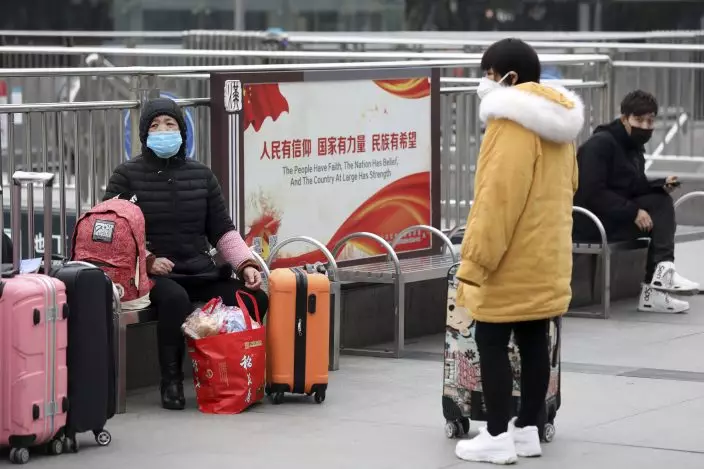
FILE - In this Jan. 23, 2020, file photo, travelers sit with their luggage outside the closed Hankou Railway Station in Wuhan in central China's Hubei Province. The Chinese city of Wuhan is looking back on a year since it was placed under a 76-day lockdown beginning Jan. 23, 2020. (Chinatopix via AP, File)
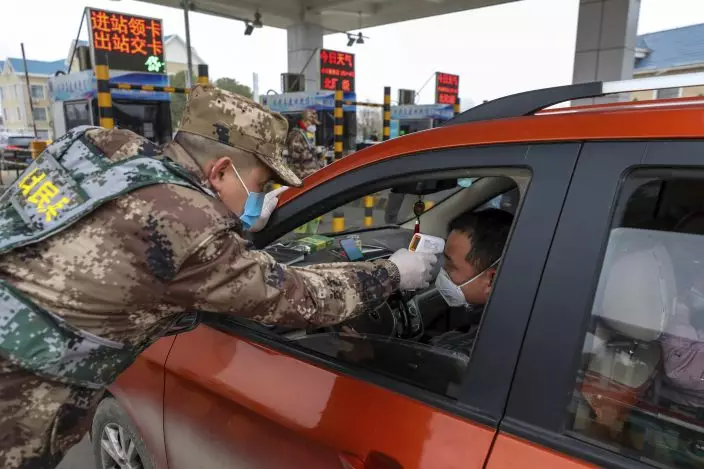
FILE - In this Jan. 23, 2020, file photo, a militia member uses a digital thermometer to take a driver's temperature at a checkpoint at a highway toll gate in Wuhan in central China's Hubei Province. The Chinese city of Wuhan is looking back on a year since it was placed under a 76-day lockdown beginning Jan. 23, 2020. (Chinatopix via AP, File)
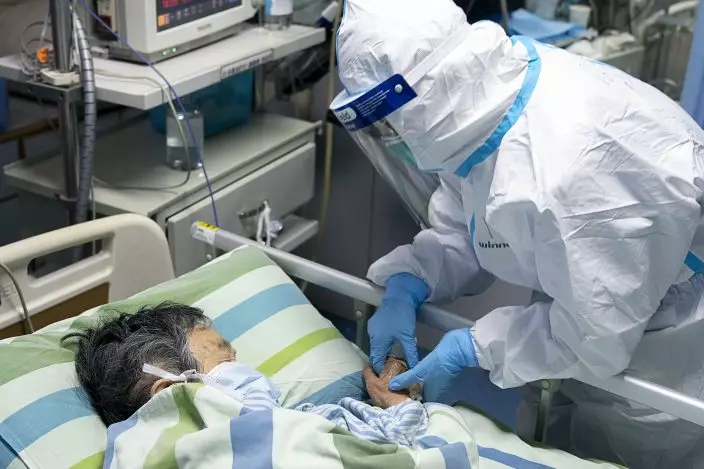
FILE - In this Jan. 24, 2020, file photo, released by China's Xinhua News Agency, a medical worker attends to a patient in the intensive care unit at Zhongnan Hospital of Wuhan University in Wuhan in central China's Hubei Province. The Chinese city of Wuhan is looking back on a year since it was placed under a 76-day lockdown beginning Jan. 23, 2020. (Xiong QiXinhua via AP, File)

FILE - In this Jan. 25, 2020, file photo, shoppers wearing face masks look for groceries with many empty shelves at a supermarket in Wuhan in central China's Hubei province. The Chinese city of Wuhan is looking back on a year since it was placed under a 76-day lockdown beginning Jan. 23, 2020. (Chinatopix via AP, File)
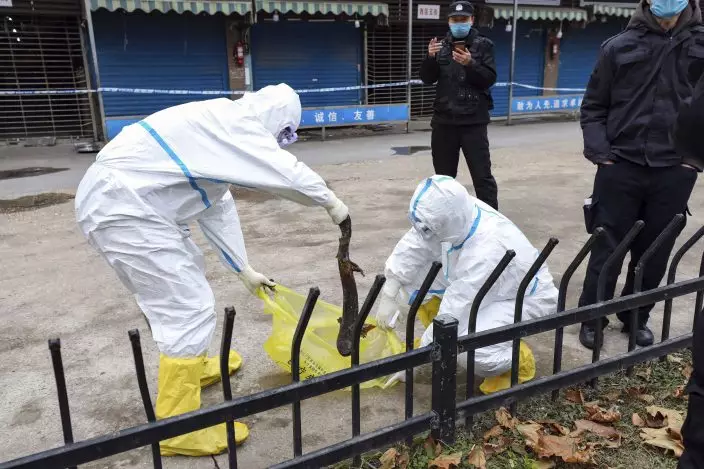
FILE - In this Jan. 27, 2020, file photo, workers in protective gears catch a giant salamander that was reported to have escaped from the Huanan Seafood Market in Wuhan in central China's Hubei Province. The Chinese city of Wuhan is looking back on a year since it was placed under a 76-day lockdown beginning Jan. 23, 2020. (Chinatopix via AP, File)
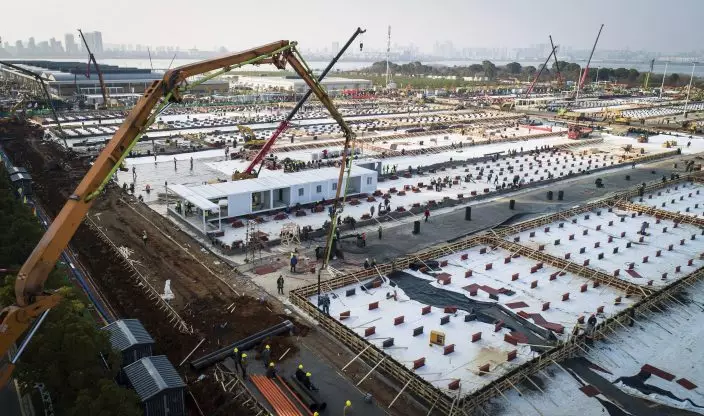
FILE - This Jan. 30, 2020, file photo released by China's Xinhua News Agency, shows construction workers at the site of the Leishenshan temporary field hospital being built in Wuhan in central China's Hubei Province. The Chinese city of Wuhan is looking back on a year since it was placed under a 76-day lockdown beginning Jan. 23, 2020. (Xiao YijiuXinhua via AP, File)
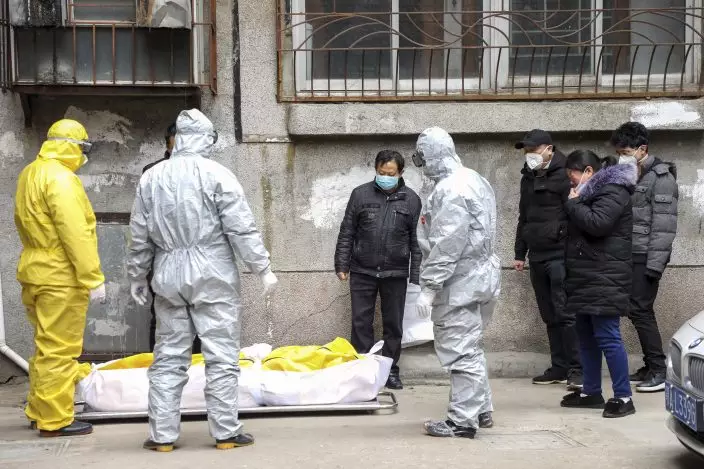
FILE - In this Feb. 1, 2020, file photo, funeral home workers remove the body of a person suspect to have died from a virus outbreak from a residential building in Wuhan in central China's Hubei Province. The Chinese city of Wuhan is looking back on a year since it was placed under a 76-day lockdown beginning Jan. 23, 2020. (Chinatopix via AP, File)

FILE - In this Feb. 3, 2020,file photo, a worker in a protective suit is disinfected outside a hotel being used for people held in medical isolation in Wuhan in central China's Hubei province. The Chinese city of Wuhan is looking back on a year since it was placed under a 76-day lockdown beginning Jan. 23, 2020. (Chinatopix via AP, File)
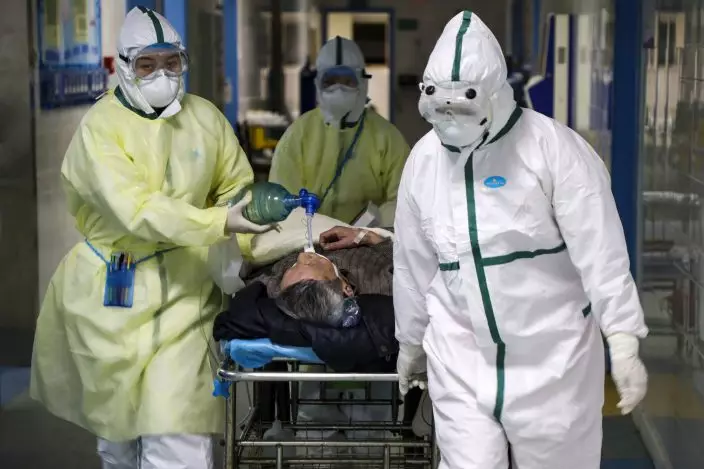
FILE - In this Feb. 6, 2020, file photo, medical workers transfer a patient in the isolation ward for the coronavirus patients at a hospital in Wuhan in central China's Hubei province. The Chinese city of Wuhan is looking back on a year since it was placed under a 76-day lockdown beginning Jan. 23, 2020. (Chinatopix via AP, File)
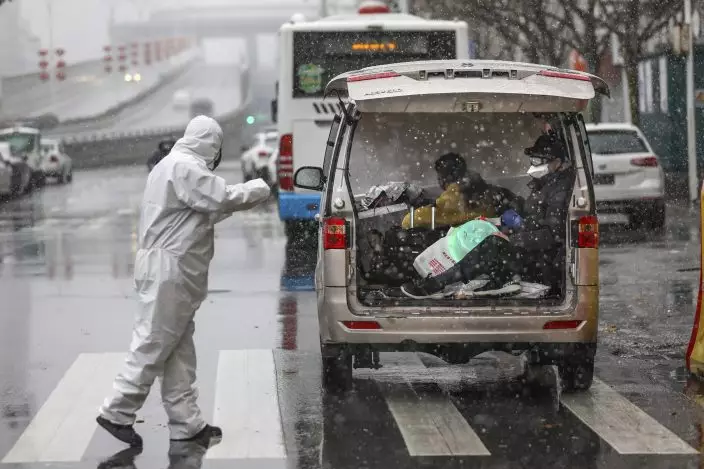
FILE - In this Feb. 15, 2020, file photo, a worker wearing a protective suit transfers patients in the back of a van at a tumor hospital newly designated to treat COVID-19 patients in Wuhan in central China's Hubei Province. The Chinese city of Wuhan is looking back on a year since it was placed under a 76-day lockdown beginning Jan. 23, 2020. (Chinatopix via AP, File)
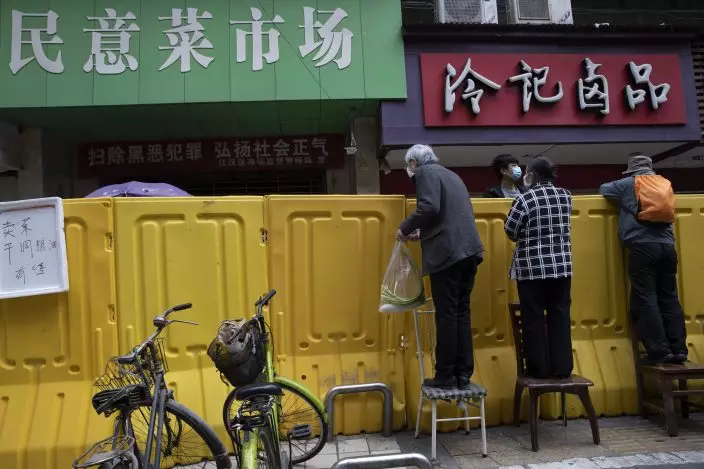
FILE - In this April 3, 2020, file photo, residents climb onto chairs to buy groceries from vendors behind barriers used to seal off a neighborhood in Wuhan in central China's Hubei province. The Chinese city of Wuhan is looking back on a year since it was placed under a 76-day lockdown beginning Jan. 23, 2020. (AP PhotoNg Han Guan, File)
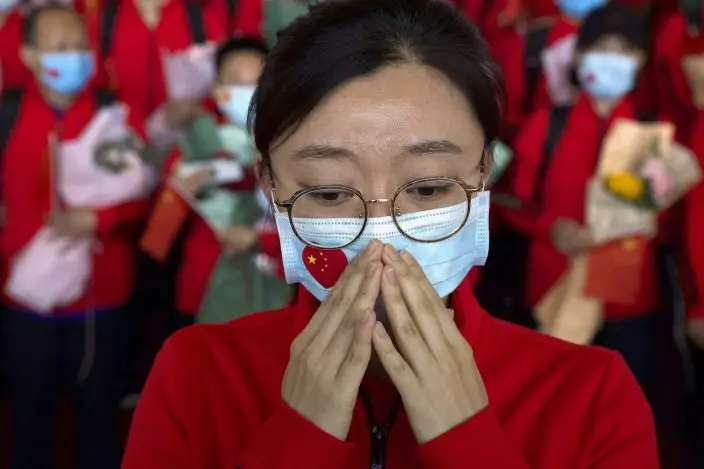
FILE - In this April 8, 2020, file photo, a medical worker from China's Jilin Province reacts as she prepares to return home at Wuhan Tianhe International Airport in Wuhan in central China's Hubei Province. The Chinese city of Wuhan is looking back on a year since it was placed under a 76-day lockdown beginning Jan. 23, 2020. (AP PhotoNg Han Guan, File)

FILE - In this April 15, 2020, file photo, a farewell ceremony is held for the last group of medical workers who came from outside Wuhan to help the city during the coronavirus outbreak in Wuhan in central China's Hubei province. The Chinese city of Wuhan is looking back on a year since it was placed under a 76-day lockdown beginning Jan. 23, 2020. (AP PhotoNg Han Guan, File)
Some events before and during that crucial period:
FILE - In this Jan. 23, 2020, file photo, travelers sit with their luggage outside the closed Hankou Railway Station in Wuhan in central China's Hubei Province. The Chinese city of Wuhan is looking back on a year since it was placed under a 76-day lockdown beginning Jan. 23, 2020. (Chinatopix via AP, File)
— Mid-December 2019: Patients begin showing up in Wuhan hospitals complaining of flu-like symptoms including high fever, cough and breathing difficulties.
— Dec. 27: A Chinese lab assembles a near-complete sequence of the virus, showing it to be similar to the coronavirus that caused the 2002-03 SARS outbreak. The lab alerts health authorities, but the information is kept under wraps.
— Dec. 30: Doctors begin warning about the disease independently on social media — most prominently Dr. Li Wenliang, who shares a lab report indicating the pathogen is a SARS-like virus.
FILE - In this Jan. 23, 2020, file photo, a militia member uses a digital thermometer to take a driver's temperature at a checkpoint at a highway toll gate in Wuhan in central China's Hubei Province. The Chinese city of Wuhan is looking back on a year since it was placed under a 76-day lockdown beginning Jan. 23, 2020. (Chinatopix via AP, File)
— Dec. 31: Officials close Wuhan's Huanan Seafood Wholesale Market, which was linked to dozens of the earliest cases. Li is punished by police and his superiors and told he is “spreading rumors.”
— Jan. 3, 2020: The Chinese Center for Disease Control and Prevention obtains a full sequence of the virus but doesn’t release it. China reports the outbreak to the WHO, but Chinese authorities order labs and medical institutes to destroy patient samples.
— Jan. 9: WHO says Chinese investigators have conducted gene sequencing of the virus, an initial step toward treatment and a vaccine. It does not recommend any specific measures for travelers.
FILE - In this Jan. 24, 2020, file photo, released by China's Xinhua News Agency, a medical worker attends to a patient in the intensive care unit at Zhongnan Hospital of Wuhan University in Wuhan in central China's Hubei Province. The Chinese city of Wuhan is looking back on a year since it was placed under a 76-day lockdown beginning Jan. 23, 2020. (Xiong QiXinhua via AP, File)
— Jan. 13: The first case outside China is identified in Thailand.
— Jan. 14: Chinese health officials say in an internal meeting that “clustered cases suggest human-to-human transmission is possible” and order emergency preparations for a pandemic. In public, they downplay the virus’s ability to infect.
— Mid-January: The Lunar New Year travel rush — the world’s largest annual human migration — gets underway, with millions of people leaving Wuhan to return home or passing through on their journeys.
FILE - In this Jan. 25, 2020, file photo, shoppers wearing face masks look for groceries with many empty shelves at a supermarket in Wuhan in central China's Hubei province. The Chinese city of Wuhan is looking back on a year since it was placed under a 76-day lockdown beginning Jan. 23, 2020. (Chinatopix via AP, File)
— Jan. 18: Tens of thousands of Wuhan families take part in a mass Lunar New Year banquet hosted by the city. Many became infected.
— Jan. 20: A top Chinese medical expert, Dr. Zhong Nanshan, announces on state television that the virus is transmissible between people.
— Jan. 22: Wuhan’s top officials attend a Lunar New Year gala. Dozens of actors, dancers and musicians perform. Some have sniffles and sneezes.
FILE - In this Jan. 27, 2020, file photo, workers in protective gears catch a giant salamander that was reported to have escaped from the Huanan Seafood Market in Wuhan in central China's Hubei Province. The Chinese city of Wuhan is looking back on a year since it was placed under a 76-day lockdown beginning Jan. 23, 2020. (Chinatopix via AP, File)
— Jan. 23: The Wuhan lockdown begins with a notice sent to people’s smartphones at 2 a.m. announcing the airport and train and bus stations will be shut at 10 a.m. Construction begins on the first of two hastily built field hospitals as thousands of patients overwhelm the city's health care system. Eventually, most of the rest of Hubei province would be locked down, affecting 56 million people.
— Feb. 2: The first field hospital, Huoshenshan, opens 10 days later. Eventually, more than a dozen venues such as gymnasiums and conference centers are converted to sprawling medical wards to treat and isolate the less serious cases.
— Feb. 7: Li Wenliang, the doctor reprimanded for sharing a lab report about the virus, dies of COVID-19. His death brings a national outpouring of grief and anger at authorities for punishing him.
FILE - This Jan. 30, 2020, file photo released by China's Xinhua News Agency, shows construction workers at the site of the Leishenshan temporary field hospital being built in Wuhan in central China's Hubei Province. The Chinese city of Wuhan is looking back on a year since it was placed under a 76-day lockdown beginning Jan. 23, 2020. (Xiao YijiuXinhua via AP, File)
— February-March: Wuhan’s streets are deserted apart from ambulances and security personnel as the city’s 11 million people are confined to their homes. Doctors and nurses arrive from around the country to help the city's exhausted medical staff, many of whom were infected in the early days when protective gear was in short supply and not always used.
— March 24: Authorities announce they will end the lockdown of most of Hubei province at midnight, as new cases subside. Wuhan remains locked down for two more weeks.
— April 8: Wuhan’s lockdown is lifted. Residents celebrate their freedom after 76 days with riverside parties while the city puts on a sound-and-light show emphasizing its resiliency and the courage and sacrifice of first responders.
FILE - In this Feb. 1, 2020, file photo, funeral home workers remove the body of a person suspect to have died from a virus outbreak from a residential building in Wuhan in central China's Hubei Province. The Chinese city of Wuhan is looking back on a year since it was placed under a 76-day lockdown beginning Jan. 23, 2020. (Chinatopix via AP, File)
FILE - In this Feb. 3, 2020,file photo, a worker in a protective suit is disinfected outside a hotel being used for people held in medical isolation in Wuhan in central China's Hubei province. The Chinese city of Wuhan is looking back on a year since it was placed under a 76-day lockdown beginning Jan. 23, 2020. (Chinatopix via AP, File)
FILE - In this Feb. 6, 2020, file photo, medical workers transfer a patient in the isolation ward for the coronavirus patients at a hospital in Wuhan in central China's Hubei province. The Chinese city of Wuhan is looking back on a year since it was placed under a 76-day lockdown beginning Jan. 23, 2020. (Chinatopix via AP, File)
FILE - In this Feb. 15, 2020, file photo, a worker wearing a protective suit transfers patients in the back of a van at a tumor hospital newly designated to treat COVID-19 patients in Wuhan in central China's Hubei Province. The Chinese city of Wuhan is looking back on a year since it was placed under a 76-day lockdown beginning Jan. 23, 2020. (Chinatopix via AP, File)
FILE - In this April 3, 2020, file photo, residents climb onto chairs to buy groceries from vendors behind barriers used to seal off a neighborhood in Wuhan in central China's Hubei province. The Chinese city of Wuhan is looking back on a year since it was placed under a 76-day lockdown beginning Jan. 23, 2020. (AP PhotoNg Han Guan, File)
FILE - In this April 8, 2020, file photo, a medical worker from China's Jilin Province reacts as she prepares to return home at Wuhan Tianhe International Airport in Wuhan in central China's Hubei Province. The Chinese city of Wuhan is looking back on a year since it was placed under a 76-day lockdown beginning Jan. 23, 2020. (AP PhotoNg Han Guan, File)
FILE - In this April 15, 2020, file photo, a farewell ceremony is held for the last group of medical workers who came from outside Wuhan to help the city during the coronavirus outbreak in Wuhan in central China's Hubei province. The Chinese city of Wuhan is looking back on a year since it was placed under a 76-day lockdown beginning Jan. 23, 2020. (AP PhotoNg Han Guan, File)