Skip to Content Facebook Feature Image

With Biden's backing, Dems revive bill to overhaul policing

News

With Biden's backing, Dems revive bill to overhaul policing
News

News

With Biden's backing, Dems revive bill to overhaul policing

2021-03-04 07:30 Last Updated At:07:40

Cheered on by President Joe Biden, House Democrats are hustling to pass the most ambitious effort in decades to overhaul policing nationwide, confident they can avoid clashing with moderates in their own party who are wary of reigniting a debate they say hurt them during last fall's election.

The George Floyd Justice in Policing Act was set for a House vote late Wednesday.

The sweeping legislation, which was approved last summer but stalled in the Senate, was named in honor of Floyd, whose killing by police in Minnesota last Memorial Day sparked protests nationwide. The bill would ban chokeholds and “qualified immunity” for law enforcement and create national standards for policing in a bid to bolster accountability.
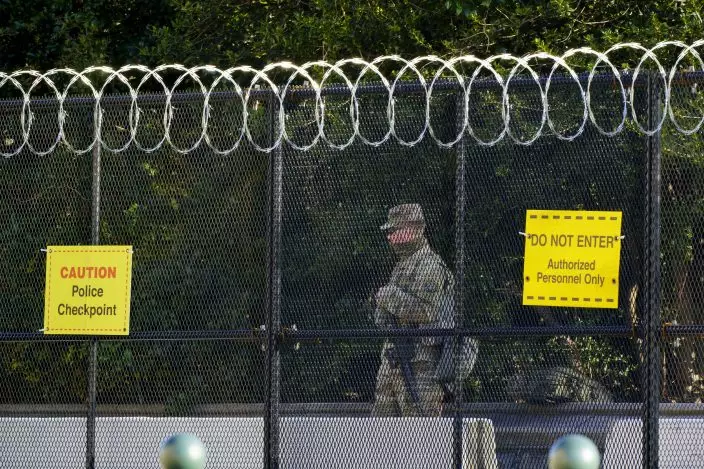
A National Guard member keeps watch along Constitution Avenue at the Capitol where heightened security remains since the Jan. 6 attacks by a mob of supporters of then-President Donald Trump, in Washington, Wednesday, March 3, 2021. The U.S. Capitol Police say they have intelligence showing there is a "possible plot" by a militia group to breach the U.S. Capitol on Thursday. (AP PhotoJ. Scott Applewhite)

A National Guard member keeps watch along Constitution Avenue at the Capitol where heightened security remains since the Jan. 6 attacks by a mob of supporters of then-President Donald Trump, in Washington, Wednesday, March 3, 2021. The U.S. Capitol Police say they have intelligence showing there is a "possible plot" by a militia group to breach the U.S. Capitol on Thursday. (AP PhotoJ. Scott Applewhite)

Democrats say they are determined to pass the bill a second time, to combat police brutality and institutional racism after the deaths of Floyd, Breonna Taylor and other Black Americans following interactions with law enforcement — images of which were sometimes jarringly captured on video. Those killings drew a national and international outcry.

But the debate over legislation has turned into a political liability for Democrats as Republicans seized on calls by some activists and progressives to “defund the police” to argue that Democrats were intent on slashing police force budgets. This bill doesn't do that.

Former Democratic National Committee Chairman Tom Perez said it was a reason the party, after talking confidently of growing its majority in November, instead saw it shrink to just 10 seats, 221-211.

“We played too much defense on ‘defund the police,’” Perez said.

Moderate Democrats said the charge helped to drive Democratic defeats in swing districts around the country.

“No one ran on ‘defund the police,’ but all you have to do is make that a political weapon,” said Rep. Henry Cuellar, a moderate Texas Democrat who has pushed for more police funding in places like his city of Laredo, where law enforcement presence is especially concentrated given the close proximity to the Mexican border.

While Democrats used their then-larger majority to pass the police reform measure in the House last summer, it stalled in the then-Republican-controlled Senate, where GOP senators pushed an alternate plan that Democrats blocked from consideration, calling it inadequate. Democrats now control both chambers of Congress, but it seems unlikely the bill could pass the Senate without substantial changes to win GOP support.

The bill had been set for a vote Thursday, but House leaders abruptly changed the schedule after U.S. Capitol Police warned of threats of violence by a militia group seeking to storm the Capitol two months after the Jan. 6 siege.

Democratic control in the House is now so narrow that the loss of even a handful of moderate votes can sink legislation. But senior Democratic congressional aides said Wednesday they were confident the policing bill would clear the House and were eager to get it to the Senate, where negotiations will take longer.

Despite the political attacks by Republicans, even the House's more centrist lawmakers, some representing more conservative districts, appear ready to back the bill. Aides pointed to the moderate New Democrat Coalition saying this week that its members would support it.

“Black Americans have endured generations of systemic racism and discrimination for too long, and this has been painfully evident in their treatment by law enforcement," said Rep. Suzan DelBene, D-Wash, who chairs the coalition.

That endorsement came despite the bill's prohibitions on so-called qualified immunity, which shields law enforcement from certain lawsuits and is one of the main provisions that will likely need to be negotiated in any compromise with the Senate.

Police unions and other law enforcement groups have argued that, without such legal protections, fears of lawsuits will stop people from becoming police officers — even though the measure permits such suits only against law enforcement agencies, rather than all public employees.

California Rep. Karen Bass, who authored the bill, understands the challenge some House members face in supporting it.,

“My colleagues, several of them, I do not make light of the difficulty they had getting reelected because of the lie around defunding the police,” Bass said.

She called provisions limiting qualified immunity and easing standards for prosecution “the only measures that hold police accountable — that will actually decrease the number of times we have to see people killed on videotape.”

Bass said she was not planning to make concessions before the bill clears the House. Changes would only serve to weaken it while failing to shield Democrats from the false “defund the police” narrative surrounding it, she said.

“Even if they were to vote against the bill, even if they were to have a press conference denouncing the bill, they are still going to be hit with the same lie,” Bass said of Democrats.

She also acknowledged the challenges Democrats faced last November — and may likely see again — when former President Donald Trump's reelection campaign and other leading Republicans crowded the airwaves with images of cities around the country burning. But Bass said those attacks, like much of the opposition to the bill, are built on racism, promoting fears about how, “The scary Black people are going to attack you if you try to rein in the police.”

“That's as old as apple pie in our history,” she said. “So do you not act because of that?”

Still, she conceded that changes are likely to come if the measure is to win the minimum 60 votes it will need to advance in the Senate, which is now split 50-50s. Bass said she'd been in contact with South Carolina Sen. Tim Scott, the only Black Republican in the chamber, and was confident he would help deliver some GOP support.

Scott said this week that the legislation's sticking points were qualified immunity and prosecutorial standards and that in both areas, “We have to protect individual officers.”

“That's a red line for me,” Scott said, adding “hopefully we'll come up with something that actually works.”

That could prove a tall order, despite the White House's vocal support for police reform. Biden has promised to combat systemic racism and signed executive orders he says will begin doing that, though advocates are expecting the new administration to go further.

Biden has tweeted that he hopes "to be able to sign into law a landmark police reform bill.”

BUDAPEST (AP) — From the jubilant crowds along the Danube in Budapest to executive offices in Brussels, praise and even glee abounded for Hungary’s next leader, Péter Magyar. But the outpouring after his stunning election focused mainly on who he’s not: outgoing Prime Minister Viktor Orbán, who many saw as a threat to Europe’s peace and prosperity.

From Madrid to Helsinki, many hope that Magyar's win will help unshackle the 27-nation European Union as it faces hybrid warfare attacks from Moscow, an antagonistic Washington and Beijing's economic pressure. EU leaders had been increasingly frustrated with Orbán over his takeover of democratic institutions and vetoing of strategic action like a 90-billion-euro loan for Ukraine.

It remains to be seen whether those hopes will be fulfilled. Magyar avoided talking about Ukraine or divisive issues like LGTBQ rights on the campaign trail, and was previously a long-time conservative insider in Orban's party. He told The Associated Press that he would work more closely with the EU and the 32-nation NATO mililtary alliance that was forged to thwart aggression from Moscow.

“All Hungarians know that this is a shared victory. Our homeland made up its mind. It wants to live again. It wants to be a European country,” Magyar said during his victory speech on Sunday.

Olga Oliker, the director of European Security at the International Crisis Group, said that "where Orban slowed actions and blocked consensus, Magyar, as he defines Hungary’s relationships with its European allies, to say nothing of those with Ukraine, Russia and the United States, can help shape the future of Europe.”

After Magyar takes his oath of office in May, the Hungarian prime minister could potentially lift Hungary's veto and enable the European Commission to provide Ukraine with the 90-billion-euro loan that Orbán had agreed to in December and then backtracked on, enraging his fellow leaders.

EU diplomats will discuss Wednesday how best to fast-track the funds to Kyiv, said a Cypriot official speaking on condition of anonymity because they were not authorized to be named. Cyprus currently holds the rotating EU presidency.

Hungary borders Ukraine, and the pro-Russian Orbán had long demonized Ukrainian President Volodymyr Zelenskyy. While congratulating Magyar on X, Zelenskyy said that “we are ready for meetings and joint constructive work for the benefit of both nations, as well as for the sake of Europe’s peace, security, and stability.”

Kremlin spokesperson Dmitry Peskov said that Russia respects the outcome of the Hungarian vote and expects to maintain contacts with the country’s new leadership.

He said that “as for what action Hungary’s new leadership will take, we probably need to be patient and see what happens.”

The prospect of a nimbler, faster-acting Europe drove widespread praise for Magyar from several European leaders. EU negotiators had to increasingly find workarounds when Orban blocked policy decisions. He also held up Sweden's accession to NATO.

Magyar said he received calls on Sunday night — before he even took the stage to announce his victory — from French President Emmanuel Macron, NATO Secretary-General Mark Rutte, German Chancellor Friedrich Merz and European Commission President Ursula von der Leyen, who was frequently vilified by Orbán during his campaign.

“Today, Europe is Hungarian," von der Leyen said at a news conference in Brussels on Monday. "The people of Hungary have spoken and they have reclaimed their European path.”

“Today Europe wins and European values win,” said Spain’s left-wing Prime Minister Pedro Sánchez in a post on X on Sunday night. Poland’s center-right Prime Minister Donald Tusk exclaimed on social media: “Back together! Glorious victory, dear friends!”

Orbán's defeat has reverberated across the world, including to the United States where President Donald Trump supported Orbán’s reelection bid and even dispatched Vice President JD Vance to Budapest last week — in the midst of the Iran war — to stump for the incumbent.

Magyar's victory might signal a shift in European politics that has been dominated by a far-right shift over the past decade. Magyar comes from a right-wing background but distanced himself from Orban’s leadership.

With nationalist parties making headways in Germany and France, the electoral earthquake in Hungary shows that “Hungarians are sending a signal to the world” said German lawmaker Daniel Freund.

“The icon of illiberal anti-European forces has now failed — brought down by a disastrous economy, corruption, and his own unfair electoral system,” he said.

Orbán's populist allies in the EU, Czech Prime Minister Andrej Babiš and Slovak Prime Minister Robert Fico, congratulated Magyar while praising the ousted strongman. But Fico also brought up the Druzhba pipeline, shuttered since an attack in Ukraine — an issue Orbán campaigned on and one exacerbated by rising energy prices over the Iran war. Magyar has criticized Orbán’s government for failing to diversify its energy mix, and advocated for reaching new agreements and constructing new infrastructure to bring oil and gas from other sources into landlocked Hungary. Both Babiš and Fico pledged to work with Hungary's next leader.

Associated Press writers Jill Lawless in London, Karel Janicek in Prague, Dusan Stojanovic in Belgrade and Derek Gatopoulos in Kyiv, Ukraine, contributed to this report.

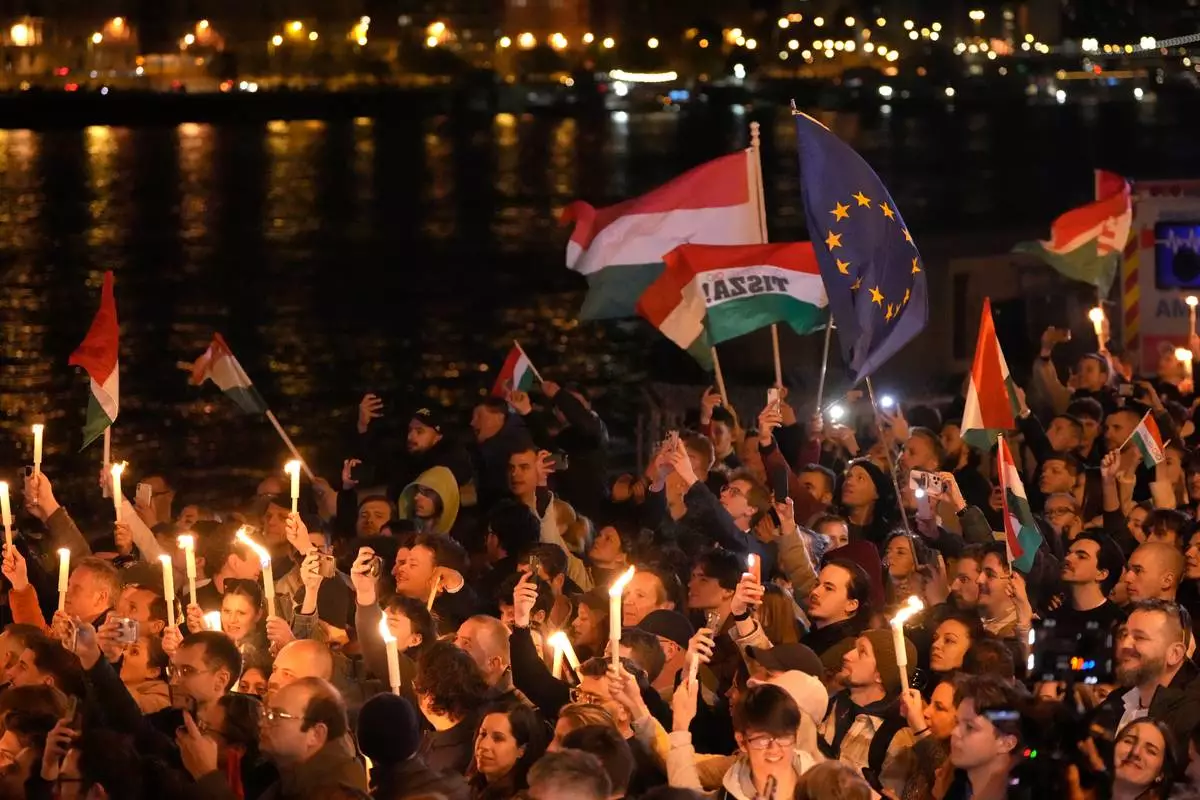
A man wrapped in the European Union flag waves a Hungarian flag, backdropped by the parliament building, early Monday April 13, 2026 as people celebrate Peter Magyar ousting Prime Minister Viktor Orban after 16 years in power. (AP Photo/Sam McNeil)

A man wrapped in the European Union flag waves a Hungarian flag, backdropped by the parliament building, early Monday April 13, 2026 as people celebrate Peter Magyar ousting Prime Minister Viktor Orban after 16 years in power. (AP Photo/Sam McNeil)

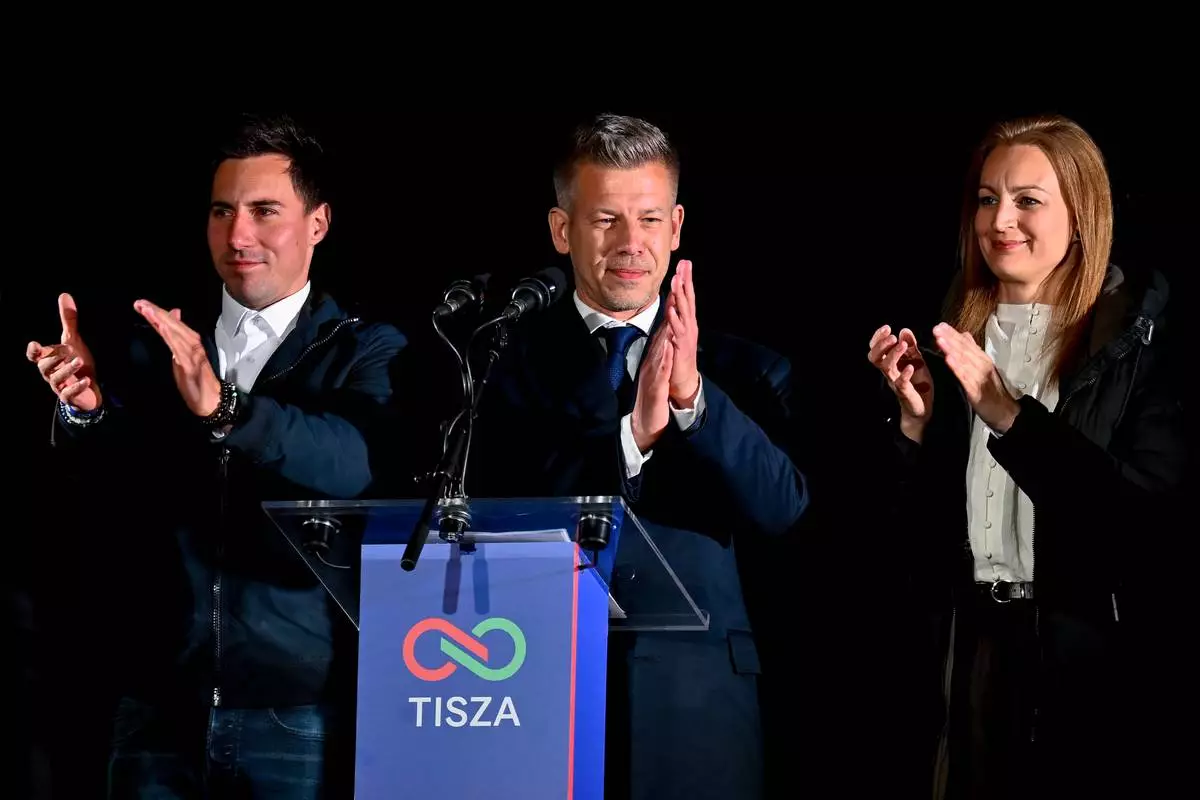
Peter Magyar, leader of the opposition Tisza party, center, speaks to his supporters following the announcement of the partial results of the parliamentary election, in Budapest, Hungary, Sunday, April 12, 2026. (AP Photo/Denes Erdos)

Peter Magyar, leader of the opposition Tisza party, center, speaks to his supporters following the announcement of the partial results of the parliamentary election, in Budapest, Hungary, Sunday, April 12, 2026. (AP Photo/Denes Erdos)

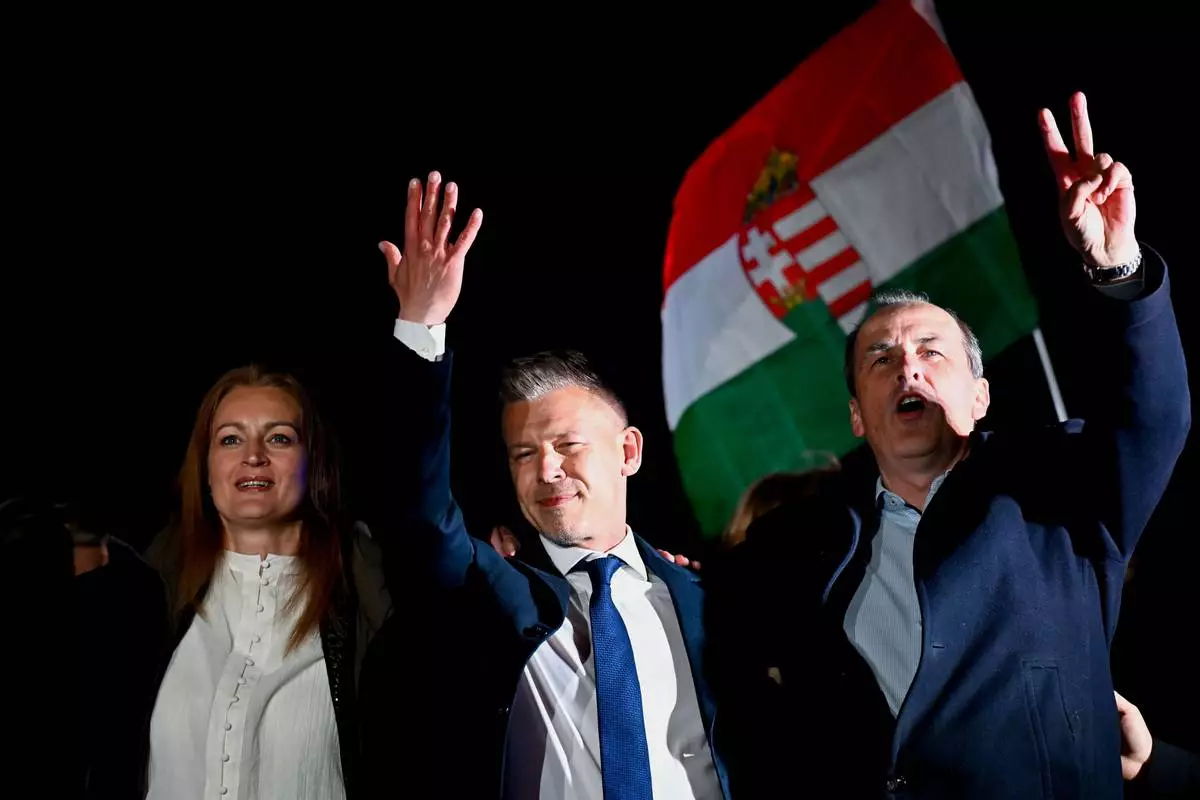
Peter Magyar, the leader of the opposition Tisza party waves a national flag after claiming victory in a parliamentary election in Budapest, Hungary, Sunday, April 12, 2026. (AP Photo/Darko Bandic)

Peter Magyar, the leader of the opposition Tisza party waves a national flag after claiming victory in a parliamentary election in Budapest, Hungary, Sunday, April 12, 2026. (AP Photo/Darko Bandic)

Peter Magyar, leader of the opposition Tisza party, waves the Hungarian flag following the announcement of the partial results of the parliamentary election, in Budapest, Hungary, Sunday, April 12, 2026. (AP Photo/Denes Erdos)

Peter Magyar, leader of the opposition Tisza party, waves the Hungarian flag following the announcement of the partial results of the parliamentary election, in Budapest, Hungary, Sunday, April 12, 2026. (AP Photo/Denes Erdos)

Supporters of Peter Magyar, the leader of the opposition Tisza party celebrate after a parliamentary election in Budapest, Hungary, Sunday, April 12, 2026. (AP Photo/Darko Bandic)

Supporters of Peter Magyar, the leader of the opposition Tisza party celebrate after a parliamentary election in Budapest, Hungary, Sunday, April 12, 2026. (AP Photo/Darko Bandic)

Peter Magyar, leader of the opposition Tisza party, center, celebrates with his party colleagues following the announcement of the partial results of the parliamentary election, in Budapest, Hungary, Sunday, April 12, 2026. (AP Photo/Denes Erdos)

Peter Magyar, leader of the opposition Tisza party, center, celebrates with his party colleagues following the announcement of the partial results of the parliamentary election, in Budapest, Hungary, Sunday, April 12, 2026. (AP Photo/Denes Erdos)

Recommended Articles