Screenplay writing, usually a fairly solitary, uneventful process, is more of a full-contact sport for a movie like “Borat Subsequent Moviefilm.”
Work for the nine Oscar-nominated writers of the “Borat” sequel began conventionally enough. Brainstorming, a draft, a table read. But as soon as shooting starts, there’s no telling what can happen, how people will react to Sacha Baron Cohen’s Kazakh alter-ego, or what strange circumstances might befall their protagonist.
As Borat hurtles through the world, a team of writers trails along, endlessly writing and rewriting for every evolving scenario. Take, for example, when Baron Cohen ended up in a five-day lockdown with two QAnon believers. Anthony Hines, a writer and producer on the film, would reach Baron Cohen by stealthily taking a ladder to Baron Cohen’s second-floor bedroom, like a Cyrano de Bergerac of comedy.
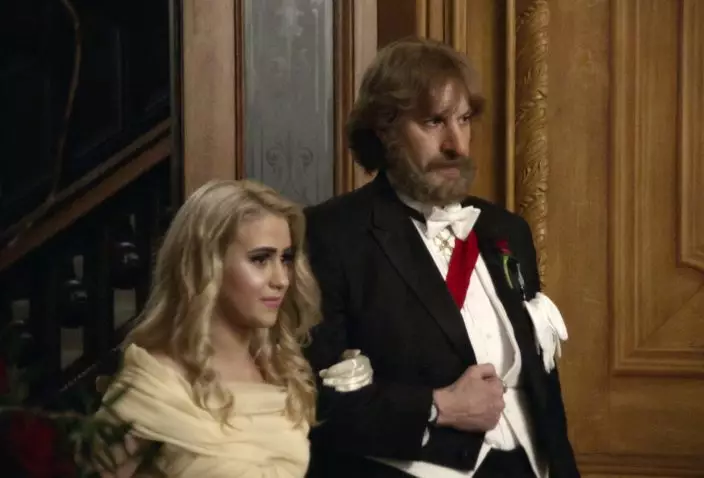
This image released by Amazon Studios shows Maria Bakalova, left, and Sacha Baron Cohen in a scene from "Borat Subsequent Moviefilm." .(Amazon Studios via AP)
“It was quite sort of dark and dangerous,” says Hines, a longtime collaborator of Baron Cohen's. “It was literally a matter of climbing up that ladder and poking your head into Borat’s bedroom window at 2 a.m. and giving him feedback and giving him some ideas.”
Like most things about “Borat Subsequent Moviefilm,” the film’s Academy Awards nomination for adapted screenplay is unusual. Seldom are the scripts to broad comedies nominated, but both “Borat” films have been. Its nine writers are the most ever nominated in the category. (When it won at the Writer Guild Awards, Baron Cohen theorized it was because 60% of the guild worked on the movie.) And the film’s full title — “Borat Subsequent Moviefilm: Delivery of Prodigious Bribe to American Regime for Make Benefit Once Glorious Nation of Kazakhstan” — is the longest ever for an Oscar nominee.
“When they read out the nomination and the title of the film, I think it will essentially feel like a filibuster,” Dan Mazer said on a recent Zoom with Hines and four other of the film’s writers, Peter Baynham, Dan Swimer, Jena Friedman and Nina Pedrad.

This image released by Amazon Studios shows Sacha Baron Cohen in a scene from "Borat Subsequent Moviefilm." (Amazon Studios via AP)
“If we win, it’s a massive boost the trophy manufacturing industry,” added Hines.
You can read a transcribed script of “Borat Subsequent Moviefilm,” and it does make for a unique reading experience. Descriptions include “EXT. MEL GIBSON SQUARE - DAY.” But the movie’s final form gives you only a small window into the gonzo art of writing for Borat.
There are plenty of scenes scripted straightforwardly, but screenwriting for Borat also means finding ways to manipulate the real world, guessing how people will respond, and shoehorning those guerilla encounters into a coherent narrative. That adds up to, says Hines, “an extraordinary amount of writing — far, far more than a conventional movie.”
“There’s nine movies,” says Swimer.
A lot of what they do never comes near the screen, nor is it even designed to. To help lure Rudy Giuliani for the film’s infamous hotel room scene, they created a fake documentary about the coronavirus called “Keeping America Alive: How Trump Defeated COVID.” After watching the tape, Giuliani’s office OK’ed the interview under the impression it was for that film.
“That’s a writing process all of its own. It’s like scripts within scripts,” says Hines. “We shot part of that documentary with other people who were not going to be in the movie like a sizzle reel with a voiceover going something like: ‘Where Trump saw an invisible enemy, the Democrats saw an invisible friend.’”
Sometimes — especially during the run-up to the 2020 election — real-life farce could seem like their handwork, too. Giuliani’s Four Seasons Landscaping press conference, for instance.
“That was us as well,” says Baynham. “We wrote the Landscaping thing.”
Most of the writers are Borat veterans, many of them going back to “Da Ali G Show.” But on “Subsequent Moviefilm,” Baron Cohen (a credited writer, too, and a regular presence in the writing room) brought some fresh voices to Borat, including Friedman, Pedrad and Erica Rivinoja. Their input was key in mapping the journey of Borat's daughter Tutar through American-style misogyny and Borat’s slow, strange transition to what might be called feminism.
But because “Borat Subsequent Moviefilm” was made in secret, just joining the project was disorienting.
“I didn’t really even know what the movie was,” says Pedrad (“Saturday Night Live”). “I go, locked in a room, read the script. A couple pages in, I’m like: ‘This sounds a lot like ... no. Is it?’”
In case of leak, scripts were written in code. Borat’s name never appeared in the pages. “One minute, he was Sergio from Guatemala, then he was Apu from Armenia,” says Hines. By the end, the names were all jumbled up. Johnny the Monkey was identified as Jeremy the Horse.
Friedman, a “Daily Show” veteran, was responsible for the scene set in a “pregnancy crisis center.” There, Pastor Jonathan Bright, led to believe that Tutar is pregnant by her father, still argues against abortion.
“I can’t believe we got that scene in a major motion picture,” says Friedman. “I remember there was a discussion like, ‘Do you think we’ll really be able to get a pastor be OK with incest?’ Just knowing what I know from those places, I was like, ‘Absolutely, yes.’”
The writers will play out some scenes with actors beforehand to get a sense of likely responses to Borat. But they also encounter plenty of people who say things that couldn’t possibly be prepared for. If Borat holds up a mirror to American society, the reflection is often unpredictable and disquieting.
That includes the plastic surgeon, Dr. Charles Wallace, visited by Borat and Tutar who frankly tells them that he would he would want to sleep with Tutar if Borat wasn't there. The moment still astounds Mazer.
“It’s a really interesting dilemma we go through because the more extreme it is, the less people believe that it’s real,” he says. “You just go: How do people like that actually exist? And they do, and we find them, and it’s more common than you would imagine.”
Their plans are frequently upended. The pandemic, itself, caused a massive rewrite. Sometimes people get wind that it’s Baron Cohen in disguise. For the scene with Tutar at a Republican women’s event, Borat was removed at the last moment after producers overheard something. In the first “Borat” film, a Civil War reenactment scene was scrubbed when one of the reenactors’ sons spotted Baron Cohen.
But remarkably frequently, the writers say, Baron Cohen finds a way to make happen the ridiculous scenarios they dream up — scenes they think can’t possibly be pulled off. Sometimes they’re watching along by a live video link. Sometimes they’re hidden among a crowd, as Hines was while an overalls-clad Cohen performed as “Country Steve” at a pro-gun rally. Or they might be anxiously waiting for word in the writers’ room.
“We’ll be sitting there nervously going, ‘How many of our jokes made it in? How did the scene go?’ The amount of times we’ll get a text back saying, ‘We did it. We got X to happen. We got Y to happen,’” says Mazer, shaking his head. “It’s like a bank job. It’s like a celebration. You just go, ’I can’t believe that happened. How did he get to it? I never in my wildest dreams imagined this crazy thing that we wrote ended up manifesting.'"
Follow AP Film Writer Jake Coyle on Twitter at: http://twitter.com/jakecoyleAP