

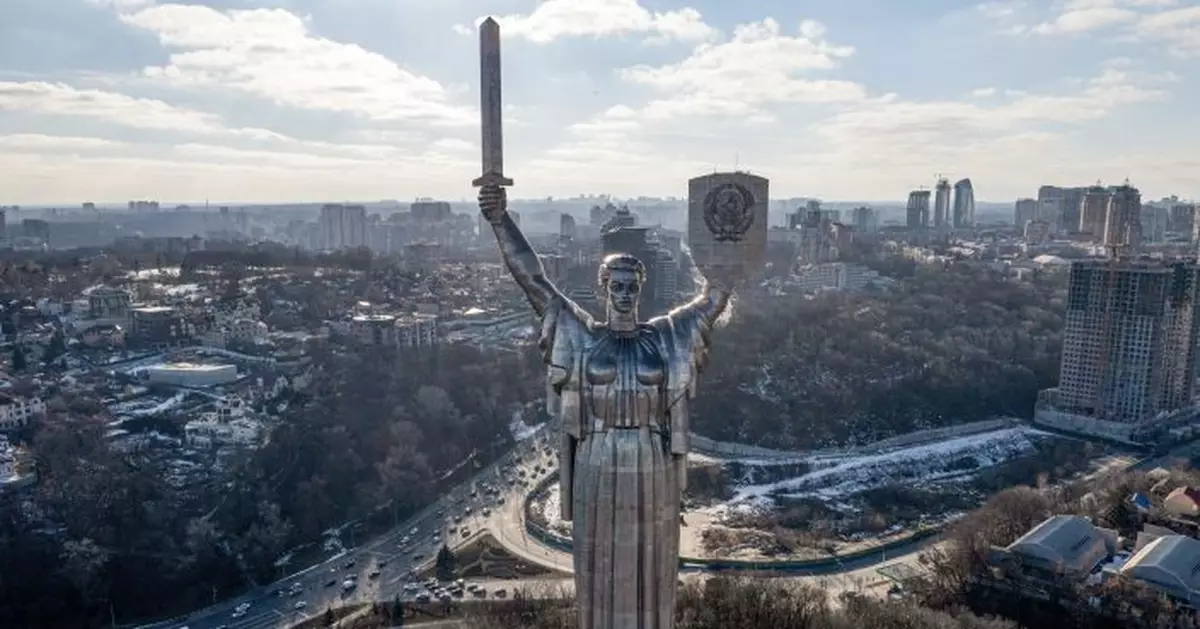
One by one, embassies and international offices in Kyiv closed. Flight after flight was canceled when insurance companies balked at covering planes arriving in Ukraine. Hundreds of millions of dollars in investment dried up within weeks.
With Russian troops encircling much of the country, Ukrainian businesses large and small no longer plan for the future — they can barely foresee what will happen week to week.
Click to Gallery
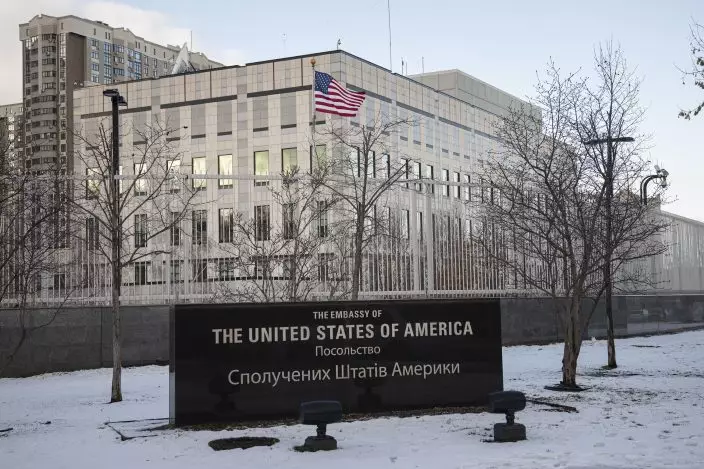
FILE - A view of the U.S. embassy in Kyiv, Ukraine, Saturday, Feb. 12, 2022. One by one, embassies and international offices in Kyiv closed. Flight after flight was canceled when insurance companies balked at covering planes arriving in Ukraine. Hundreds of millions of dollars in investment dried up within weeks. With Russian troops encircling much of the country, Ukrainian businesses large and small no longer plan for the future, they can barely foresee what will happen week to week. (AP PhotoAndrew Kravchenko, File)
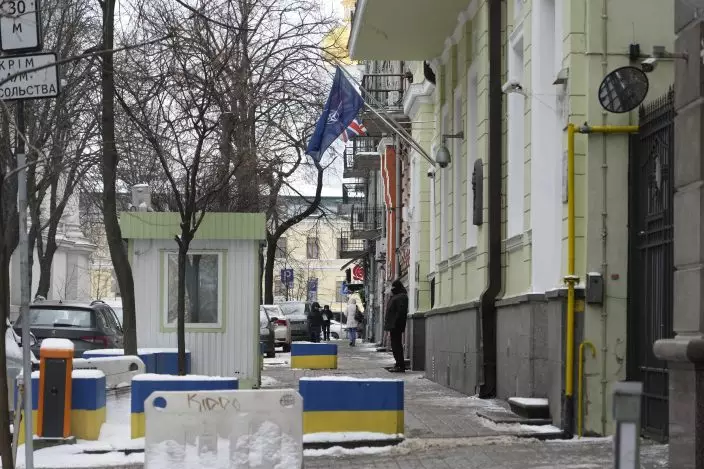
FILE - A security stands the British Embassy in Kyiv, Ukraine, Monday, Jan. 24, 2022. One by one, embassies and international offices in Kyiv closed. Flight after flight was canceled when insurance companies balked at covering planes arriving in Ukraine. Hundreds of millions of dollars in investment dried up within weeks. With Russian troops encircling much of the country, Ukrainian businesses large and small no longer plan for the future, they can barely foresee what will happen week to week. (AP PhotoEfrem Lukatsky, File)
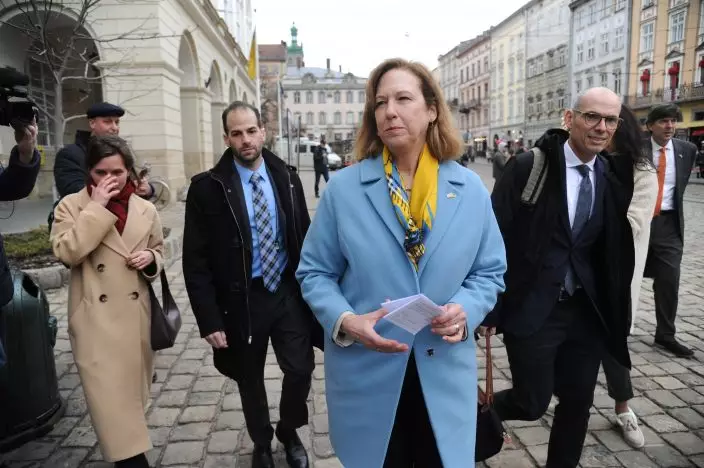
FILE - Acting United States ambassador Kristina Kvien, center, walks in Lviv, Ukraine, Tuesday, Feb. 15, 2022. The United States relocated the embassy from Kyiv to the western Ukrainian city of Lviv, citing a "dramatic acceleration" in the buildup of Russian forces at the country's border. One by one, embassies and international offices in Kyiv closed. Flight after flight was canceled when insurance companies balked at covering planes arriving in Ukraine. Hundreds of millions of dollars in investment dried up within weeks. (AP PhotoMykola Tys, File)
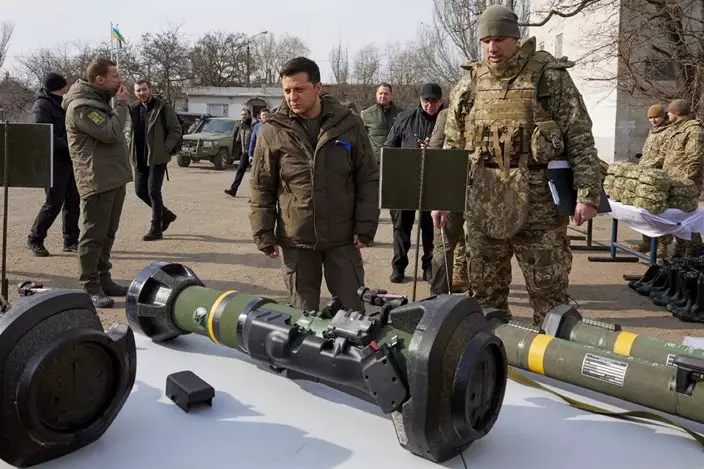
FILE - In this handout photo provided by the Ukrainian Presidential Press Office, President Volodymyr Zelenskyy inspects weapons during a visit to Ukrainian coast guards in Mariupol, Donetsk region, eastern Ukraine, Thursday, Feb. 17, 2022. In late January, Zelenskyy said that $12.5 billion had been withdrawn from accounts in the country. Last week, he called on members of parliament and businessmen who had fled to return. More than 20 charters and private jets left Kyiv last week, carrying some of the country's most prominent executives. (Ukrainian Presidential Press Office via AP, File)
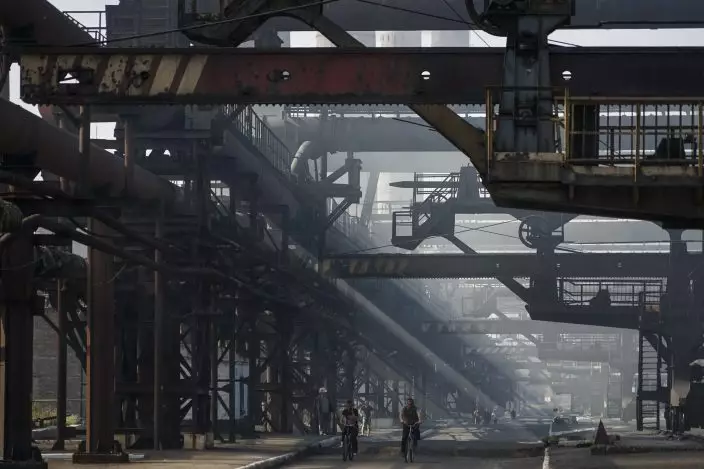
FILE - Workers walk and cycle along the coal transporters at the front-line Avdiivka coking plant in eastern Ukraine, Tuesday, Aug. 4, 2015. The squeezing of Ukraine's economy is a key destabilizing tactic in what the government describes as "hybrid warfare" intended to eat away at the country from within. (AP PhotoMstyslav Chernov, File)
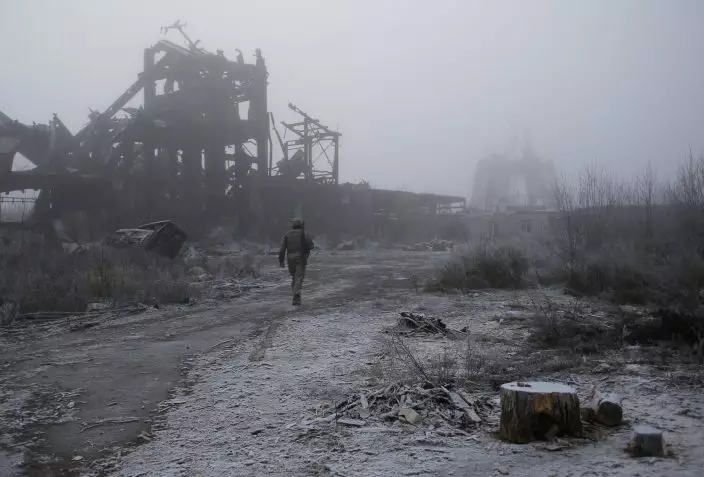
FILE - In this Nov. 19, 2019 file photo, a Ukrainian soldier passes by a destroyed Butovka coal mine as he approaches his front line position in the town of Avdiivka in the Donetsk region, Ukraine. It is Ukraine, not Russia, where the economy is eroding the fastest under the threat of war. Even before Russia launched its latest invasion, costing 70 years of hard-won European peace, Ukraine was the biggest loser in the agonizing, slow-motion aggression. (AP PhotoVitali Komar, File)
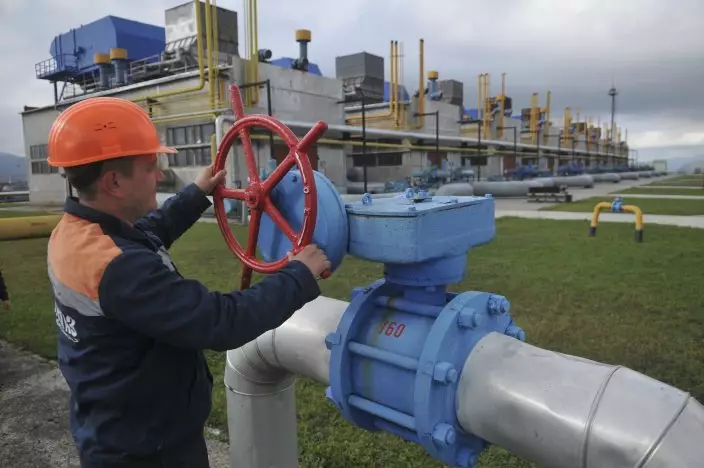
FILE - A worker at a gas facility in Volovets, western Ukraine, adjusts a valve on Wednesday, Oct. 7, 2015. Ukrainian and Russian officials say final details have been worked out for a contract that will continue shipments of Russian gas to European markets. The Ukrainian presidential administration says details will be announced on Saturday, Dec. 21, 2019. (AP PhotoPavlo Palamarchuk, File)
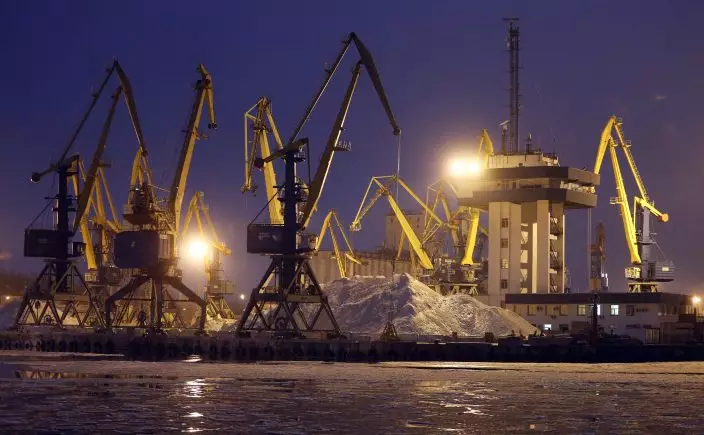
FILE - Harbor cranes are seen in Mariupol trade port in Mariupol, south coast of Azov sea, eastern Ukraine, Sunday, Dec. 2, 2018. Andrey Stavnitser, CEO of the port operator TIS Group said the Black Sea ports are operating as usual for now, but it's only a matter of time before the same insurance problems that cut off commercial flights start to hit the shipping industry. Ukraine is one of the world's top grain exporters, loading container ships that carry 12% of the world's wheat supply and 16% of its corn. (AP PhotoEfrem Lukatsky, File)
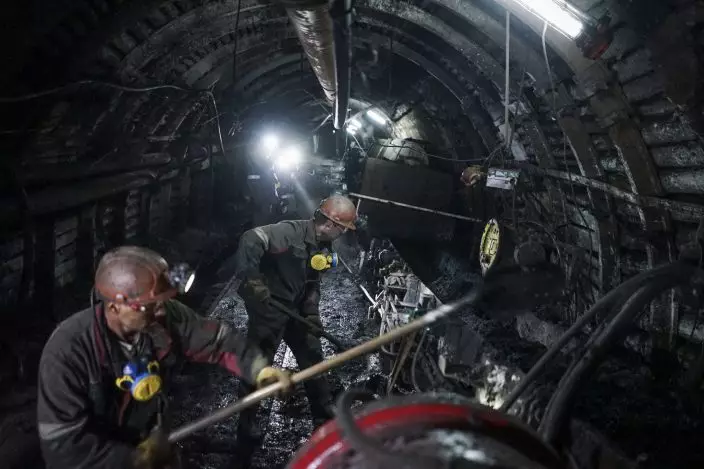
FILE - Miners perform maintenance at the start of a shift at one of the Krasnodonugol coal mines in Krasnodon, eastern Ukraine, Thursday, Aug. 6, 2015. It is Ukraine, not Russia, where the economy is eroding the fastest under the threat of war. Even before Russia launched its latest invasion, costing 70 years of hard-won European peace, Ukraine was the biggest loser in the agonizing, slow-motion aggression. (AP PhotoMstyslav Chernov, File)
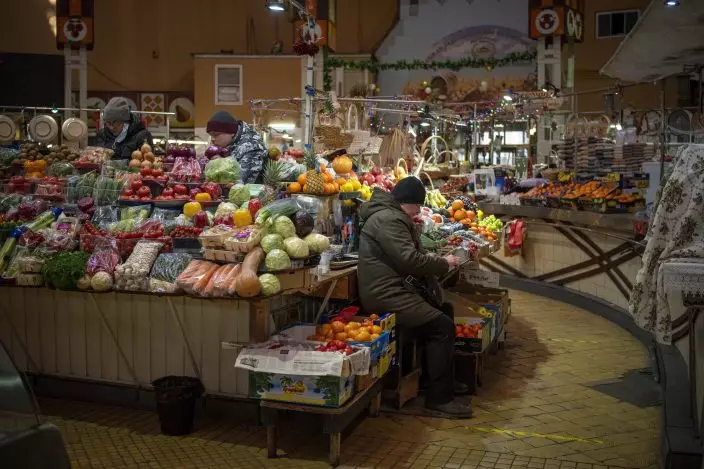
FILE - Vendors wait for customers at their fruit market stall in downtown Kyiv, Ukraine, Monday, Feb. 14, 2022. With Russian troops encircling much of the country, Ukrainian businesses large and small no longer plan for the future — they can barely foresee what will happen week to week. (AP PhotoEmilio Morenatti, File)
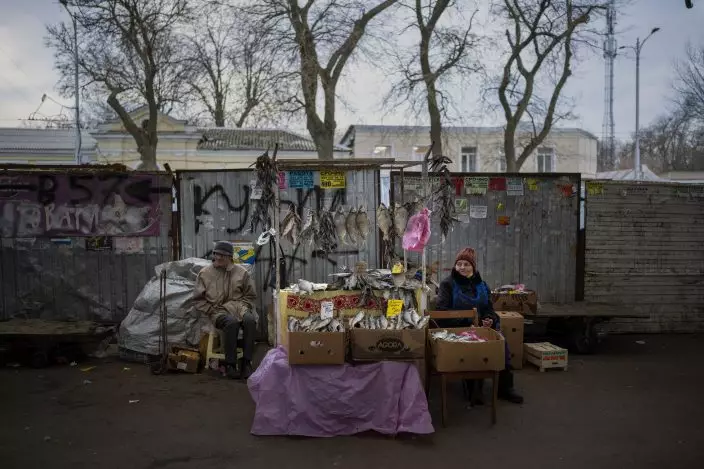
FILE - A vendor selling dried fish at her street stall waits for customers in Odessa, Ukraine, Thursday, Feb. 17, 2022. Since the beginning of the crisis in January, the national currency, the hryvnia, has steadily lost value, and it plunged 1% Tuesday after Russia recognized the two breakaway regions led by Russia-backed separatists. (AP PhotoEmilio Morenatti, File)
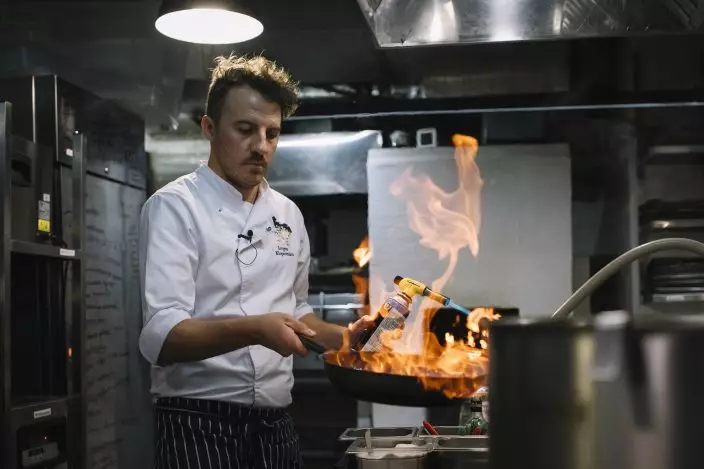
Ievgen Klopotenko cooks at his restaurant in Kyiv, Ukraine, on Sunday, Feb. 20, 2022. Klopotenko is a restauranteur who has made Ukrainian food his life's mission. He promotes it as a crucial part of national identity, a national identity that he says has changed radically since 2014 and is now fundamentally European-facing. (AP PhotoAndrew Kravchenko)

FILE - Young people dance in the night club "Moskvich", which means a Moscow resident, in Kharkiv, Ukraine, Sunday, Jan. 30, 2022. The economic woes include restaurants that dare not keep more than a few days of food on hand, stalled plans for a hydrogen production plant that could help wean Europe off Russian gas and uncertain conditions for shipping in the Black Sea, where container ships must carefully edge their way around Russian military vessels. (AP PhotoEvgeniy Maloletka, File)
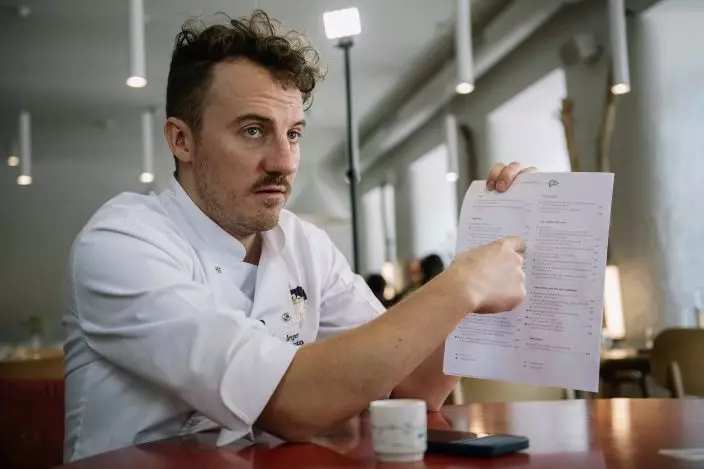
Ievgen Klopotenko speaks during an interview at his restaurant in Kyiv, Ukraine, on Sunday, Feb. 20, 2022. Klopotenko is a restauranteur who has made Ukrainian food his life's mission. He promotes it as a crucial part of national identity, a national identity that he says has changed radically since 2014 and is now fundamentally European-facing. (AP PhotoAndrew Kravchenko)
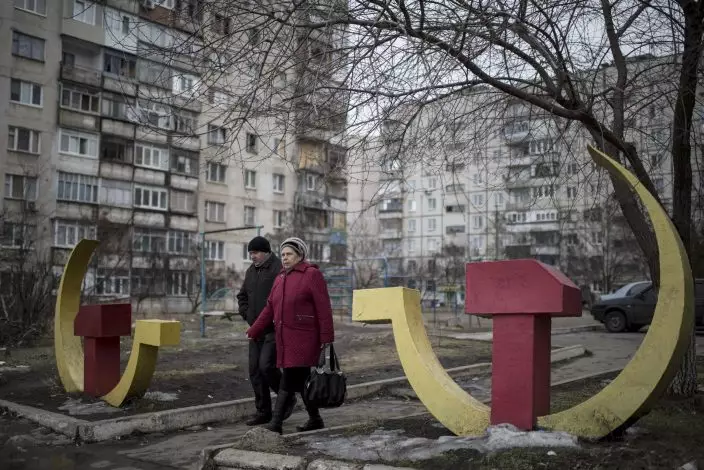
FILE - An armored vehicle rolls down a street outside Donetsk, the territory controlled by pro-Russian militants, eastern Ukraine, late Wednesday, Jan. 28, 2015.Russian President Vladimir Putin has raised the stakes in the Ukraine standoff by recognizing the independence of rebel regions in the country's east. A key question now is whether he will stop at that or try to move deeper into Ukraine. (AP PhotoFile)
It is Ukraine, not Russia, where the economy is eroding the fastest under the threat of war. Even before Russian troops rolled into rebel-held areas in the country's east and Russian President Vladimir Putin recognized the independence of the separatist region, Ukraine was the biggest loser in the agonizing, slow-motion aggression.
FILE - A view of the U.S. embassy in Kyiv, Ukraine, Saturday, Feb. 12, 2022. One by one, embassies and international offices in Kyiv closed. Flight after flight was canceled when insurance companies balked at covering planes arriving in Ukraine. Hundreds of millions of dollars in investment dried up within weeks. With Russian troops encircling much of the country, Ukrainian businesses large and small no longer plan for the future, they can barely foresee what will happen week to week. (AP PhotoAndrew Kravchenko, File)
“Why is it that we are suffering consequences already? And Russia, who is actually threatening the whole world, in Europe, is not suffering any consequences?” asked Andrey Stavnitser, CEO of the port operator TIS Group.
The squeezing of Ukraine’s economy is a key destabilizing tactic in what the government describes as “hybrid warfare” intended to eat away at the country from within. The Ukrainian president is also juggling state-sponsored cyberattacks, a Russia-backed separatist movement and the threat of 150,000 Russian soldiers surrounding his country on three sides.
The economic woes include restaurants that dare not keep more than a few days of food on hand, stalled plans for a hydrogen production plant that could help wean Europe off Russian gas and uncertain conditions for shipping in the Black Sea, where container ships must carefully edge their way around Russian military vessels.
FILE - A security stands the British Embassy in Kyiv, Ukraine, Monday, Jan. 24, 2022. One by one, embassies and international offices in Kyiv closed. Flight after flight was canceled when insurance companies balked at covering planes arriving in Ukraine. Hundreds of millions of dollars in investment dried up within weeks. With Russian troops encircling much of the country, Ukrainian businesses large and small no longer plan for the future, they can barely foresee what will happen week to week. (AP PhotoEfrem Lukatsky, File)
Stavnitser said the Black Sea ports are operating as usual for now, but it’s only a matter of time before the same insurance problems that cut off commercial flights start to hit the shipping industry. Ukraine is one of the world’s top grain exporters, loading container ships that carry 12% of the world’s wheat supply and 16% of its corn.
Alex Riabchyn is a former member of Ukraine’s parliament who now spearheads a project to set up hydrogen plants for the national Naftogaz energy company. The idea is to give Europe — and especially its largest economy, Germany — a stable new source of hydrogen, which can be used to produce low-emission energy for transport, industry and other uses.
What he hears from European investors now is “we can buy everything that you can produce, but to come and invest to build these plants, it’s too risky.”
FILE - Acting United States ambassador Kristina Kvien, center, walks in Lviv, Ukraine, Tuesday, Feb. 15, 2022. The United States relocated the embassy from Kyiv to the western Ukrainian city of Lviv, citing a "dramatic acceleration" in the buildup of Russian forces at the country's border. One by one, embassies and international offices in Kyiv closed. Flight after flight was canceled when insurance companies balked at covering planes arriving in Ukraine. Hundreds of millions of dollars in investment dried up within weeks. (AP PhotoMykola Tys, File)
German Foreign Minister Annalena Baerbock over the weekend acknowledged that the constant threat against Ukraine is "having very real effects — on investments, on air traffic, on jobs and on the daily life of people.”
She said the Group of Seven ministers of leading industrial nations promised to ensure Ukraine gets help for financial stability.
Since the beginning of the crisis in January, the national currency, the hryvnia, has steadily lost value, and it plunged 1% Tuesday after Russia recognized the two breakaway regions led by Russia-backed separatists. The United States last week offered a $1 billion loan guarantee, and the European Parliament approved $1.3 billion in loans for Ukraine to cover financing needs this year.
FILE - In this handout photo provided by the Ukrainian Presidential Press Office, President Volodymyr Zelenskyy inspects weapons during a visit to Ukrainian coast guards in Mariupol, Donetsk region, eastern Ukraine, Thursday, Feb. 17, 2022. In late January, Zelenskyy said that $12.5 billion had been withdrawn from accounts in the country. Last week, he called on members of parliament and businessmen who had fled to return. More than 20 charters and private jets left Kyiv last week, carrying some of the country's most prominent executives. (Ukrainian Presidential Press Office via AP, File)
But by late January, Ukrainian President Volodymyr Zelenskyy said that $12.5 billion had been withdrawn from accounts in the country. Last week, he called on members of parliament and businessmen who had fled to return. More than 20 charters and private jets left Kyiv last week, carrying some of the country's most prominent executives.
“The more the government urges not to panic, the more nervous businesses are," said Volodymyr Sidenko, an analyst with the Razumkov Center.
In Russia, Margarite Simonyan, the head of the state-owned Russian RT news network, gloated last week that “Kyiv's economy is in tatters,” calling it "a small but pleasant thing.”
FILE - Workers walk and cycle along the coal transporters at the front-line Avdiivka coking plant in eastern Ukraine, Tuesday, Aug. 4, 2015. The squeezing of Ukraine's economy is a key destabilizing tactic in what the government describes as "hybrid warfare" intended to eat away at the country from within. (AP PhotoMstyslav Chernov, File)
But Deputy Prime Minister Olga Stefanishyna said the destabilization of Ukraine’s economy isn't a side effect of the Russian threat, but the point. It saps faith in the government, and it forces Ukraine to divert attention and resources from needed reforms. It is, she said, an essential pillar of the “hybrid war” Russia is waging.
“It’s really important that we are resilient as we have never been before and we do our best to preserve the stability. But the longer this tension and escalation is taking place, the weaker Ukrainian economy can become,” she said.
The Centre for Economics and Business research estimated this month that the conflict with Russia cost Ukraine $280 billion in lost gross domestic product between 2014 and 2020 — with those loses expected to climb this year.
FILE - In this Nov. 19, 2019 file photo, a Ukrainian soldier passes by a destroyed Butovka coal mine as he approaches his front line position in the town of Avdiivka in the Donetsk region, Ukraine. It is Ukraine, not Russia, where the economy is eroding the fastest under the threat of war. Even before Russia launched its latest invasion, costing 70 years of hard-won European peace, Ukraine was the biggest loser in the agonizing, slow-motion aggression. (AP PhotoVitali Komar, File)
The United States and Europe worked out a series of limited sanctions on Tuesday, including targeting several Russian officials and banks financing the Russian armed forces, and putting limits on Moscow’s access to EU capital and financial markets.
Additional plans to target trade from the breakaway regions are unlikely to have much of an effect on them or Russia as they've been largely isolated from the international community since 2014.
Daniel Fried, a former U.S. diplomat who helped write sanctions in 2014, said the challenge in designing any new sanctions is that Russia is already succeeding in what he called “the slow strangulation of Ukraine.”
FILE - A worker at a gas facility in Volovets, western Ukraine, adjusts a valve on Wednesday, Oct. 7, 2015. Ukrainian and Russian officials say final details have been worked out for a contract that will continue shipments of Russian gas to European markets. The Ukrainian presidential administration says details will be announced on Saturday, Dec. 21, 2019. (AP PhotoPavlo Palamarchuk, File)
“When we saw the airlines pull out of Kyiv — they’re not pulling out of Russia. They’re pulling out of Kyiv. Putin is getting something that he wants without war.”
Kyiv restaurateur Ievgen Klopotenko said he keeps just a few days worth of stock in his kitchens, to avoid having his money literally rot away if the crisis worsens. Planning more than a year into the future, he said, is folly.
“If something happens, I don’t know, I will be open," he said, gesturing outside the window overlooking one of Kyiv's broad sunlit streets as though imagining a day when they would be filled with soldiers, not families looking for brunch. "If I need to cook for the army, I will cook for the army."
FILE - Harbor cranes are seen in Mariupol trade port in Mariupol, south coast of Azov sea, eastern Ukraine, Sunday, Dec. 2, 2018. Andrey Stavnitser, CEO of the port operator TIS Group said the Black Sea ports are operating as usual for now, but it's only a matter of time before the same insurance problems that cut off commercial flights start to hit the shipping industry. Ukraine is one of the world's top grain exporters, loading container ships that carry 12% of the world's wheat supply and 16% of its corn. (AP PhotoEfrem Lukatsky, File)
Yuras Karmanau contributed to this report.
Follow AP’s coverage of the Ukraine crisis at https://apnews.com/hub/russia-ukraine
FILE - Miners perform maintenance at the start of a shift at one of the Krasnodonugol coal mines in Krasnodon, eastern Ukraine, Thursday, Aug. 6, 2015. It is Ukraine, not Russia, where the economy is eroding the fastest under the threat of war. Even before Russia launched its latest invasion, costing 70 years of hard-won European peace, Ukraine was the biggest loser in the agonizing, slow-motion aggression. (AP PhotoMstyslav Chernov, File)
FILE - Vendors wait for customers at their fruit market stall in downtown Kyiv, Ukraine, Monday, Feb. 14, 2022. With Russian troops encircling much of the country, Ukrainian businesses large and small no longer plan for the future — they can barely foresee what will happen week to week. (AP PhotoEmilio Morenatti, File)
FILE - A vendor selling dried fish at her street stall waits for customers in Odessa, Ukraine, Thursday, Feb. 17, 2022. Since the beginning of the crisis in January, the national currency, the hryvnia, has steadily lost value, and it plunged 1% Tuesday after Russia recognized the two breakaway regions led by Russia-backed separatists. (AP PhotoEmilio Morenatti, File)
Ievgen Klopotenko cooks at his restaurant in Kyiv, Ukraine, on Sunday, Feb. 20, 2022. Klopotenko is a restauranteur who has made Ukrainian food his life's mission. He promotes it as a crucial part of national identity, a national identity that he says has changed radically since 2014 and is now fundamentally European-facing. (AP PhotoAndrew Kravchenko)
FILE - Young people dance in the night club "Moskvich", which means a Moscow resident, in Kharkiv, Ukraine, Sunday, Jan. 30, 2022. The economic woes include restaurants that dare not keep more than a few days of food on hand, stalled plans for a hydrogen production plant that could help wean Europe off Russian gas and uncertain conditions for shipping in the Black Sea, where container ships must carefully edge their way around Russian military vessels. (AP PhotoEvgeniy Maloletka, File)
Ievgen Klopotenko speaks during an interview at his restaurant in Kyiv, Ukraine, on Sunday, Feb. 20, 2022. Klopotenko is a restauranteur who has made Ukrainian food his life's mission. He promotes it as a crucial part of national identity, a national identity that he says has changed radically since 2014 and is now fundamentally European-facing. (AP PhotoAndrew Kravchenko)
FILE - An armored vehicle rolls down a street outside Donetsk, the territory controlled by pro-Russian militants, eastern Ukraine, late Wednesday, Jan. 28, 2015.Russian President Vladimir Putin has raised the stakes in the Ukraine standoff by recognizing the independence of rebel regions in the country's east. A key question now is whether he will stop at that or try to move deeper into Ukraine. (AP PhotoFile)