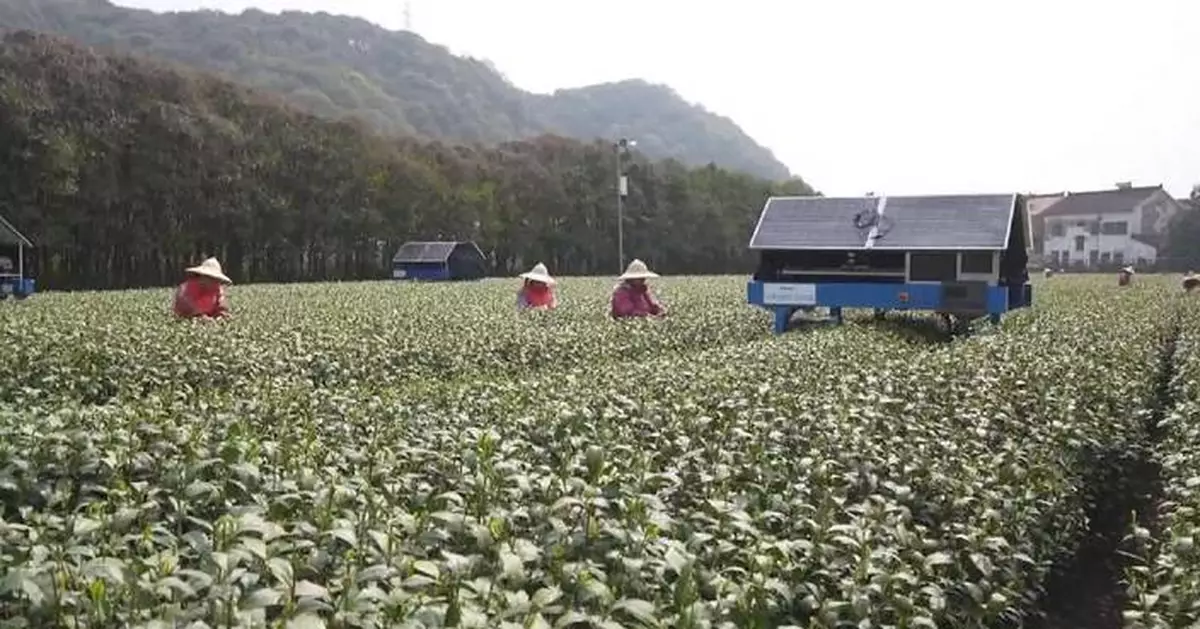
In the origin area of the renowned West Lake Longjing tea bushes in east China's Zhejiang Province, newly upgraded intelligent robots are accurately locating and picking tea buds and leaves, providing reliable assistance to local tea planters during the busiest season for spring tea picking.
The Qingming Festival, which falls on Wednesday this year, is the major harvest period for premium spring tea.
The newly upgraded sixth-generation intelligent tea-picking robot uses photovoltaic power generation technology and can achieve continuous tea-picking 24 hours a day.
The head of the robot's development team said that the robot has a set of recognition models called deep convolutional neural networks. After training from a large amount of image data, it can automatically identify tea buds and leaves that are ready for harvest.
"For different regions and different times, we have to feed a large number of images for learning. Last year, our recognition was able to reach an accuracy rate of about 90 percent. This year we have an improved version, and its recognition success rate should be about two percentage points higher than that in the previous years," said Wu Chuanyu, head of the robot’s development team.
After continuous exploration and experiments, the intelligent picking robot can use binocular cameras to scan tea leaves to achieve 3D positioning just like human eyes, thereby accurately finding the location of the tea buds and leaves.
"It can move freely like a human being, and can discover the buds that are blocked. Therefore, the identification efficiency of our picking this year will be improved. When our robot moves over, it will basically pick all the buds that can be harvested," Wu said.
After identifying and locating the tea buds, the next step is to pick them quickly and without damage. At this time, another key function of the robot is needed, the mechanical arm.
Experts said that the buds and leaves of early spring tea are about two centimeters each, and the petiole is only a few millimeters. The buds and leaves usually grow between the old leaves and old stems, which poses a high demand on the accuracy of the operation of the robotic arm.
"It has a rotatable part at the end, with additional degree in freedom of rotation. It is really like human hands, and can approach the buds from different fixed angles. This is one of the reasons why we can improve the success rate of its efficient picking this year compared to the previous years," said Wu.
Longjing tea, also known as West Lake Dragon Well tea, is a variety of green tea. As one of China's 10 most famous teas, it is characterized by its green color, delicate aroma, mellow taste, and beautiful shape.
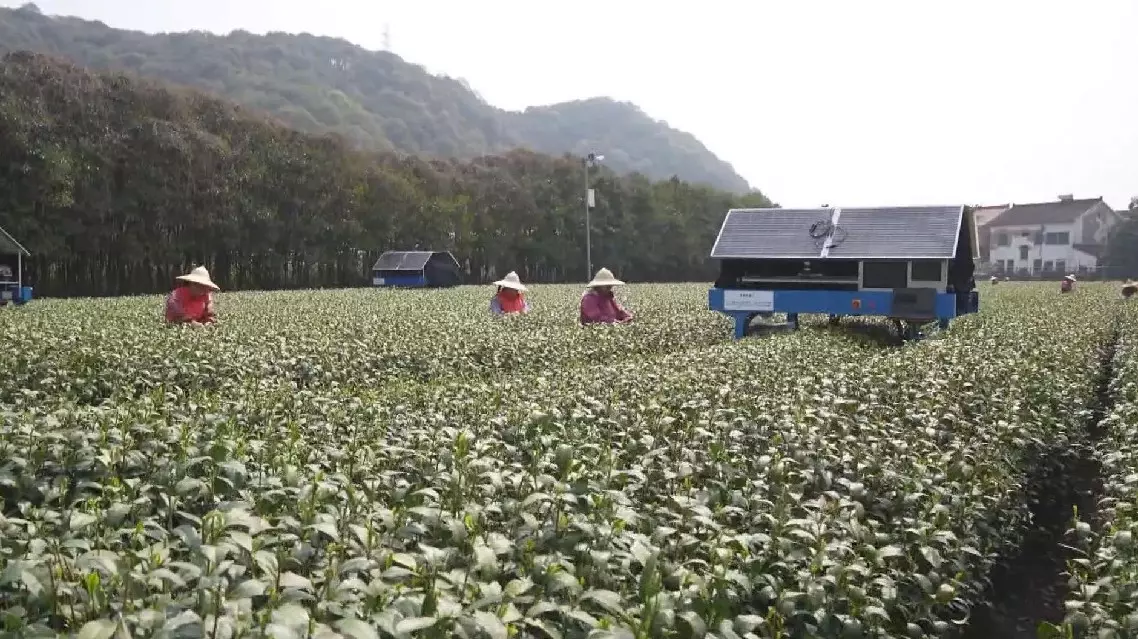
Intelligent robots join workforce to help tea picking in China's Hangzhou