Skip to Content Facebook Feature Image

China increases investment in cold chain logistics infrastructure

HotTV

HotTV

HotTV

China increases investment in cold chain logistics infrastructure

2024-04-28 17:26 Last Updated At:19:47

Investments in cold chain infrastructure, including cold storage facilities and refrigerated containers, are experiencing rapid growth in China, laying a strong foundation for the swift revival of cold chain logistics, industrial data showed.

The total investment and construction of China's cold chain logistics infrastructure in the first three months of this year surged 20 percent from the last year, according to China Federation of Logistics and Purchasing on Sunday.

Among these infrastructure, intelligent temperature control facilities and equipment have been adopted by logistics companies across the country to reduce loss of packaged agricultural products and food and ensure the safety of these products in transportation.

A train loaded with 230 tons of frozen chicken bound for Moscow, Russia, on Tuesday embarked on its maiden trip from the China-Europe Freight Train (Shenyang) Assembly Center in northeast China's Liaoning Province. To ensure the smooth transportation of the frozen meat to its destination, the assembly center applied plug-in refrigerated containers that support manual temperature control throughout the entire journey.

"Since this year, we have continued to increase investment in related equipment and facilities based on market developments and customers' transportation needs. We have also continued to launch new products for China-Europe freight train services," said Li Haiping, deputy director of operations department at the assembly center.

Meanwhile, the country has seen a significant surge in investment in cold storage warehousing. In the first quarter, the investment in national cold chain warehousing projects amounted to approximately 14.7 billion yuan (around 2.07 billion U.S. dollars), up 22.5 percent year on year. During the same period, the demand for rental cold chain warehouses in China exceeded 510,000 square meters, with a year-on-year increase of around 10 percent.

"Currently, investment is now mainly in cold storage facilities construction. Generally speaking, there is a periodic surplus, but some structural demands are still insufficient. Therefore, some of our current investments primarily focus on rectifying these structural shortcomings and enhancing the overall completeness of our cold chain infrastructure," explained Cui Zhongfu, deputy chief, China Federation of Logistics and Purchasing.

China increases investment in cold chain logistics infrastructure

China increases investment in cold chain logistics infrastructure

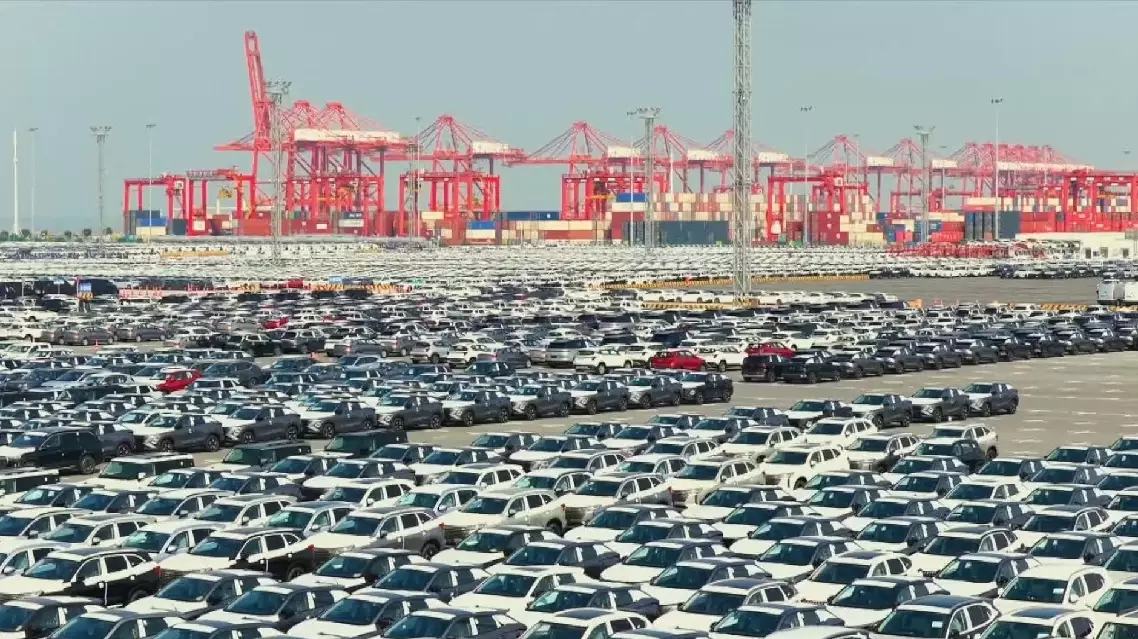
China's auto exports are on track to surpass 10 million units in 2026 as export volumes continue to expand, with new energy vehicles emerging as the main driving force, according to the latest data released by the China Association of Automobile Manufacturers (CAAM) on Monday.

CAAM data showed that China exported 8.2 million vehicles in the January-September period, up more than 65 percent year on year, putting annual exports on course to break the 10-million-unit mark for the first time.

This expansion has been accompanied by strong performances from several domestic automakers. Chery Group exported a cumulative 1.5 million vehicles in the first three quarters, a 65 percent increase year on year, while MG, the British brand under SAIC Motor, sold more than 280,000 units in the European market during the same period, up 23 percent.

At the same time, the geographic reach of Chinese auto exports has continued to widen, with Europe, South America, Southeast Asia and the Middle East becoming the main destination markets.

Behind these figures, new energy vehicles are turning into the key engine of export growth.

In the first nine months of the year, China exported over four million new energy vehicles, up 1.3 times year on year. Starting in June, the share of new energy vehicles in total auto exports has exceeded 50 percent for four consecutive months.

Industry observers noted this rapid rise reflects how Chinese automakers are leveraging their advantages in electrification and intelligent technologies.

Liu Yan, deputy secretary-general of the CAAM, said the export boom reflects a fundamental shift in the source of China's automotive competitiveness.

"The global competitiveness of China's automotive industry has evolved from cost-effectiveness to a systemic competitiveness centered on new energy. This is not only injecting new momentum into global green and low-carbon development, but also securing new long-term competitive advantages for Chinese automakers," she said.

China's auto exports projected to top 10 million units in 2026

China's auto exports projected to top 10 million units in 2026

Recommended Articles