A herd of 42 wild Asian elephants were spotted in Mengla County of southwest China's Yunnan Province recently, according to footage captured by the local monitoring team.
According to the team, the herds including 13 baby elephants mainly traveled between Mengban Town and neighboring Yaoqu Yaozu Township.
They displayed adorable and playful behaviors, often gathering in groups to bathe and frolic in the river.
According to the infrared thermal imaging captured by drones, three adult elephants slowly descending from the mountains, making their way towards the cornfields near the river. Shortly after, the other 39 elephants followed in batches.
The herds are strolling in Mengban Town at present.
In April, another herd of 41 wild Asian elephants appeared near the Shangyong Protection Area in Mengla County.
As wild Asian elephants are typically solitary or live in small groups, rarely coming together in such large numbers, the consecutive sightings of two separate herds of over 40 elephants in different areas were exceptionally rare.
According to local forestry officials, this is the largest recorded number of wild Asian elephants observed in Mengban.
The local government has organized elephant monitors to track and record real-time information about the herd as it has affected the daily lives and personal safety of nearby villagers.

Large wild Asian elephant herd spotted in Yunnan
With the Pinglu Canal in the Guangxi Zhuang Autonomous Region officially open to shipping, Yangpu Port in south China's Hainan Province will fully leverage the policy and geographical advantages of the Hainan Free Trade Port (FTP) to accelerate its development into an international shipping hub, further connecting the New International Land-Sea Trade Corridor with global markets.
The canal stretches along the New International Land-Sea Trade Corridor, a strategic trade route connecting China's inland regions with ASEAN and other global markets. It is the first river-to-sea canal project planned and coordinated at the national level since the founding of the People's Republic of China in 1949.
Located in the northwest of the island province, Yangpu Port is the deep-water port closest to the main international shipping routes in the Beibu Gulf, and is also one of the maritime outlets of the New International Land-Sea Trade Corridor.
The opening of the Pinglu Canal to navigation has opened up a new sea-river intermodal transport corridor for goods entering and leaving the southwestern region, and has also brought new opportunities to some enterprises.
At a petrochemical enterprise in Danzhou City, robotic arms are bagging and packaging chemical products on a conveyor belt, and these goods will be shipped to southwest China's Guizhou Province and other places.
Most of this enterprise's customers in the Chinese mainland are concentrated in the southwestern Chinese provinces of Yunnan, Sichuan and Guizhou. At present, the enterprise is adjusting its future shipping plans in response to the logistics changes brought by the opening of the Pinglu Canal to navigation.
"We plan to shift about 70 percent of our goods to this new sea-river intermodal transport corridor, and overall logistics costs are expected to drop by 30 to 40 percent. Next year we also plan to build another plant in Hainan, which will allow us to take advantage of the free trade port's policies, import raw materials from places like Indonesia, and after processing, sell the products to the southwestern region or re-export them. This is expected to add about 200,000 tons of production capacity," said Wei Jianqiang, head of Hainan Oxiranchem Co., Ltd.
Behind the enterprises' expansion of production and the busier flow of goods, there is also the upgraded service support made possible by the opening of the Pinglu Canal to navigation. In this regard, the relevant authorities have also made full preparations.
"After the Pinglu Canal opens to navigation, we will strengthen safeguard measures in areas such as facilitating the entry and exit of container ships on fixed routes, credit-based regulation, and cross-regional coordination," said Jiang Yufeng, head of the Xiaochantan Maritime Patrol and Law Enforcement Brigade, Yangpu Maritime Safety Administration.
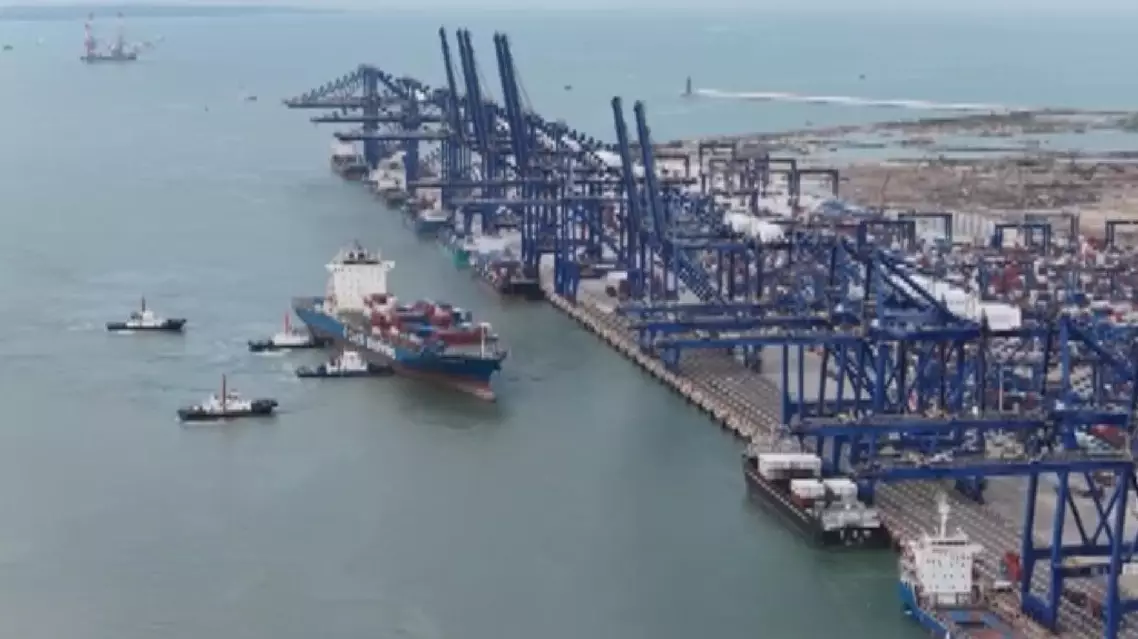
Pinglu Canal underscores growing role of Yangpu Port as int'l shipping hub