Beibu Gulf Port in south China's Guangxi Zhuang Autonomous Region has innovated its operation system to improve shipment efficiency and facilitate transfer process between port and railway transportation systems.
A batch of lithium battery energy storage cabinets were recently loaded onto a Dutch ship at berth No. 2 of Dalanping south operation area of Qinzhou Port, a part of Beibu Gulf Port, which is the first time that Beibu Gulf has realized the bulk shipment of lithium battery energy storage cabinets for export.
Since the beginning of this year, Beibu Gulf Port has actively coordinated resources to resolve bottlenecks. In the loading and unloading operations, it endeavored to solve the problems of small loading volume of each container export shipment and difficulty in booking shipping space.
"Now the export of the 'new trio' (electric vehicles, lithium-ion batteries and photovoltaic products) from Beibu Gulf Port is growing rapidly, with large cargo volumes and high values, and some of the goods are included in the nine categories of dangerous goods. All these factors have put high requirements on the service capabilities of port enterprises," said Song Haitao, manager of Beibu Gulf Port Qinzhou Bonded Port Area Shenggang Terminal Co., Ltd.
Facilities, like bridge crane and rail cranes, and unmanned transport vehicles at the Beibu Gulf Port Qinzhou automated container terminal can be accessed with one click in its remote control room.
As the world's first automated terminal to adopt a U-shaped layout, the terminal has innovated operation mode to isolate container trucks from outside the port and unmanned transport vehicles in the port, which has improved the safety of different kinds of vehicles running at the terminal and the efficiency of container stacking.
Guangxi is connected to ASEAN countries by land and sea and has a natural port good for shipment, but it once faced with the embarrassment of shorter shipping distance but longer shipping time and higher costs due to poor operation.
While improving efficiency with technological innovation, Guangxi has conducted an in-depth mechanism reform in wider range, to stimulate the vitality of the sea-rail intermodal transportation of Beibu Gulf Port.
Guangxi issued several documents on the integrated construction and operation of Beibu Gulf Port sea-rail intermodal transportation in 2023, which has vigorously improved efficiency through measures such as spatial integration, policy coordination and information sharing.
The first step of operation was to remove the separation wall that had existed for many years between the railway center station and the port area and put the two units under the administration of the customs.
Along with physical segregation, data barriers between multiple departments were also removed to simplify the transfer process of sea-rail intermodal transportation.
"We used to have to go through two gates and made a detour of two kilometers to pick up containers. Now, after the gates were removed, we can save about 20 minutes," said Pang Daying, a driver of Qinzhou North Port Supply Chain Co., Ltd.
"Beibu Gulf Port was the first in China to achieve real-time connection between ports and railway stations, which has increased the container transfer efficiency between ports and railway by about 50 percent," said Song.
At present, the sea-rail intermodal train of the new western land-sea corridor have radiated more than 70 cities and over 150 railway stations in 18 domestic provinces, autonomous regions and municipalities, reaching more than 500 ports in over 120 countries and regions.
In the first half of this year, more than 276,000 TEUs of goods were shipped through Beibu Gulf Port on the new western land-sea corridor, up 22.4 percent.
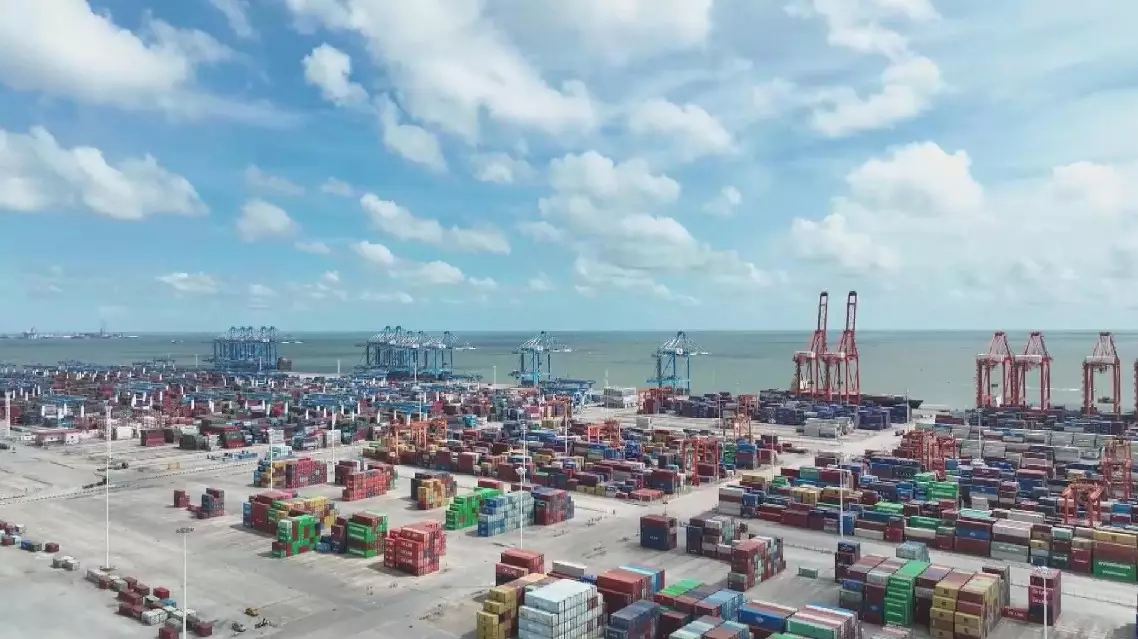
Beibu Gulf Port streamlines procedures to achieve optimal transit efficiency