Skip to Content Facebook Feature Image

C&ED Disciplines Four Money Service Operators for Anti-Money Laundering Violations

HK

C&ED Disciplines Four Money Service Operators for Anti-Money Laundering Violations
HK

HK

C&ED Disciplines Four Money Service Operators for Anti-Money Laundering Violations

2024-09-03 15:00 Last Updated At:09-04 00:26

Hong Kong Customs takes disciplinary actions against four licensed money service operators for breaching statutory requirements

The Customs and Excise Department (C&ED) today (September 3) took disciplinary actions, including issuing public reprimands and ordering remedial actions, againstfour licensed money service operators (MSOs) for breaching the statutory requirements as stipulated in the Anti-Money Laundering and Counter-Terrorist Financing Ordinance.

Officers of the C&ED earlier discovered four MSOs failed to comply with the requirements of the Ordinance. One MSO failed to keep the related records of the remittance transaction, and to establish and maintain effective procedures for determining whether a customer or a beneficial owner of a customer is a politically exposed person, and to notify the Commissioner of the C&ED of a change in particulars of a bank account for provision of money service within a specific period of time.

One MSO failed to keep the related records of the remittance transactions, and to identify and verify the beneficial owner's identity of the originator or the person's authority to act on behalf of the customer before carrying out remittance transactions.

One MSO failed to identify and verify the customer's identity or the beneficial owner's identity of the customer, and/or the person's authority to act on behalf of the customer, before establishing business relationship with customers, and to record the recipient's address and/or the time of receipt of instruction before carrying out remittance transactions, and to notify the C&ED of the date of cessation of the money service operation at the premises specified in the licence within a specified period of time.

One MSO failed to notify the C&ED of a change in particulars of bank accounts for provision of money service within a specified period of time.

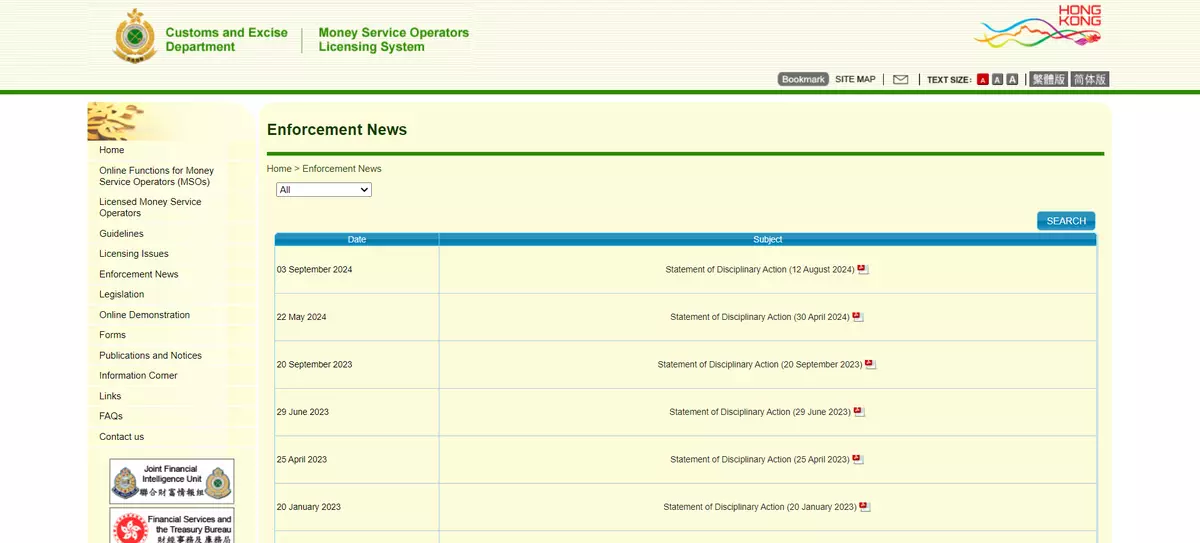
With regard to the above-mentioned contraventions, the C&ED has earlier prosecuted the MSOs. The department today further took disciplinary actions against them in order to send a deterrent message to the industry. The relevant Statement of Disciplinary Action is available on the website of the C&ED (eservices.customs.gov.hk/MSOS/common/enforcenew?request_locale=en).

The C&ED reminds all MSOs to comply with the statutory requirements as stipulated in the Ordinance. The maximum penalty upon conviction is a fine of $1 million and imprisonment for seven years.

In addition, the C&ED may take disciplinary action such as issuing a public reprimand, imposing a pecuniary penalty and ordering a remedial action against MSOs. The pecuniary penalty would not exceed the amount that is the greater of $10 million or three times the amount of the profit gained or costs avoided (whichever is the greater).


Subsidiary legislation on plain packaging for conventional smoking products and duty stamps gazetted today

The Government today (September 11) published in the Gazette three pieces of subsidiary legislation to take forward a new phase of the "10 measures for tobacco control", including establishing specific statutory requirements for the plain packaging of conventional smoking products and updating the health warnings on the packaging in tandem, so as to reduce the attractiveness of the packaging, prevent smoking especially among young people, and increase willingness to quit smoking; and implementing the duty stamp system to enable the public and law enforcement officers to more effectively distinguish duty-paid cigarettes from "cheap whites", thereby strengthening the combating of illicit cigarettes.

The implementation of plain packaging is a measure recommended by the World Health Organization's Framework Convention on Tobacco Control. Tobacco companies have long been using the packaging design to influence consumers' health risk perception, and cigarette packets are displayed at retail outlets and carried around by smokers, thereby serving to promote the products. Plain packaging will remove brand logos, various colours and the decorative elements including slogans and signs on the packaging, fundamentally undermining the brand effect. Studies in Australia and France show that the relevant requirements not onlycan encourage smokers to seek assistance to quit, but also prevent young people from becoming addicted to smoking in the first place, so that they will not turn into a new generation of smokers. Plain packaging has already been implemented in 27 countries and regions, and experience has proven that it effectively reduces smoking prevalence.

Studies show that plain packaging will direct consumers' attention to the health warnings. The Government will update the content of the 12 health warnings that have been in use for eight years to further strengthen their deterrent effect. These include disabilities, disfigurement and a significant decrease in the quality of life caused by relevant diseases. In addition, some tobacco companies use the so-called "light" and "low tar" descriptions to lure consumers, misleading them into believing that such products are less harmful when in fact, even with lower exposure to tar and nicotine, they are equally harmful. The Government has therefore removed the requirement to print tar and nicotine yields on the packaging to avoid misunderstanding.

It is an offence to buy or sell illicit cigarettes. The duty stamp system enables members of the public and retailers to easily distinguish duty-paid cigarettes from "cheap whites", and will also enhance enforcement effectiveness of the Customs and Excise Department (C&ED) against "cheap whites". After implementation, all cigarette packets containing duty-paid cigarettes must bear a valid duty stamp with anti-counterfeiting features. Anyone who sells or supplies cigarettes in packets without a duty stamp affixed commits an offence.

A Government spokesman said, "Plain packaging and duty stamp complement each other. The former reduces the attractiveness of tobacco products on the demand front, while the latter combats illicit cigarettes on the supply front. In formulating the specific requirements, the Government has fully listened to and taken on board the views of stakeholders on technical specifications and the timetable. The preparation period commenced in January this year, and no insurmountable technical difficulties have emerged during the process. The detailed proposal on plain packaging was also announced in April this year, and the specific statutory requirements are now gazetted, which is nearly 15 months ahead of full implementation. The Government will continue to advance tobacco control efforts in an evidence-based and steady manner."

Plain packaging and duty stamps will take effect in phases, and the 13-month preparation period started as early as January this year, with a view to allowing sufficient preparation time for the industry. The three pieces of subsidiary legislation gazetted today will be tabled at the Legislative Council (LegCo) for the negative vetting procedure on October 7, and the measures prescribed will take effect on March 1 next year, with a nine-month transitional period before the full implementation on December 1. Detailed technical provisions and transitional arrangements are set out in the LegCo brief.

The Government took the initiative in April this year to adjust the full implementation date of the measures from the second quarter of next year to December 1 next year, and to extend the preparation and transitional periods to 22 months, aiming to allow the industry to adjust their production lines and clear stocks in phases. To enable the industry to know the specific statutory requirements as early as possible, the Health Bureau gazetted the subsidiary legislation today, ahead of their submission to the LegCo for scrutiny in October. The period from gazettal to full implementation is nearly 15 months, which is comparable to or even slightly longer than the time taken for previous legislative amendments to update health warnings. The industry should therefore have ample time to clear stocks in original packaging, while planning the manufacture, import and sale of products in the new packaging.

At the same time, the Government has made a number of adjustments based on actual market conditions and the legislation of major jurisdictions with similar arrangements implemented. These include relaxing the requirements on the dimensions of cigarette packets. The vast majority of products currently on the market already comply with the relevant requirements, which also makes it easier for tobacco companies to adjust their packaging to comply with the requirements. On duty stamps, the C&ED launched a pilot run as early as October last year with sample stamps provided to the industry for trial use, and also announced the specifications for duty stamps in January this year.

The Tobacco and Alcohol Control Office of the Department of Health and the C&ED will continue to maintain communication with the industry on the implementation details of the new requirements, and provide appropriate assistance in light of actual circumstances to ensure smooth implementation of the measures.

Source: AI-found images

Source: AI-found images

Recommended Articles