Skip to Content Facebook Feature Image

NATIONAL ENERGY AWARDS 2024 SHOWCASES MALAYSIA'S COMMITMENT TO ENERGY MANAGEMENT, ENERGY EFFICIENCY AND RENEWABLE ENERGY SOLUTIONS

Business

NATIONAL ENERGY AWARDS 2024 SHOWCASES MALAYSIA'S COMMITMENT TO ENERGY MANAGEMENT, ENERGY EFFICIENCY AND RENEWABLE ENERGY SOLUTIONS
Business

Business

NATIONAL ENERGY AWARDS 2024 SHOWCASES MALAYSIA'S COMMITMENT TO ENERGY MANAGEMENT, ENERGY EFFICIENCY AND RENEWABLE ENERGY SOLUTIONS

2024-09-13 15:00 Last Updated At:15:15

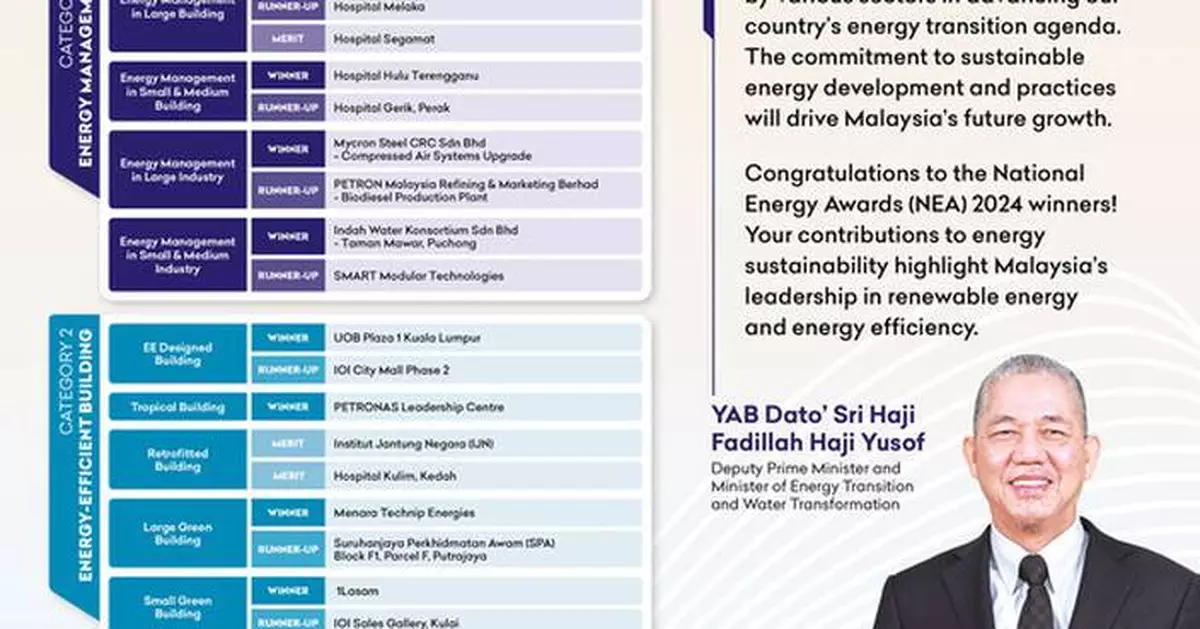
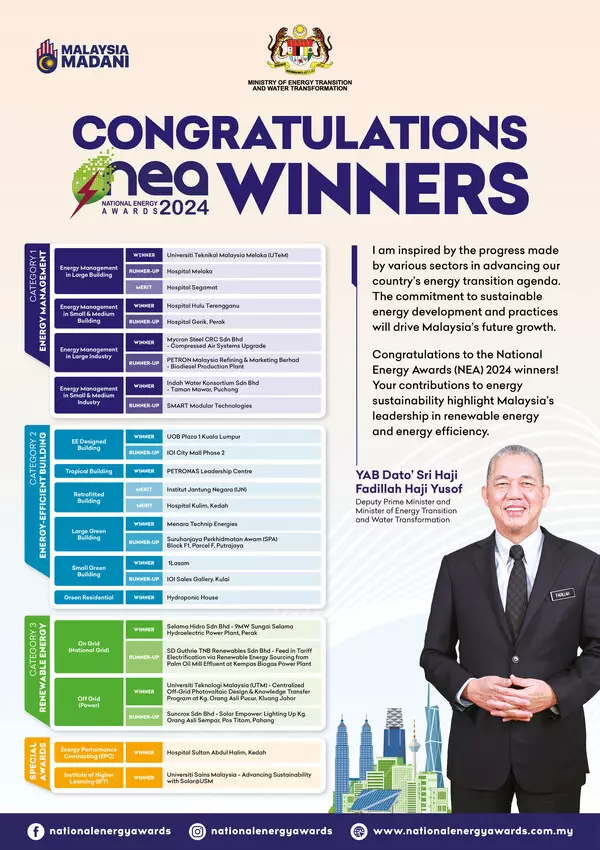
KUALA LUMPUR, Malaysia, Sept. 13, 2024 /PRNewswire/ -- The National Energy Awards (NEA) 2024 uphold its tradition of honouring industry leaders and organisations for their commitment to adopting energy efficiency, renewable energy, technologies and practices. This year, 25 recipients are honoured for their significant contributions to optimising energy management, improving energy efficiency, and advancing renewable energy.

Spearheaded by the Ministry of Energy Transition and Water Transformation (PETRA), the NEA supports Malaysia's goal of reducing reliance on carbon-based fuels and promoting sustainable energy practices across all sectors, advancing the nation toward net-zero GHG emissions by 2050.

This year's National Energy Awards (NEA) received 134 submissions from various sectors, including healthcare, government bodies, and private sectors. These efforts collectively saved 315.37 gigawatt-hours (GWh) of energy usage annually, which is equivalent to about RM 45 million in reduced energy bills per annum at current tariffs, and generated over 283.71 GWh annually from renewable energy sources. The healthcare sector, particularly government hospitals, stood out with more than 65 submissions, showcasing strong leadership in energy efficiency and setting a positive example for others. This high level of participation underscores the sector's commitment to sustainability and the country's energy-saving goals.

"I am inspired by the progress made by various sectors in advancing our country's energy transition agenda. The commitment to sustainable energy development and practices will drive Malaysia's future growth. Congratulations to the National Energy Awards (NEA) 2024 winners! Your contributions to energy sustainability highlight Malaysia's leadership in energy management, renewable energy and energy efficiency." said Dato` Sri Haji Fadillah bin Haji Yusof the Deputy Prime Minister and the Minister of Energy Transition and Water Transformation (PETRA).

These energy savings are crucial in advancing the nation's environmental goals, contributing to an annual reduction of 238,504.41 metric tons of carbon emissions, equivalent to planting 5,962,610 trees. This demonstrates Malaysia's continued dedication to a just and sustainable energy transition, in line with the country's pathway to achieving net zero by 2050.

Leading the way among the winning submissions is Universiti Teknikal Malaysia Melaka (UTeM), which achieved the highest score, placing them in first place in Category 1 for Energy Management in Large Buildings. The university exceeded its annual energy reduction target of 3% per annum by achieving reductions of 17.8%, 18.5%, and 19.3% for the years 2021 to 2023.

The NEA also recognized outstanding achievements in Category 2 for Green Residential, where the Hydroponic House set a high standard with its central courtyard, natural lighting, and a 6-kW solar PV system that meets over 34% of its electricity needs. Additionally, under the Tropical Building sub-category, the PETRONAS Leadership Centre in Bangi was celebrated for its extensive greenery and eco-friendly design, including a man-made lake and solar energy integration that seamlessly blend with the landscape.

YAB Minister Fadillah Yusof emphasized that these achievements demonstrate Malaysia's commitment to sustainability and net-zero emissions. As energy demand grows, integrating renewable sources and improved grid management will be crucial in driving the transition to a sustainable energy future.

The National Energy Awards continue to invite submissions from all sectors, recognizing that sustainability can emerge from anywhere. The 2025 edition of the NEA will open for submissions in October, providing another opportunity for Malaysian organizations to showcase their contributions to the nation's energy goals.

For more information on the National Energy Awards and to learn more about the 2024 winners, please visit the official website: https://www.nationalenergyawards.com.my.

About National Energy Awards:

Spearheaded by the Minister of Energy Transition and Water Transformation (PETRA), the National Energy Award (NEA) recognises the adoption of sustainable energy practices by Malaysia's business organisations across all industries and sectors.

The NEA initiative, which supports Malaysia's ambition to achieve net-zero GHG emissions by 2050, encourages adopting sustainable energy practices and sharing knowledge of activities that adhere to sustainable energy standards. This is aligned with Malaysia's aspiration to be net-zero GHG emissions by 2050.

About Malaysian Green Technology and Climate Change Corporation (MGTC)

MGTC is an agency under the Ministry of Natural Resources and Environmental Sustainability mandated to accelerate green growth, advance climate action and inculcate green lifestyle.

Guided by the National Green Technology Policy (NGTP), the National Policy on Climate Change (NCCP), the Green Technology Master Plan 2017-2030 (GTMP) and the Twelfth Malaysia Plan, MGTC carries out programmes and initiatives to support stakeholders at all levels.

By 2030, through its various programs and initiatives, MGTC aims to facilitate RM100 billion in green investments, create 230,000 green jobs and help Malaysia achieve its net-zero GHG emissions as early as 2050 target.

** The press release content is from PR Newswire. Bastille Post is not involved in its creation. **
NATIONAL ENERGY AWARDS 2024 SHOWCASES MALAYSIA'S COMMITMENT TO ENERGY MANAGEMENT, ENERGY EFFICIENCY AND RENEWABLE ENERGY SOLUTIONS

NATIONAL ENERGY AWARDS 2024 SHOWCASES MALAYSIA'S COMMITMENT TO ENERGY MANAGEMENT, ENERGY EFFICIENCY AND RENEWABLE ENERGY SOLUTIONS
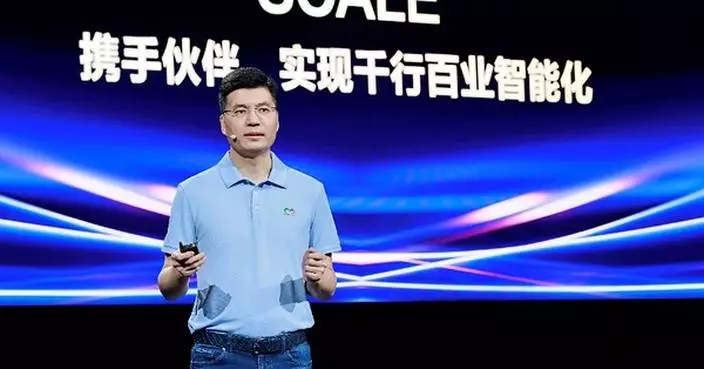
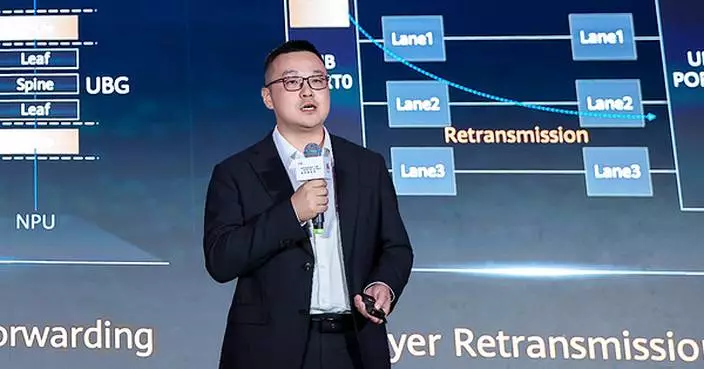
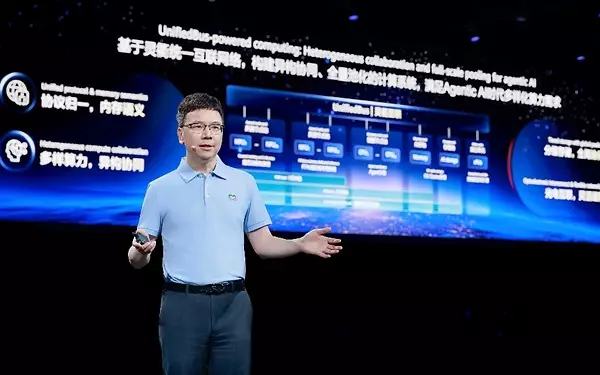
SHANGHAI, Sept. 21, 2026 /PRNewswire/ -- In a keynote speech on computing architecture innovation at HUAWEI CONNECT 2026, Yang Chaobin, Huawei's Executive Director of the Board and CEO of the ICT Business Group, unveiled new details about the UnifiedBus interconnect architecture, announced a series of computing products based on this architecture, and explained how the company has collaborated with open-source communities to enable application innovation by customers, partners, and developers.

In a traditional computing architecture, resource utilization declines as a cluster scales. As little as 20% of a 100,000-NPU cluster's computing capacity is actually utilized by models, with a vast amount of compute sitting idle during data communications. A 10 trillion-parameter model, which requires massive amounts of intermediate data to train, far exceeds the capacity of the memory on a single accelerator under traditional architectures. Interconnection and communications between components within a cluster have become a key performance bottleneck for computing systems.

According to Yang, Huawei's solution to this bottleneck is its new computing architecture, powered by the interconnect technology called UnifiedBus, which facilitates collaboration between clusters and SuperPoDs. This architecture has been designed to support the boom in compute demand that is emerging as new agentic applications hit the market. UnifiedBus-powered computing systems have four key features:

  • Unified protocol and memory semantics: More than ten interconnect protocols have been combined under the UnifiedBus protocol, which increases interconnect bandwidth from 100 GB/s level to TB/s level and reduces round-trip time (RTT) latency from 7 microseconds to 2 microseconds. This protocol also enables unified global memory addressing within SuperPoDs.
  • Heterogeneous compute collaboration: UnifiedBus directly interconnects CPUs, NPUs, memory, and solid-state drives (SSDs) to enable decentralized, peer-to-peer access between them and flexible CPU-NPU mixing. In addition, tiered hardware acceleration for Transformer enables Attention-FFN disaggregation (AFD).
  • Tiered storage with global pooling: UnifiedBus uses hybrid-media resource pooling to support the caching of activations. Double Data Rate (DDR) memory serves as the alternative memory for NPUs, reducing latency for search, recommendation, and advertising services, and doubling the performance of vector retrieval for 100 billion-level data items with thousands of dimensions. This also reduces the per-NPU HBM capacity requirements for the training of 10 trillion-parameter models, and improves cluster model FLOPs utilization (MFU).
  • Optoelectronic interconnect and flexible networking: UnifiedBus serves as a global ultra-high bandwidth, ultra-low latency "data highway", enabling flexible scaling of compute.

Yang then moved on to unveil Huawei's newest UnifiedBus interconnect products that cover interconnection within cabinets, between cabinets, and across clusters. This enables elastic scaling from a single cabinet to a million-NPU cluster.

  • Within cabinets, the UnifiedBus LinkBlade eliminates circuit losses with a cable-free design, which reduces copper cabling within a 4,096-NPU SuperPoD by about 196 kilometers.
  • Between cabinets, the UnifiedBus LinkDevice supports 176 ports, with 1.6 Tbit/s bandwidth per port, delivering 280 Tbit/s all-optical interconnection. This is the industry's highest-bandwidth, highest-port-count high-speed bus-protocol interconnect device, with an RTT latency as low as 2 microseconds.
  • Across clusters, the UnifiedBus UBG switch provides a massive radix fan-out capacity of up to 1,024, meaning it can support a million-NPU SuperCluster and evolution towards supporting tens of trillions of model parameters.

Yang also launched Huawei's UnifiedBus-powered agentic AI SuperCluster, which is comprised of TaiShan 950 and Atlas 960 SuperPoDs, OceanStor M900 memory storage, and a Xinghe UBG switch. This cluster enables diverse compute collaboration and tiered resource pooling.

Beyond SuperPoDs, Huawei has also applied the UnifiedBus technology to its compute appliances. The company has developed a new series of UnifiedBus-based appliances (supporting one to eight NPUs) and Kunpeng and Ascend modules, which enable small and medium-sized enterprises to run trillion-parameter models locally.

On the ecosystem front, Yang said that Ascend is collaborating with open-source frameworks like DeepSeek Harness, OpenCode, and openJiuwen to develop fully open-source intelligent management, inference acceleration, and security framework agent plugins.

Yang promised, "Huawei is committed to innovating at the system level, building a computing-foundation product portfolio, and going open source and open system. We will continue working with customers, partners, and developers to help this ecosystem thrive and offer the world a new option for compute."

** This press release is distributed by PR Newswire through automated distribution system, for which the client assumes full responsibility. **

Huawei Unveils New UnifiedBus Computing Architecture for SuperPoDs and Clusters

Huawei Unveils New UnifiedBus Computing Architecture for SuperPoDs and Clusters

Recommended Articles