Chinese scientists' first research paper on the lunar samples taken to the Earth by the Chang'e-6 mission has revealed the distinct characteristics of soil on the far side of the Moon which are different from that of previously obtained samples.
The study was conducted by a joint scientific research team with members from the National Astronomical Observatories of the Chinese Academy of Sciences, the Lunar Exploration and Space Engineering Center, and the Beijing Institute of Spacecraft System Engineering.
The research paper, discussing the physical, mineralogical and geochemical characteristics of the samples taken from the far side of the Moon, was published in the National Science Review journal on Sept 17.
The Chang'e-6 probe was launched from the Wenchang Spacecraft Launch Site in south China's Hainan Province on May 3, 2024. On June 25, its returner made a landing in north China, bringing back 1,935.3 grams of samples from the far side of the moon.
In terms of external morphology and physical characteristics, the Chang'e-6 samples have a lighter color, lower density, and a more complex particle origin than the Chang'e-5 samples, according to Chinese scientists involved in the research.
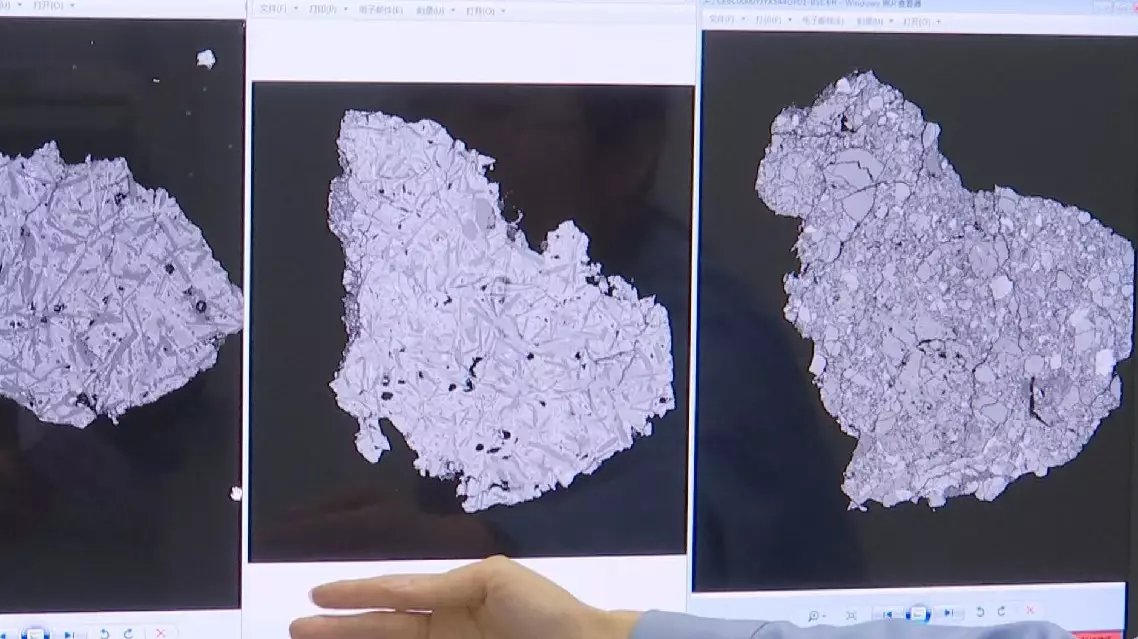
In an experimental hall of the Chinese Lunar Sample Laboratory, researchers detected the structure and mineral composition of the Chang'e-6 lunar samples with scanning electron microscopes.
The instrument can magnify hundreds of thousands of times, with a resolution of 1 nanometer, which is equivalent to one-sixty-thousandth the size of the diameter of a single hair. It is capable of collecting information from, and magnifying and re-imaging of objects of materials such as rock, soil and ceramics, so as to obtain their characteristics such as microscopic morphology, microstructure and mineral composition.
"In the breccia obtained by the Chang'e-6, we can find many small rock fragments that actually came from the non-lunar maria area, which is the highlands on the moon, that is, the white or shiny part of the moon that we see with the naked eye. These fragments were sputtered onto their area by impact and then cemented into rocks. And the proportion of this kind of rocks is significantly higher than that of the Chang'e-5 samples," said Zhou Qin, researcher at the National Astronomical Observatories of the Chinese Academy of Sciences, who also serves as a deputy chief designer of ground application system of the Chang'e-6 mission.
"Comparing the images of basalt in the Chang'e-5 and Chang'e-6 samples, we've found out that the rock structures of these two are similar. But the further detailed study of the mineralogical content indicates that the olivine content of the Chang'e-6 samples is significantly lower compared to the Chang'e-5 samples," said Zhou.
"The overall petrochemical composition of the Chang'e-6 samples is quite different from Chang'e-5 samples. It's a low titanium, low aluminum, low potassium basalt composition. There is almost no olivine in basalt from the Chang'e-6 samples, indicating that its rock genesis, material source, and chemical composition are quite different from that of the Chang'e-5 samples. It shows that the samples taken from the far side of the moon are indeed very different from that from the near side," said Li Chunlai, researcher with the National Astronomical Observatories and a deputy chief designer Chang'e-6 mission.
Since humanity's lunar exploration began, humans had successfully brought lunar samples back to Earth for 10 times -- all from the near side of the Moon -- including the Chang'e-5 mission. It meant that only half of the Moon had been known to humanity, until the completion of the Chang'e-6 mission.
The sampling site of the Chang'e-6 mission was located in the South Pole-Aitken basin, the deepest and oldest impact basin on the far side of the Moon. The mission carried unparalleled significance for studying the composition of the lunar core, the formation of the Moon, and even the evolution of the solar system.
Research paper on Chang'e-6 lunar samples reveals different composition from previous samples