Chinese agricultural experts have used big data and gene technology in breeding to revitalize the vast stretches of saline-alkaline farmland in northwest China's Ningxia Hui Autonomous Region to boost yields and ensure national food security.
China has managed to feed one fifth of the world's population with less than 9 percent of the world's arable land. With an annual grain output of more than 650 million tons, China has become one of the world's largest food producers and exporters. The country is still exploring ways to increase yields.
At an agricultural base in Ningxia's Shizuishan City, the lush sorghum field used to be a barren land covered with a layer of salt crust. The soil was too harsh even for the toughest crops to grow until two years ago – when scientists discovered a way of transforming the waste land through cutting-edge agricultural technology and comprehensive soil improvement.
An expert team led by chief rice scientist Xie Qi from Syngenta Group China began their research in Shizuishan two years ago, planting a trial species in the saline-alkaline soils in hope of providing a solution to food security challenges.
"By means of genomics and big data, we discovered a gene called AT1, which is associated with alkaline tolerance in crops. We found it in sorghum. We applied this technology to rice, corn, millet and wheat, and they all achieved the same yield increase in saline-alkaline farmland," Xie said.
This is the first time in the world that saline alkaline tolerance genes have been discovered in crops. According to this breakthrough finding, the research team has cultivated sorghum varieties based on AT1 technology and carried out production planting in Dawukou, Ningxia.
The yield of the test field has exceeded 4,500 kilograms per hectare, which is beyond Xie's expectation.
"We're certainly very delighted that the research we made and the varieties we bred mean contributions to society and grain production. Some 500 million mu (about 33 million hectares) of saline alkaline land in China has the possibility of utilization. [If we can make use of] this 500 million mu of land, plus China's 1.8 billion mu [of arable land], the country's food production will definitely grow," Xie said.
China has about 1.5 billion mu (100 million hectares) of saline-alkaline land, which is one tenth of the total such land in the world. President Xi Jinping emphasized the importance of comprehensive management of these land during his inspection in Ningxia in June.
Besides planting more resilient crops, experts in Shizuishan have also made exploration for restoring the arid soils by means of scientific approaches.
"Through two years of comprehensive treatment, the current seeding emergence rate of those fields that once did not grow grain has reached 66 percent, and more than 600 mu (40 hectares) of them has reached almost the level of normal farmland. The yield of more than 4,000 mu of crops-growing farmland here has increased," said Yang Jinguang, general manager of Northwest China Region of Sinochem Modern Agriculture.
The modern agricultural project in Shizuishan has proven to be commercially feasible, with a complete supply chain for several downstream industries. A local distillery has already placed an order for sorghum this year, while corn silage is harvested and processed for animal feed.
Yang said that in the coming years, the project will tap into more desolate soils in China's great northwest and unleash their potential.
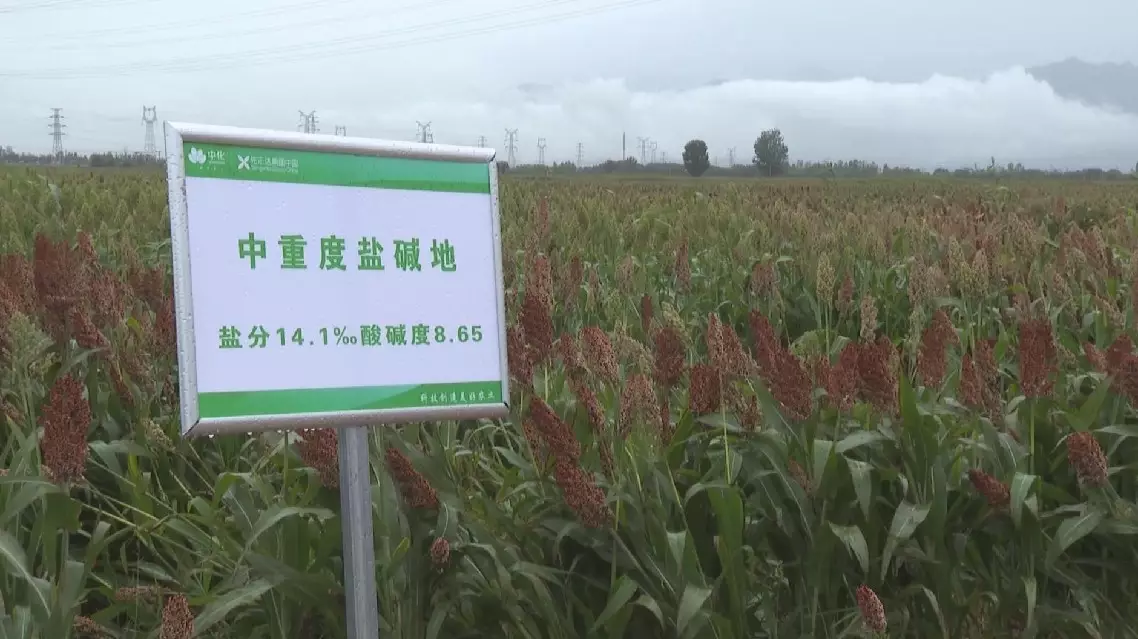
Cutting-edge technology transforms barren land in northwest China's Ningxia into lush fields