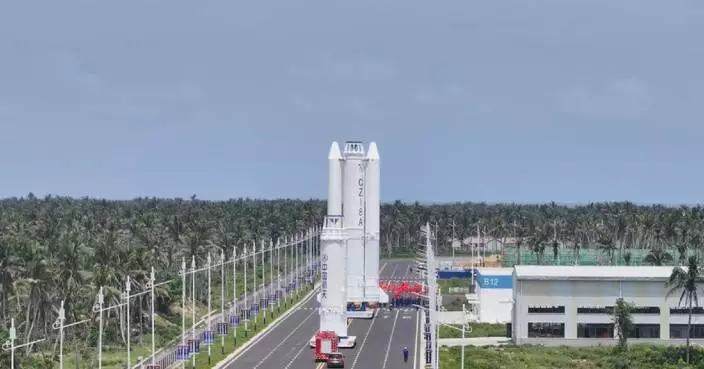
A senior scientist from the China National Space Administration (CNSA) has revealed China's plans to construct a research center on the moon, which will be open to collaboration with all countries interested in the lunar mission. In a 4K documentary named "Back to the Far Side," Wu Weiren, the chief designer of China's Lunar Exploration Program, revealed that the country's future missions to the moon are already in the planning stages. Specifically, the upcoming Chang'e-7 and Chang'e-8 missions will focus on exploring the Lunar South Pole. "The main purpose of the Chang'e-7 mission, we need to leap into the permanent shadow zone to find direct evidence of water. We will also launch Chang'e-8, the main purpose of which will be to investigate what resources are at the south pole of the moon, and other resource development," Wu said. Over a span of 20 years, it has developed from launching China's first lunar satellite to bringing back lunar samples. The program has also remained committed to international participation, which will continue with Chang'e-7 and Chang'e-8. Both missions will also carry international payloads. Scientists from around the world are working together to put their best equipment on the moon. The moon's south pole will also host a long-term scientific project, the International Lunar Research Station. China aims to build this station in collaboration with multiple countries. "This scientific research station will combine the orbital and lunar surface stations, plus ground facilities such as a base for large scientific projects. This is being done so that work can continue for a long time with or without people at the moon's south pole. It will facilitate scientific exploration and resource development. For the International Lunar Research Station to work, I think there are four must-haves: tools, energy, communication and shelter. We've started to prepare the first bricks. We could use sunlight and draw on local resources. It's possible with 3D printing that such bricks could be used to build walls, houses and roads. We hope in the future, the lunar research station will be a hub that prepares us for more distant celestial bodies, such as for Mars exploration," Wu said. By 2030, China aims to realize a manned lunar landing, and by 2035, to establish the core structure of an international lunar research base. With the world on the verge of a new age, China is spearheading global collaboration to explore the moon and beyond for the good of all humanity. "We all agree that it's must to open up to the world. We don't put up any obstacles. So far (July 2024), we have agreements with over 10 countries and nearly 30 international research institutions. We hope to work with 500 foreign scientific research institutions and 5,000 foreign scientific research personnel to build our International Lunar Research Station," Wu said. The "Back to the Far Side" is produced by CGTN and the News Center of the China National Space Administration to mark the 20th anniversary of China's Chang'e lunar exploration program.
China's lunar research base construction welcomes more global partners: chief designer