Over the past decades, China's aerospace industry has grown from weak to strong and has achieved various achievements in space science, technology, and application, thanks to efforts made by generations of visionary scientists and engineers.
A piece of special report by China Global Television Network (CGTN) has outlined the growth of China's aerospace industry over the past 75 years. The first part of the special report chronicled China's journey in aerospace.
China set sights on its own artificial satellite in 1958, a year after the then Soviet Union launched mankind's first object in space, Sputnik 1. But it was a lofty goal for a then nine-year-old government struggling with resources. So China focused on rocket development and upper altitude physical exploration.
In 1960, China achieved a significant milestone with the successful launch of its first sounding rocket, setting the stage for future space endeavors. Subsequent advancements, including the development of the Dongfeng-1 and Dongfeng-2 missiles, further propelled the nation's journey into space exploration.
Following that, Chinese aerospace engineers and physicists revived China's satellite development project and a work plan was approved in 1965, laying the groundwork for a new era of space exploration in the country.
In 1968, the China Academy of Space Technology was established. Its late president Qian Xuesen is acknowledged as the father of China's space industry.
However, the beginnings were not without challenges.
"We started from scratch when making Dongfanghong-1. If you wanted to eat steamed buns at that time, you couldn't buy steamed buns from shops. You could neither get flour or wheat. You had to open up wasteland to grow wheat," said Pan Houren, then deputy head of the Overall Design Team for the "Dongfanghong-1" Satellite.
"China's technological and industrial levels were still lagging behind at the time. It was very difficult to complete such a task under such conditions," said Qi Faren, responsible technical person for the Dongfanghong-1's research and design and the chief designer of China's Shenzhou spacecraft.
But the team persevered. On April 24, 1970, a Long March-1 rocket carrying the Dongfanghong-1 space satellite was launched into orbit. The song of Dongfanghong echoed in space, as China became the fifth country in the world to send an artificial satellite into orbit. It was a huge step in aerospace development for China.
Through political, social, and economic challenges over the next 20 years, China's aerospace industry never wavered in its pursuit of bigger milestones in space. It embarked on a "three-step" strategy to boost its manned space program in 1992.
The safety of human life aboard the vessel was paramount.
"The first thing we did was to build the Aerospace City. In order to ensure the safety of human life in space, you need to do all the experiments on the ground. Ground experiments test all the conditions that may be encountered in space. Only then can we say that there are no problems. The Aerospace City was very advanced in the world at the time," said Qi.
In November 1999, China launched its first experimental manned spacecraft Shenzhou-1, with no crew onboard. Following this, three more Shenzhou missions were carried out.
Four years later, in October 2003, Shenzhou-5 with China's first taikonaut Yang Liwei on board was launched into space.
"I have received many awards in my life. But the most favorite award I've received is what Yang Liwei once said: Awesome Chinese Spacecraft," said Qi.
Five years later, in September 2008, China's first spacewalk was completed by taikonaut Zhai Zhigang during the Shenzhou-7 mission. And two female taikonauts were sent into space on subsequent missions.
From Yang Liwei's historic 21-hours aboard Shenzhou-5 in 2003, mission duration was extended to 33 days for Shenzhou-11 in 2016.
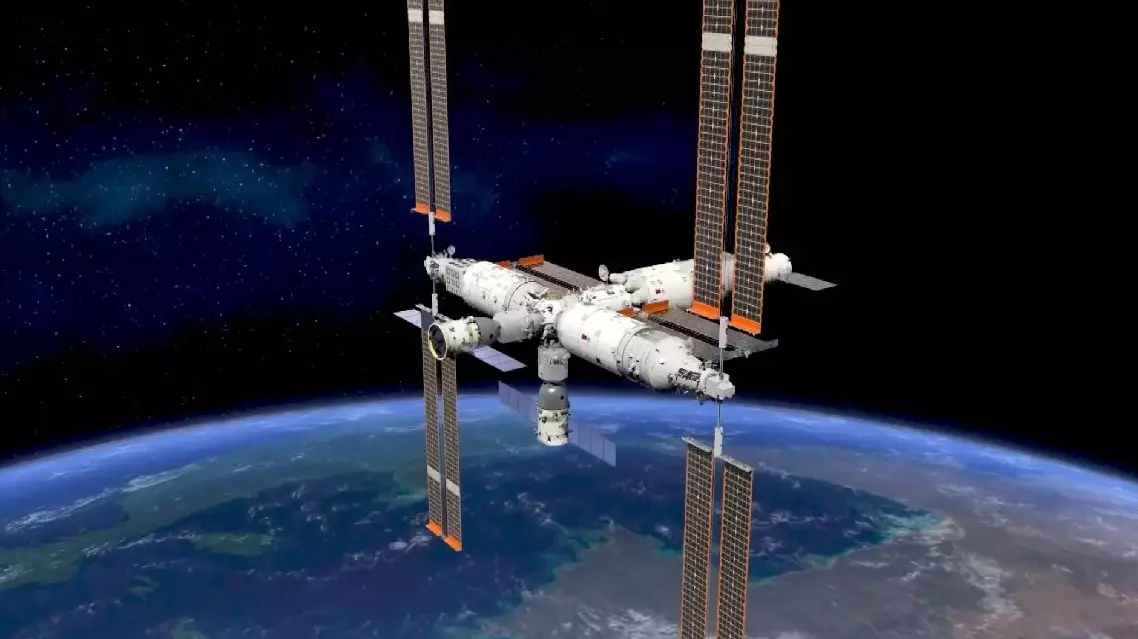
Meanwhile, China's space station known as the Tiangong, which means "Heavenly Palace", was in the process of intense research and construction.
In April 2021, China's space station construction entered the phase of full implementation with the launch of the Tianhe core module.
Over the next three years, the Tianhe welcomed seven Shenzhou spacecraft carrying 21 taikonauts, six Tianzhou cargo spacecraft, and two lab modules--the Wentian and Mengtian. China's first space station is also looking forward to hosting astronauts from other countries.
China's aerospace technology grew by leaps and bounds, enabling taikonauts to live comfortably in the space station for at least five months while they completed extravehicular missions, in-orbit maintenance, and space science experiments.
China's journey in aerospace: from inception to triumph