The growth of China's aerospace industry not only enables Chinese scientists to conduct experiments in space, but also embraces international cooperation, according to a piece of special report by China Global Television Network (CGTN).
The CGTN special report has outlined the growth of China's aerospace industry over the past 75 years. The second part of the it delves into experiments conducted on China's space station and its commitment to international collaboration.
At the testing center of China Academy of Sciences' Shanghai Institute of Ceramics, a team has conducted a melt thermophysical performance test in the Container-free Laboratory Cabinet at China's space station. The test aimed to eliminate the gravitational influences that distort measurements on Earth, ensuring greater accuracy in thermal properties assessments.
"The reason why we need to do it in space is because it is not accurate on the ground. Experiments on the ground are influenced by gravity. It will greatly impact the measurement of thermal properties. For example, viscosity is one of the important indicators of the performance of high-temperature thermal materials. The effect of gravity will cause buoyancy convection. This will lead to the uncertainty of viscosity measurements exceeding 30 percent. If the figure exceeds 30 percent, it is not considered reliable. But if you do it in space, the accuracy will be much higher," said Zeng Yi, director of the testing center.
The projects are housed in specially built units that can withstand extreme conditions.
"It took us eight years to make the high-temperature material test cabinet and the containerless materials rack. For the high-temperature materials rack, one of the biggest difficulties was getting it to withstand extremely high temperatures of up to the maximum 1,600 degrees Celsius. The second challenge is to develop multi-sample management. The third was that we have achieved real-time X-ray observation under the microgravity of a space station for the first time. Leakage of X-ray can't happen. But the main difficulty is the X-ray protection device has to be limited by the volume and weight. We did five rounds to reduce the device's weight. It provides a very good method for material research. The technique enables us to observe the material preparation process in-situ under microgravity in space. It's also the first time that people are able to implement such a measure in a space station," said Liu Xuechao, the chief designer of the high-temperature material rack of Shanghai Institute of Ceramics.
The experiments aboard China's space station also include the projects jointly selected by the United Nations Office for Outer Space Affairs and the China Manned Space Agency.
While the Tiangong space station orbits the Earth at an altitude between 340 to 450 kilometers, further off at an altitude of 500 kilometers within the sun-synchronous orbit is China's first dark matter detection satellite "Wukong" or Monkey King, which helps pin down the identity of dark matter.
Launched in 2015, the Dark Matter Particle Explorer satellite aims to detect the highest-energy beams of light, known as cosmic rays. The eyes that help "Wukong" identify particles are the 308 BGO crystals, which at 60-centimeters long, were the world's longest BGO crystals back then.
"The longer the length of such a crystal, the larger the detection area that can be formed. This will allow us to cover a larger angle of dark matter or possible sources of signals. The invention process began in 2010 and lasted almost four and a half years. It was quite a hard journey. The difficulty is that our growth device has many physical limitations. Conventional preparation processes are no longer compatible with the control of such a growth process. Another difficulty is the control of the crystal's growth. We didn't have much understanding and control methods at that time. The main breakthrough is the development of a growth device with four-temperature zones. It is also equipped with our growth process. We also built better platforms for performance characterization," said Chen Junfeng, deputy director of the research group of Advanced Radiation Detection Crystals and Devices at the New Materials Research and Development Center of Shanghai Institute of Ceramics.
China's dream of space exploration extends far beyond Wukong's orbit, reaching approximately 380,000 kilometers away to encompass Earth's satellite, the Moon, and the vast expanse of deep space.
In 2004, a year after Yang Liwei's successful space voyage on Shenzhou-5, China launched its lunar exploration program.
"We must advance towards the solar system. China must work harder to do better to have more innovation and new discoveries," said Ouyang Ziyuan, then chief scientist of China's Lunar Exploration Program.
Three years later in October 2007, China launched its first lunar probe Chang'e-1, named after the mythical Chinese goddess of the moon.
From obtaining lunar images to a soft-landing on the Moon, from performing scientific surveys to bringing back lunar samples for research, China's lunar exploration program has achieved milestones towards its goal of finally landing taikonauts on the Moon by 2030.
In the latest lunar mission, Chang'e-6, which was launched in May 2024, has achieved a first in human space history, the successful retrieval of samples from the moon's far side.
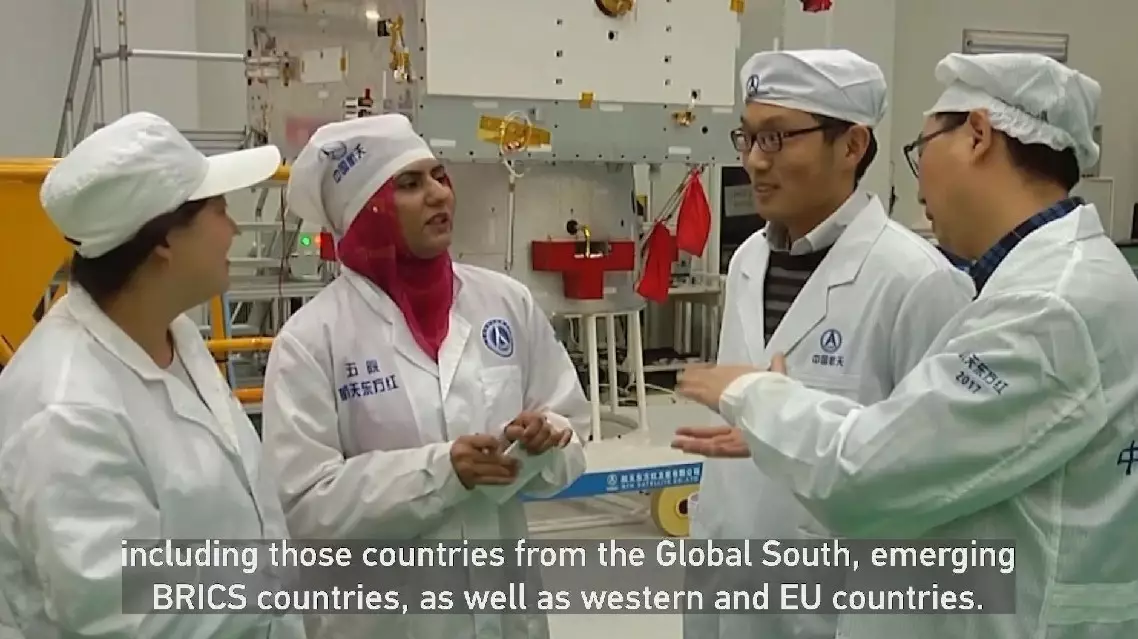
"We are open and welcome international cooperation from all countries, including those countries from the Global South, emerging BRICS countries, as well as Western and EU countries. We do not have any isolation or exclusion policy, and we want to cooperate in an all-round way," said Wu weiren, chief designer of China's Lunar Exploration Program.
Growth of China's aerospace industry enables space experiments, embraces global collaboration