Skip to Content Facebook Feature Image

A tiny tribe is getting pushback for betting big on a $600M casino in California's wine country

News

A tiny tribe is getting pushback for betting big on a $600M casino in California's wine country
News

News

A tiny tribe is getting pushback for betting big on a $600M casino in California's wine country

2024-10-02 01:47 Last Updated At:01:51

SAN FRANCISCO (AP) — For decades a small, landless tribe in Northern California has been on a mission to get land, open a casino and tap into the gaming market enjoyed by so many other tribes that earn millions of dollars annually.

The Koi Nation's chances of owning a Las Vegas-style casino seemed impossible until a federal court ruling in 2019 cleared the way for the tiny tribe to find a financial partner to buy land and place it into a trust to make it eligible for a casino.

Now the tribe of 96 members has teamed up with the Chickasaw Nation of Oklahoma, which owns the biggest casino in the world, and is waiting for U.S. Department of Interior Secretary Deb Haaland to decide whether the 68-acre (27-hectare) parcel the tribe bought for $12.3 million in Sonoma County in 2021 is put into trust.

Placing the land into trust would allow the Koi to move closer to building a $600 million casino and resort on prime real estate in the heart of Northern California’s wine country.

The decision comes as the U.S. government tries to atone for its history of dispossessing Indigenous people of their land, in part through a federal legal process that goes beyond reinstating ancestral lands and allows a tribe to put land under trust if it can prove “a significant historical connection to the land.”

The Koi Nation, a Southeastern Pomo tribe whose ancestors lived in Northern California for thousands of years, faces mounting opposition from other tribes and even California Gov. Gavin Newsom over its plans for the Shiloh Resort and Casino, which would include a 2,500-slot machine casino and 400-room hotel with spa and pool.

If approved, the casino would be built near Windsor, about 65 miles (105 kilometers) north of San Francisco, near two other Native American casinos a few miles away: Graton Resort and Casino in Rohnert Park and River Rock Casino in Geyserville.

The money generated would allow tribal members a better life in one of the country's most expensive regions, including educational opportunities for young tribe members, said Dino Beltran, Vice Chairman of the Koi Nation’s Tribal Council.

“It has taken us years to be on the same playing field as every other tribe in the United States and now the same tribes that have established themselves are against us. It’s a very sad thing,” Beltran said.

Among the most vocal critics of the Koi Nation’s project is Greg Sarris, chairman of Graton Rancheria, a federation of Coast Miwok and Southern Pomo people with more than 1,500 members. The tribe's casino is the biggest in the Bay Area and is undergoing a $1 billion expansion.

Sarris, who last year was appointed by Newsom to the University of California Board of Regents, said the Koi Nation are Southeastern Pomo people whose ancestral home is in Lake County, about 50 miles (80 kilometers) northeast of the project site.

The tribe, Sarris said, is not linguistically, culturally or historically connected to Sonoma County and he accused the tribe of cherry-picking land that already draws tourists.

“They are claiming that part of their deep historical connection is they had a family member in the early 20th century who lived in Sonoma County,” Sarris scoffed.

The Indian Gaming Regulatory Act, enacted by Congress in 1988, sets rules for how and where Native American tribes can operate casinos, and generally limits them to ancestral lands that have been returned to the tribe.

But the law also makes a “restored lands” exception for federally recognized tribes that do not have a reservation — or rancheria, as they are called in California — to build a casino outside their ancestral land if the tribe can show historical and modern connections to the area where the gambling facility will be located. The land also has to be near where a significant number of tribal members reside.

“Generally speaking, tribes cannot game on any land that is taken into trust after 1988 but there are important exceptions to that general prohibition that are meant to be fair to tribes that did not have land in 1988,” said Kathryn Rand, an expert on tribal gaming law at the University of Nevada, Las Vegas’s International Center for Gaming Regulation.

Before white colonizers arrived in California, Koi Nation’s ancestors lived on an island in Lake County and traded with other tribes in Northern California, according to the tribe’s website.

In 1916, the U.S. government approved land in Lake County for Koi Nation's rancheria about 28 miles (45 kilometers) north of the proposed casino site. The land was eventually declared uninhabitable by the Bureau of Indian Affairs because of its rocky terrain and many Koi families moved south to neighboring Sonoma County, mainly to Sebastopol and Santa Rosa, where the tribe is now headquartered.

Four decades later, the federal government took that land and sold it for an airport, leaving the tribe landless. After a lengthy court battle, a federal judge in 2019 ruled the Koi Nation had the right to pursue buying land for a casino.

Michael Anderson, a Koi Nation attorney, said a historic trail used by the tribe from the Clear Lake basin to Bodega Bay, on Sonoma County’s Pacific Coast, runs through a portion of the property, which supports the legal requirement of having a "significant historical connection to the land.”

Anderson said their legal case is strong. But, “the politics is a whole different thing,” he added.

Sarris, whose casino gives millions to small, non-gaming tribes and has become a major donor to California politicians, said the Koi Nation has previously tried to get land under trust to open a casino in Solano and Alameda Counties — both in the San Francisco Bay Area — and accused the tribe of “reservation shopping.”

Anderson said the term was offensive and Sarris is simply trying to protect his lucrative casino from competition.

“This is about market protection, that’s the heart of it,” Anderson said.

Newsom and local politicians also oppose the project along with the Dry Creek Band of Pomo Indians, which operates River Rock Casino.

Newsom’s office sent a letter last month to Department of the Interior Assistant Secretary of Indian Affairs Bryan Newland urging him not to move forward with the Shiloh casino project and another proposed casino in the Bay Area, saying the governor is concerned the department is not considering other sites for the casinos and approving them would “stretch the limits of the ‘restored lands’ exception."

The department is weighing three other land trust applications under the “restored lands” exception, including one by the Scotts Valley Tribe that wants to build a casino in Solano County. In Oregon, the Coquille Indian Tribe wants to open a casino in Medford, about 170 miles (273 kilometers) south of its tribal headquarters and closer to the California border.

Casino-owning tribes are pushing back on both. The Guidiville Rancheria tribe in Northern California has applied but has not yet identified land for their project, according to the Bureau of Indian Affairs.

Haaland will consider several factors in making her decision, including opposition to the casinos, said Steve Light, an expert on tribal gaming policy at the UNLV International Center for Gaming Regulation.

But the secretary also will take into account whether the casino will help with "tribal self-determination, tribal self-governance, and tribal economic development, job creation and resources for the tribe,” he said.

Of the 574 federally recognized tribes, 110 are in California. According to the American Gaming Association, there are 87 tribal casinos in the state, making California the largest tribal gaming market in the country.

“With 40 million people in California, this is presumably still an untapped market, but one that is increasingly competitive,” Light said.

__

This story has been updated to correct the name of the law that regulates tribal casinos. It is the Indian Gaming Regulatory Act.
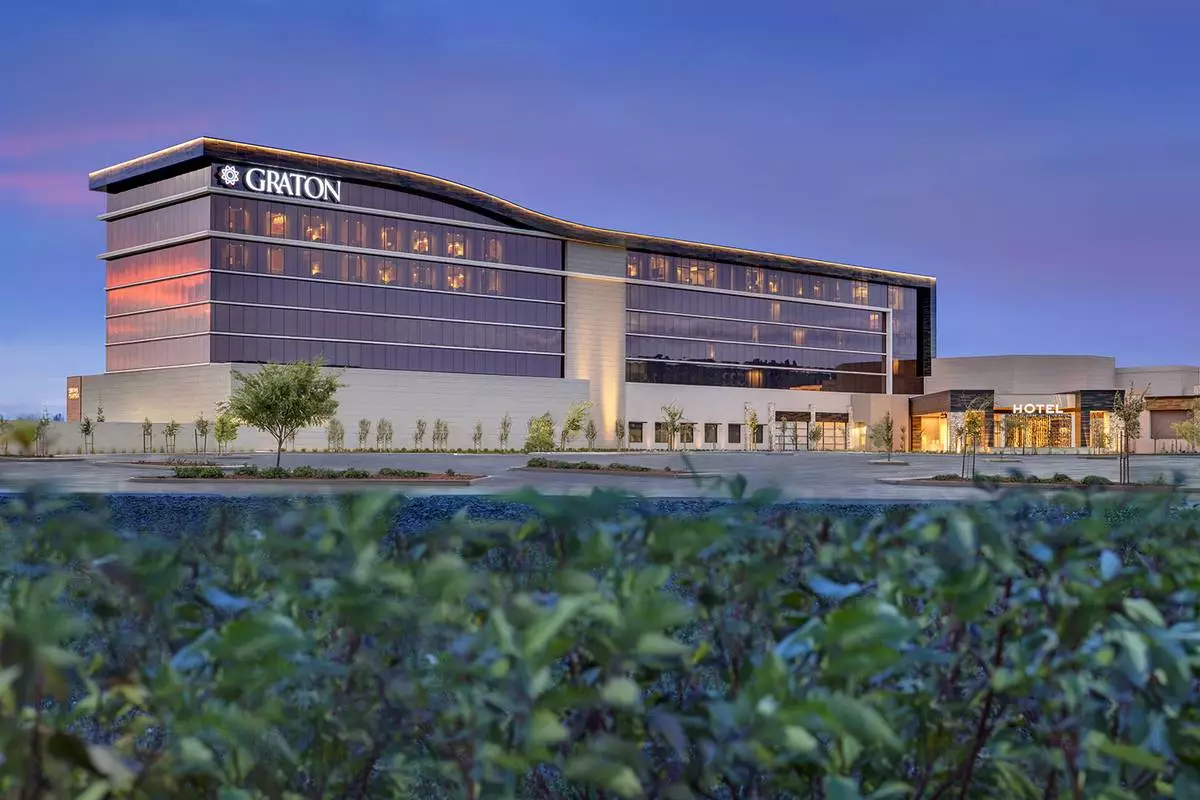
This undated photo provided by the Federated Indians of Graton Rancheria shows an exterior view of The Graton Resort and Casino in Rohnert Park, Calif. (Federated Indians of Graton Rancheria via AP)
This undated photo provided by the Federated Indians of Graton Rancheria shows an exterior view of The Graton Resort and Casino in Rohnert Park, Calif. (Federated Indians of Graton Rancheria via AP)

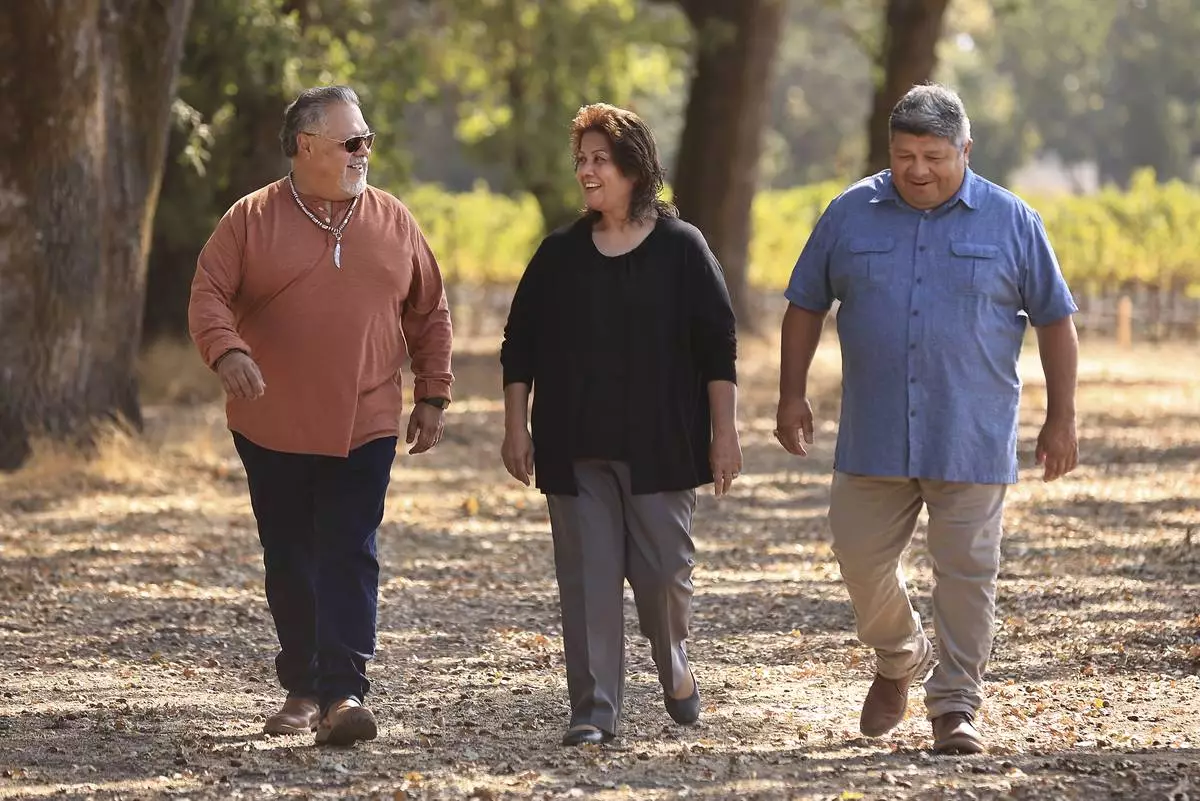
From left, Dino Beltran, Judy Fast Horse and Darin Beltran, of Sonoma County's Native American Koi Nation, tour a portion of land designated for casino project, Sept. 17, 2021, near Windsor, Calif. (Kent Porter/The Press Democrat via AP)
From left, Dino Beltran, Judy Fast Horse and Darin Beltran, of Sonoma County's Native American Koi Nation, tour a portion of land designated for casino project, Sept. 17, 2021, near Windsor, Calif. (Kent Porter/The Press Democrat via AP)

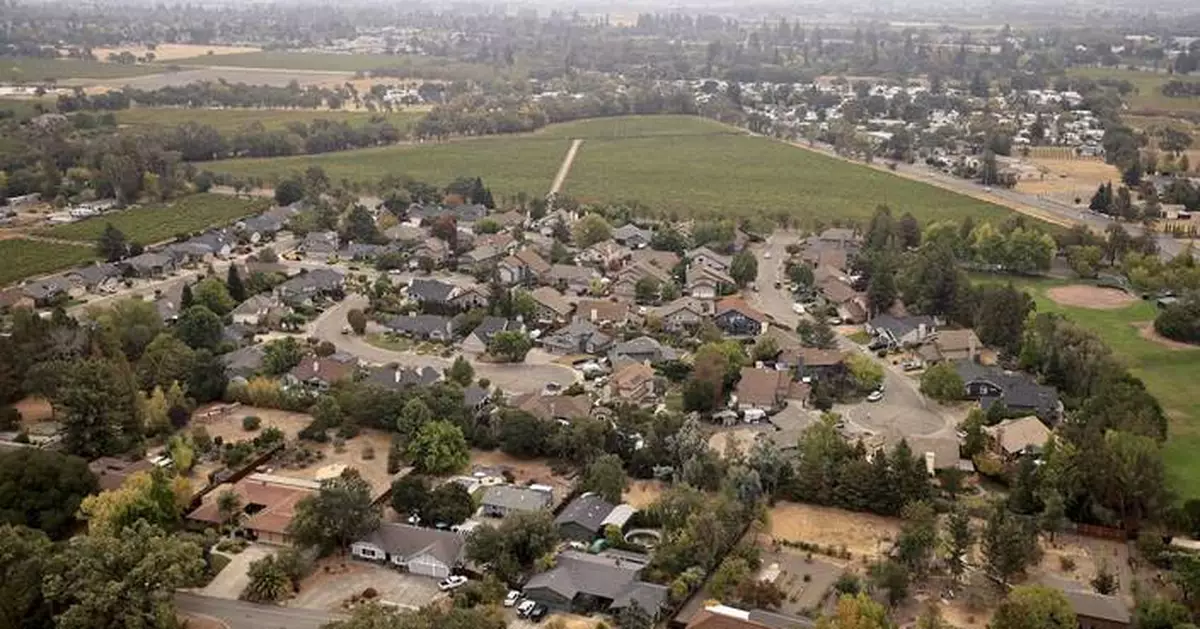
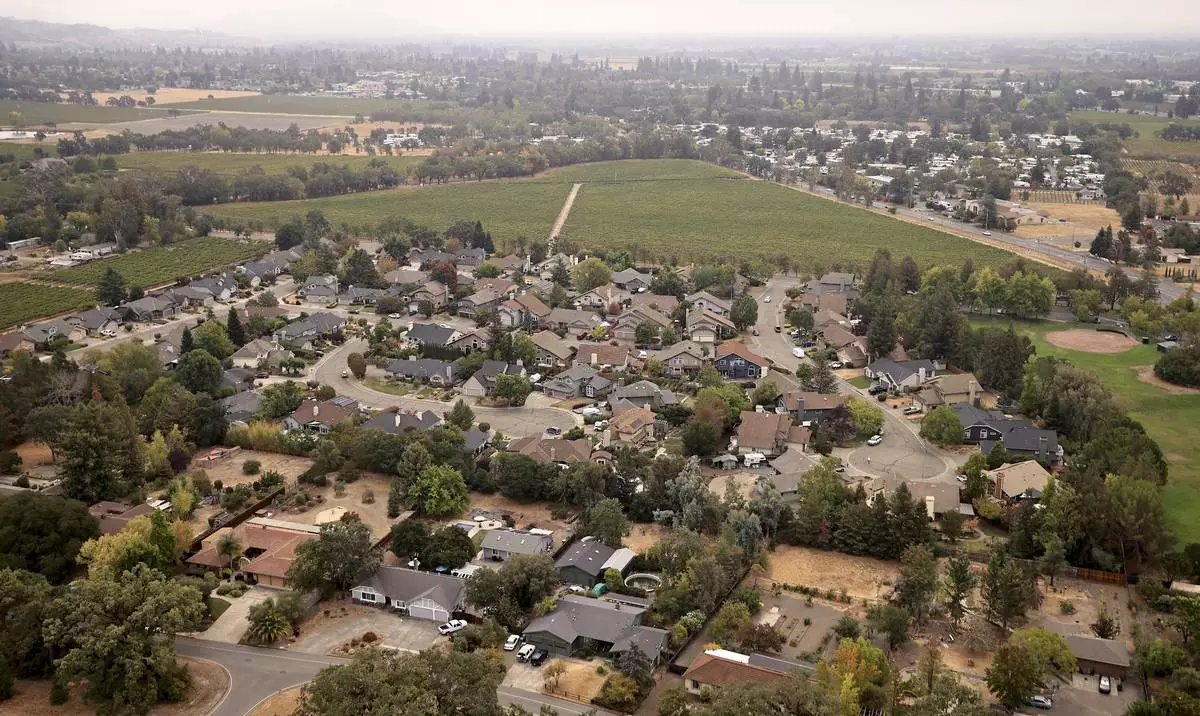
This aerial photo shows a subdivision at the site of a proposed resort and casino development, Sept. 17, 2021, near Windsor, Calif. (Kent Porter/The Press Democrat via AP)
This aerial photo shows a subdivision at the site of a proposed resort and casino development, Sept. 17, 2021, near Windsor, Calif. (Kent Porter/The Press Democrat via AP)
U.S. President Donald Trump says Iran has proposed negotiations after his threat to strike the Islamic Republic as an ongoing crackdown on demonstrators has led to hundreds of deaths.

Trump said late Sunday that his administration was in talks to set up a meeting with Tehran, but cautioned that he may have to act first as reports mount of increasing deaths and the government continues to arrest protesters.

“The meeting is being set up, but we may have to act because of what’s happening before the meeting. But a meeting is being set up. Iran called, they want to negotiate,” Trump told reporters on Air Force One on Sunday night.

Iran did not acknowledge Trump’s comments immediately. It has previously warned the U.S. military and Israel would be “legitimate targets” if America uses force to protect demonstrators.

The U.S.-based Human Rights Activists News Agency, which has accurately reported on past unrest in Iran, gave the death toll. It relies on supporters in Iran cross checking information. It said at least 544 people have been killed so far, including 496 protesters and 48 people from the security forces. It said more than 10,600 people also have been detained over the two weeks of protests.

With the internet down in Iran and phone lines cut off, gauging the demonstrations from abroad has grown more difficult. Iran’s government has not offered overall casualty figures.

The Latest:

A witness told the AP that the streets of Tehran empty at the sunset call to prayers each night.

Part of that stems from the fear of getting caught in the crackdown. Police sent the public a text message that warned: “Given the presence of terrorist groups and armed individuals in some gatherings last night and their plans to cause death, and the firm decision to not tolerate any appeasement and to deal decisively with the rioters, families are strongly advised to take care of their youth and teenagers.”

Another text, addressed “Dear parents,” which claimed to come from the intelligence arm of the paramilitary Revolutionary Guard, also directly warned people not to take part in demonstrations.

The witness spoke to the AP on condition of anonymity due to the ongoing crackdown.

—- By Jon Gambrell in Dubai, United Arab Emirates

Iran drew tens of thousands of pro-government demonstrators to the streets Monday in a show of power after nationwide protests challenging the country’s theocracy.

Iranian state television showed images of demonstrators thronging Tehran toward Enghelab Square in the capital.

It called the demonstration an “Iranian uprising against American-Zionist terrorism,” without addressing the underlying anger in the country over the nation’s ailing economy. That sparked the protests over two weeks ago.

State television aired images of such demonstrations around the country, trying to signal it had overcome the protests, as claimed by Iranian Foreign Minister Abbas Araghchi earlier in the day.

China says it opposes the use of force in international relations and expressed hope the Iranian government and people are “able to overcome the current difficulties and maintain national stability.”

Chinese Foreign Ministry spokesperson Mao Ning said Monday that Beijing “always opposes interference in other countries’ internal affairs, maintains that the sovereignty and security of all countries should be fully protected under international law, and opposes the use or threat of use of force in international relations.”

German Chancellor Friedrich Merz condemned “in the strongest terms the violence that the leadership in Iran is directing against its own people.”

He said it was a sign of weakness rather than strength, adding that “this violence must end.”

Merz said during a visit to India that the demonstrators deserve “the greatest respect” for the courage with which “they are resisting the disproportional, brutal violence of Iranian security forces.”

He said: “I call on the Iranian leadership to protect its population rather than threatening it.”

Iran’s Foreign Ministry spokesman on Monday suggested that a channel remained open with the United States.

Esmail Baghaei made the comment during a news conference in Tehran.

“It is open and whenever needed, through that channel, the necessary messages are exchanged,” he said.

However, Baghaei said such talks needed to be “based on the acceptance of mutual interests and concerns, not a negotiation that is one-sided, unilateral and based on dictation.”

The semiofficial Fars news agency in Iran, which is close to the paramilitary Revolutionary Guard, on Monday began calling out Iranian celebrities and leaders on social media who have expressed support for the protests over the past two weeks, especially before the internet was shut down.

The threat comes as writers and other cultural leaders were targeted even before protests. The news agency highlighted specific celebrities who posted in solidarity with the protesters and scolded them for not condemning vandalism and destruction to public property or the deaths of security forces killed during clashes. The news agency accused those celebrities and leaders of inciting riots by expressing their support.

Canada said it “stands with the brave people of Iran” in a statement on social media that strongly condemned the killing of protesters during widespread protests that have rocked the country over the past two weeks.

“The Iranian regime must halt its horrific repression and intimidation and respect the human rights of its citizens,” Canada’s government said on Monday.

Iran’s foreign minister claimed Monday that “the situation has come under total control” after a bloody crackdown on nationwide protests in the country.

Abbas Araghchi offered no evidence for his claim.

Araghchi spoke to foreign diplomats in Tehran. The Qatar-funded Al Jazeera satellite news network, which has been allowed to work despite the internet being cut off in the country, carried his remarks.

Iran’s foreign minister alleged Monday that nationwide protests in his nation “turned violent and bloody to give an excuse” for U.S. President Donald Trump to intervene.

Abbas Araghchi offered no evidence for his claim, which comes after over 500 have been reported killed by activists -- the vast majority coming from demonstrators.

Araghchi spoke to foreign diplomats in Tehran. The Qatar-funded Al Jazeera satellite news network, which has been allowed to work despite the internet being cut off in the country, carried his remarks.

Iran has summoned the British ambassador over protesters twice taking down the Iranian flag at their embassy in London.

Iranian state television also said Monday that it complained about “certain terrorist organization that, under the guise of media, spread lies and promote violence and terrorism.” The United Kingdom is home to offices of the BBC’s Persian service and Iran International, both which long have been targeted by Iran.

A huge crowd of demonstrators, some waving the flag of Iran, gathered Sunday afternoon along Veteran Avenue in LA’s Westwood neighborhood to protest against the Iranian government. Police eventually issued a dispersal order, and by early evening only about a hundred protesters were still in the area, ABC7 reported.

Los Angeles is home to the largest Iranian community outside of Iran.

Los Angeles police responded Sunday after somebody drove a U-Haul box truck down a street crowded with the the demonstrators, causing protesters to scramble out of the way and then run after the speeding vehicle to try to attack the driver. A police statement said one person was hit by the truck but nobody was seriously hurt.

The driver, a man who was not identified, was detained “pending further investigation,” police said in a statement Sunday evening.

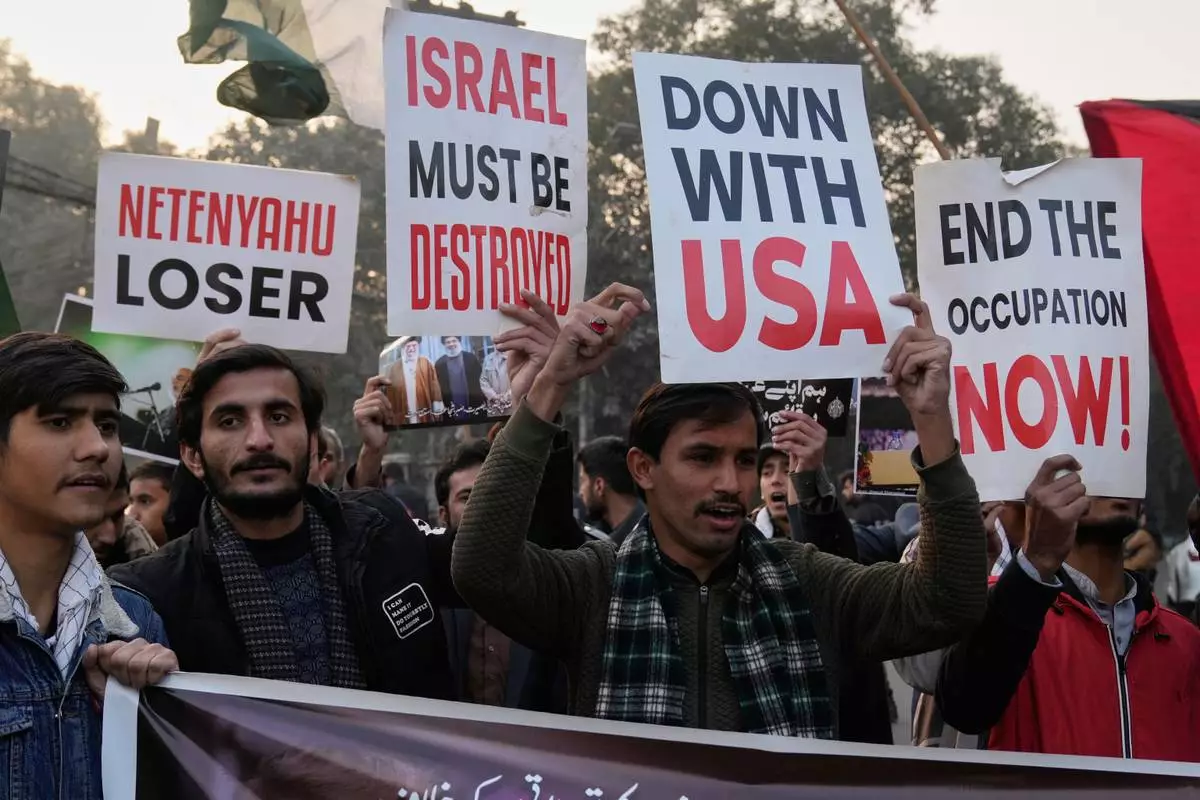
Shiite Muslims hold placards and chant slogans during a protest against the U.S. and show solidarity with Iran in Lahore, Pakistan, Sunday, Jan. 11, 2026. (AP Photo/K.M. Chaudary)

Shiite Muslims hold placards and chant slogans during a protest against the U.S. and show solidarity with Iran in Lahore, Pakistan, Sunday, Jan. 11, 2026. (AP Photo/K.M. Chaudary)

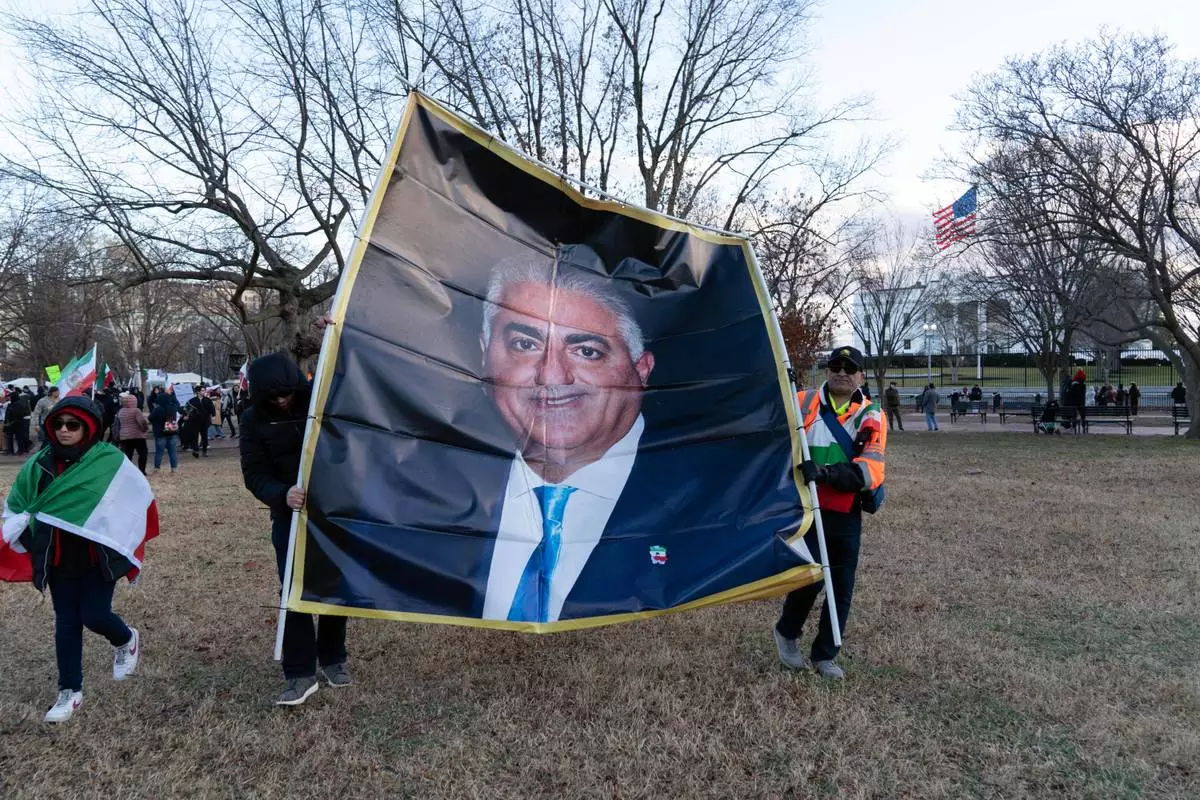
Activists carrying a photograph of Reza Pahlavi take part in a rally supporting protesters in Iran at Lafayette Park, across from the White House, in Washington, Sunday, Jan. 11, 2026. (AP Photo/Jose Luis Magana)

Activists carrying a photograph of Reza Pahlavi take part in a rally supporting protesters in Iran at Lafayette Park, across from the White House, in Washington, Sunday, Jan. 11, 2026. (AP Photo/Jose Luis Magana)

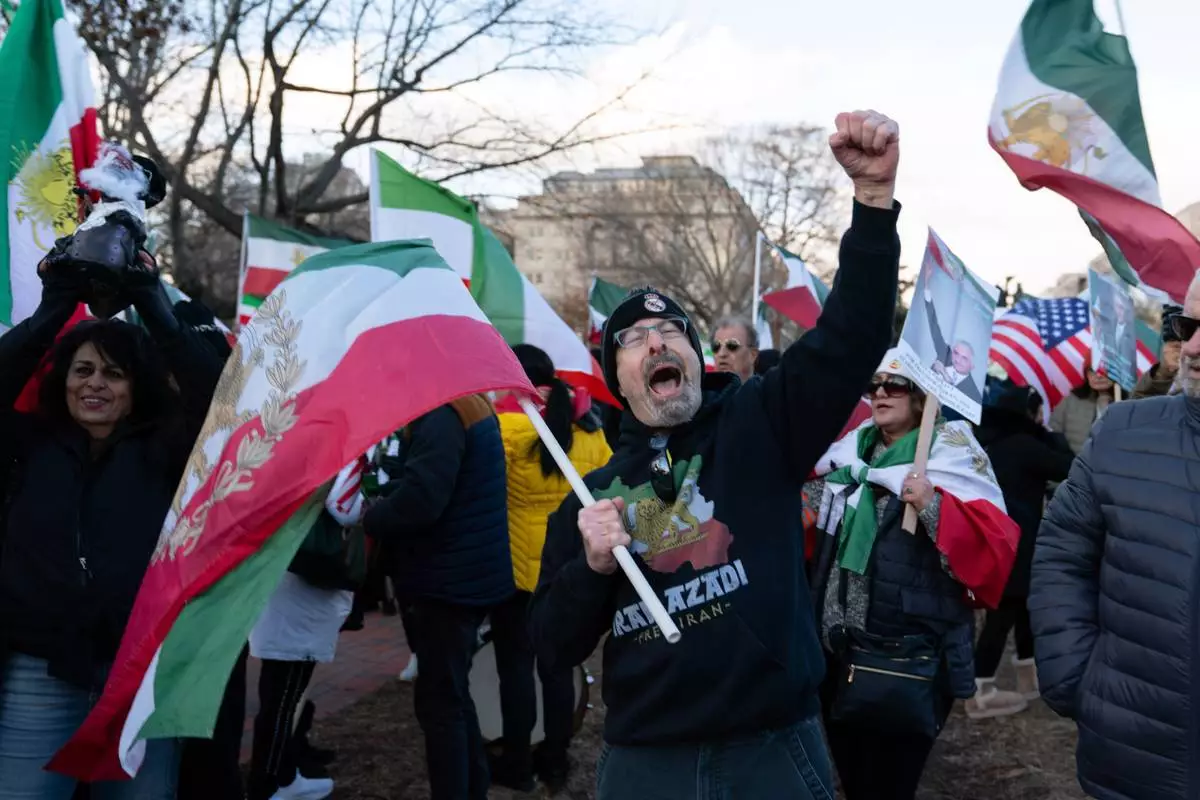
Activists take part in a rally supporting protesters in Iran at Lafayette Park, across from the White House in Washington, Sunday, Jan. 11, 2026. (AP Photo/Jose Luis Magana)

Activists take part in a rally supporting protesters in Iran at Lafayette Park, across from the White House in Washington, Sunday, Jan. 11, 2026. (AP Photo/Jose Luis Magana)

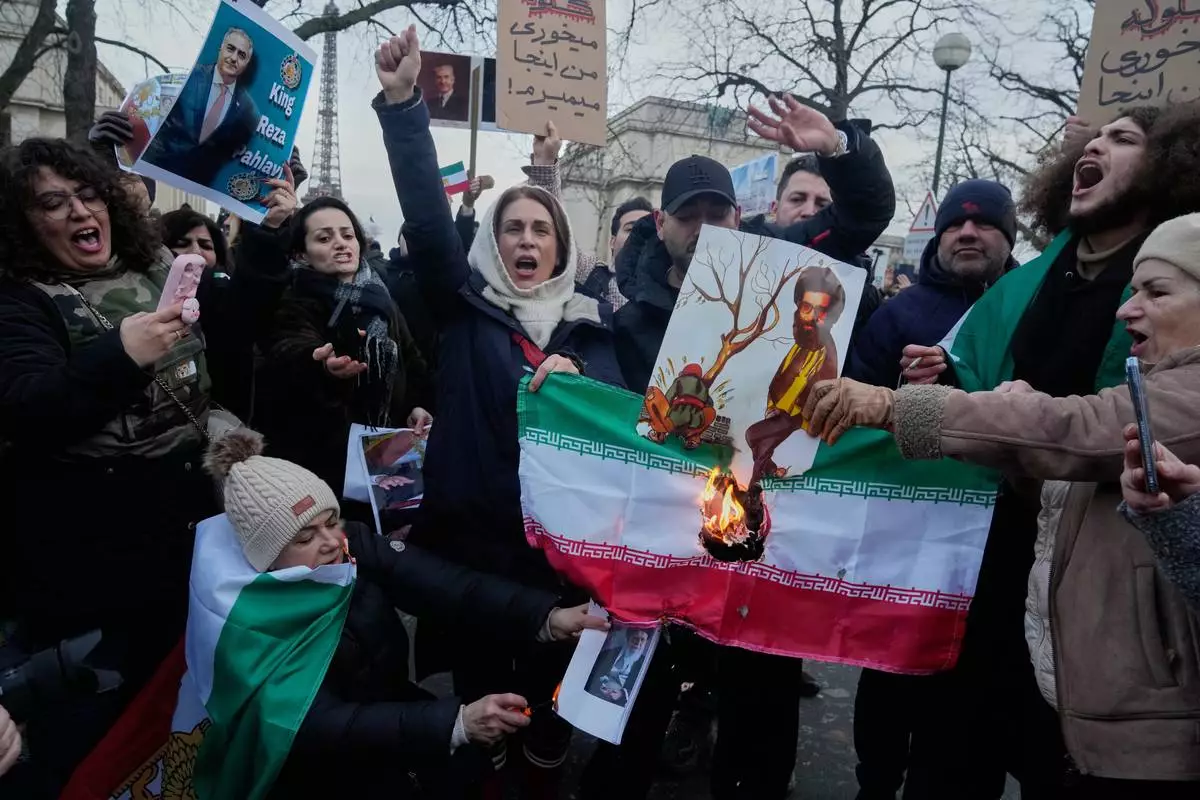
Protesters burn the Iranian national flag during a rally in support of the nationwide mass demonstrations in Iran against the government in Paris, Sunday, Jan. 11, 2026. (AP Photo/Michel Euler)

Protesters burn the Iranian national flag during a rally in support of the nationwide mass demonstrations in Iran against the government in Paris, Sunday, Jan. 11, 2026. (AP Photo/Michel Euler)

Recommended Articles