Skip to Content Facebook Feature Image

Helene and other storms dumped a whopping 40 trillion gallons of rain on the South

ENT

Helene and other storms dumped a whopping 40 trillion gallons of rain on the South
ENT

ENT

Helene and other storms dumped a whopping 40 trillion gallons of rain on the South

2024-10-01 19:27 Last Updated At:19:31

More than 40 trillion gallons of rain drenched the Southeast United States in the last week from Hurricane Helene and a run-of-the-mill rainstorm that sloshed in ahead of it — an unheard of amount of water that has stunned experts.

That's enough to fill the Dallas Cowboys' stadium 51,000 times, or Lake Tahoe just once. If it was concentrated just on the state of North Carolina that much water would be 3.5 feet deep (more than 1 meter). It's enough to fill more than 60 million Olympic-size swimming pools.

More Images
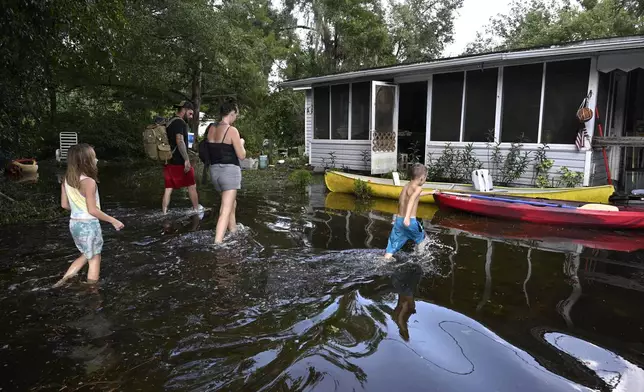
FILE - Dustin Holmes, rear, his girlfriend Hailey Morgan, and her children Aria Skye Hall, 7, left, and Kyle Ross, 4, right, arrive to their flooded home in the aftermath of Hurricane Helene, Sept. 27, 2024, in Crystal River, Fla. (AP Photo/Phelan M. Ebenhack, File)
FILE - Dustin Holmes, rear, his girlfriend Hailey Morgan, and her children Aria Skye Hall, 7, left, and Kyle Ross, 4, right, arrive to their flooded home in the aftermath of Hurricane Helene, Sept. 27, 2024, in Crystal River, Fla. (AP Photo/Phelan M. Ebenhack, File)

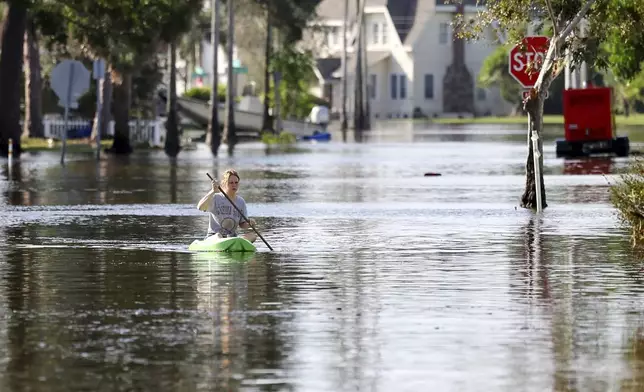
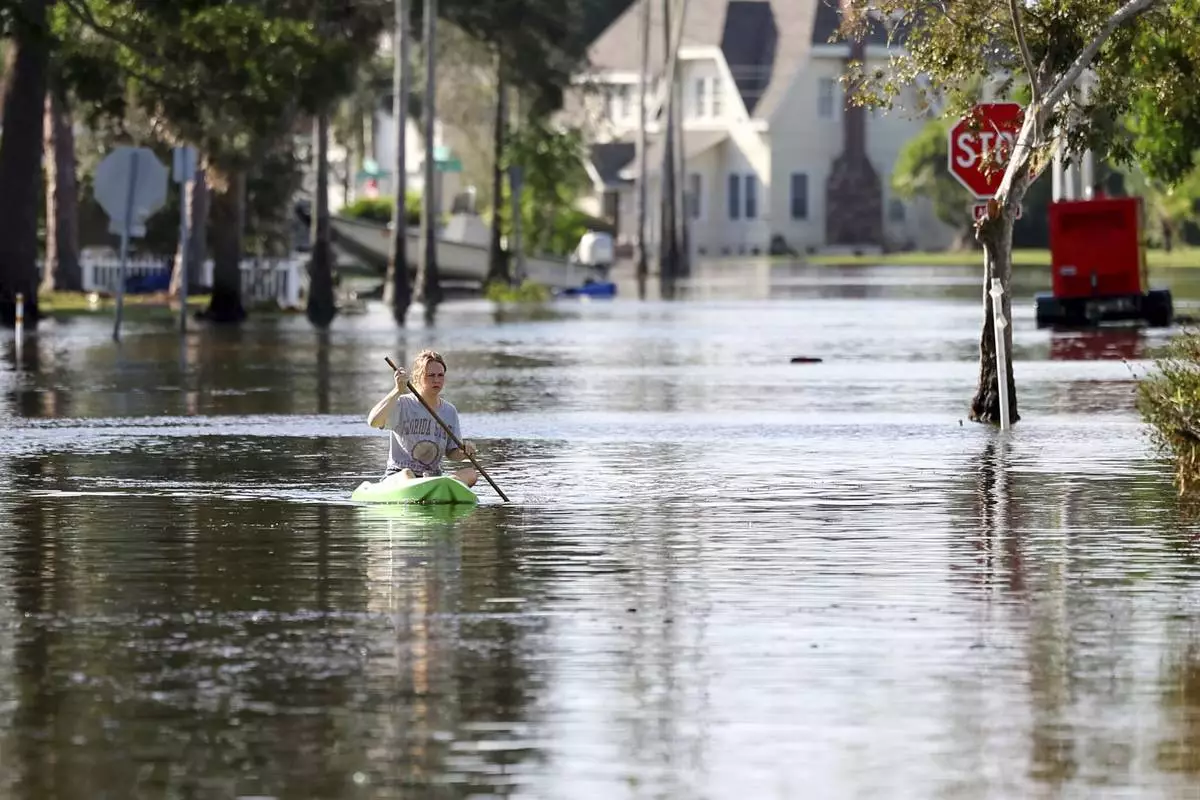
FILE - Halle Brooks kayaks down a street flooded by Hurricane Helene in the Shore Acres neighborhood Sept. 27, 2024, in St. Petersburg, Fla. (AP Photo/Mike Carlson, File)
FILE - Halle Brooks kayaks down a street flooded by Hurricane Helene in the Shore Acres neighborhood Sept. 27, 2024, in St. Petersburg, Fla. (AP Photo/Mike Carlson, File)

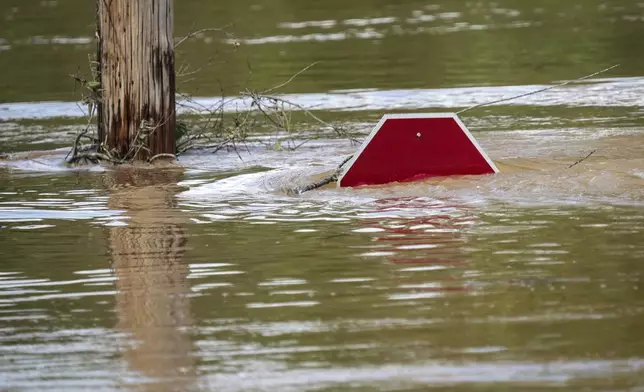
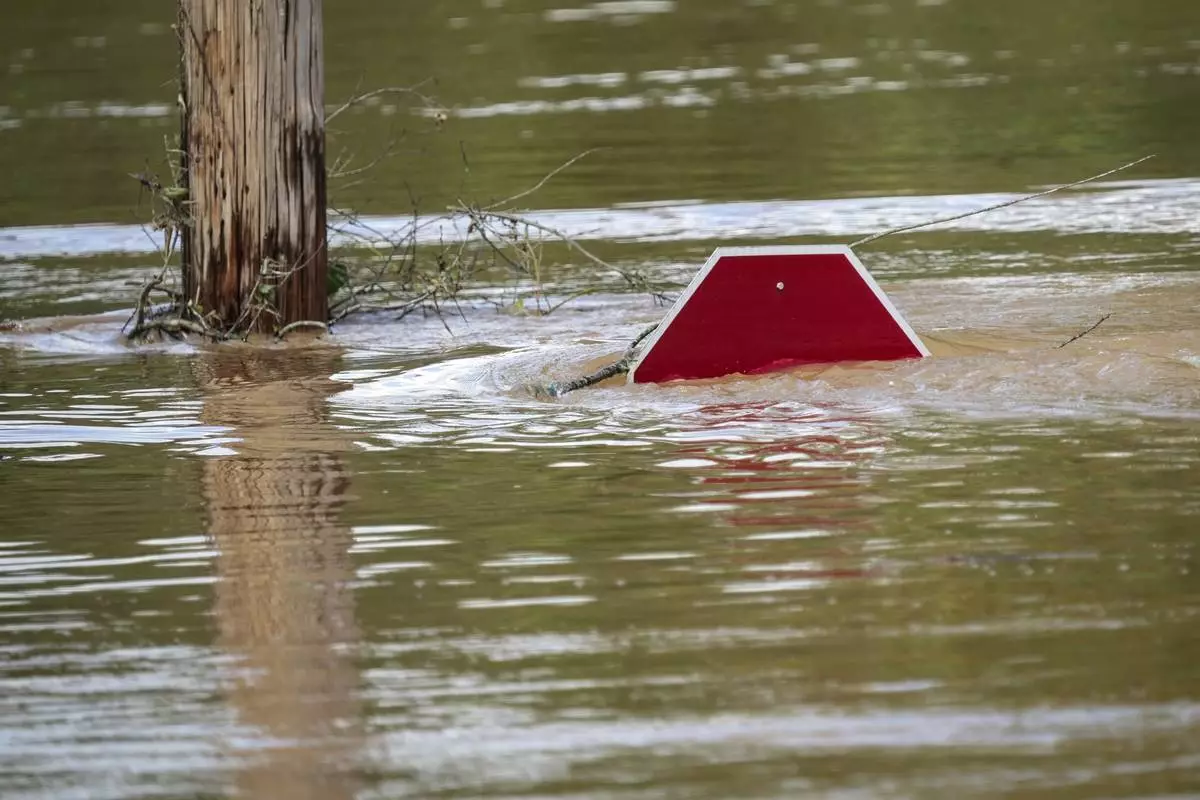
FILE - A stop sign is barely visible in floodwaters of a parking lot after torrential rain from Hurricane Helene, Saturday, Sept. 28, 2024, in Morganton, N.C. (AP Photo/Kathy Kmonicek, File)
FILE - A stop sign is barely visible in floodwaters of a parking lot after torrential rain from Hurricane Helene, Saturday, Sept. 28, 2024, in Morganton, N.C. (AP Photo/Kathy Kmonicek, File)

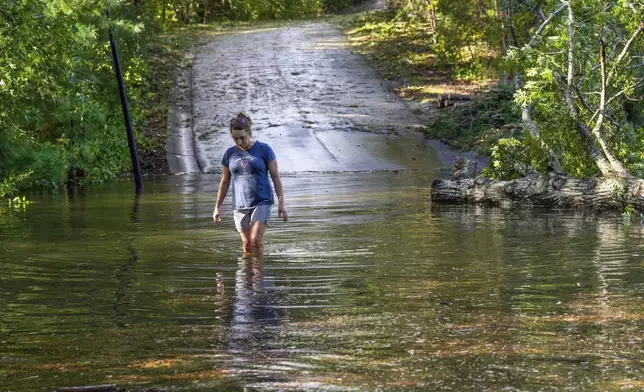
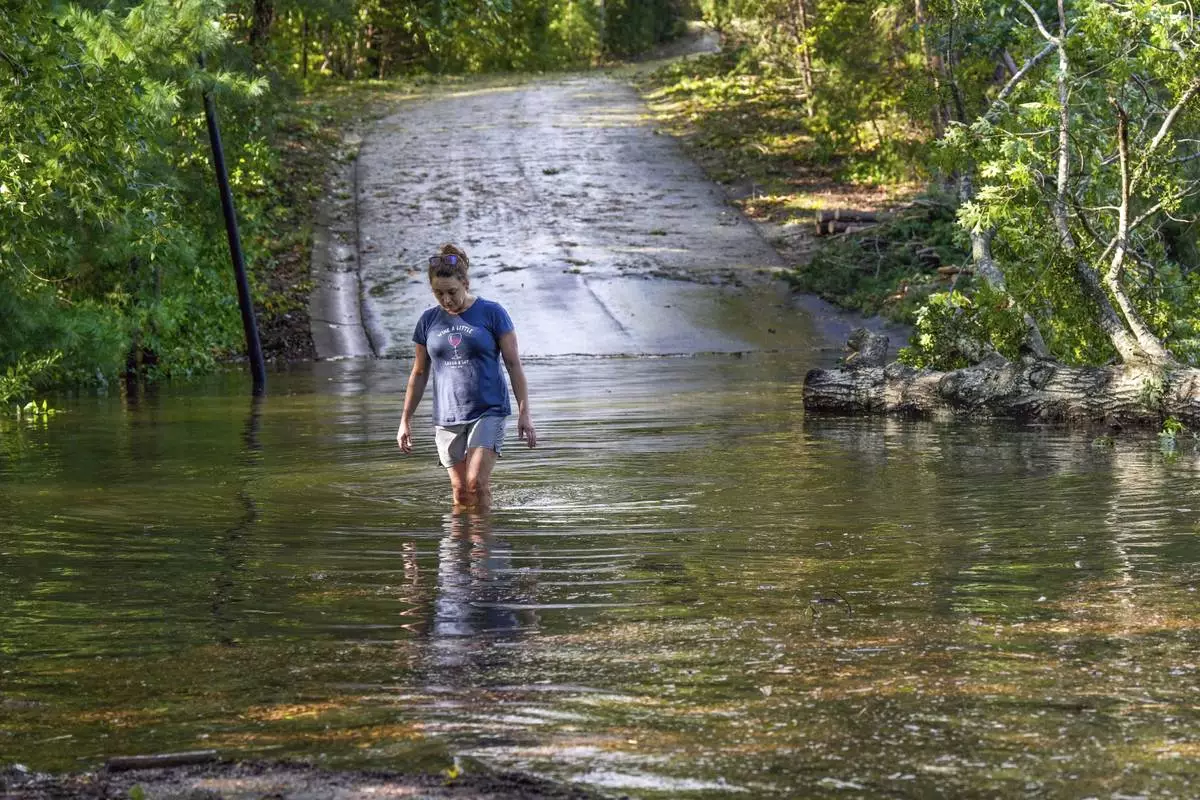
FILE - Teresa Elder walks through a flooded Sandy Cove Drive from Hurricane Helene on Sept. 27, 2024, in Morganton, N.C. (AP Photo/Kathy Kmonicek, File)
FILE - Teresa Elder walks through a flooded Sandy Cove Drive from Hurricane Helene on Sept. 27, 2024, in Morganton, N.C. (AP Photo/Kathy Kmonicek, File)

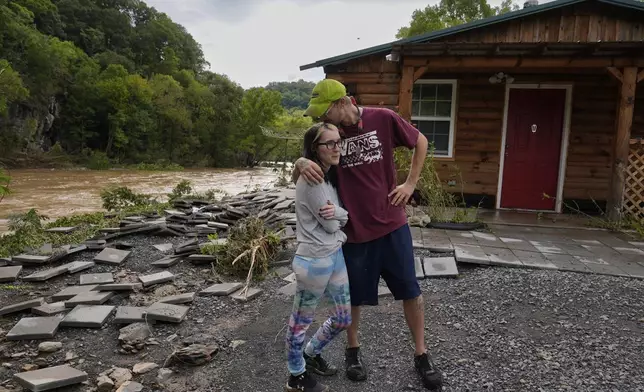
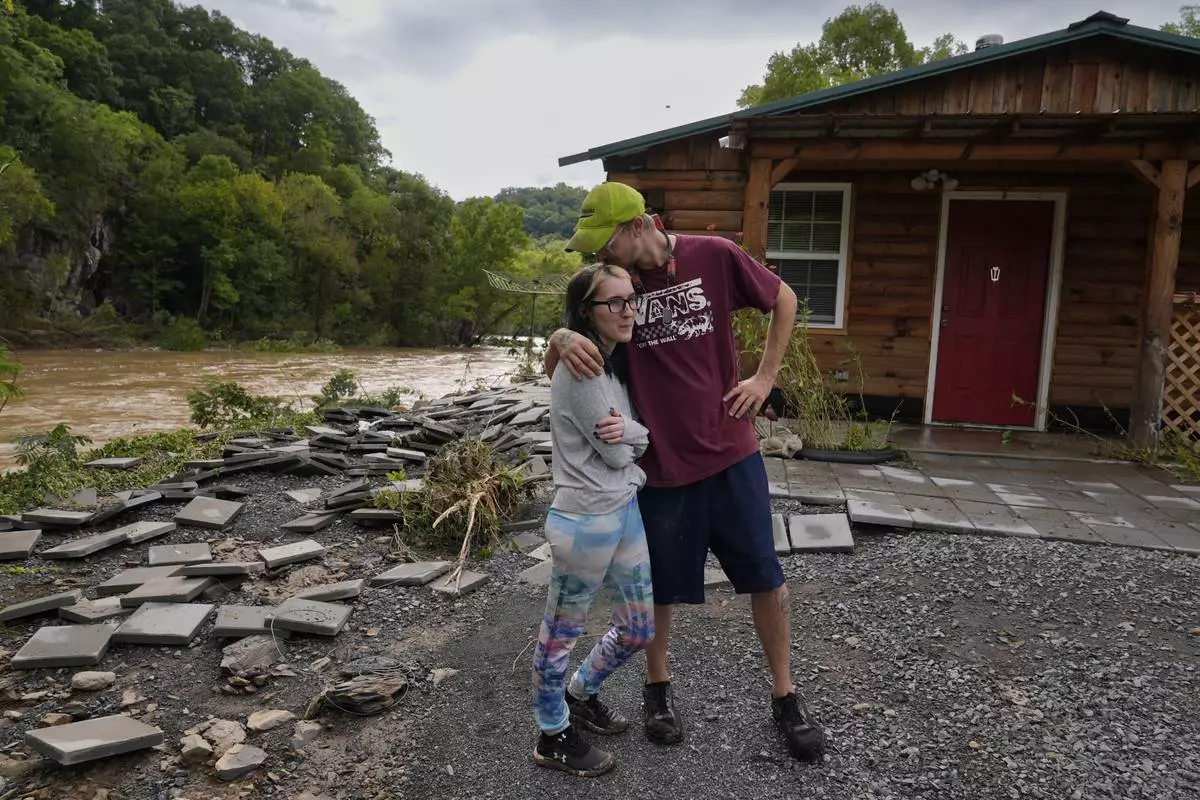
FILE - Jonah Wark, right, kisses his wife Sara Martin outside their flood-damaged home on the Pigeon River in the aftermath of Hurricane Helene, Sept. 28, 2024, in Newport, Tenn. (AP Photo/George Walker IV, File)
FILE - Jonah Wark, right, kisses his wife Sara Martin outside their flood-damaged home on the Pigeon River in the aftermath of Hurricane Helene, Sept. 28, 2024, in Newport, Tenn. (AP Photo/George Walker IV, File)

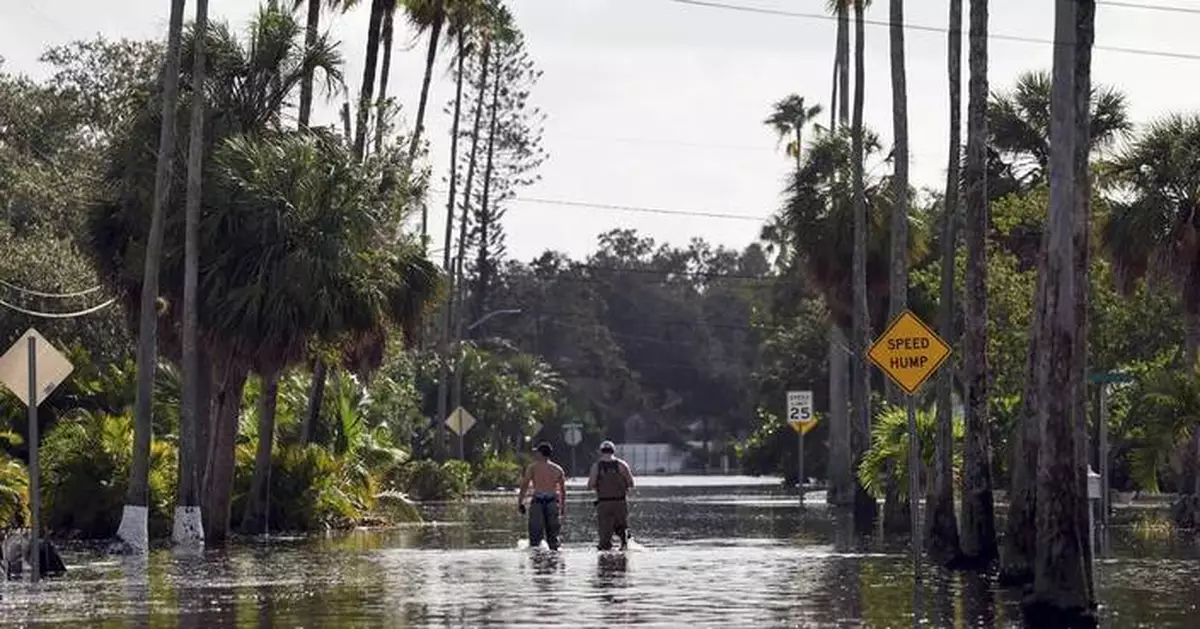
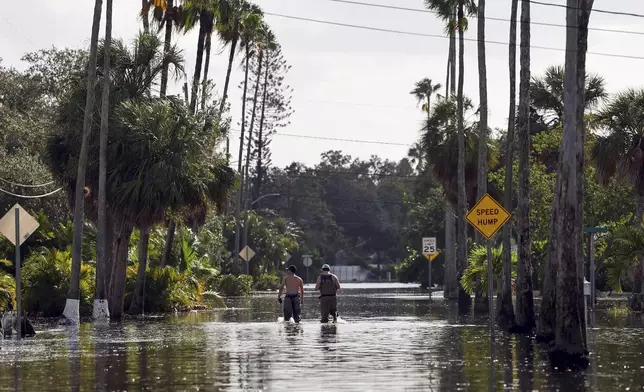
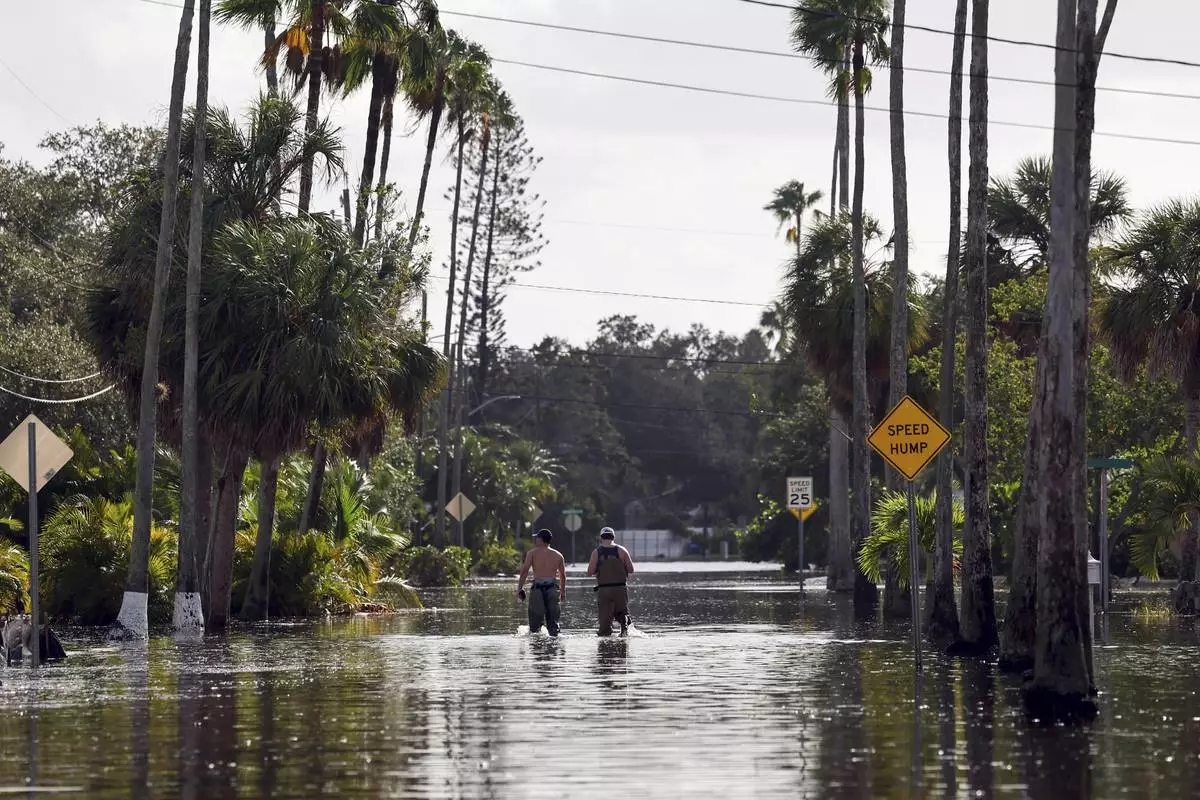
FILE - Men walk down a street flooded by Hurricane Helene in the Shore Acres neighborhood Sept. 27, 2024, in St. Petersburg, Fla. (AP Photo/Mike Carlson, File)

FILE - Men walk down a street flooded by Hurricane Helene in the Shore Acres neighborhood Sept. 27, 2024, in St. Petersburg, Fla. (AP Photo/Mike Carlson, File)

“That's an astronomical amount of precipitation,” said Ed Clark, head of the National Oceanic and Atmospheric Administration's National Water Center in Tuscaloosa, Alabama. "I have not seen something in my 25 years of working at the weather service that is this geographically large of an extent and the sheer volume of water that fell from the sky.''

The flood damage from the rain is apocalyptic, meteorologists said. More than 100 people are dead, according to officials.

Private meteorologist Ryan Maue, a former NOAA chief scientist, calculated the amount of rain, using precipitation measurements made in 2.5-mile-by-2.5 mile grids as measured by satellites and ground observations. He came up with 40 trillion gallons through Sunday for the eastern United States, with 20 trillion gallons of that hitting just Georgia, Tennessee, the Carolinas and Florida from Hurricane Helene.

Clark did the calculations independently and said the 40 trillion gallon figure (151 trillion liters) is about right and, if anything, conservative. Maue said maybe 1 to 2 trillion more gallons of rain had fallen, much of it in Virginia, since his calculations.

Clark, who spends much of his work on issues of shrinking western water supplies, said to put the amount of rain in perspective, it's more than twice the combined amount of water stored by two key Colorado River basin reservoirs: Lake Powell and Lake Mead.

Several meteorologists said this was a combination of two, maybe three storm systems. Before Helene struck, rain had fallen heavily for days because a low pressure system had “cut off” from the jet stream — which moves weather systems along west to east — and stalled over the Southeast. That funneled plenty of warm water from the Gulf of Mexico. And a storm that fell just short of named status parked along North Carolina's Atlantic coast, dumping as much as 20 inches of rain, said North Carolina state climatologist Kathie Dello.

Then add Helene, one of the largest storms in the last couple decades and one that held plenty of rain because it was young and moved fast before it hit the Appalachians, said University of Albany hurricane expert Kristen Corbosiero.

“It was not just a perfect storm, but it was a combination of multiple storms that that led to the enormous amount of rain,” Maue said. “That collected at high elevation, we’re talking 3,000 to 6000 feet. And when you drop trillions of gallons on a mountain, that has to go down.”

The fact that these storms hit the mountains made everything worse, and not just because of runoff. The interaction between the mountains and the storm systems wrings more moisture out of the air, Clark, Maue and Corbosiero said.

North Carolina weather officials said their top measurement total was 31.33 inches in the tiny town of Busick. Mount Mitchell also got more than 2 feet of rainfall.

Before 2017's Hurricane Harvey, “I said to our colleagues, you know, I never thought in my career that we would measure rainfall in feet,” Clark said. “And after Harvey, Florence, the more isolated events in eastern Kentucky, portions of South Dakota. We’re seeing events year in and year out where we are measuring rainfall in feet.”

Storms are getting wetter as the climate change s, said Corbosiero and Dello. A basic law of physics says the air holds nearly 4% more moisture for every degree Fahrenheit warmer (7% for every degree Celsius) and the world has warmed more than 2 degrees (1.2 degrees Celsius) since pre-industrial times.

Corbosiero said meteorologists are vigorously debating how much of Helene is due to worsening climate change and how much is random.

In a quick analysis, not peer-reviewed but using a method published in a study about Hurricane Harvey's rainfall, three scientists at the Department of Energy's Lawrence Berkeley National Lab determined that climate change caused 50% more rainfall during Helene in some parts of Georgia and the Carolinas.

For Dello, the “fingerprints of climate change” were clear.

“We’ve seen tropical storm impacts in western North Carolina. But these storms are wetter and these storms are warmer. And there would have been a time when a tropical storm would have been heading toward North Carolina and would have caused some rain and some damage, but not apocalyptic destruction. ”

Follow AP’s climate coverage at https://apnews.com/hub/climate

Follow Seth Borenstein on Twitter at @borenbears

Associated Press climate and environmental coverage receives support from several private foundations. See more about AP’s climate initiative here. The AP is solely responsible for all content.
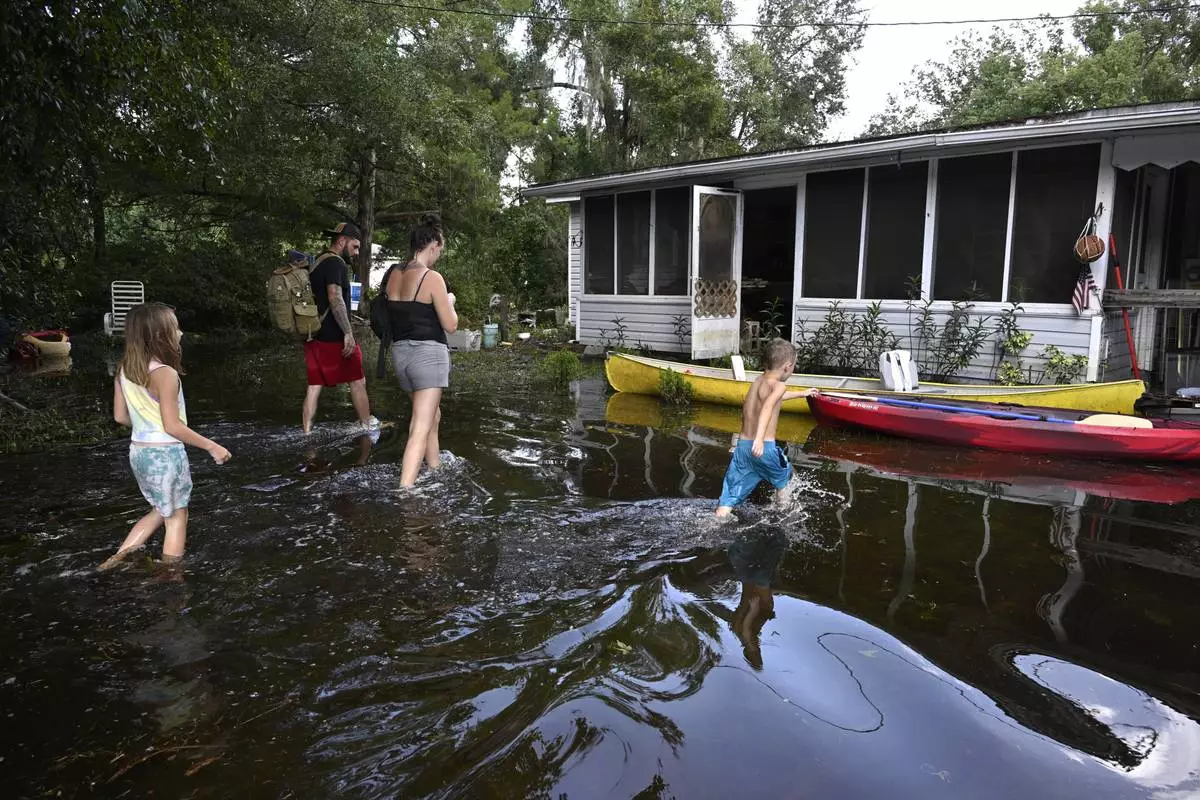
FILE - Dustin Holmes, rear, his girlfriend Hailey Morgan, and her children Aria Skye Hall, 7, left, and Kyle Ross, 4, right, arrive to their flooded home in the aftermath of Hurricane Helene, Sept. 27, 2024, in Crystal River, Fla. (AP Photo/Phelan M. Ebenhack, File)
FILE - Dustin Holmes, rear, his girlfriend Hailey Morgan, and her children Aria Skye Hall, 7, left, and Kyle Ross, 4, right, arrive to their flooded home in the aftermath of Hurricane Helene, Sept. 27, 2024, in Crystal River, Fla. (AP Photo/Phelan M. Ebenhack, File)

FILE - Halle Brooks kayaks down a street flooded by Hurricane Helene in the Shore Acres neighborhood Sept. 27, 2024, in St. Petersburg, Fla. (AP Photo/Mike Carlson, File)
FILE - Halle Brooks kayaks down a street flooded by Hurricane Helene in the Shore Acres neighborhood Sept. 27, 2024, in St. Petersburg, Fla. (AP Photo/Mike Carlson, File)

FILE - A stop sign is barely visible in floodwaters of a parking lot after torrential rain from Hurricane Helene, Saturday, Sept. 28, 2024, in Morganton, N.C. (AP Photo/Kathy Kmonicek, File)
FILE - A stop sign is barely visible in floodwaters of a parking lot after torrential rain from Hurricane Helene, Saturday, Sept. 28, 2024, in Morganton, N.C. (AP Photo/Kathy Kmonicek, File)

FILE - Teresa Elder walks through a flooded Sandy Cove Drive from Hurricane Helene on Sept. 27, 2024, in Morganton, N.C. (AP Photo/Kathy Kmonicek, File)
FILE - Teresa Elder walks through a flooded Sandy Cove Drive from Hurricane Helene on Sept. 27, 2024, in Morganton, N.C. (AP Photo/Kathy Kmonicek, File)

FILE - Jonah Wark, right, kisses his wife Sara Martin outside their flood-damaged home on the Pigeon River in the aftermath of Hurricane Helene, Sept. 28, 2024, in Newport, Tenn. (AP Photo/George Walker IV, File)
FILE - Jonah Wark, right, kisses his wife Sara Martin outside their flood-damaged home on the Pigeon River in the aftermath of Hurricane Helene, Sept. 28, 2024, in Newport, Tenn. (AP Photo/George Walker IV, File)

FILE - Men walk down a street flooded by Hurricane Helene in the Shore Acres neighborhood Sept. 27, 2024, in St. Petersburg, Fla. (AP Photo/Mike Carlson, File)


FILE - Men walk down a street flooded by Hurricane Helene in the Shore Acres neighborhood Sept. 27, 2024, in St. Petersburg, Fla. (AP Photo/Mike Carlson, File)

Several Middle Eastern allies of the United States have urged the Trump administration to hold off on strikes against Iran for the government’s deadly crackdown on protesters, according to an Arab diplomat familiar with the matter.

Top officials from Egypt, Oman, Saudi Arabia and Qatar have raised concerns in the last 48 hours that a U.S. military intervention would shake the global economy and destabilize an already volatile region, said the diplomat who spoke on condition of anonymity to describe the sensitive conversations.

Oil prices fell Thursday as the markets appeared to take note of President Donald Trump’s shifting tone as a sign that he’s leaning away from attacking Iran after days of launching blistering threats at Tehran for its brutal crackdown.

Nevertheless, White House press secretary Karoline Leavitt on Thursday maintained that “all options remain on the table” for Trump as he deals with Iran.

Here's the latest:

Nobel Peace Prize winners can give away their medals but the original laureate remains the prize’s recipient, the Norwegian Nobel Committee said Friday, a day after Venezuelan opposition leader María Corina Machado said she presented her medal to President Donald Trump.

The committee said in a statement that a laureate cannot share the prize or transfer it to others once it’s been announced. But the medal, prize money of diploma can be given away, donated and sold, with several having done so over the decades.

The committee added that it does not “see it as their role to engage in day-to-day commentary on Peace Prize laureates or the political processes that they are engaged in.”

President Donald Trump took the unusual step on Friday of thanking the Iranian government for not following through on executions of what he said was meant to be hundreds of political prisoners.

“Iran canceled the hanging of over 800 people,” Trump told reporters while leaving the White House to spend the weekend at his Mar-a-Lago estate in Palm Beach, Florida. He added “and I greatly respect the fact that they canceled.”

The Republican president also suggested on his social media site that more than 800 people had been set to be executed, but he said they now won’t be. Those sentiments come after Trump spent days suggesting that the U.S. might strike Iran militarily if its government triggered mass killings during widespread protests that have swept that country.

The death toll from those protests continues to rise, activists say. Still, Trump seemed to hint that the prospects for U.S. military action were fading since Iran had held off on the executions.

▶ Read more about Iran protests

A White House official says President Donald Trump plans to pardon former Puerto Rico Gov. Wanda Vázquez.

Vázquez pleaded guilty last August to a campaign finance violation in a federal case that authorities say also involved a former FBI agent and a Venezuelan banker. Her sentencing was set for later this month.

Federal prosecutors had been seeking one year behind bars. The official who confirmed the planned pardon wasn’t authorized to reveal the news by name and on the condition of anonymity Friday. Vázquez was the U.S. territory’s first former governor to plead guilty to a crime, specifically accepting a donation from a foreigner for her 2020 political campaign.

▶ Read more about pardon of ex-Puerto Rico Gov. Wanda Vázquez

— Darlene Superville

“It’s a pleasure to interact with journalists who can speak freely,” Machado said in Spanish, just before she exited the stage at Heritage Foundation.

In several different lines of questioning about what she felt Trump should do or if she had urged the U.S. president to make certain moves, Machado repeatedly deferred, saying, “I think I don’t need to urge the president on specific things.”

She also said she was “very impressed” at how closely she perceived Trump was following the situation in Venezuela.

“I’m not going to speculate,” Machado said in Spanish, in response to a question about if Venezuela’s acting president should participate. “I’m just speaking about the facts. About Mrs. Delcy Rodríguez, I believe U.S. justice has enough information.”

“It’s very clear what her profile is,” she added.

Asked if she feared Trump’s statements that he’s working with Rodriguez would perpetuate the current regime, Machado responded that she felt Rodríguez was “just following orders.”

Describing the ongoing transition in vague terms, Machado offered no deadlines for elections that could disrupt the Trump administration’s plans to stabilize the country.

But the opposition leader expressed confidence that at the end of that process, democracy would be restored and Venezuela’s economy would emerge as the “real Latin American miracle.”

Trump has said it would be difficult for Machado to lead because she “doesn’t have the support within or the respect within the country” and, while he’s signaled support for new elections, has given no timeline.

Machado’s party is widely believed to have won 2024 elections rejected by Maduro

Machado said she wouldn’t speak too much about how she was able to safely leave her home country late last year, but she did say she was hurt while on a boat and that “we got lost in the ocean.”

“For protection of those involved and helped me get here, I will wait until the regime is no longer in capacity to harm them to share that detail,” Machado said.

Before she appeared in Oslo, Norway, in December, hours after her daughter accepted her Nobel Peace Prize, Machado had been in hiding for nearly a year, when she was briefly detained after joining supporters in a protest in Caracas, Venezuela’s capital. An American firm with experience in special operations helped spirit her out of Venezuela en route to Norway.

The Treasury Department’s Office of Foreign Assets Control imposed sanctions on 21 people and firms accused of procuring weapons and financial services for the Houthi militant group Friday.

The sanctions also target front companies and people in Yemen, Oman, and the United Arab Emirates that are part of the Houthis’ revenue generation and smuggling networks, according to the Treasury Department.

Treasury Secretary Scott Bessent said the department “will use all tools at its disposal to expose the networks and individuals enabling Houthi terrorism.”

Calling acting Venezuelan President Delcy Rodríguez “a communist,” Machado said she was “profoundly confident that we will have an orderly transition” from the former Maduro-led government to her own.

Afterward, Machado said she would pledge that Venezuela would be among the United States’ closest allies.

“I didn’t come here to seek anything for myself,” Machado said in Spanish, in response to a journalist’s query as to why she had come to the U.S. “I came as a representative of the people of Venezuela.”

Saying “we are facing challenging times ahead,” Machado said she wanted to assure Venezuelans that their country “is going to be free, and that’s going to be achieved with the support of the people of the United States and the president, Donald Trump.”

Machado said she understood “that there are many concerns regarding the transition in Venezuela,” and that part of the Washington trip she’s making is intended to make her case to U.S. leaders.

Saying it “seems like a miracle to be sitting here in a free country” during her U.S. visit, Machado cast ahead for her home country, which she said she felt was now seeing the “first steps of a true transition to democracy” after Maduro.

Machado said the process ahead is “very complex and difficult” and said she was “absolutely grateful” for Trump.

“It took a lot of courage to do what he did,” she said, in Trump’s move to arrest Maduro and bring him to the U.S. to face charges.

She’s begun her remarks to a crowd at the conservative Washington think tank. A Heritage executive said the group was “honored to host history.”

Machado met Thursday with Trump at the White House, where she later said she had “presented” him with her Nobel Peace Prize. The White House later posted a photo of Machado standing next to Trump in the Oval Office as he holds the medal in a large frame.

Machado also held meetings with senators on Capitol Hill.

Trump interrupted Sen. Dan Sullivan, seemingly pressuring him to bring his fellow Alaskan Lisa Murkowski in line with the president.

Sullivan was bragging on Trump’s health care agenda, especially rural health spending.

“Will you get Lisa Murkowski to vote for it?” Trump broke in.

Sullivan explained that Murkowski did back the “Big Beautiful Bill” that included rural health money. Trump clarified he meant upcoming votes on the GOP’s proposed health savings accounts to replace Affordable Care Act insurance premium subsidies.

“Are you gonna get her to vote for it?” Trump asked several times.

Sullivan finally relented: “We’ll work on it, sir. We’ll work on it.”

Murkowski has voted with Democrats to extend ACA subsidies. Neither Trump nor Sullivan mentioned that Sullivan also voted to extend the subsidies.

Separately, Murkowski resisted Trump’s pressure this week and voted to restrict his war powers in Venezuela. Sullivan stuck with Trump.

Mexican President Claudia Sheinbaum said Friday that efforts to crack down on Mexican cartels and slow migration north were showing “compelling results” in an effort to head off intervention talk by the Trump administration.

The comments come after Trump threatened that U.S. forces “will now start hitting land” in Mexico targeting drug cartels, after the dramatic United States military raid on Venezuela that deposed then-President Nicolás Maduro.

Sheinbaum, a leftist who boasts of taking on chaos with a “cool head,” has sought to placate Trump and, unlike Maduro, has worked to build out a strong relationship between the Mexican and U.S. governments. The early January raid in Venezuela set much of Latin America on edge, fueling concern that Trump could soon turn American forces on other nations, particularly Cuba and Mexico.

▶ Read more about relations between Mexico and the U.S.

A senior embassy official says there’s been “no outreach from Saudi Arabia to the White House regarding potential military strikes against Iran.” The official wasn’t authorized to comment publicly and spoke on condition of anonymity.

The embassy denial comes after several news outlets, including The Associated Press, reported Thursday that the kingdom was among several Middle Eastern allies of the United States that have urged the Trump administration to hold off on strikes against Iran for the government’s deadly crackdown on protesters.

Top officials from Egypt, Oman, Saudi Arabia and Qatar had raised concerns that U.S. military action against Iran would shake the global economy and destabilize an already volatile region, according to an Arab diplomat who spoke on condition of anonymity to describe the sensitive conversations.

White House press secretary Karoline Leavitt and Ambassador Mike Waltz, the chief U.S. envoy to the United Nations, on Thursday said all options remain on the table even as Trump highlighted that Iran has stopped the killing of protesters and backed away from plans to execute hundreds of protesters.

— Aamer Madhani

He’s pushing for bipartisan support for the GOP proposal to replace expanded Affordable Care Act premium subsidies with individual health savings accounts.

Trump said he hopes to get votes from Democrats but said Republicans can own the issue without them.

Recent AP-NORC polls have shown why Trump is concerned. Approval of Trump’s handling of health care was 34% in November. It slipped to 29% in December.

Most of the decrease came from Republicans. In November, 68% of Republicans had a positive view of Trump’s handling of health care. In December, while still a majority, it was down to 59%.

Exiled Crown Prince Reza Pahlavi told reporters Friday in Washington that he still believes Trump’s promise that “help is on the way” for the Iranian people still stands despite lack of action by the U.S.

Asked if he’s lost faith in the U.S. president, Pahlavi said, “I believe the president is a man of his word. As I said before, how many days it may take? Who knows? Hopefully sooner than later. But as I said before, regardless of whether action is taken or not, we as Iranians have no choice to carry on the fight.”

U.S. envoy Steve Witkoff has met with Pahlavi, a White House official confirmed Wednesday, speaking on condition of anonymity about the private meeting. The official provided no further details. Pahlavi refused to discuss any meetings with U.S. officials, including whether he’ll directly meet Trump.

“I may put a tariff on countries if they don’t go along with Greenland,” the president said, without providing details. “We need Greenland for national security.”

Trump for months has insisted the U.S. should control Greenland, a self-governing territory that’s part of the kingdom of Denmark.

But he’d not previously mentioned using tariffs to try and force the issue.

European leaders have joined Denmark in saying the U.S. can’t control the world’s largest island.

The department’s Office for Civil Rights has opened fewer than 10 sexual violence investigations nationwide since it was hit by mass layoffs last March, according to internal data obtained by The Associated Press.

Previously, it had been opening dozens of such investigations a year.

The layoffs last year left half as many lawyers to investigate complaints of discrimination based on race, sex or disability in schools.

At the same time, the administration has doubled down on sexual discrimination cases of another kind. Trump officials have used Title IX, a 1972 gender-equality law, against schools that make accommodations for transgender students and athletes. The Office for Civil Rights has opened nearly 50 such investigations since Trump took office.

▶ Read more about Education Department sexual violence investigations

The president quickly turned his health care forum into a grievance session against Democrats and a bragging session on the votes he’s gotten in rural America.

“I’m all about the rural community. … We’re taking care of those great people,” he said, arguing that former President Barack Obama “didn’t care about the rural community, to be totally blunt.”

“The Democrats are so horrible toward the rural community,” Trump added. He asked voters to “remember ... in the midterms” that Democrats did not back his “Big Beautiful Bill” that included $10 billion for rural healthcare this year.

Trump effectively blamed Obama’s “Un-Affordable Care Act” for rural hospital closures and financial struggles. In truth, KFF has found that rural hospitals closed at a higher rate in states that did not expand Medicaid under Democrats’ 2010 health care overhaul than in states that did expand to take in more federal money.

“I actually want to keep you where you are, if you know the truth,” Trump told Kevin Hassett, the director of the National Economic Council.

Trump made the comment at a White House event on rural health, drawing laughter in the room. But it wasn’t clear the president himself was joking.

It comes as Trump is believed to be in final interviews with potential replacements for the Fed’s current chair, Jerome Powell, a frequently target of Trump’s public attacks.

“We don’t want to lose him Susie,” Trump said of Hassett to White House chief of staff Susie Wiles, who also at the health event. “We’ll see how it all works out.”

The White House is touting health care spending across small-town America intended to transform how care is delivered in places that have lost many hospitals and providers.

A look at some numbers:

That makes him the highest ranking U.S. official to visit the country following the U.S. military strike which captured former leader Nicolás Maduro.

Thursday’s meeting, first reported by The New York Times, was confirmed Friday by a U.S. government official who spoke on condition of anonymity because they weren’t authorized to discuss the matter publicly.

The official said the meeting in Caracas came at President Trump’s direction and was intended to demonstrate the U.S. desire for a better relationship with Venezuela. The official said Ratcliffe discussed potential economic collaboration with the U.S. and warned that Venezuela can never again allow the presence of American adversaries, including drug traffickers.

— David Klepper

As Attorney General Pam Bondi approaches her first year on the job, the firings of Justice Department attorneys have defined her turbulent tenure. The terminations and a larger voluntary exodus of lawyers have erased centuries of combined experience and left the department with fewer career employees to act as a bulwark for the rule of law at a time when President Trump, a Republican, is testing the limits of executive power by demanding prosecutions of his political enemies.

Interviews by The Associated Press of more than a half-dozen fired employees offer a snapshot of the toll throughout the department. The departures include lawyers who prosecuted violent attacks on police at the U.S. Capitol on Jan. 6, 2021, environmental, civil rights and ethics enforcers, counterterrorism prosecutors, immigration judges and attorneys who defend administration policies. They continued this week, when several prosecutors in Minnesota moved to resign amid turmoil over an investigation into the shooting of a woman by an Immigration and Customs Enforcement officer.

▶ Read more about firings at the Justice Department

The White House and a bipartisan group of governors are pressuring the operator of the mid-Atlantic power grid to take urgent steps to boost energy supply and curb price hikes, holding a Friday event aimed at addressing a rising concern among voters about the enormous amount of power used for artificial intelligence ahead of elections later this year.

The White House said its National Energy Dominance Council and the governors of several states, including Pennsylvania, Ohio and Virginia, want to try to compel PJM Interconnection to hold a power auction for tech companies to bid on contracts to build new power plants.

The Trump administration and governors will sign a statement of principles toward that end Friday.

▶ Read more about the administration and AI-driven power shortages

The Justice Department’s investigation into Federal Reserve Chair Jerome Powell has brought heightened attention to a key drama that will play out at the central bank in the coming months: Will Powell leave the Fed when his term as chair ends, or will he take the unusual step of remaining a governor?

Powell’s term as Fed chair ends May 15, but because of the central bank’s complex structure, he has a separate term as one of seven members of its governing board that lasts until January 31, 2028. Historically, nearly all Fed chairs have stepped down from the board when they’re no longer chair. But Powell could be the first in nearly 50 years to stay on as a governor.

Many Fed-watchers believe the criminal investigation into Powell’s testimony about cost overruns for Fed building renovations was intended to intimidate him out of taking that step. If Powell stays on the board, it would deny the White House a chance to gain a majority, undercutting the Trump administration’s efforts to seize greater control over what has for decades been an institution largely insulated from day-to-day politics.

▶ Read more about Federal Reserve Chair Jerome Powell

Trump on Thursday announced the outlines of a health care plan he wants Congress to take up as Republicans have faced increasing pressure to address rising health costs after lawmakers let subsidies expire.

The cornerstone is his proposal to send money directly to Americans for health savings accounts so they can handle insurance and health costs as they see fit. Democrats have rejected the idea as a paltry substitute for the tax credits that had helped lower monthly premiums for many people.

Trump’s plan also focuses on lowering drug prices and requiring insurers to be more upfront with the public about costs, revenues, rejected claims and wait times for care.

Trump has long been dogged by his lack of a comprehensive health care plan as he and Republicans have sought to unwind former President Barack Obama’s signature legislation, the Affordable Care Act. Trump was thwarted during his first term in trying to repeal and replace the law.

▶ Read more about Trump’s health care plan

Most American presidents aspire to the kind of greatness that prompts future generations to name important things in their honor.

Donald Trump isn’t leaving it to future generations.

As the first year of his second term wraps up, his Republican administration and allies have put his name on the U.S. Institute of Peace, the Kennedy Center performing arts venue and a new class of battleships.

That’s on top of the “Trump Accounts” for tax-deferred investments, the TrumpRx government website soon to offer direct sales of prescription drugs, the “Trump Gold Card” visa that costs at least $1 million and the Trump Route for International Peace and Prosperity, a transit corridor included in a deal his administration brokered between Armenia and Azerbaijan.

On Friday, he plans to attend a ceremony in Florida where local officials will dedicate a 4-mile (6-kilometer) stretch of road from the airport to his Mar-a-Lago estate in Palm Beach as President Donald J. Trump Boulevard.

▶ Read more about Trump’s renaming efforts

Nearly a year into his second term, Trump’s work on the economy hasn’t lived up to the expectations of many people in his own party, according to a new AP-NORC survey.

The poll from The Associated Press-NORC Center for Public Affairs Research finds a significant gap between the economic leadership Americans remembered from Trump’s first term and what they’ve gotten so far as he creates a stunning level of turmoil at home and abroad.

Just 16% of Republicans say Trump has helped “a lot” in addressing the cost of living, down from 49% in April 2024, when an AP-NORC poll asked Americans the same question about his first term.

At the same time, Republicans are overwhelmingly supportive of the president’s leadership on immigration — even if some don’t like his tactics.

There is little sign overall, though, that the Republican base is abandoning Trump. The vast majority of Republicans, about 8 in 10, approve of his job performance, compared with 4 in 10 for adults overall.

▶ Read more about the poll’s findings

Several Middle Eastern allies of the United States have urged the Trump administration to hold off on strikes against Iran for the government’s deadly crackdown on protesters, according to an Arab diplomat familiar with the matter.

Top officials from Egypt, Oman, Saudi Arabia and Qatar have raised concerns in the last 48 hours that a U.S. military intervention would shake the global economy and destabilize an already volatile region, said the diplomat who spoke on condition of anonymity to describe the sensitive conversations.

Oil prices fell on Thursday as the markets appeared to take note of President Donald Trump’s shifting tone as a sign that he’s leaning away from attacking Iran after days of launching blistering threats at Tehran for its brutal crackdown.

Nevertheless, White House press secretary Karoline Leavitt on Thursday maintained that “all options remain on the table” for Trump as he deals with Iran.

▶ Read more about Trump and Iran

— Matthew Lee, Aamer Madhani and Ben Finley

President Donald Trump speaks during an event to honor the 2025 Stanley Cup Champion Florida Panthers in the East Room of the White House, Thursday, Jan. 15, 2026, in Washington. (AP Photo/Alex Brandon)

President Donald Trump speaks during an event to honor the 2025 Stanley Cup Champion Florida Panthers in the East Room of the White House, Thursday, Jan. 15, 2026, in Washington. (AP Photo/Alex Brandon)

Recommended Articles