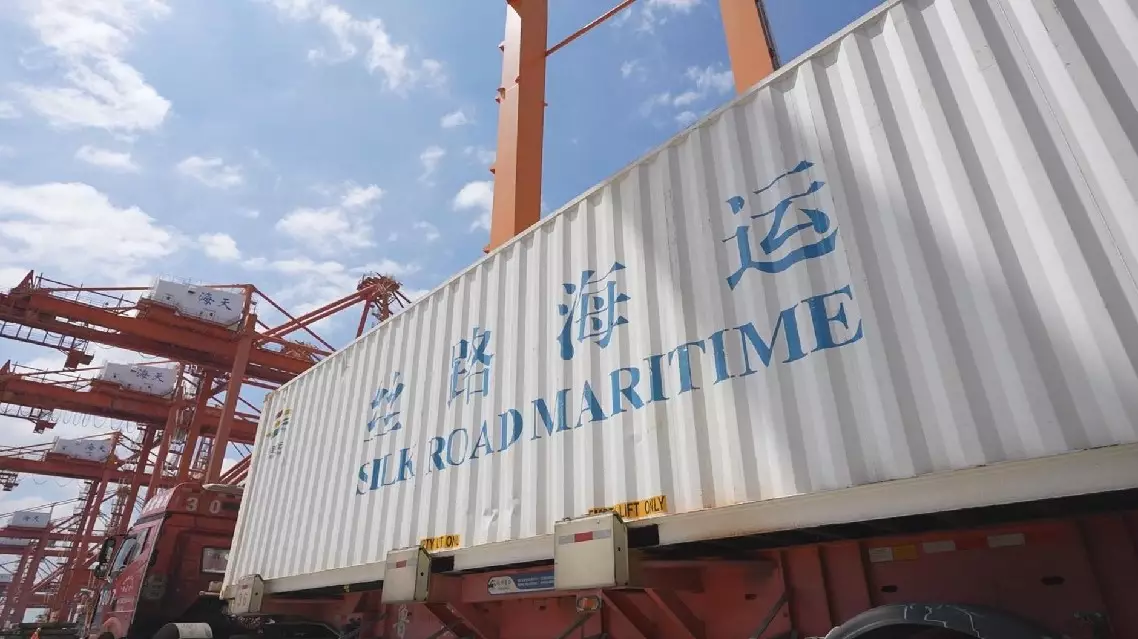
China, as home to seven of the world's ten largest container ports, has been looking to increase international cooperation in the global shipping industry, and has established the Silk Road Maritime brand based in Xiamen City along the country's southeastern coast to support this goal.
Silk Road Maritime is a shipping-themed international comprehensive logistics service brand and platform whose mission is to aid the construction of the Belt and Road.
"First of all, it is a brand. Secondly, it is a platform. We promote it as a brand and platform geared towards the Belt and Road Initiative, with shipping as the theme," said Li Nan, General Manager of Fujian Silk Road Maritime Management Co.
Over the past six years, Silk Road Maritime has crossed various milestones that underscore its commitment to enhancing global shipping and connectivity.
The brand has successfully formed an association that brings together various stakeholders in the industry, fostering collaboration and shared standards.
A dedicated platform has been developed to streamline services and information-sharing among members.
One of its notable technological advancements is the creation of a weather navigation software that helps vessels plan optimal routes based on real-time weather data, marking a breakthrough for China in an industry largely dominated by Western companies.
Additionally, the brand has introduced smart trackable containers, ensuring greater transparency in tracking cargo.
To incentivize efficiency, the initiative names and rewards exemplary shipping routes, recognizing companies that excel in service quality. Furthermore, it has hosted numerous forums to facilitate dialogue and exchange of ideas, ultimately aiming to create a more interconnected and efficient international supply chain. "We also hope that in the next steps, through projects like building the Port of Piraeus in Greece and the Port of Mandola, we can not only export our hardware but also input our software. We aim to export our standards and input our services. By promoting these standardized services, we can make the entire international supply chain more efficient, safe, stable and controllable," explained Li.
In just six years, the Silk Road Maritime initiative has gathered over 340 members, including major global ports and trade enterprises. "Over the past two years, there have been talks of decoupling and breaking supply chains, but our trade continues to grow. This matter relates to national interests and the well-being of people worldwide, making it less susceptible to political interference. We believe that as long as we maintain friendly exchanges with the people of these countries along the Belt and Road Initiative, sharing common economic interests and interactions, we can definitely achieve our goal of building a community with a shared future. This path is undoubtedly the right one," said Li.
As global trade continues to grow, initiatives like Silk Road Maritime are crucial in fostering international connections, ensuring that even amid political challenges the flow of goods remains uninterrupted.
China builds global maritime shipping alliance to advance Belt and Road cooperation